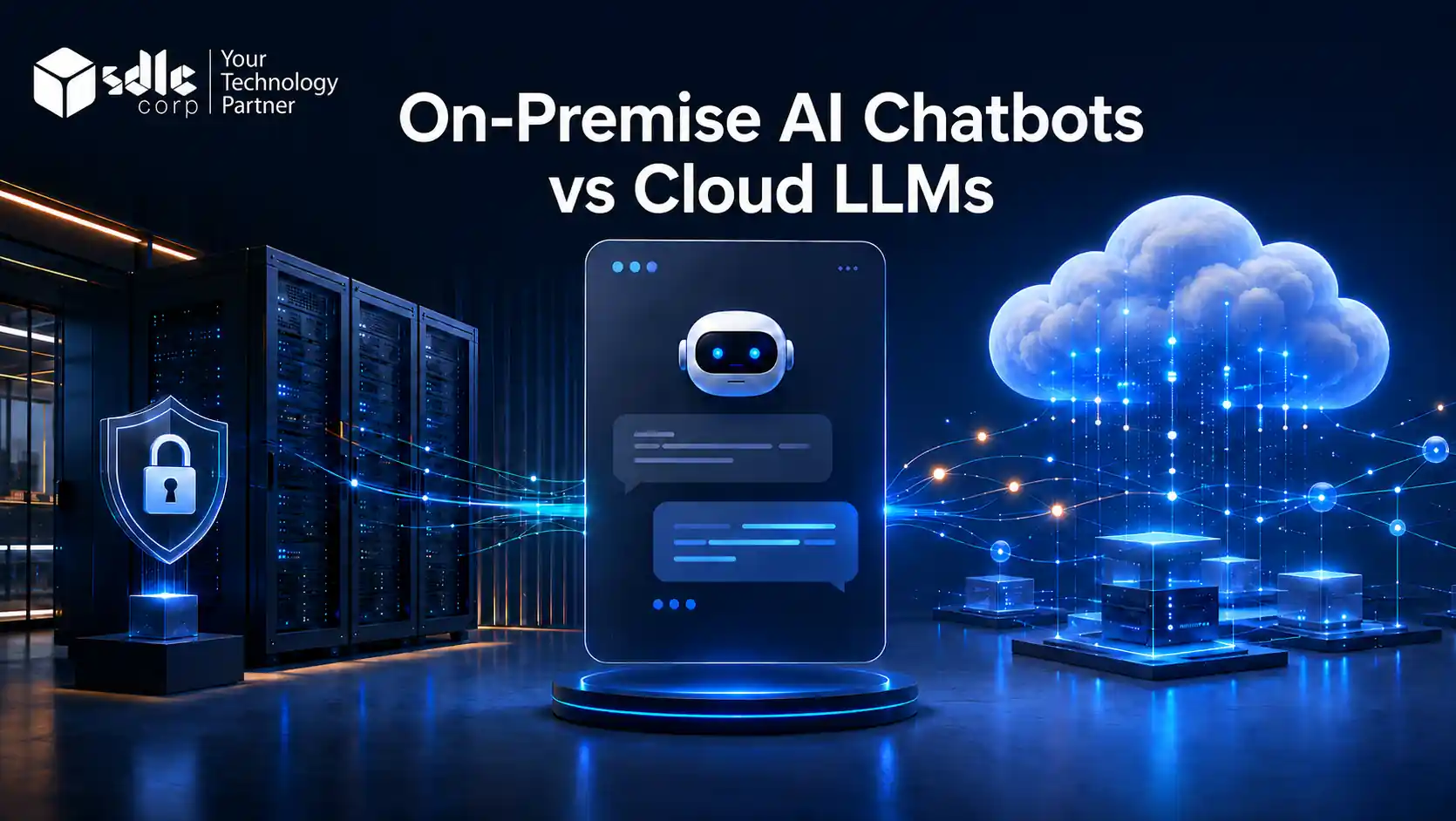
Choosing between an on-premise AI chatbot and a cloud large language model (LLM) affects more than where AI runs. It determines how business data moves, which systems the chatbot can access, how quickly capacity can grow, what your team must maintain, and how costs change as adoption increases.
An on-premise AI chatbot keeps critical chatbot components within infrastructure controlled by the organization. Cloud LLMs deliver language-model capabilities through managed cloud infrastructure or APIs. Hybrid AI, a third option, combines private and cloud components based on the requirements of each workload.
There is no universal winner. The right architecture depends on the sensitivity of the data, expected traffic, model requirements, integrations, security controls, internal expertise, and long-term economics.
On-Premise AI Chatbots vs Cloud LLMs at a Glance
This comparison highlights the practical differences that most directly affect enterprise AI planning. Use it as a quick reference for control, infrastructure, scalability, model access, operating effort, and the type of workload each deployment approach fits best. For broader enterprise planning, see our AI Development Services.
| Factor | On-Premise AI Chatbot | Cloud LLM |
|---|---|---|
| Data control | Direct organizational control | Depends on provider and configuration |
| Initial investment | Usually higher | Usually lower |
| Deployment speed | Typically slower | Typically faster |
| Scalability | Requires capacity planning | Highly elastic |
| Infrastructure | Operated internally | Mostly provider-managed |
| Model control | High | Provider-dependent |
| Customization | Extensive | Varies by service |
| Offline operation | Possible | Usually requires connectivity |
| Latency | Can be low on local networks | Network and service dependent |
| Data residency | Directly controlled | Region and service dependent |
| Cost model | Infrastructure-driven | Usually consumption-driven |
| Internal expertise | Higher requirement | Lower infrastructure burden |
| Model access | Private/open-weight models | Broad managed-model selection |
| Best fit | Controlled or predictable workloads | Fast-moving or variable workloads |
What Is an On-Premise AI Chatbot?
An on-premise AI chatbot operates within infrastructure controlled by the organization. Common environments include an enterprise data center, a dedicated GPU cluster, private infrastructure, or an isolated network with restricted external connectivity. Model hosting, data handling, access controls, integrations, monitoring, and the infrastructure behind every chatbot interaction all become direct organizational responsibilities. Organizations that need specialized LLM engineering support can also Hire Generative AI Developers.
Think of it as a complete private AI stack rather than a single model:
User → Chat Interface → Identity & Permissions → AI Orchestration → Enterprise Knowledge → Private LLM → Validated Response
The organization controls where these components run, how information moves between them, who can access them, and where conversations and logs are stored.
For example, an internal financial-services assistant could retrieve information from approved policies and private knowledge sources while keeping retrieval and model inference inside controlled infrastructure.
That control comes with responsibility. Someone internal must operate the model-serving environment, maintain security, monitor performance, manage capacity, handle upgrades, and keep the service available.
What Is a Cloud LLM?
A cloud LLM is a large language model accessed through managed cloud infrastructure or an API instead of being operated entirely on an organization's own hardware. Providers manage much of the underlying compute and model-serving environment, which lets teams focus on application integration, governance, security, and workload design. This managed delivery model is closely related to AI as a Service (AIaaS).
How Cloud LLM Access Works in Practice
In a production chatbot, authentication, retrieval, guardrails, monitoring, business logic, and enterprise integrations usually surround this model interaction.
Cloud deployment reduces the need to purchase and operate dedicated AI hardware. Teams can also test new models quickly and increase capacity without waiting for physical infrastructure.
Part of the AI processing occurs in an environment operated by another provider.
Processing location can affect residency and regulatory requirements.
Review how prompts, responses, files, embeddings, and logs are handled.
Retention behavior may vary across services and features.
Consider both provider controls and your own identities, roles, and applications.
Geographic requirements should be checked against the exact service and deployment configuration.
What Cloud LLM Tokens Actually Cost
Published list rates in 2026 fall into three broad bands. All figures below are per million tokens, quoted separately for input (your prompt and retrieved context) and output (what the model writes back).
| Model band | Input per 1M tokens | Output per 1M tokens | Typical chatbot use |
|---|---|---|---|
| Small and efficient | $0.03 to $0.60 | $0.13 to $2.40 | Intent routing, classification, short factual answers, high-volume traffic |
| Mid-tier production | $1 to $3 | $5 to $15 | Everyday enterprise assistant work, RAG answers, summaries |
| Frontier tier | $5 to $10 | $25 to $50 | Complex reasoning, code generation, long-document analysis |
Output almost always costs three to six times more than input, so response length drives the bill more than prompt length. Batch APIs commonly cut both rates by half, and prompt caching can reduce repeated input by up to 90 percent.
Worked example on the mid-tier band: a 2,000-token prompt with a 400-token answer costs roughly $0.008 per request, or about $800 per month at 100,000 requests. Rates move often, so confirm against the provider's current pricing page before budgeting.
An On-Premise Chatbot Is Not the Same as an On-Premise LLM
This distinction is important because the two terms describe different parts of an AI system. Knowing where the chatbot application ends and the language model begins makes it easier to evaluate hosting, security, data movement, integrations, and operational ownership correctly. These architecture boundaries also matter when scoping Generative AI Development Services.
Language Engine
Handles language understanding, reasoning, response generation and model inference across all business requests.
Complete Application
Adds authentication, retrieval, memory, permissions, integrations, guardrails, monitoring, and a user interface.
Fully On-Premise
In a fully on-premise design, the chatbot, model, retrieval layer, enterprise data connections, logs, and supporting services remain inside private infrastructure.
Maximum direct control · Highest operational responsibilityPrivate Chatbot With a Cloud LLM
With a private chatbot and cloud LLM, the application and enterprise data layer remain private while approved model requests are sent to a cloud LLM.
Private application · Managed model infrastructureCloud Chatbot With Private Enterprise Data
Under this pattern, the chatbot runs in cloud infrastructure but retrieves authorized information from private enterprise systems through controlled connections.
Cloud application · Private enterprise dataHybrid AI Chatbot
A routing layer selects a private or cloud model according to the request, sensitivity, permissions, performance needs, and cost.
Policy-based routing · Flexible workload placementDo not ask only “Where should the chatbot run?” Ask where each component (application, data, retrieval, and model) should run.
Can I Run an AI Chatbot on Premise?
Yes. An AI chatbot can run entirely on-premise when the organization has suitable infrastructure and the technical capability to operate the complete stack. Planning should account for model serving, retrieval, storage, identity, monitoring, integrations, capacity, upgrades, and the internal expertise required to keep the service reliable. The same infrastructure and operational questions apply during AI & ML Implementation.
A practical architecture can keep identity, retrieval, enterprise-system access, model inference, and validation inside the organization's controlled environment.
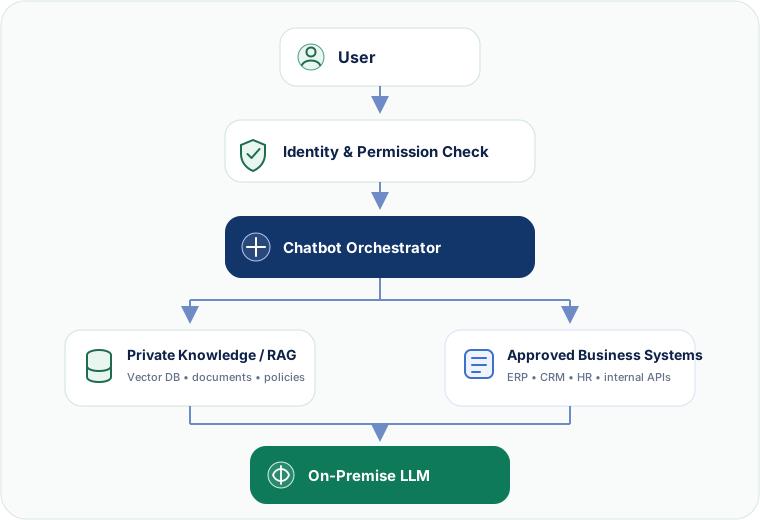
The chatbot can connect to ERP, CRM, HR, document management, inventory, support, and other internal applications through controlled APIs while keeping sensitive retrieval and inference inside a defined environment.
Production readiness still depends on security, monitoring, capacity, backup, recovery, permissions, model quality, and incident response. Hosting the model is only one part of operating a reliable enterprise chatbot.
Indicative GPU Classes for Private Serving
Hardware sizing follows the model you intend to serve, the precision you run it at, and how many people use it at once. These configurations are a starting point for capacity discussions rather than a purchase list.
| Model size | Precision | VRAM needed | Typical GPU configuration |
|---|---|---|---|
| 7B to 8B | 4-bit | 6 to 8 GB | Single 24 GB card such as L4, A10, or RTX 4090 |
| 13B to 34B | 4-bit or 8-bit | 20 to 45 GB | One 48 GB card such as L40S or RTX 6000 Ada |
| 70B | 4-bit | 40 to 48 GB | Two 24 GB cards, or a single 80 GB A100 or H100 |
| 70B | FP16 | Around 140 GB | Two H100 80 GB with tensor parallelism, or one H200 141 GB |
| 200B and above, mixture of experts | FP8 or INT4 | 150 to 320 GB and up | Four to eight H100 or H200 cards in one node, 640 GB to 1.13 TB pooled |
Two figures teams routinely miss: fine-tuning needs roughly three to four times the memory of inference for the same model, and system RAM should be at least twice your GPU VRAM so layers never spill to disk.
Concurrency changes the answer as much as model size. One 80 GB card serving a single user behaves very differently from the same card serving dozens through continuous batching, so size against measured peak concurrency rather than parameter count alone.
How Do On-Premise AI Chatbots and Cloud LLMs Compare?
Ten dimensions decide most enterprise chatbot deployments. Reading them side by side produces a more realistic architecture decision than comparing hosting location alone. For a structured governance reference, organizations can also use the NIST AI Risk Management Framework.
Control, Security, Cost, and Scale
| Dimension | On-Premise AI Chatbot | Cloud LLM |
|---|---|---|
| Data privacy and control | Prompts, retrieved data, responses, and logs stay under direct organizational control | Sensitive workloads are possible, though processing location, retention, access, and deletion rules need verification |
| Security and compliance | More infrastructure control, with full internal responsibility for identity, patching, and monitoring | Part of the security burden shifts to the provider, while configuration and governance stay in-house |
| Cost and total cost of ownership | Capacity purchased or allocated in advance, giving infrastructure-driven economics; H100-class cards run roughly $25,000 to $40,000 each, or $2 to $8 per hour rented | Spending rises with usage at roughly $0.03 to $10 per million input tokens and $0.13 to $50 per million output tokens, depending on model band |
| Performance, latency, and throughput | Local network round trip usually stays under 50 ms, so generation dominates; fixed compute limits cap peak concurrency | Easier scaling, though public network hops add roughly 100 to 300 ms before quotas, prompt size, and tool calls are counted |
| Scalability | Best suited to stable, forecastable demand | Better suited to sudden growth or uncertain traffic |
Models, Knowledge, and Operations
| Dimension | On-Premise AI Chatbot | Cloud LLM |
|---|---|---|
| Model quality and task complexity | Focused workflows handled well by smaller private or open-weight models | Faster access to advanced reasoning, coding, multimodal, and tool-use capability |
| Model control and customization | Version control, fine-tuning, inference settings, routing, and upgrade timing stay in-house | Lower operational effort, with more of the model lifecycle under provider control |
| RAG and enterprise knowledge | Embedding models, vector storage, and retrieval all run privately | Private retrieval remains possible, with only approved context sent to the model |
| ERP, CRM, and business-system integration | Identity checks, approved APIs, validation, and audit logging sit inside your environment | Deterministic application controls are still required, keeping model calls outside the authorization path |
| Operations, reliability, and vendor control | Internal teams own serving, monitoring, recovery, and capacity planning | Providers maintain model infrastructure, and separating chatbot from model layer limits lock-in |
Where the two columns pull in different directions, hybrid deployment can combine private baseline capacity with approved cloud elasticity. Test candidate models against real business tasks before treating any row as settled.
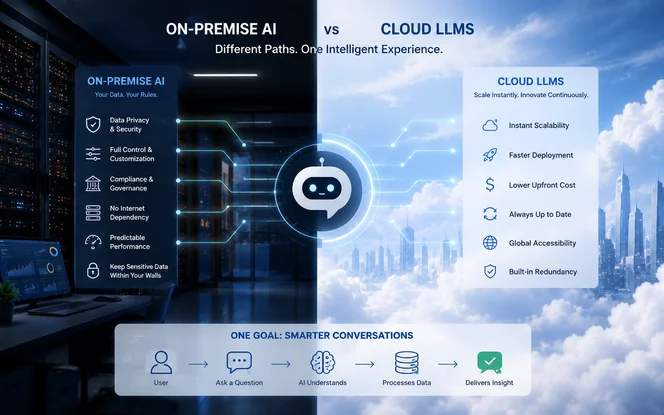
Where Do Private Cloud and Sovereign AI Fit?
Enterprise AI deployment is a spectrum rather than a simple cloud-versus-on-premise choice. Private cloud, sovereign AI, dedicated environments, and hybrid architectures create additional options for organizations that need stronger control without operating every infrastructure component themselves. Similar hosting, lifecycle, and infrastructure decisions also influence Machine Learning Development.

Options Between Public Cloud and Full Ownership
Moving across that spectrum changes how infrastructure control, residency, connectivity, operating responsibility, and scalability are balanced.
A private cloud can provide dedicated or isolated infrastructure without requiring the organization to operate every physical component.
Sovereign environments address specific geographic, residency, jurisdictional, or operational requirements.
Dedicated hosted infrastructure keeps resources reserved for one organization while running outside its own facilities.
These models help when conventional public cloud does not provide enough control but fully self-operated infrastructure would create excessive operational burden.
When Should You Choose On-Premise AI?
On-premise deployment deserves serious consideration when control is the dominant requirement. Teams evaluating generative AI risks can also review the NIST Generative AI Profile.
Typical signals include sensitive information that must remain within defined infrastructure, restricted connectivity, strict model-version requirements, predictable utilization, existing AI infrastructure, or the need for deep customization.
Engineering and operational capability to maintain the environment matters just as much as the decision to build it.
If infrastructure control is necessary but the organization cannot reliably operate that infrastructure, the architecture has solved one problem by creating another.
When Should You Choose a Cloud LLM?
Cloud LLMs make sense when speed and elasticity matter more than infrastructure ownership. An experienced AI Consulting Company can help evaluate these trade-offs before committing to a deployment model.
They work particularly well when an organization needs to validate a use case quickly, traffic is unpredictable, new model capabilities are important, or operating dedicated GPU infrastructure would add unnecessary complexity.
Experimentation also becomes considerably cheaper.
Instead of committing to large private capacity before knowing whether employees or customers will adopt the chatbot, teams can validate demand first.
When Is Hybrid AI the Better Choice?
Hybrid architecture becomes useful when different workloads have conflicting requirements. Sensitive or predictable processing can stay private while approved cloud models handle work that benefits from elasticity, specialized capabilities, or faster access to model innovation. For complex routing and governance decisions, Generative AI Consulting Services can help define a practical hybrid architecture.
Imagine one enterprise chatbot receiving three requests:
What Changes Is the Routing, Not the Interface
Requests can be classified according to data sensitivity, user permissions, task complexity, latency, geography, model capability, and cost before being sent to the appropriate environment.
How to Choose the Right AI Chatbot Deployment Model
A strong decision process starts with the business workload. Define the users, data sensitivity, integrations, response-time expectations, model requirements, traffic patterns, compliance constraints, and operating capabilities before selecting the infrastructure or model provider. For cloud-specific safeguards, review Google Cloud Vertex AI Security Controls.
Define the Workload
Identify who will use the chatbot, what tasks it must perform, which channels it will support, and what business outcome it should improve.
Classify the Data
Group the information the chatbot may process:
Public → Internal → Confidential → Regulated → Highly Sensitive
Determine which environments are permitted to process each category.
Map the Complete Data Flow
Follow prompts, retrieved documents, embeddings, responses, conversation histories, and logs from creation through deletion.
This exposes risks that teams miss when they focus only on the model endpoint.
Establish Performance Requirements
Set expectations for users, peak concurrency, response time, throughput, availability, and growth.
Those numbers determine how much capacity the architecture actually needs.
Evaluate Models With Real Business Tasks
Build a representative test set.
Measure answer quality, groundedness, reasoning, tool use, consistency, latency, and cost.
Compare Multi-Year Economics
Calculate cloud and private costs under multiple adoption scenarios.
Include infrastructure, staffing, security, networking, monitoring, redundancy, maintenance, and refresh cycles.
Assess Operational Readiness
Determine whether internal teams can reliably support model serving, RAG, monitoring, security, evaluation, capacity planning, backup, and recovery.
Run a Controlled Pilot
Test the proposed architecture using a realistic but limited workload.
Measure:
Quality + Security + Reliability + Performance + Cost
Results from a pilot provide stronger evidence than assumptions made before deployment.
A Practical Deployment Decision Path
Start with the constraint that matters most and work down the list until one direction fits the workload. The objective is not to force every use case into one architecture, but to identify where private, cloud, or hybrid processing creates the best operational balance. For another first-party cloud reference, see Microsoft Foundry Data, Privacy, and Security.
How to read it: answer each question in order. A yes ends the path at that point. A no simply moves you to the next question below.
Must the workload remain inside controlled infrastructure?
Residency, jurisdiction, or connectivity rules decide the architecture before cost or capability enter the discussion.
Is usage unpredictable, or is rapid experimentation the priority?
Variable traffic and early-stage validation favour elastic capacity over committed private hardware.
Do workloads carry significantly different privacy or model requirements?
Conflicting requirements are handled by routing each request rather than by placing every workload in one environment.
Is utilization expected to remain consistently high?
Steady high utilization is the point where private TCO becomes worth modelling against cloud consumption.
Lower or irregular utilization usually leaves cloud capacity as the more flexible option. Either way, confirm the choice through security, performance, operational, and financial review before committing.
Illustrative Enterprise Scenario: One Chatbot, Three Processing Paths
Consider an enterprise assistant used across HR, operations, and sales. The same chatbot interface receives very different requests. Each one can carry a different level of sensitivity, business risk, latency expectation, and model requirement, so the processing path should be selected according to policy rather than convenience.
Sensitive Employee Request
Private path“Show my remaining leave balance and compensation information.”
The system verifies identity, checks authorization, retrieves information from the HR system, and follows the organization's private processing policy.
Internal Knowledge Request
Private RAG“What expenses can I claim during an international business trip?”
A permission-aware RAG service retrieves the current travel policy and gives the model the relevant approved context.
Public Content Request
Cloud route“Rewrite this public product description for a customer presentation.”
No confidential business information is required, so an approved cloud model can handle the task without consuming private inference capacity.
Those bands assume normal load and a first token arriving inside a second on each path. Private lookups stay fastest because the payload is small and the hop is local. Retrieval adds roughly 100 to 400 ms before generation starts, and cloud rewrites run longest simply because the answer is longer.
Set alerts on the band rather than the average. A private path drifting past five seconds usually signals queueing at the GPU, not a slow model.
Common Mistakes When Choosing an AI Deployment Model
Deployment decisions often go wrong when teams optimize one technical factor without considering the complete operating model. Six patterns below show where cost, security, authorization, capacity, retrieval, and model-selection assumptions create avoidable problems later.
Infrastructure First, Use Case Second
The mistake: Selecting infrastructure before the chatbot use case is clearly defined.
Why it hurts: Avoidable cost, complexity, and technical constraints get locked in early.
Better approach: Define users, data, tasks, integrations, performance, and value first.
GPU Price vs API Price
The mistake: Comparing a one-time hardware purchase price directly against recurring cloud token pricing.
Why it hurts: Hidden engineering, power, security, monitoring, and support costs keep growing.
Better approach: Compare multi-year TCO using realistic workloads and adoption levels.
Treating RAG as a Black Box
The mistake: Securing the LLM while ignoring retrieval permissions and data flows.
Why it hurts: Sensitive information may still be retrieved, exposed, or improperly shared.
Better approach: Apply identity, permission, and data controls across every retrieval workflow.
Making the LLM the Authorization Layer
The mistake: Letting the model decide whether sensitive business actions are allowed.
Why it hurts: Authorization then depends on probabilistic model output and behavior.
Better approach: Keep permissions inside deterministic application and approved API layers.
Building for Maximum Scale Before Proving Demand
The mistake: Buying private AI capacity before real demand and usage are validated.
Why it hurts: Expensive infrastructure may sit underused while operating costs grow.
Better approach: Validate demand and utilization before making major capacity investments.
Using One Model for Every Task
The mistake: Sending every request to one model regardless of task requirements.
Why it hurts: Simple tasks cost more while complex tasks receive insufficient capability.
Better approach: Route workloads to models matching required capability, latency, and cost.
Conclusion
Choosing between an on-premise AI chatbot and a cloud LLM depends on how your organization balances data control, model capability, scalability, cost, and operational responsibility.
The strongest architecture aligns those trade-offs with actual business workloads, governance requirements, internal skills, expected adoption, and the long-term operating model. On-premise deployment offers greater infrastructure control and suits sensitive or predictable workloads, while cloud LLMs provide faster deployment, elasticity, and easier access to advanced managed models.
For many enterprises, a hybrid approach provides the best balance by keeping sensitive workloads private while using approved cloud models where flexibility or stronger capabilities are needed. Base the final decision on real workload requirements, data flows, performance targets, multi-year TCO, and your organization's ability to operate the chosen architecture reliably.
Frequently Asked Questions
Is An On-Premise LLM More Secure Than A Cloud LLM?
Not automatically. On-premise deployment provides greater direct control over infrastructure and data flows, but the environment still requires secure configuration, patching, identity management, monitoring, and incident response. Cloud services can also provide strong enterprise security controls. The safer option depends on the architecture and how well it is operated.
What Is The Difference Between An On-Premise Chatbot And An On-Premise LLM?
An on-premise LLM is the language model hosted within private infrastructure. The chatbot is the broader application and may include authentication, RAG, vector storage, business integrations, conversation management, guardrails, and monitoring.
Can An On-Premise Chatbot Work Without Internet Access?
Yes. If the model, knowledge sources, authentication, databases, and other required services are available inside the local environment, the chatbot can operate without internet access. External APIs and cloud integrations would still require connectivity.
Is An On-Premise AI Chatbot Cheaper Than A Cloud LLM?
It depends on workload volume, predictability, hardware utilization, staffing, energy, maintenance, and the cloud services being compared. Private infrastructure can become economically attractive for some stable, high-volume workloads, while cloud consumption may be more efficient for smaller or variable workloads.
What Hardware Is Required For An On-Premise AI Chatbot?
There is no universal hardware specification. Requirements depend on model size, quantization, context length, concurrent users, throughput, latency targets, and redundancy. Infrastructure should be sized using measured workload requirements.
Can A Private Chatbot Use A Cloud LLM When Needed?
Yes. A hybrid architecture can keep sensitive application and retrieval components private while sending approved workloads to cloud models. Routing and policy layers determine which environment can process each request.
Can Cloud LLMs Process Confidential Business Information?
Potentially, but suitability depends on the specific provider, service, deployment configuration, geography, contractual terms, retention controls, and organizational requirements. The exact service should be evaluated rather than assuming all cloud LLMs handle data identically.
Does An On-Premise Chatbot Support RAG?
Yes. The embedding model, vector database, retrieval service, knowledge sources, and LLM can all operate within private infrastructure. Hybrid RAG is also possible, where retrieval stays private while only approved context reaches a cloud model.
What Is The Difference Between Private Cloud And On-Premise AI?
On-premise AI runs within infrastructure directly controlled by the organization. Private cloud uses dedicated or isolated cloud infrastructure while shifting some infrastructure operation outside the organization's physical environment. The responsibility model depends on the implementation.
How Do You Calculate The Cost Of An On-Premise LLM?
Include hardware, utilization, power, cooling, storage, networking, engineering, security, monitoring, redundancy, maintenance, and hardware refresh. Compare that multi-year cost with realistic cloud consumption scenarios.
Which AI Deployment Model Works Best For Regulated Industries?
There is no single answer for every regulated workload. On-premise, private cloud, sovereign cloud, hybrid, and appropriately configured public-cloud services can all be viable depending on the data, jurisdiction, controls, and regulatory requirements.