An enterprise voice AI platform is the system a business runs its phone conversations on.
It carries calls, holds the conversation, applies business rules, reaches the systems that hold the real data, and gives the teams who own those calls a way to see and change what happened. The word enterprise is doing real work in that sentence.
- Enterprise means operable Multi-team ownership, change control and audit trails matter more than any single feature on a demo call.
- Five layers, not one product Communications, orchestration, speech and knowledge, business systems, and the people who oversee all of it.
- Evaluate the second year Ask who changes the agent, who sees failures, and what happens when a dependency stops responding.
Most products in this category demo well. A demo is one call, placed by the person who built the agent, against a script they chose. An enterprise deployment is thousands of calls placed by strangers, owned by people who did not build it, and answerable to someone who was not in the room.
Four things separate a platform that survives that transition from one that does not: what the category has to do at volume, how the stack is layered, where the line between a platform and a voice agent builder falls, and who inside the business ends up answerable for each layer.
What an Enterprise Voice AI Platform Has to Do
Enterprise is not a company-size label. It describes a set of obligations that appear the moment a voice system stops being one team's project. Those obligations are what an evaluation should test, because they surface in month six rather than in the first week.
A voice agent that answers well is table stakes. The harder requirement is that the organization can run it: change it safely, explain it to an auditor, and keep it working when something upstream fails.
Sales, support and operations own different calls, rules and destinations, on shared infrastructure with separate permissions.
Someone must be able to say who changed what, when, and on whose approval, without reading raw configuration.
Transcripts, summaries, outcomes and failures have to reach the people responsible for them, not only engineers.
Answers and actions depend on the CRM, ticketing, scheduling and internal systems that hold the real data.
Calls keep arriving when a model, a call leg or a lookup does not respond, and the platform needs a defined answer.
Voice is rarely the only channel carrying these obligations. Where the same intents, rules and escalation paths also run in chat and messaging, the wider frame in enterprise conversational AI across voice, chat and workflow is the right one for the platform decision.
The obligations also change shape with the direction of traffic. Inbound and outbound are two operating models with different consent, pacing and staffing questions, set out in the two voice AI operating models.
Which of the two a business leads with usually follows from the industry it operates in and the calls it cannot afford to miss. Which calls those are, sector by sector, is the subject of voice AI use cases mapped by industry, and the obligations above hold whichever sector a business starts in.
The Layers a Platform Is Assembled From
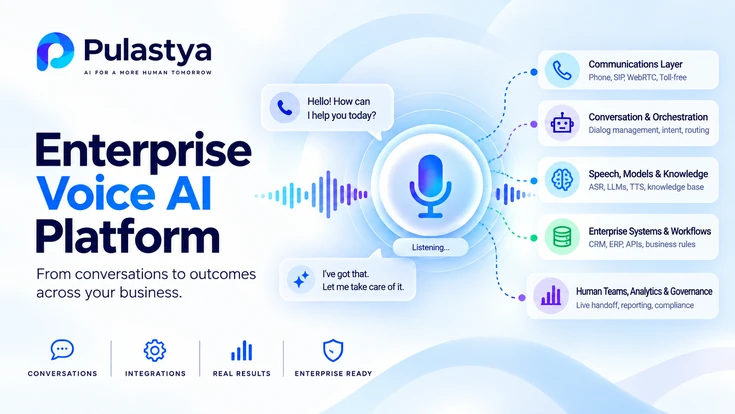
A voice AI platform presents as one product and is assembled from five layers. Naming them separately is what makes an evaluation tractable, because a failed call belongs to exactly one of them, and so does most of the running cost.
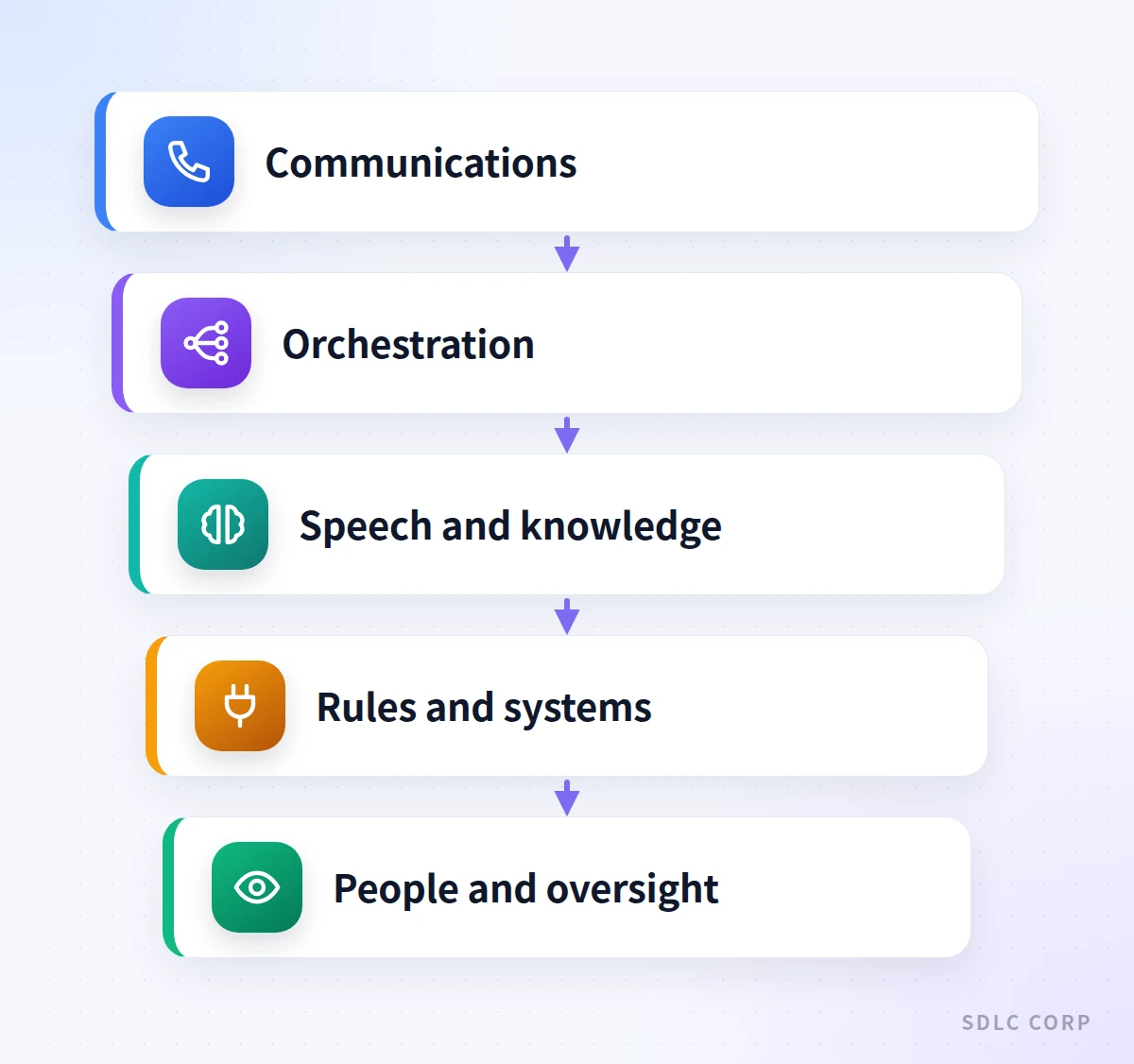
| Layer | What it owns | Typical internal owner |
|---|---|---|
| Communications | Numbers, call legs, media handling and concurrency | Telecom or IT infrastructure |
| Conversation and agent orchestration | Turn taking, retrieval timing, tool calls and handoff decisions | The team that runs the agent |
| Speech, models and knowledge | Recognition, synthesis, the model and the approved content it answers from | Platform team with named content owners |
| Business rules, workflows and enterprise systems | Policies, routing rules and writes into systems of record | The business function that owns the call |
| Human teams, analytics and governance | Escalation paths, reporting, review and change approval | Operations, with compliance oversight |
Orchestration is the layer buyers look at least and depend on most. How turns are managed, when knowledge is retrieved, and when a call is handed to a person are covered in AI voice agent architecture.
The layers under orchestration are separate markets with separate vendors and pricing units. The voice AI integrations landscape maps telephony, speech and model suppliers, and shows which questions belong to a provider rather than to the platform above them.
The knowledge layer decides whether a spoken answer is defensible. A system that answers from approved documents can be corrected by correcting the document, and what goes into a voice agent knowledge base covers how to structure and own those sources.
Grounding has a second half: what the agent says when the sources run out. Pulastya answers from documents the organization provides, and when it lacks context it says so and offers a transfer instead of guessing, which is the behavior worth testing rather than assuming.
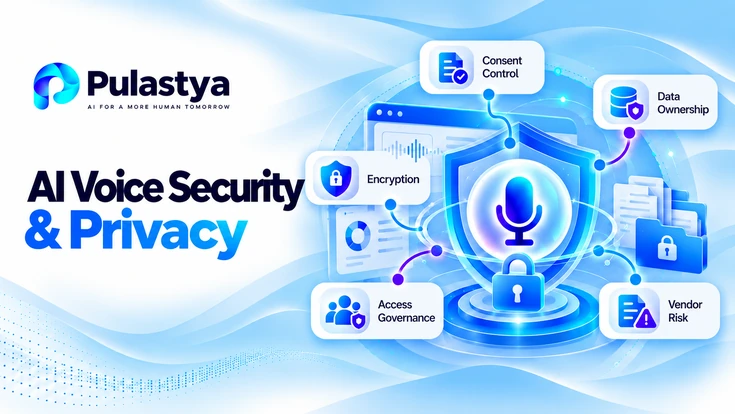
The top layer is the one enterprises under-specify. Access control, retention, consent, recording and the approval path for changes all sit there, and they are the subject of voice AI security and governance.
What Separates a Platform From a Voice Agent Builder
Many products in this category are builders: environments where a capable person assembles an agent. A platform is the surrounding machinery that lets an organization operate what was built. Both are legitimate, and the wrong choice is expensive in a way that only shows up later.
The distinction is not feature count. It is whether the second year of ownership has been designed for, and whether the people who will actually run the system appear anywhere in the product.
| Question | Agent builder | Enterprise platform |
|---|---|---|
| Who changes the agent? | Whoever can edit the prompt or the flow | A named role, through a reviewable change path |
| Who sees a bad call? | Whoever opens the logs | The team that owns the call, in a dashboard |
| What happens on failure? | Undefined, or handled per agent | A configured fallback and a human line |
| How is a change tested? | Ad hoc calls before launch | Repeatable scenarios run before each release |
| How does a second team onboard? | Duplicate the agent and diverge | Separate rules and permissions on shared infrastructure |
Change Control
Ask a vendor who can change agent behavior, and what stops a bad change reaching live calls. Prompt, persona and behavior settings are the surface that moves most often, covered in AI voice agent configuration. A platform makes those edits reviewable and reversible.
Evidence That It Works
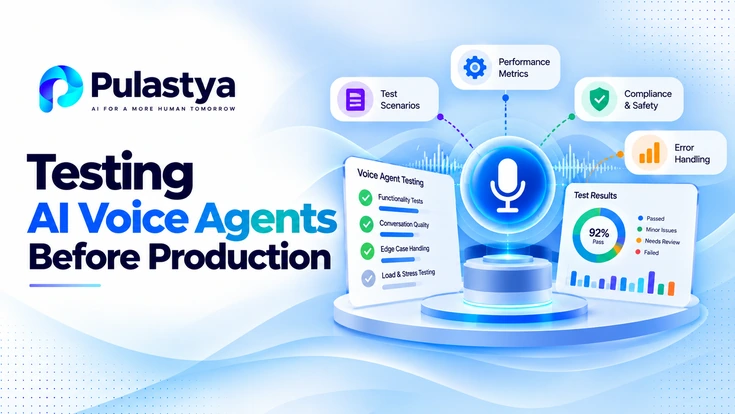
Operations teams need two things builders often skip: a way to check a change before it ships, and a way to see what happened after. The first is testing voice agents before production, the second is the call metrics that matter.
What Happens When Something Breaks
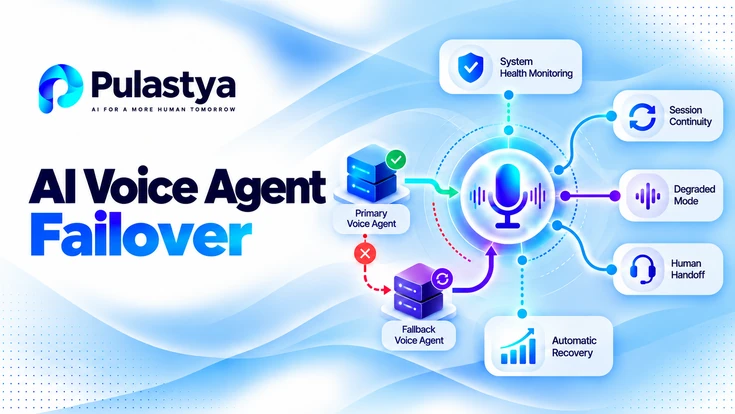
Calls arrive whether or not the stack is healthy. A platform has a defined answer for a model timeout, a failed lookup or a communications problem, including a human line to fall back to. Failover and recovery covers those patterns in detail.
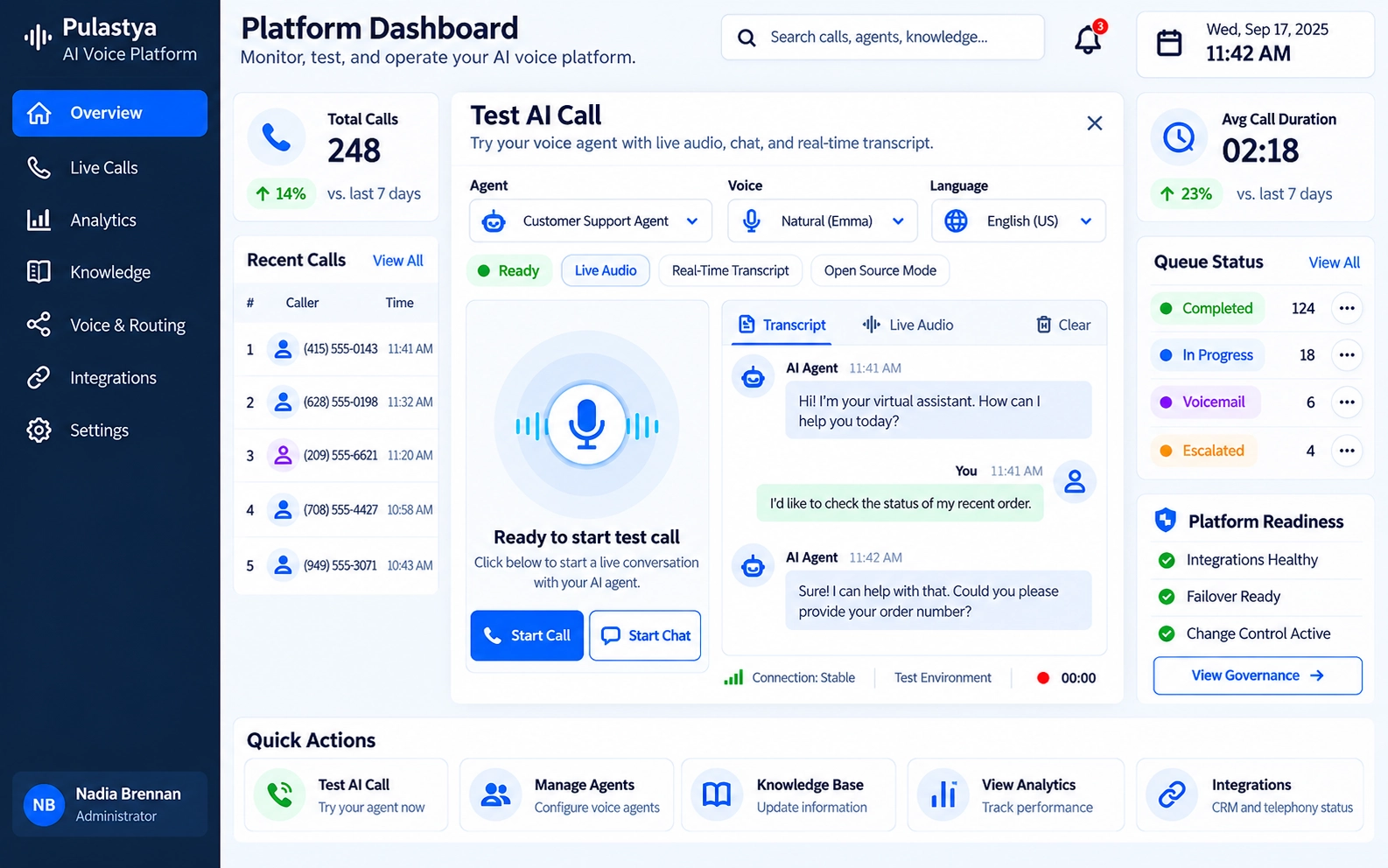
Pulastya, the SDLC Corp voice platform for inbound and outbound business calls, is built around that operating view: a four-step setup aimed at business teams rather than developers, a browser test call before the number goes live, and transcripts, call summaries and a call dashboard afterwards.
A useful test during a vendor call: name the person in your organization who would make a routine wording change six months after launch, and ask the vendor to show that person's screen. If the answer involves an engineer and a configuration file, you are buying a builder.
How to Run the Evaluation
An evaluation that starts with vendor demos ends up comparing presentation skills. Starting with your own call population and operating model puts the vendor conversation on your terms, and makes the shortlist short.
- Describe the call populationVolumes, peaks, languages, and the mix of inbound and outbound work the platform will carry.
- Write the operating modelWhich team owns which calls, who approves changes, who watches failures, and who receives transfers.
- Score against a checklistTurn those requirements into questions a vendor answers in writing rather than in a live demo.
- Pilot on real trafficRun one narrow call type end to end, including handoff and failure, before widening the scope.
- Model the running costPrice the layers separately, against the traffic you expect rather than the traffic in the demo.
Step three is where most of the work sits. The voice agent software evaluation checklist turns requirements into specific questions, and the platform comparison shows how named vendors line up against them.
Steps four and five have their own pages. Phasing, effort and realistic timelines are set out in the voice agent implementation guide, and the cost drivers behind any per-minute quote are in AI voice agent pricing.
Commercial structure deserves a question of its own. With Pulastya, customers connect their own Twilio and OpenAI accounts and those providers bill usage directly, there is no platform software fee above that usage, and an existing business number can be kept by pointing its webhook at the platform.
If you want to see what an operable deployment looks like before writing the checklist, the enterprise voice AI platform from SDLC Corp shows setup, routing and the call dashboard in one place. To walk through it against the call types you actually run, book a guided walkthrough.
Conclusion
An enterprise voice AI platform earns its place when teams can operate it reliably beyond the first demo. Communications, orchestration, approved knowledge, business workflows and human oversight must work together. The deciding questions are who controls changes, who investigates a failed call and how service continues when a model, integration or call connection fails.
Evaluate vendors against your actual call volumes, ownership structure and existing systems. Start with a narrow pilot that tests routine conversations, human handoffs, reporting and failure recovery, then estimate costs across the full stack. A platform that makes those activities visible and manageable is better positioned to support multiple teams as usage grows.
Frequently Asked Questions
Operability rather than features. An enterprise platform supports more than one owning team, records who changed what and when, shows call outcomes and failures to the people responsible for them, connects to the systems that hold the real data, and has a defined behavior when a dependency stops responding.
Yes. A builder is where an agent is assembled, and it is judged on how quickly a capable person can produce a working call. A platform is judged on whether an organization can run that call for years: change control, permissions, observability, escalation to people, and a documented answer for failure.
Ownership is usually split. The business function owns the rules, the script and the escalation path for its own calls. A platform or IT team owns the shared infrastructure, integrations and releases. Compliance or risk reviews access, retention and recording. Naming these owners before the evaluation makes vendor questions much sharper.
Long enough to include a pilot on real traffic, and no longer. Requirements and vendor questionnaires can move quickly, but a shortlist decided without running one genuine call type end to end, including a handoff to a person and a deliberate failure, tends to be revisited after launch.
Pick a call type that is high volume, well understood and low risk, where the correct answer already exists in a document someone owns. Narrow scope makes problems legible. Once the handoff, the failure path and the reporting all behave as expected, widen to adjacent call types deliberately rather than all at once.