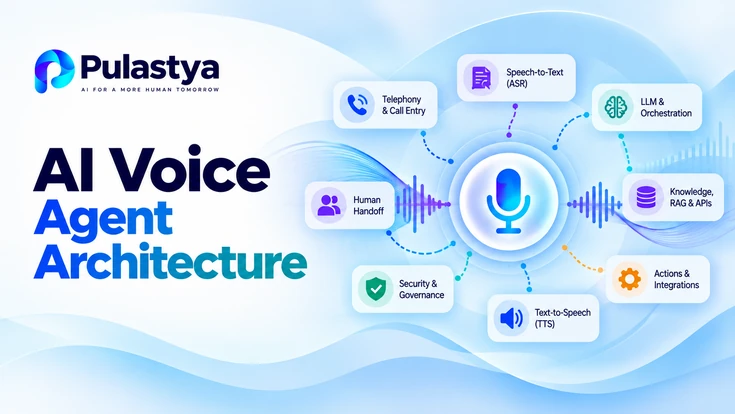
AI voice agent architecture maps the systems, data flows, and operational controls that let voice AI handle real customer calls at scale.
In practice, that means the telephony and speech plumbing, intent and orchestration layers, knowledge and API control surfaces, plus actions, handoff, observability, and failover patterns for enterprise deployments.
- Design for latency and determinism Prioritize streaming ASR and compact context propagation to meet subsecond turn times for simple intents, and plan graceful degradation for higher latency actions.
- Treat confidence as control input Use ASR and NLU confidence scores to trigger clarification prompts, reclassification attempts, or immediate escalation to human agents based on configurable thresholds.
- Separate knowledge and action planes Keep knowledge retrieval and policy evaluation decoupled from action execution so the same dialog can drive read-only responses or gated transactions with audit and consent checks.
Enterprises deploying voice AI must design for predictable call quality, secure access to authoritative data, and operational control over how agents decide, clarify, or escalate. The architecture spans real-time telephony integration, streaming speech-to-text, natural language understanding, context management, knowledge retrieval, policy enforcement, and action execution.
Each component imposes tradeoffs between latency, cost, transparency, and developer velocity. Concrete call flows expose those tradeoffs and guide choices for carriers, ASR providers, NLU models, and orchestration engines.
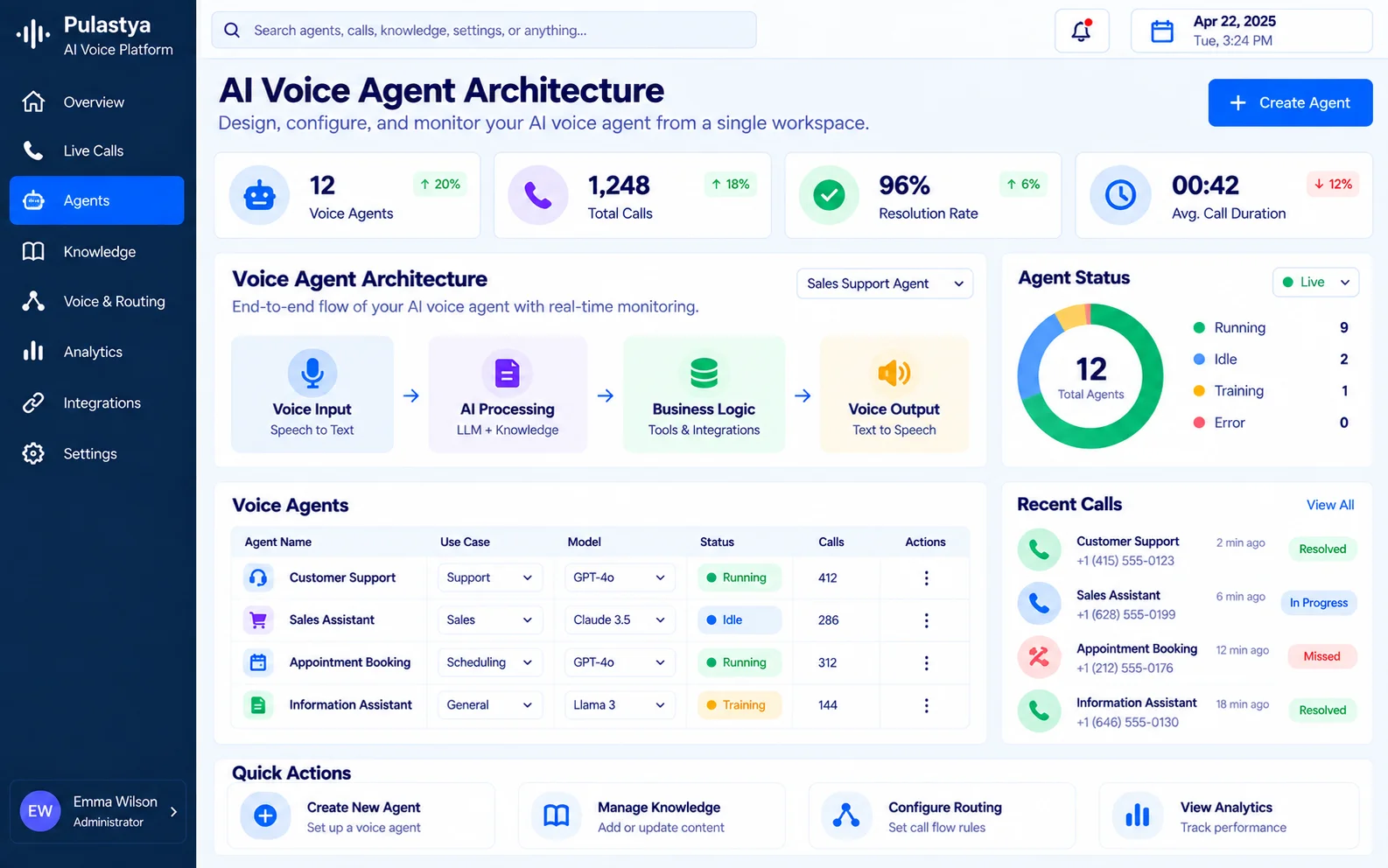
A typical call path shows how the components interact and what teams should measure.
An inbound call arrives from the carrier over SIP or cloud telephony; an outbound call starts when a campaign or business trigger asks the platform to dial.
From the moment someone answers, both follow the same path: audio streams to ASR for live transcription, feeds an intent engine with session context, consults knowledge systems or APIs, and then the agent responds, executes an action, or hands off.
The architecture must also treat confidence as an explicit input driving clarification, reclassification, or handoff according to configured policy.
Telephony and Speech Layer
The telephony and speech layer is the entry point for voice calls and the boundary where network-level behavior materially affects downstream AI accuracy. Calls arrive via SIP trunks, cloud telephony APIs, or PSTN gateways and are encoded in RTP streams.
The platform must handle varying codecs, sample rates, and packet loss characteristics while exposing a clean streaming audio feed to the ASR. Design choices here, codec negotiation, jitter buffers, and echo cancellation, influence real-time transcription quality and end-to-end latency.
Inbound and Outbound Entry Paths
Inbound calls enter when a caller dials a business number. The carrier or cloud telephony provider receives the call and hands it to the voice layer, either by sending a webhook to the voice platform, which then opens an audio stream, or by delivering the call over a SIP trunk. Numbers, business hours and failover destinations are configured at this boundary.
Outbound calls enter from the opposite direction. A campaign schedule, CRM event, missed-call follow-up or other business trigger asks the platform to place a call through the telephony provider. Before dialing, the platform should check consent, calling-hour and opt-out rules; after the call connects, it may need to detect whether a person or voicemail answered.
Once a live person is on the line, both directions share the same speech, intent, knowledge, policy and action layers.
The main architectural differences sit before the conversation (who initiates and which compliance checks run) and in the outcome records, such as callback requests or campaign results. For the operating differences, see inbound AI voice agents and software for outbound AI calling.
Streaming ASR should operate with partial, incremental transcripts so the dialog manager can start intent evaluation before the caller finishes speaking. Implement low-latency voice activity detection and barge-in support so the system can interrupt prompts when a caller speaks.
Also instrument and surface ASR partial confidence to the orchestration layer; partial transcripts with low confidence often require clarification prompts rather than immediate action. Decide whether to use edge or cloud ASR based on latency, compliance, and cost considerations.
Operational concerns include call recording policy, transcription retention, and redaction. Capture raw RTP for diagnostics but apply redaction and access controls before storing transcripts.
Provide packet-level telemetry and call-level metrics such as mean audio gap, retransmit rate, and ASR round trip time. Maintain a developer-visible signal chain so teams can trace a misclassified intent back to packet loss, codec mismatch, or noisy audio to prioritize fixes.
- SIP trunk or cloud telephony provider selection based on regional coverage and egress latency
- Separate entry handling for inbound numbers (webhook or SIP) and outbound triggers (consent and calling-hour checks before dialing)
- RTP stream normalization: resampling, codec transcoding, and jitter buffering before ASR
- Streaming ASR with partial transcripts and incremental confidence reporting
- Voice activity detection, echo cancellation, and barge-in handling for natural dialog
- Recording, redaction rules, and secure storage separate from production transcripts
Treat the telephony layer as a source of signal quality metadata, not just audio.
Architecture layers
Where Inbound and Outbound Calls Enter a Voice AI Architecture
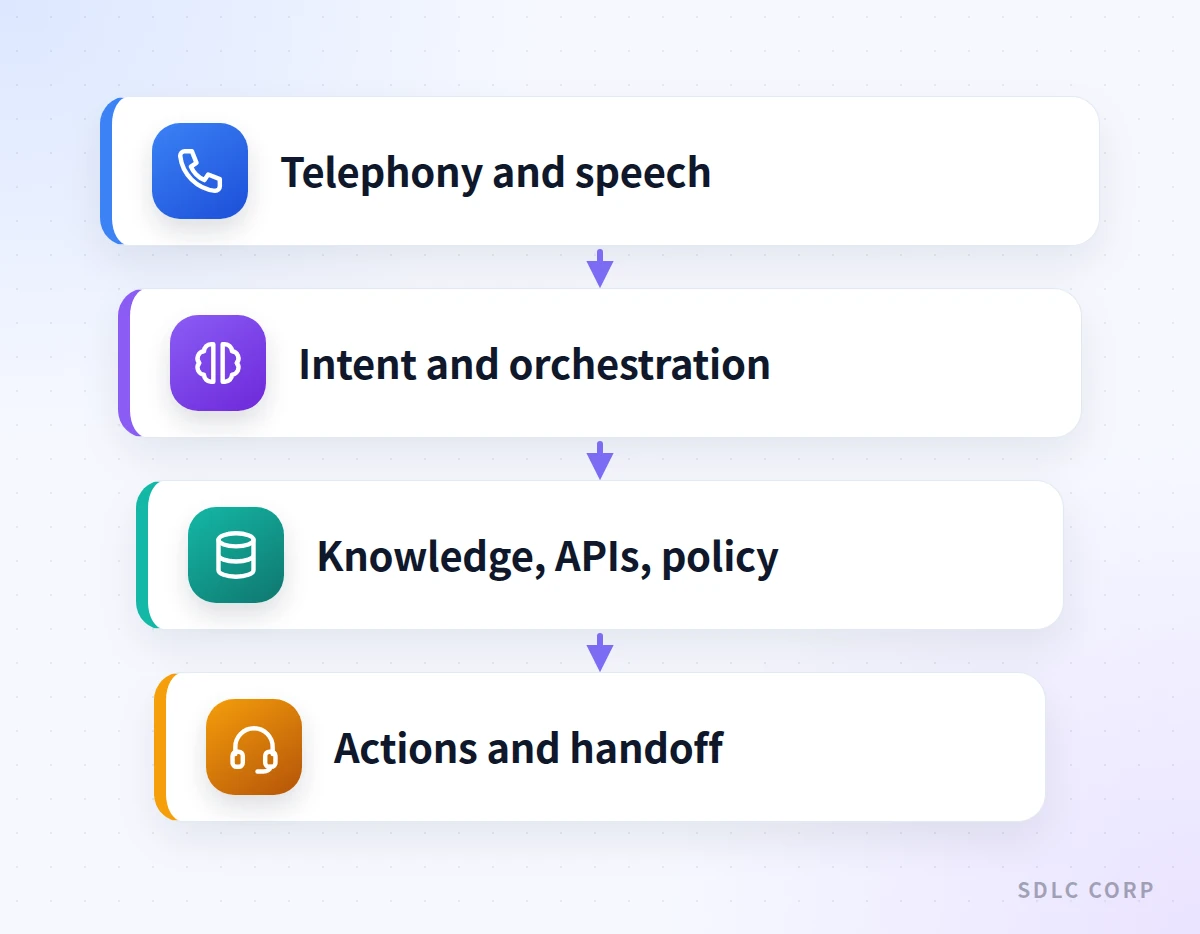
- Call entry: inbound or outboundInbound: number to webhook or SIP. Outbound: trigger, consent checks, then dial
- Telephony and speechAudio stream, streaming ASR, barge-in and end-of-speech detection
- Intent, context and orchestrationClassify intent, track session state, map confidence to confirm or clarify
- Knowledge, APIs and policyApproved content, live system data, access, consent and audit checks
- Response or actionSpoken reply or a policy-gated transaction, logged to the call session
Possible outcomes
- Resolved and loggedTranscript, decisions and outcome stored for review
- Handoff with contextWarm or cold transfer carrying transcript, entities and flags
- Failover modeCached answers, callback capture or a priority route to a human
Notice that inbound and outbound calls differ only at the entry point; after someone answers, both use the same speech, reasoning and action layers.
Intent, Context, and Orchestration
Intent recognition and slot filling are core to deciding what an agent should do next. Use a layered NLU approach: lightweight intent classifiers for rapid routing, followed by deeper semantic parsers for complex transactions. Keep intent schemas explicit and versioned so downstream systems can rely on stable signals.
Include confidence scores from both ASR and NLU as structured inputs. For example, an order status intent with low combined confidence should trigger a specific clarifying question rather than an automated shipment lookup.
Context management maintains conversational state across turns, channels, and transfers. Implement short-term session memory for slot filling and turn history, plus a controlled interface to longer-lived context from CRM or consent records.
When a caller moves from the bot to a human, propagate a compact context package that includes recent transcripts, extracted slots, confidence history, and policy flags. This avoids forcing human agents to ask the same questions and supports warm handoffs.
The orchestration layer coordinates NLU outcomes, business policy, and action execution. It enforces decision policies that map confidence thresholds to behaviors: confirm, clarify, retry NLU, or escalate.
Orchestration should also allow parallel attempts, such as trying alternate intent classifiers or querying a cached knowledge result while awaiting a live API, to minimize perceived latency. Maintain an explicit policy engine so operations staff can change thresholds, add fallback prompts, or reroute specific intent classes without code changes.
- Two-tier NLU: fast intent routing followed by deeper parsing for high-value transactions
- Session context model that serializes into a compact handoff package for humans
- Combined ASR and NLU confidence used as structured policy input
- Policy-driven orchestration engine with configurable thresholds and retry rules
- Parallel workstreams to query cache or alternate models while awaiting live results
Make confidence and context first-class inputs to the orchestration policy.
Knowledge, APIs, and Policy Controls
Knowledge access includes FAQ content, product catalogs, CRM records, and transactional APIs. Design the knowledge plane as a set of connectors and caches with clear freshness guarantees and provenance.
For read-only queries, prefer cached vector or keyword search to reduce latency. For authoritative answers, call the source of truth APIs and surface the response with a confidence tag and the data timestamp so the orchestration layer can decide whether to act or to ask a confirmation from the caller.
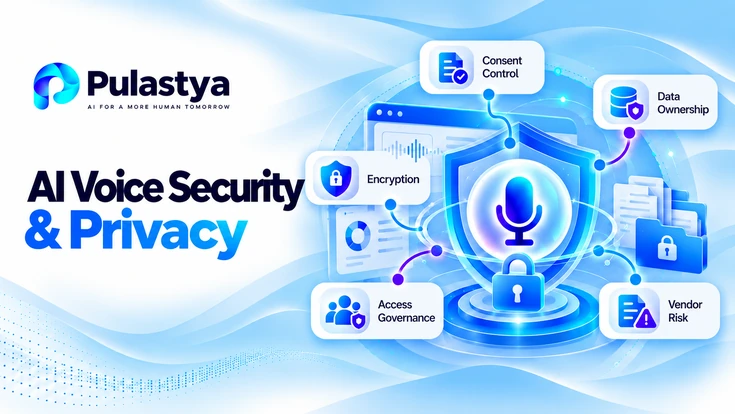
Policy controls govern what the agent can read or do on behalf of a caller. Implement attribute-based access controls and entitlements for API calls, and apply request-level redaction rules for PII.
Include consent checks in the knowledge retrieval flow: if a requested data element requires explicit consent, the orchestration engine should surface a consent prompt and record the response before forwarding the API call. Add rate limiting, idempotency tokens, and circuit breakers to protect downstream systems from bursts.
Design auditability into the knowledge and API plane. Log each knowledge fetch, API call, returned confidence, and any policy decisions that modified the action.
Use immutable event records tied to the call session so compliance teams can reconstruct call decisions. Provide a sandbox mode for human agents to replay queries and test policy changes without impacting production data or invoking live transactions.
- Connectors to CRM, order management, and catalog services with clear SLA expectations
- Cached knowledge stores for subsecond responses and authoritative fallbacks for accuracy
- Consent and policy checks before returning or acting on sensitive data
- Per-call audit logs capturing queries, API responses, and policy decisions
- Rate limiting, idempotency, and circuit breakers to protect backend systems
Separate knowledge retrieval from execution and require policy approval for sensitive actions.
Actions, Handoff, Observability, and Failover
Actions include passive responses, API transactions against business systems, scheduling callbacks, and taking payments. Gate any action that mutates state behind multi-step policy checks: confirm intent, verify caller identity, check consent flags, and evaluate risk scoring.
For a call that requests a refund, the orchestration engine should verify purchase history via API, evaluate fraud signals, confirm the caller via a short verification flow, and then execute the refund using an idempotent API call while logging the approval chain.
Handoff strategies range from cold transfers, where the live call goes straight to the destination and a context note travels with it, to warm transfers, where the agent first reaches and briefs the receiving person before connecting the caller.
The warm vs cold transfer comparison covers when each fits. Always attach a context payload: recent transcript, extracted entities, confidence timeline, and policy flags.
Implement structured handoff APIs so contact center software can render the context and pick the appropriate response. For high-risk or low-confidence calls, route directly to a skilled human queue and mark the session to preserve verbatim recording for later review.
Observability and failover reduce operational risk. Instrument ASR latency, NLU error rates, intent confusion matrices, API error distributions, and end-to-end time to resolution. Configure alerts on rising misclassification rates or backend API errors that exceed a threshold.
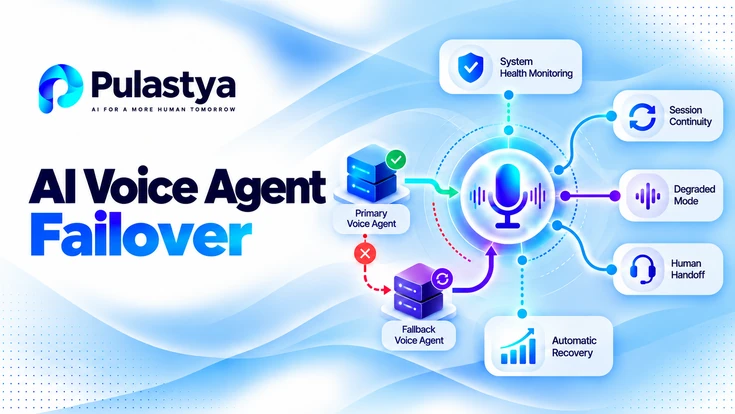
For failover, provide degraded interaction modes: switch to a voice menu with limited options, record contact data for a callback, or route to a human with a priority tag. Maintain runbooks that map specific telemetry signatures to remedial actions.
- Policy-gated actions with identity verification, consent capture, and idempotent API calls
- Warm handoff with structured context package to minimize repeat questioning
- Routing rules that prioritize human queues for high-risk or low-confidence sessions
- Operational telemetry: ASR latency, intent accuracy, API success rates, and throughput
- Failover modes: degrade to IVR, queue for callback, or switch to human with priority tag
Design handoff and failover as planned operational modes, not emergency hacks.
Conclusion
An effective AI voice agent architecture connects telephony, streaming speech recognition, intent orchestration, and trusted business systems through a policy-driven call flow. Low-latency audio processing and defined confidence thresholds help the agent interpret requests, clarify uncertainty, and respond without bypassing identity verification, consent, or access controls.
For reliable enterprise deployment, keep knowledge retrieval separate from transaction execution and plan human handoff, observability, and failover from the start. Monitor transcription quality, response latency, API reliability, and transfer outcomes to improve call experiences while maintaining security, auditability, and operational control.
Frequently Asked Questions
Treat confidence as an explicit decision input. Define policies that map score ranges to actions such as immediate confirmation, clarification prompts, reclassification attempts, or escalation to a human agent. Track combined ASR and NLU confidence history per session so orchestration can factor transient drops or consistent low confidence into routing decisions.
Serialize a compact context package that includes recent transcript snippets, extracted entities and slots, confidence timeline, policy flags, and attempted actions. In a warm transfer, brief the receiving agent and show those details before connecting the caller, which avoids repeated verification steps and reduces average handle time.
Apply redaction at ingestion, enforce attribute-based access controls on knowledge queries, and require consent before returning or using PII. Log only the minimum necessary metadata for operations, and store full transcripts in encrypted, access-controlled buckets with retention policies governed by compliance requirements.
Start with ASR latency and error rates, NLU intent accuracy and confusion rates, API success and error codes, end-to-end turn time, and human handoff frequency. Correlate spikes in misclassification or API errors with recent deploys or carrier incidents to speed root cause analysis.
Implement tiered failover: first use cached knowledge or simpler dialog flows, then degrade to an IVR menu or callback capture, and finally route to human agents. Use circuit breakers and telemetry-driven triggers so failover happens automatically when predefined thresholds are exceeded.