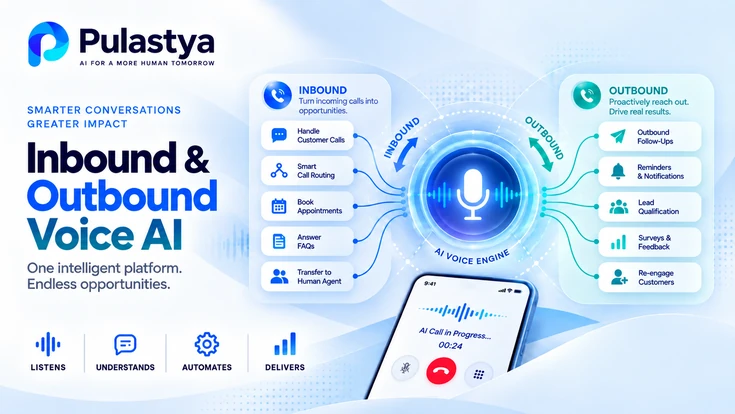
Inbound and outbound voice AI run on the same technology and answer to different rules. Inbound means the caller chose to ring you, so the programme is judged on coverage and routing. Outbound means you chose to ring them, so the programme is judged on consent, list quality and pacing.
- Direction sets the duty Inbound obligations begin when the phone rings. Outbound obligations begin before the first call is placed.
- Two scoreboards Coverage, containment and routing accuracy on one side; contact rate, suppression and disposition quality on the other.
- Share plumbing, not policy Numbers, knowledge and escalation paths can be shared. Consent records, scripts and metrics should not be.
Most teams buy one platform and then find they are running two programmes. The agent can be the same and the number can be the same, but the obligations, the metrics and the failure modes are not, and neither are the people who should own them.
Separating the two early is what keeps them from being run as one programme: what changes when the direction of the call changes, what each side has to get right, and who should be answerable for it.
Why Inbound and Outbound Are Different Programmes
Voice automation is usually sold as one capability. In practice the direction of the call decides most of what follows, because it decides who agreed to the conversation and who is waiting on the outcome.
| Dimension | Inbound programme | Outbound programme |
|---|---|---|
| Who initiated | The caller, with a question or a problem already in mind | You, into someone else's day, uninvited |
| What governs it | Service commitments, hours of cover and escalation policy | Consent records, do-not-call suppression and permitted calling windows |
| What you measure | Answer rate, containment, routing accuracy and time to a person | Contact rate, list health, disposition quality and attempts per contact |
| What goes wrong | Calls unanswered, callers misrouted, a wrong answer delivered confidently | Calls to people who opted out, at the wrong hour, too many times |
| Who notices first | The caller who waited, then the queue behind them | The complaint, the carrier and the brand |
An inbound programme is a coverage and routing problem. Demand arrives when it arrives, in volumes you did not choose, and the work is to answer it, understand it and put it in the right place quickly. Broader inbound scope is covered in inbound AI voice agents.
An outbound programme is a consent, list and pacing problem. You control the volume and the timing, which is exactly why the controls exist. The category view sits in outbound calling software, and the dialing layer underneath it in what an AI dialer does.
The consequence is organizational. The two programmes need different launch criteria, different reviewers and different definitions of a good week, even when one team runs both on one platform.
What an Inbound Programme Has to Get Right
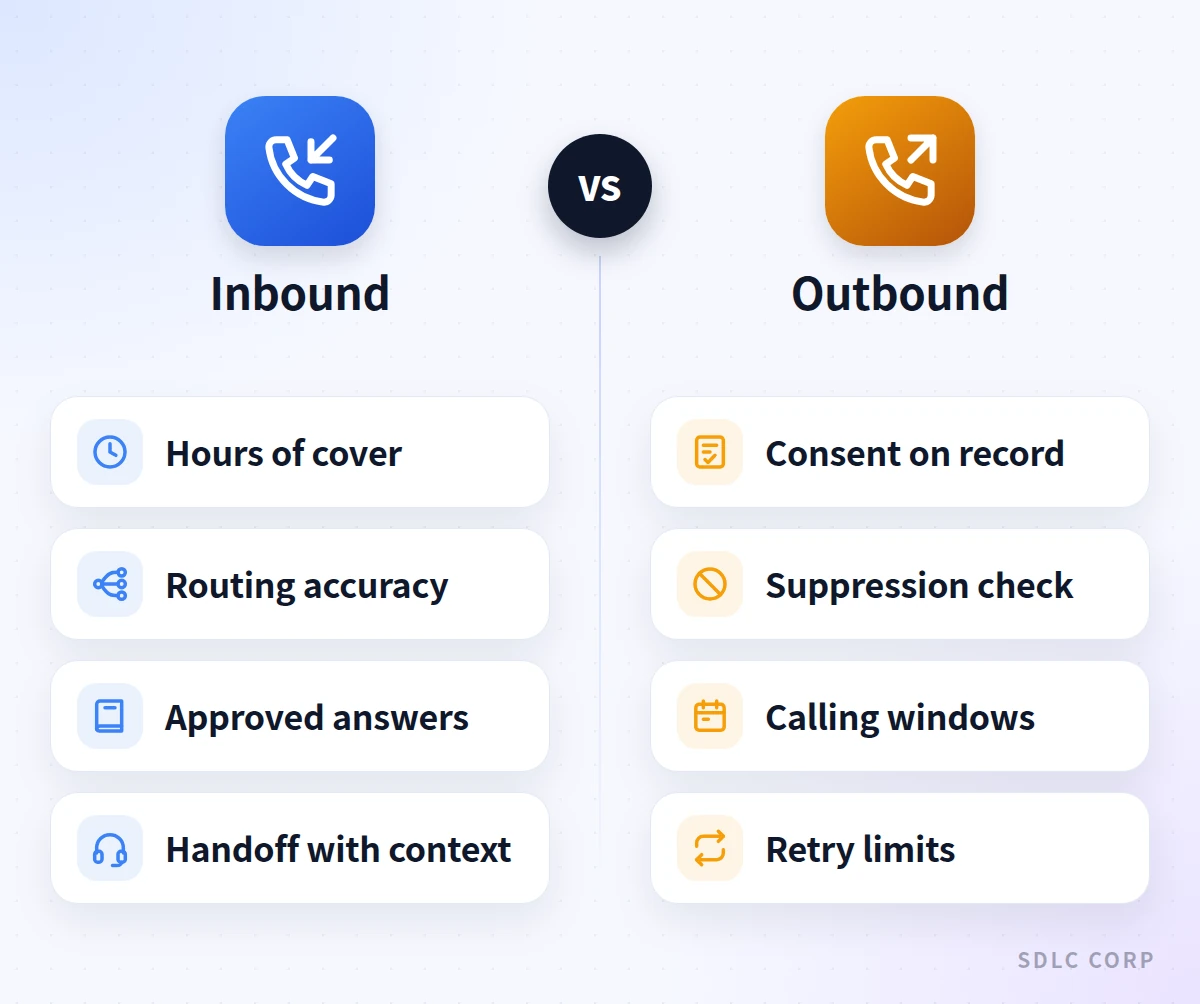
An inbound programme is a promise of coverage. The caller has already decided to spend their time on you, so the failure that matters most is the call nobody answered, followed by the call answered badly.
Missed calls concentrate outside staffed hours and during peaks, which is where automation earns its return.
Work out what the caller actually needs, rather than asking them to classify themselves against your org chart.
Spoken answers on hours, policy and pricing get acted on, so they should trace back to a document someone owns.
When a person takes over, they should receive what the caller already said instead of restarting the conversation.
Coverage is mostly a question of hours and overflow. The rules for time-of-day behavior, holidays and urgent exceptions are in after-hours call handling, and the front-desk shape of the job, including messages and bookings, is in the AI receptionist guide.
Routing is where inbound programmes quietly lose value. Every avoidable transfer costs the caller time and a colleague an interruption, which is why intent capture deserves more design than the menu it replaces. The mechanics are in call intake and routing.
Pulastya, the SDLC Corp platform for inbound and outbound business calls, takes the conservative line on the answer itself: responses come from documents the organization provides, and when the agent lacks context it says so and offers a transfer rather than guessing.
Containment is a useful inbound metric and a dangerous target. A rising share of calls resolved without a person can mean the agent got better, or it can mean it stopped offering the transfer callers asked for. Read it next to transfer requests and repeat calls, never on its own.
What an Outbound Programme Has to Get Right
An outbound programme starts before the first call is placed. The question is not whether the agent speaks well. It is whether this number should be dialed at all, at this hour, for the third time this week.
Every outbound control exists to answer some version of that question. Treat the list below as the minimum to verify with any vendor, whatever the product calls them: a control you cannot find is a risk the programme absorbs itself.
- Consent and suppression: a record of why each number may be called, and a do-not-call check that runs before dialing rather than after a complaint. Outbound calling compliance covers what to keep.
- Calling windows: permitted hours follow the number being called, not the office placing the call, which makes time zones a data problem. See calling hours and time zone rules.
- Retry limits: a cap on attempts per contact and per period, with a defined gap between them and a rule for when a contact is retired. Retry logic sets out the patterns.
- List upload and hygiene: field mapping, duplicates, invalid numbers and a recorded source for every list. Uploading and managing lead lists covers the handling.
- Pacing and answering-machine detection: how many calls are in flight at once, and what happens when a voicemail greeting answers instead of a person. Both sit in outbound campaign setup.
- Dispositions: every attempt ends in a coded outcome, because reporting, retries and suppression all read from those codes. Outbound campaign metrics explains which ones matter.
- Number presentation: which caller ID is shown and how numbers are rotated, done so recipients recognize you, never to work around filtering.
Outbound calls also end differently. An interested person often needs a colleague immediately, while the context is still live, which is a handoff rather than a queue. The patterns are in transferring an outbound call to a person.
Ask any vendor to demonstrate three things in the product rather than on a slide: a number suppressed before it is dialed, a call blocked because the recipient's local window has closed, and an attempt refused at the retry cap. Whichever cannot be shown is the one that becomes an incident.
Running Both Without Running Them Twice
Most businesses end up doing both. The two failure modes are running them as one programme because they share a vendor, or as two disconnected projects because they share nothing else.
What Can Be Shared
- Communications and numbers, including the accounts and concurrency that carry both directions.
- Approved content, so an outbound campaign and an inbound caller get the same answer to the same question.
- Transfer destinations and the failover line that catches a call when nobody is available.
- Governance: who may change agent behavior, who sees transcripts, and how long they are kept.
- One place to read what happened, rather than two reporting habits that never reconcile.
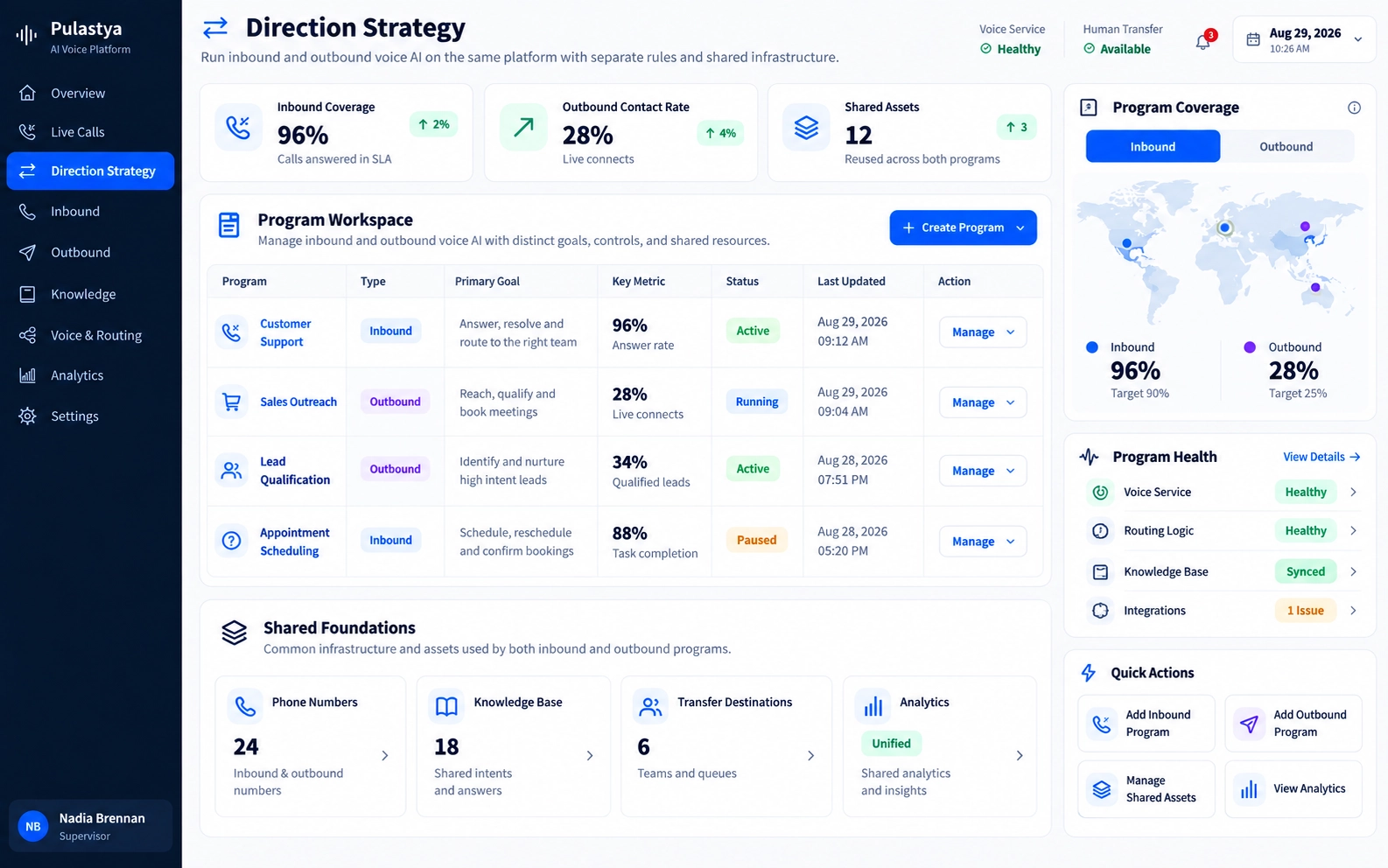
Transcripts and summaries are the obvious shared asset, because an outbound call that ends in a complaint and an inbound call that ends in a transfer get read by the same people. Pulastya keeps both directions in one call dashboard with transcripts and call summaries attached.
What Should Stay Separate
- Consent and suppression records, which exist for outbound and have no inbound equivalent.
- Openings and scripts, because a caller who rang you does not need to be told why you are calling.
- Metrics, since inbound call quality measures and campaign measures answer different questions.
- Staffing, because inbound cover follows arrival patterns while outbound cover follows the dial plan you chose.
- Escalation thresholds, which are usually tighter on a call the recipient did not ask for.
Staffing is where the two meet in practice. Deciding which calls people take, in which direction, and at what point the automation steps aside is covered in hybrid AI and human call handling.
- Name the lead directionDecide which programme goes first based on the calls you cannot afford to miss or delay, and resource that one properly.
- Write the obligation listOne page per direction: what governs it, who approves changes, and what the agent must never do alone.
- Share the plumbing deliberatelyReuse numbers, content, transfer destinations and governance, and record which are shared so a change is not a surprise.
- Measure them apartKeep separate scoreboards and review each against its own definition of a good week.
Both programmes sit on the same foundations. The platform questions underneath them are in how to evaluate an enterprise voice AI platform, and the controls that make either defensible after the fact are in voice AI security and governance.
On commercial structure, Pulastya customers connect their own Twilio and OpenAI accounts and those providers bill usage directly, there is no platform software fee above that usage, and an existing business number can be kept by pointing its webhook at the platform.
To see both models in one setup, the voice AI platform for inbound and outbound calls from SDLC Corp shows call handling, routing and the dashboard together. To walk through it against your own call mix, book a guided walkthrough.
Conclusion
Inbound and outbound voice AI may use the same technology, but they need different operating rules. Inbound programmes succeed by answering calls reliably, routing people correctly and handing over with context. Outbound programmes must establish consent, apply suppression checks, respect calling windows and limit retries before a call is placed. Each direction deserves its own owner, launch criteria and performance measures.
Start with the direction that addresses your most pressing need, then build around clear responsibilities and measurable outcomes. Share approved knowledge, phone infrastructure and call records where useful, but keep scripts, compliance controls and scorecards separate. Review real calls and handoffs regularly to confirm the AI is helping callers without creating unnecessary contacts or compliance risks.
Frequently Asked Questions
Outbound carries more setup before the first call, because consent records, suppression, calling windows, retry limits and dispositions all have to be right in advance. Inbound can start narrower, with one call type and a clear handoff, but it is judged on coverage from day one, so a pilot that only runs in office hours proves less than it looks.
Usually yes at the conversation level, even on one platform. The opening, the goal and the point at which a person takes over differ enough that one shared script serves neither well. What you should share is the approved content behind the answers, the transfer destinations and the governance around changes.
That depends on your jurisdiction, the industry and the purpose of the call, so it is a question for your own counsel rather than a vendor. What is constant is the operational requirement: a record of where each number came from and on what basis it may be called, a suppression list checked before dialing, and an easy way for someone to opt out during the call.
Compare them only at the business outcome, such as resolved requests or qualified opportunities per period. The operational numbers do not translate: containment and time to a person describe an inbound queue, while contact rate and disposition mix describe a campaign. Forcing them onto one dashboard row hides problems in both.
Technically yes, and there is an argument for it, because people who see a missed call often ring it back and should reach something useful. The caution is that a campaign generates return traffic the inbound side was not staffed for, so plan the callback path before the campaign, not after it.