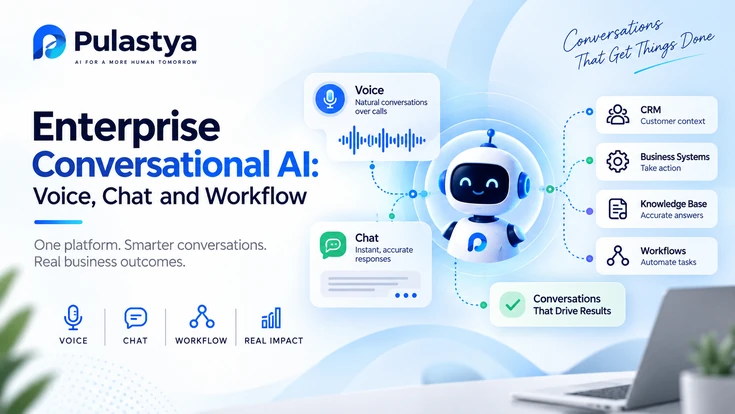
Enterprise conversational AI is the category covering every automated conversation a business holds with a customer or an employee, whatever carries it: a phone call, a chat window, a messaging thread or an in-app assistant.
Voice AI is the part of that category carried by a call, and usually the part with the most at stake.
- A nesting, not a rivalry Conversational AI is the category that contains voice AI. Neither term replaces or relabels the other.
- Voice has no surface No interface, no scrollback and no send button, which changes turn taking, timing and error handling.
- The base is shared Knowledge, customer context, business rules, escalation and reporting are common to both channels.
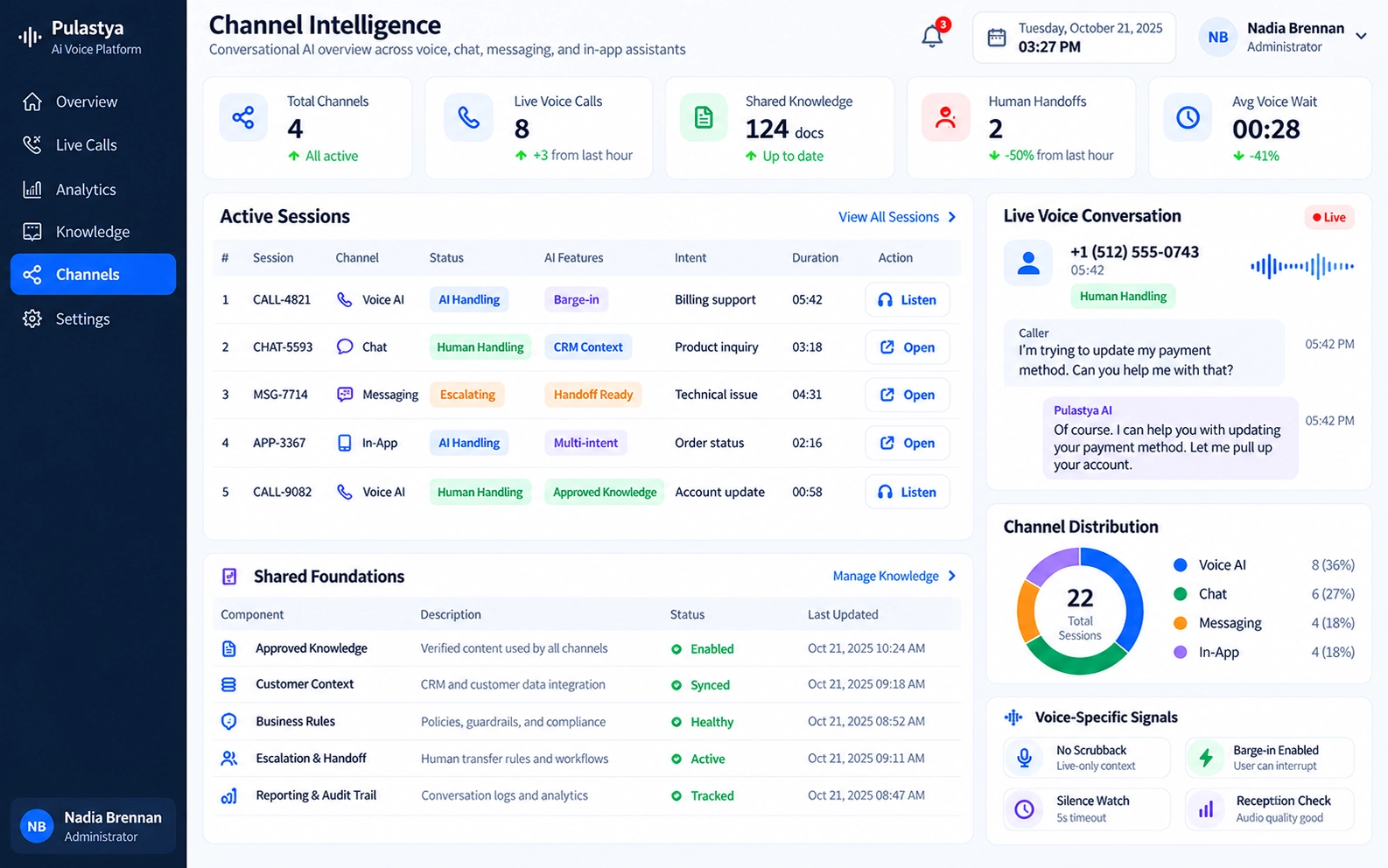
The distinction matters because the budget is usually approved at the wider level and the work is done at the narrower one. A team buys conversational AI, then discovers that the phone has rules of its own.
Three things are worth settling before that discovery becomes expensive: how the terms nest, what is mechanically different about a spoken channel, and what voice and chat genuinely share.
Where Conversational AI Sits Above Voice AI
Enterprise conversational AI describes the whole surface on which a business holds automated conversations. Voice AI describes the part of that surface carried by a phone call. Vendor material uses the two almost interchangeably, which makes shortlists harder to compare than they need to be.
The clean way to hold them is as a nesting. Each level narrows the one above it, and each level is where a different question gets decided.
| Level | What it covers | The question decided here |
|---|---|---|
| Enterprise AI | Every applied AI system inside the business | Which problems are worth automating at all |
| Conversational AI | Automated conversation on any channel | Which channels the business will answer on |
| Voice AI | Conversation carried by a phone call | Whether spoken interaction is worth its constraints |
| AI voice agents | The agent that handles a specific call type | What one agent may resolve, capture or transfer |
| Workflows and use cases | The rules and systems behind the answer | What a conversation is allowed to change |
Most day-to-day work lives in the bottom two rows. What an agent hears, decides and says, and where the boundary of its job sits, is set out in how an AI voice agent works.
The comparison buyers ask for first is voice against chat interfaces. That is a genuine comparison rather than a hierarchy, and voice AI compared with chatbots covers where each performs better and why many businesses end up running both.
Conversational AI is not a newer replacement for voice AI, and a voice deployment does not become a conversational AI deployment by being renamed. The wider term names what contains the phone channel, alongside chat and messaging. It does not name something that supersedes it.
What Changes When the Channel Is a Phone Call
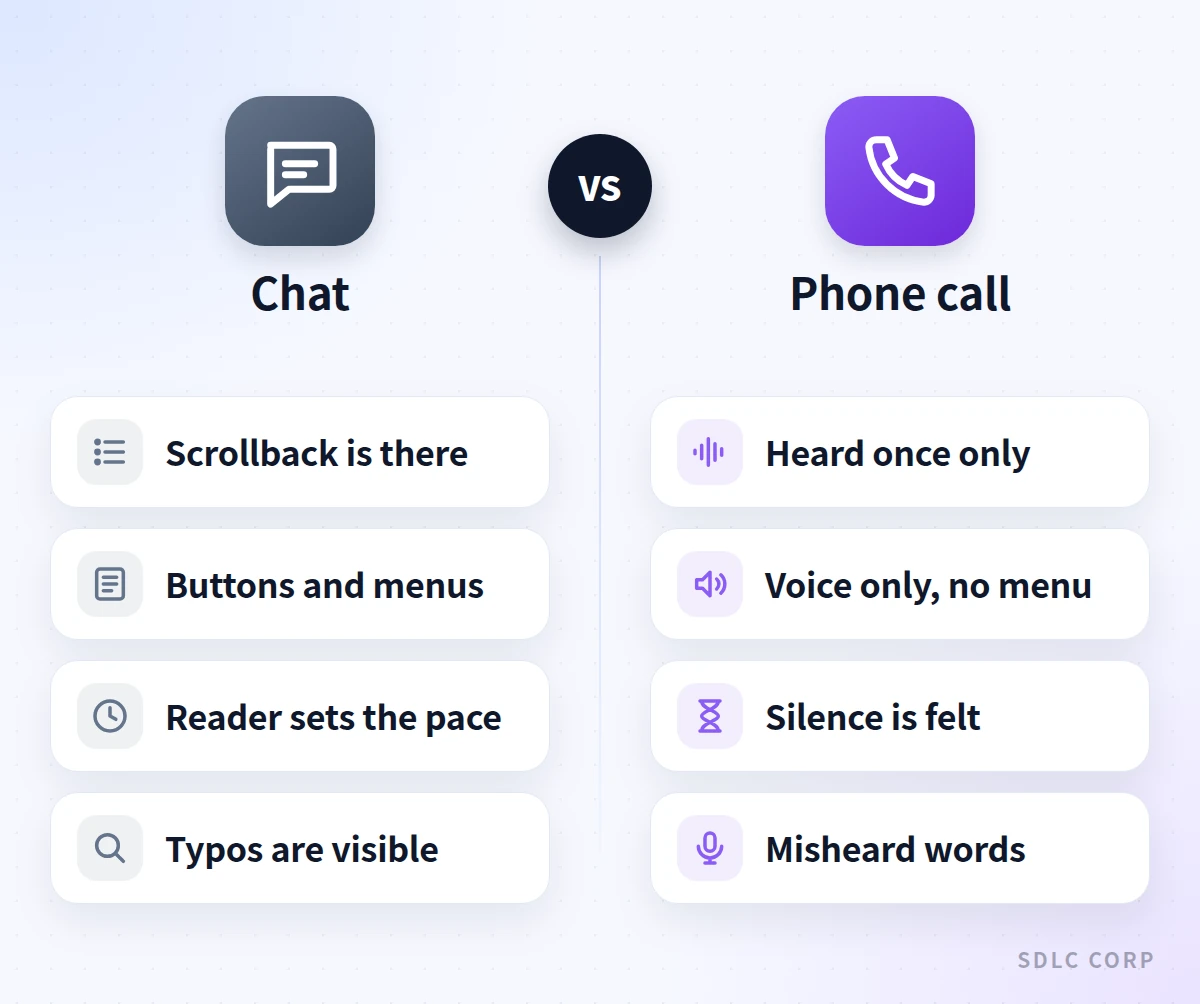
Channel comparisons usually stop at tone of voice. The differences that decide whether a deployment works are mechanical, and they follow from one fact: a call has no surface. There is nothing for the caller to look at, and nothing to look at again.
| What differs | In chat | On a call |
|---|---|---|
| The interface | Buttons, links, forms and formatting | Nothing visible, only what was just said |
| Going back | Scrollback lets the user re-read everything | The caller hears each sentence once |
| Turn taking | The user sends when ready | Both sides can speak at once |
| Delay | A pause reads as the other side typing | Silence reads as a dropped line |
| Input error | A typo is visible to the person who made it | A misheard word is silent and plausible |
| Repair | Edit the message and send again | Ask again, and the caller pays in time |
The Caller Cannot Re-Read Anything
In chat, the whole exchange stays on screen. A caller has only what was just said, so everything before it has to be held by the system rather than by a transcript in front of the user. Confirmations, list lengths and reference numbers all have to survive a single hearing.
That makes conversation state a requirement rather than a refinement. Carrying context across a conversation covers what has to be retained, for how long, and how it is confirmed back to the caller.
Both Sides Can Talk at Once
Chat turns are discrete: the user sends, then the assistant answers. A call has no send button. Callers interrupt, trail off, think out loud and answer a question two questions early, so the agent has to decide continuously whether the caller has finished.
Barge-in, where a caller cuts across a spoken answer and is heard, is the difference between a conversation and a recording. Pulastya handles barge-in and end-of-speech detection, and both are worth hearing on a real call rather than reading from a feature list.
Silence Is Expensive
In chat, a two-second pause is invisible. On a call it is the sound of nothing, and callers read it as a failure. Every retrieval, lookup and model call sits inside a budget the caller can hear, which constrains how much work a turn can do.
That budget shapes everything above the call: when knowledge is fetched, when a tool is invoked, and what is said while the caller waits. AI voice agent architecture covers how those decisions are sequenced.
A Misheard Word Is Not a Typo
A typo is visible to the person who made it and gets corrected on the spot. Recognition error is silent: the system receives a plausible wrong word and acts on it with full confidence. Accents, background noise, spelled-out names and long numbers are where this concentrates.
Two pages own the response. Intent classification for voice covers deciding what a caller meant from imperfect input, and handling accents and multiple languages covers recognition quality across speakers.
Requests Arrive in One Breath
A chat user tends to send one question at a time. A caller says three things in a sentence and expects all three answered, in order, without repeating them. Handling multiple intents in one utterance covers how those requests are separated and sequenced.
Shared Foundations Across Voice and Chat
The differences are real, and they sit on top of a shared base. Almost everything behind the point where words become a request is common to both channels, which is why a business rarely builds the two independently.
Sharing that base is also what keeps answers consistent. A customer told one thing on the phone and another in chat has found a governance problem rather than a channel problem.
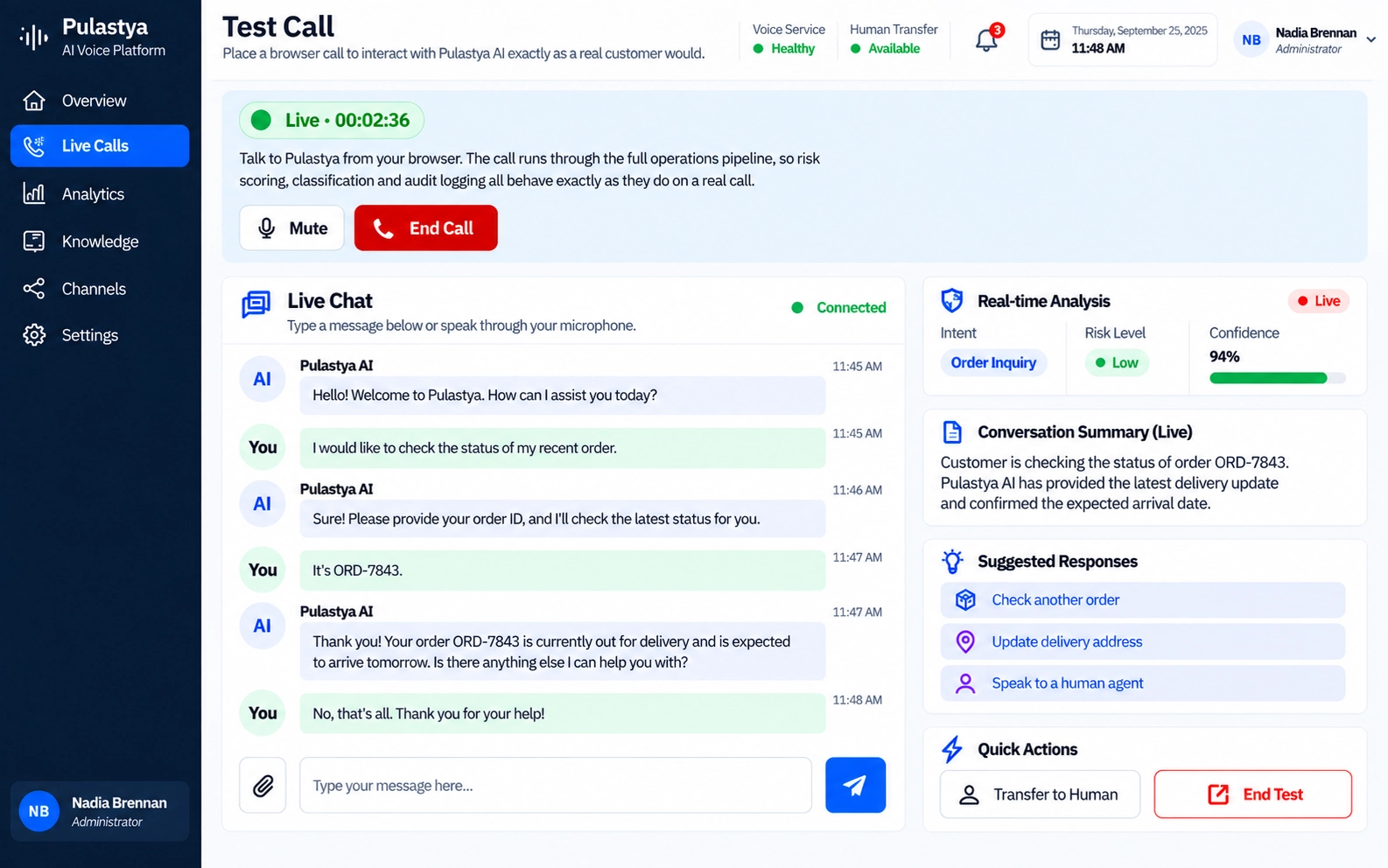
Working out what the customer wants, and what to do about it, is the same job once the words arrive.
Both channels should answer from approved content the business owns rather than general model knowledge.
Who is calling or typing, their history and their open items, read from the system of record.
What may be resolved, what needs approval, and what a conversation is allowed to change.
When to stop, who receives the handoff, and what context travels with it.
Transcripts, outcomes, review and change approval, reported across channels rather than per channel.
Grounding is the foundation that most often decides whether a deployment is defensible. Retrieval against approved sources, and what the agent says when those sources run out, are covered in retrieval for live voice agents.
The second half of grounding is behavior under uncertainty. Pulastya answers from documents the organization provides, and when it lacks context it says so and offers a transfer rather than guessing, which is the behavior to test on both channels.
Customer context is the next foundation. Reading the record before the conversation starts, and writing back to it afterwards, is set out in CRM personalization for voice agents.
Underneath both channels sits a supplier layer that neither owns. The voice AI integrations landscape maps the communications, speech and model providers a conversational deployment is assembled from, and which questions belong to them rather than to the platform above.
Where Enterprises Start
The common mistake is to start with the channel that is easiest to launch rather than the one where a missed conversation costs the most. For many businesses that is the phone, because a caller who does not get through rarely sends a follow-up message.
- Rank by cost of missingOrder conversations by what a failure costs, not by how simple the integration looks on a diagram.
- Narrow to one conversation typePick a well-understood request where the correct answer already exists in a document someone owns.
- Write the boundaries firstDecide what is resolved, what is captured and what always reaches a person, before any script.
- Build the shared base onceKnowledge, customer context, rules and escalation get reused when a second channel follows.
- Test where the channel is hardestInterruptions, accents, noise and multi-part requests, rather than the clean path you designed for.
Customer support is where most first deployments land, because the call types repeat and the answers are already written down somewhere. AI voice agents in customer support covers that starting point in detail.
Two questions usually follow. Evaluating an enterprise voice AI platform sets out the obligations that appear once more than one team owns the calls, and voice automation across the wider workflow covers the work that continues after the conversation ends.
Commercial structure deserves an early question, because it differs more between products than the conversation quality does. With Pulastya, customers connect their own Twilio and OpenAI accounts and those providers bill usage directly, and an existing business number can be kept by pointing its webhook at the platform.
Setup is four steps aimed at business teams rather than developers, with a browser test call before the number goes live, and transcripts, call summaries and a call dashboard afterwards. To see how the pieces fit the conversations you actually run, start with the enterprise voice AI platform from SDLC Corp, or book a guided walkthrough.
Conclusion
Enterprise conversational AI brings voice, chat and messaging under one approach to automated conversations, but each channel needs its own interaction design. Voice AI works within that broader category, with distinct demands for real-time responses, interruptions, speech recognition and clear handoffs. Understanding these differences helps enterprises choose channels based on customer needs rather than treating every automated conversation as the same experience.
The practical starting point is a focused use case supported by approved knowledge, customer context, business rules and human escalation. Build those foundations to serve both voice and chat, then test each channel against the situations it handles least easily. This creates a more consistent experience for customers and a clearer path to expanding conversational AI across the business.
Frequently Asked Questions
No. Conversational AI is the wider category covering automated conversation on any channel, including chat, messaging and in-app assistants. Voice AI is the part carried by a phone call. Voice sits inside conversational AI rather than beside it, and neither term is a newer name for the other.
Start with the channel where a missed conversation costs the most, which for many businesses is the phone. Callers who do not get through rarely follow up in another channel. Chat is easier to launch, but easy to launch and expensive to miss are two different rankings.
A call has no interface and no scrollback. The caller hears each sentence once, both sides can speak at the same time, a pause reads as a dropped line, and a misheard word arrives looking exactly like a correct one. Those constraints change design far more than tone of voice does.
The foundations should be shared even when the interaction layers differ. Approved knowledge, customer context, business rules, escalation paths and reporting belong to the business rather than to a channel. Keeping them common is what stops a customer getting one answer on the phone and a different one in chat.
Obligations rather than features. Several teams own different conversations, changes need review and an audit trail, outcomes and failures have to reach the people responsible, and there must be a defined behavior when a dependency stops responding.