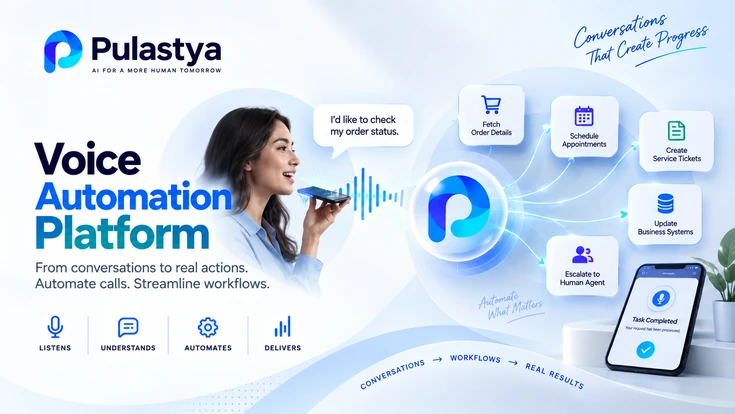
A voice automation platform is not a phone system with a better voice.
It is the machinery between a spoken sentence and a record in a business system: extraction, validation, policy checks, the write into a system of record, and the confirmation the caller hears. The call is the front door. The automation is everything behind it.
- The call is the front door Value comes from what happens in the systems behind it, not from how natural the conversation sounded.
- A decision and a record Every automated call should end with a routing decision and a structured record another system can act on.
- A written stop list Automation stops where the cost of being wrong is higher than the cost of a person taking the call.
Every call produces two things worth keeping: a decision about what happens next, which routes the call, and a record of what was asked and agreed, which has to land somewhere another system can act on.
Following that record end to end is what makes the category legible: what is actually automated, how speech becomes structured data, how that data becomes work in a queue, and where automation should stop short of a person.
What Voice Automation Actually Automates
Most descriptions of voice AI stop at the conversation: the agent understood the caller, answered well, sounded natural. That is the visible half. The measurable half is whether a correctly filled record exists afterwards, in the right queue, with nobody retyping it.
The useful distinction is between a call that was handled and a call that was only recorded. A recorded call leaves work for someone else. An automated call ends with that work started, or parked for review with a reason attached.
| Handling model | What exists after the call | Work left for a person |
|---|---|---|
| Voicemail | An audio file and a caller number | Listen, interpret, retype, route |
| Phone menu and queue | A caller waiting in a queue they chose themselves | Take the whole request again, live |
| Voice agent that only answers | A transcript and a call summary | Read the summary, then create the record |
| Voice automation platform | A validated record in the system of record | Review the exceptions only |
Voice automation owns the distance between the last two rows, which is where most of the labor and the risk sits.
- Turning speech into named fields that a schema will accept.
- Checking those fields against live systems rather than assumptions.
- Applying business rules before anything is said or written.
- Writing the result into the system that owns it, once, and confirming it back.
The end-to-end path from a caller's first sentence to a validated trigger is set out in the guide to how a phone call becomes a workflow trigger. For the wider platform view, including the layers beneath the automation, see what an enterprise voice AI platform includes.
From Spoken Request to Structured Data
Spoken language is not data. A caller says next Tuesday, reads a serial number with a pause in the middle, gives a street name with three plausible spellings, and describes urgency as soon as you can. A workflow needs a date, an asset ID, an address and a priority code.
Closing that gap is extraction and normalization: deciding which words fill which field, converting them into the format the target system stores, and carrying a confidence value with each one. The mechanics are covered in turning spoken requests into structured data.
Confidence is what makes this different from a web form. A form field is filled or empty. A spoken field can be present, plausible and wrong, so each confidence band needs a defined behavior.
- High confidence on a low-risk field: accept it and move on.
- Low confidence on a field that changes the outcome: read it back before using it.
- Repeated recognition failure on a code or number: offer keypad entry instead of a fourth attempt.
- Missing a required field at the end: park the request for review rather than write a partial record.
Half the Fields Do Not Come From the Caller
A record usually needs values the caller cannot supply: entitlement, account status, open cases, the stage of an order. Those come from a live lookup mid-call, which is a different discipline from answering questions. Latency budgets and failure handling belong to real-time API calls during a live conversation.
Choosing the wrong source is a common mistake. Policies belong in curated content; anything that changes hourly belongs in a system query. The comparison in knowledge base versus real-time API sets out which source each question type needs.
Status enquiries are the clearest case, because a stale answer sounds exactly like a correct one. The pattern of verifying the caller, looking up the record and stating how fresh the answer is appears in automating status and order enquiries.
From Structured Data to a Workflow
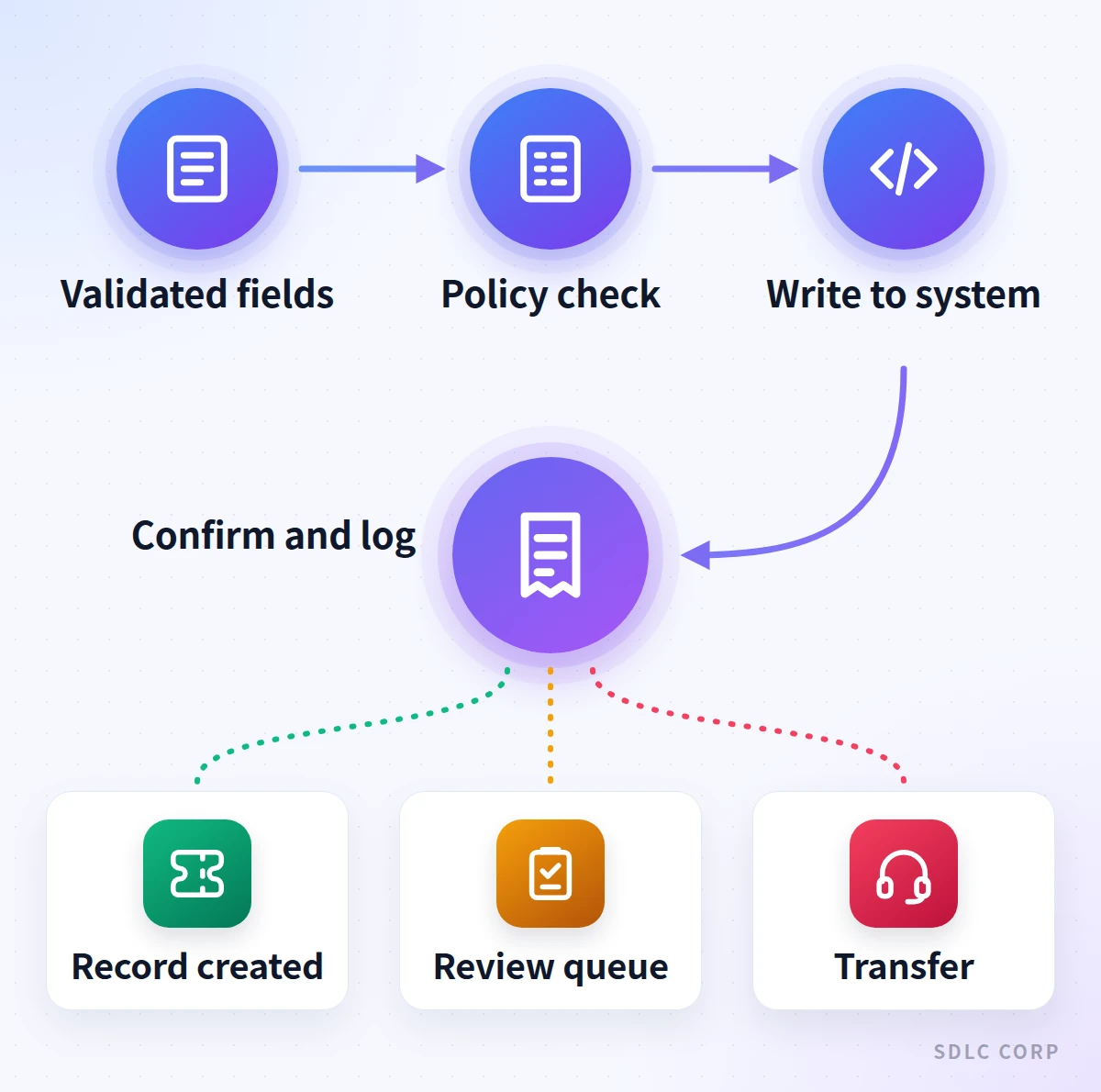
Validated fields are still just fields. The workflow begins at the write: creating the ticket, updating the case, publishing the status event, queueing the callback. Everything before that is preparation; everything after it is another process picking the work up.
The first question is shape. Every system of record has a schema, mandatory fields and a category tree that predates the voice channel, and the agent has to produce records that look like the ones people create. Which pattern fits which system is covered in CRM, ERP and ITSM integration patterns for voice agents.
An idempotency key per request, so a retry after a timeout does not create a second ticket for the same call.
Confirm the account, entitlement and duplicate state before the write, not after the caller has been promised an outcome.
If the target system rejects the write, the call needs a defined ending: a queued request, a transfer, or a callback commitment.
Read back the reference number if one exists. Say the request is queued if it is. Never assert a ticket that was not created.
Rules sit in front of all of it. Whether this caller may request this action, in this region, on this account, should be evaluated and logged before the agent speaks or writes. That belongs in a policy and rule engine for voice agents rather than in prompt wording.
The Same Spine Across Different Work
Service intake is the canonical example: classify, collect the mandatory fields, enrich, create the ticket, confirm the number. The sequence is in automating service request intake by voice, and its most demanding version in an AI voice agent for the IT service desk.
Field operations show the same spine under harder conditions. A driver calling in an ETA change or a delivery exception triggers a status write, and the risk differs with every transaction, which is why voice automation for logistics and field service sets a commit rule per transaction type.
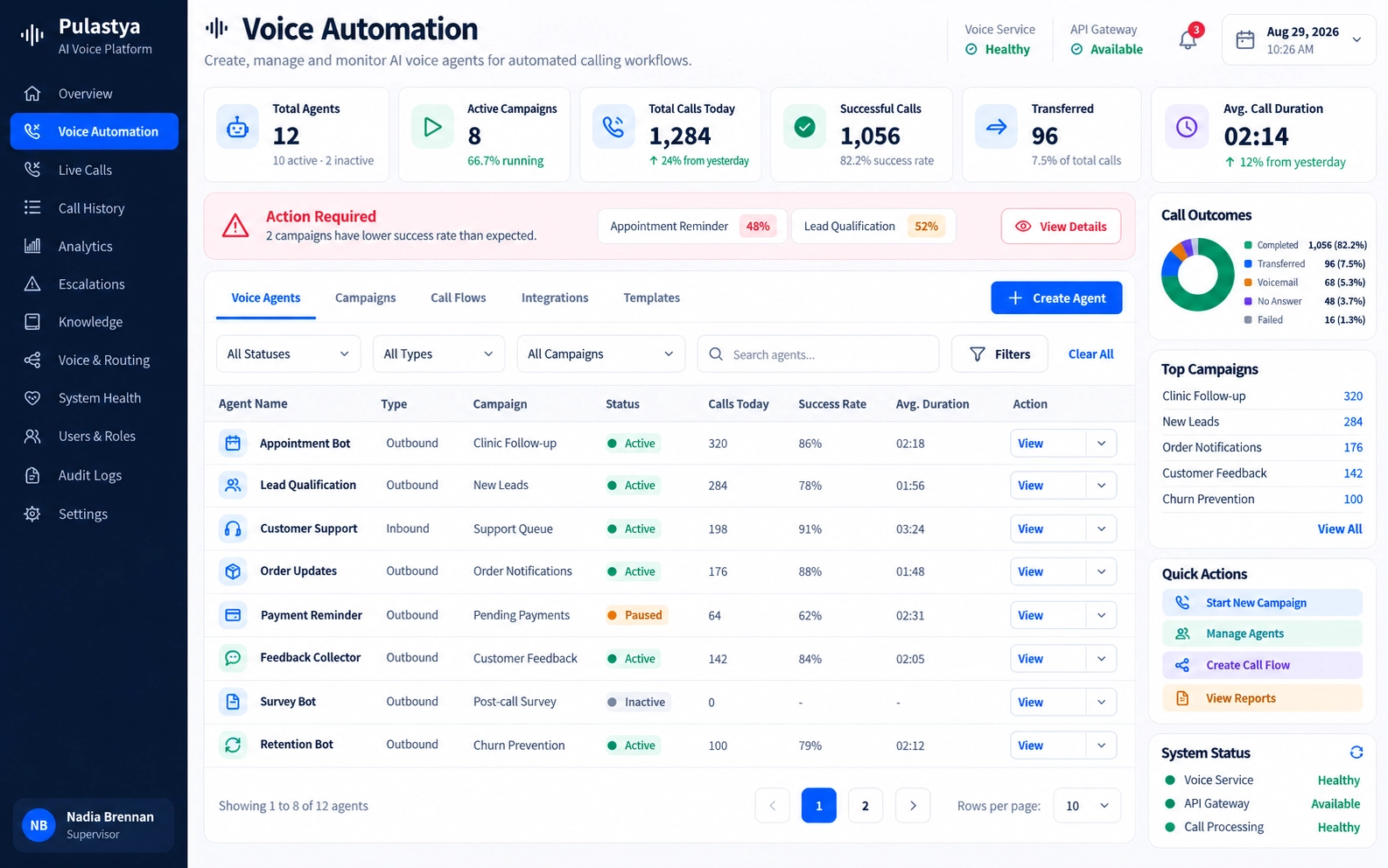
The record half of this is visible in the tooling. Pulastya, the SDLC Corp platform for inbound and outbound business calls, keeps transcripts, call summaries and a call dashboard, and attaches the conversation context and call summary to a warm transfer so the receiving person starts from what was already said.
Which systems can actually be written to is a procurement question, and the answer differs by platform; the layers underneath are mapped in the voice AI integrations ecosystem.
Where Automation Should Stop
Automation should stop where the cost of being wrong exceeds the cost of a person. That test beats a list of forbidden topics, because it scales with the action rather than the subject: the same account question can be safe to answer and unsafe to act on.
Four categories fail that test consistently. Write them down as a stop list before launch, with the replacement behavior named for each one, so the boundary is a configuration decision rather than an improvisation on a live call.
| Stop condition | What it looks like on a call | What the platform should do instead |
|---|---|---|
| Identity proofing | Changing bank details, resetting access, adding a person to an account | Move to an authenticated channel or a verified human agent |
| Irreversible without confirmation | Canceling a policy, dispatching an engineer, releasing a payment | Require explicit confirmation, or hand the action to a person |
| A wrong value that sounds right | A dosage, a part number, a meter reading, an amount off by a digit | Read back, then queue for human check instead of auto-committing |
| Judgment a regulator expects | A formal complaint, a safety report, a vulnerability disclosure | Route to a trained person and log the routing decision |
A fifth stop needs no analysis: the caller asks for a person, or is distressed, confused or angry. Qualifying loops at that moment make the outcome worse, so the transfer should happen immediately with the context already captured.
How a call leaves the routine flow and reaches a specialist is covered in handling sensitive calls with AI voice agents. The triggers, and the context a transfer should carry, are in when AI voice agents should transfer a call.
Fail closed on missing information. If an entitlement lookup times out, a consent attribute is unavailable or a confidence threshold is not met, the safe default is to treat the check as failed and route the call to a person, not to proceed on the assumption that the missing value would have been favorable.
The stop list also has an evidence requirement. Somebody will ask what the agent said, which rule applied and who approved the action, and logs answer that better than recollection. Those obligations sit in voice AI security and governance for enterprises.
Evaluating a platform against this shape means asking what it writes, where, under which rules, and what it refuses to do.
The voice automation platform from SDLC Corp answers that way: Pulastya grounds answers in documents the organization provides, says when it lacks context and offers a transfer instead of guessing, and allows a browser test call before a number goes live. To walk the routing settings and call dashboard first, book a guided walkthrough.
Conclusion
A voice automation platform delivers value when a conversation becomes a reliable action, not just a transcript. It must turn spoken requests into structured fields, verify them against live information, apply business rules, write to the system of record, and confirm only what actually succeeded. When a request cannot be completed safely, a clear review queue or informed human transfer is the right outcome.
Start with frequent, low-risk calls such as status enquiries and routine service requests. Define required fields, confidence thresholds, stop conditions, and fallback paths before launch. Then measure completed workflows, successful system updates, and exceptions alongside call volumes. The goal is not to automate every conversation; it is to reduce manual work while keeping accuracy, accountability, and human judgment where they matter.
Frequently Asked Questions
A voice AI agent handles the conversation: it listens, understands and speaks. A voice automation platform includes that agent but is judged on what happens in the systems behind the call. It extracts fields, validates them against live data, applies business rules, writes a record into the system that owns it, and confirms the outcome.
No. It feeds them. The ticketing system, CRM or scheduling tool stays the system of record and keeps its own schema and rules. Voice automation removes the manual step of a person listening to a call and retyping its content into that system.
The call needs a defined ending rather than an apology. Common patterns are queueing the request for a retry with an idempotency key, transferring to a person who can act, or committing to a callback. What matters is that the agent never confirms a record that was not created.
Rank call reasons by volume and by the cost of being wrong. Start with high-volume requests that are reversible and verifiable, such as status enquiries and routine service intake. Leave identity changes, irreversible actions and regulated conversations to people until the routine paths are stable.
Partly. Without integration the agent can still answer from approved content and capture a structured request with the details confirmed, which removes the second clarifying call. It cannot check live status, prevent duplicates or create the record, so the work still waits for a person.