
Telemedicine Software Development Company
SDLC Corp is a telemedicine software development company for healthcare providers and digital health teams. We connect video visits, patient and clinician apps, scheduling and supported EHR integrations around your care workflow.
Connected Virtual Care
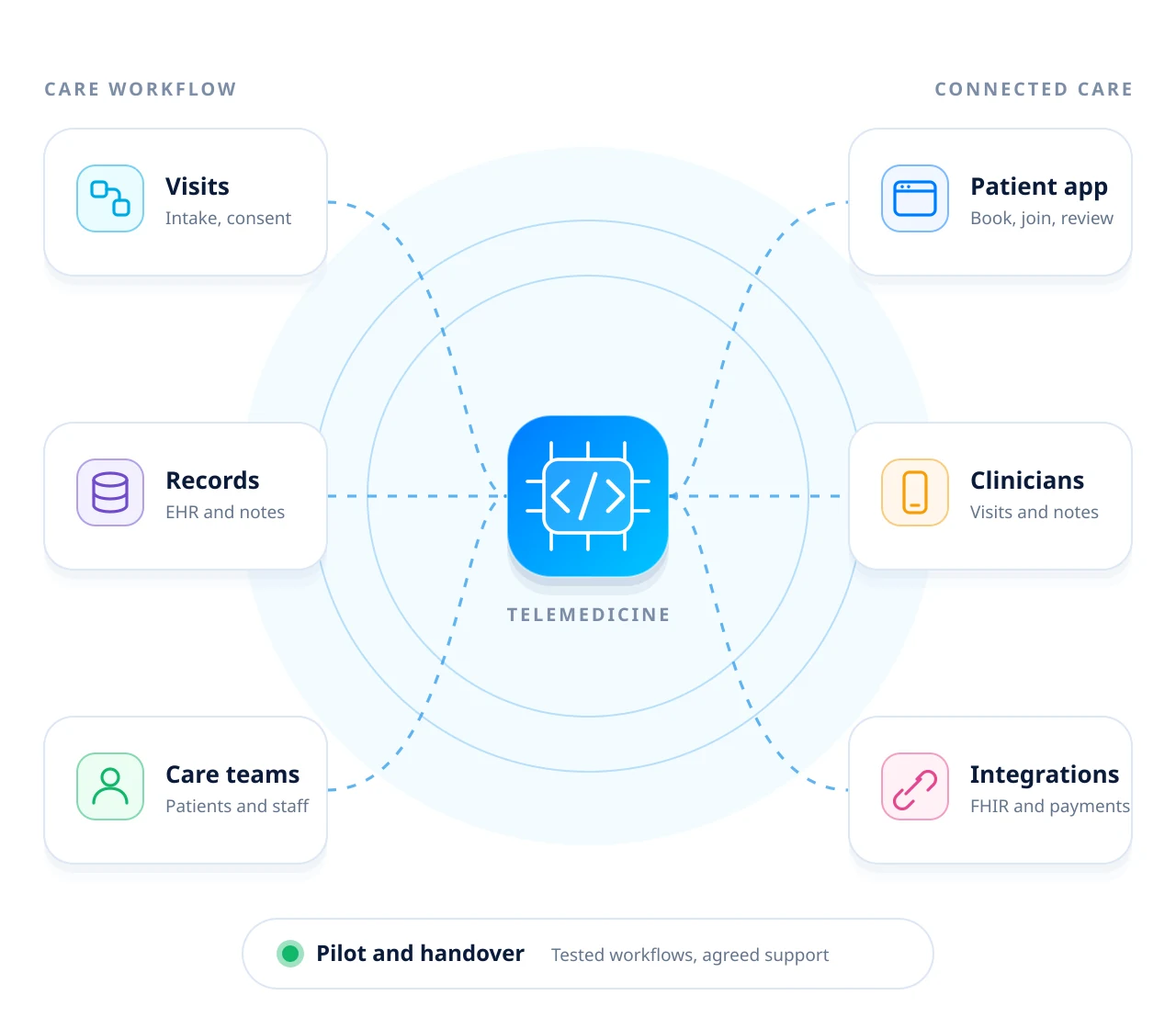
One Connected Virtual-Care Journey
Connect booking, consultation and follow-up so patients and care teams know what happens next.
Before the visit
Book & prepare
Patients book a visit, complete intake and consent, then check their camera and microphone. Eligibility checks follow your approved clinical and regional rules.
During the visit
Consult & document
Clinicians review the patient record, conduct the consultation and document the outcome. If the connection drops, the agreed reconnection or fallback workflow guides both users.
After the visit
Follow up & reconcile
Send approved notes, orders and follow-up tasks to the correct record. Staff can review failed updates, payment issues and missed appointments.
Telemedicine Software Development Services
Build a focused virtual-care module or a connected platform around your first-release priorities.
Platforms
Custom telemedicine platforms
Build patient, clinician and administrator experiences around your visit types, specialty workflows and access rules.
Explore care settings →Consultations
Live video consultation
Connect waiting rooms, video, audio and messaging. Include device checks, reconnection, captions and supported audio fallback.
See integration details →Store-and-forward
Asynchronous virtual care
Collect intake, attachments and secure messages for clinician review without a live call. Set review queues, response expectations and escalation routes.
Explore care settings →Mobile
Patient & Clinician Apps
Our telemedicine app development services cover booking, visit access, clinician tasks and notifications, with testing and release preparation for the selected platforms.
Review scope & pricing →Interoperability
EHR & Clinical Integrations
Connect records, notes, orders and results through supported HL7, FHIR or vendor APIs. Confirm vendor access and test mappings before implementation.
See integration details →Monitoring
Remote Patient Monitoring
Bring supported device readings into review queues. Clinicians set alert thresholds and response responsibilities; staff can track missing data and device status.
See integration details →Connected services
Prescribing, Labs & Payments
Connect supported prescribing, lab and payment services, with the credentials, approval steps and regional eligibility your care model requires.
Review security approach →Evolution
Modernisation & Support
Extend an existing product, migrate supported data or improve accessibility and weak-network performance. Agree maintenance and incident coverage before handover.
View delivery process →Telemedicine Integrations & Data Flow
Connect the visit to the systems responsible for patient identity, clinical records, communication and payments.
Identity & Consent
Map patient and clinician identities, permissions, consent records and care-team access. Confirm how duplicate records and changes in consent are handled.
EHR & Health Records
Use supported HL7 v2, FHIR R4, SMART on FHIR or vendor APIs where available. Validate patient matching, field mappings, write permissions, retries and reconciliation in a sandbox.
Video & Messaging
Define waiting-room access, session tokens, reconnection, chat retention and fallback behaviour. Review the communication vendor’s data handling and applicable agreements.
Prescriptions & Labs
Connect approved orders, prescriptions and results through supported providers. Clinical approval, eligibility and regional prescribing rules are set by your clinical and legal teams.
Devices & Monitoring
Check supported device protocols, timestamps, units, missing readings and data quality. Clinicians own thresholds and escalation rules; monitoring coverage is explicitly agreed.
Payments & Operations
Track bookings, payment status, refunds and follow-up tasks with stable transaction references. Surface exceptions so staff can reconcile incomplete visits or failed provider updates.
Security, Privacy & Clinical Boundaries
Protect patient information and define who owns clinical decisions, privacy requirements and incident response.
Access controls
Access & audit
Define least-privilege access, authentication, clinician and administrator roles, and audit trails for sensitive actions. Test access across users and care settings.
Data handling
Data & vendor agreements
Map where protected information is processed and retained. Review applicable business associate and data-processing agreements with the relevant vendors before live use.
Patient privacy
Consent & retention
Specify consent capture, withdrawal, attachments, recording policy, retention and deletion. Recording is a separate decision, not a default feature of every visit.
Human oversight
Clinical decisions
Clinicians approve care decisions, prescribing and escalation rules. Software permissions and review steps reflect those responsibilities.
Usability
Accessible care
Test booking, intake, visit entry, captions, keyboard navigation and screen-reader flows with representative users and assistive technology.
Operations
Continuity & recovery
Plan backups, restoration checks, incident ownership, communication-provider outages and downtime procedures. Emergency and urgent-care routes follow your organisation’s approved protocols.
From Care Workflow to Pilot Launch
Review working software and acceptance evidence at each stage, then expand from an agreed pilot.
- 01
Discover & scope
Map users, visit types, current systems, clinical responsibilities and first-release priorities. Compare a custom build with extending or configuring an existing product.
Deliverables: Workflow map, scope, dependencies and acceptance criteria.
- 02
Design the platform
Agree identity, consent, data flows, hosting, vendor interfaces and applicable privacy requirements. Identify access and procurement dependencies early.
Deliverables: Architecture, data map and security responsibilities.
- 03
Validate the experience
Prototype patient, clinician and administrator journeys. Check visit preparation, accessibility, error messages and recovery from interruptions before development.
Deliverables: Reviewed prototype and usability findings.
- 04
Build & integrate
Deliver in two-week sprints with working builds and demonstrations. Connect available vendor sandboxes and document interface behaviour and exceptions.
Deliverables: Working increments and documented integrations.
- 05
Test & rehearse
Test scheduling, consent, video interruptions, record matching, failed writes, payments and recovery. Review security, load and accessibility against agreed acceptance criteria.
Deliverables: Test findings, reconciled data and release acceptance.
- 06
Pilot & hand over
Pilot with an agreed care team, train users and monitor issues before wider rollout. Confirm source-code access, documentation, support ownership and coverage.
Deliverables: Pilot review, training, handover and support plan.
Related Healthcare Projects
Related delivery experience in caregiver apps, clinic operations and accessible patient journeys.
JooL Caregiver Support App
A US-market Android and iOS app connecting carers, care buddies and care recipients through profiles, care circles, communication, scheduling and daily care records. The MVP launched in November 2022 after nine months of delivery.
- 7,500 registered usersDecember 2022–March 2023 dashboard and operational reports recorded 2,000 active users. Active means a login within the previous 30 days.

Dental Care Centre ERP
Patient records, appointments, billing, doctor schedules and reporting were connected with website bookings in one clinic ERP. The project covered eight custom modules and 16 months of delivery.
- About 15 to 5 hours per weekWeekly front-desk administration, measured in the first two months after launch using Google Analytics and ERP dashboard reporting.
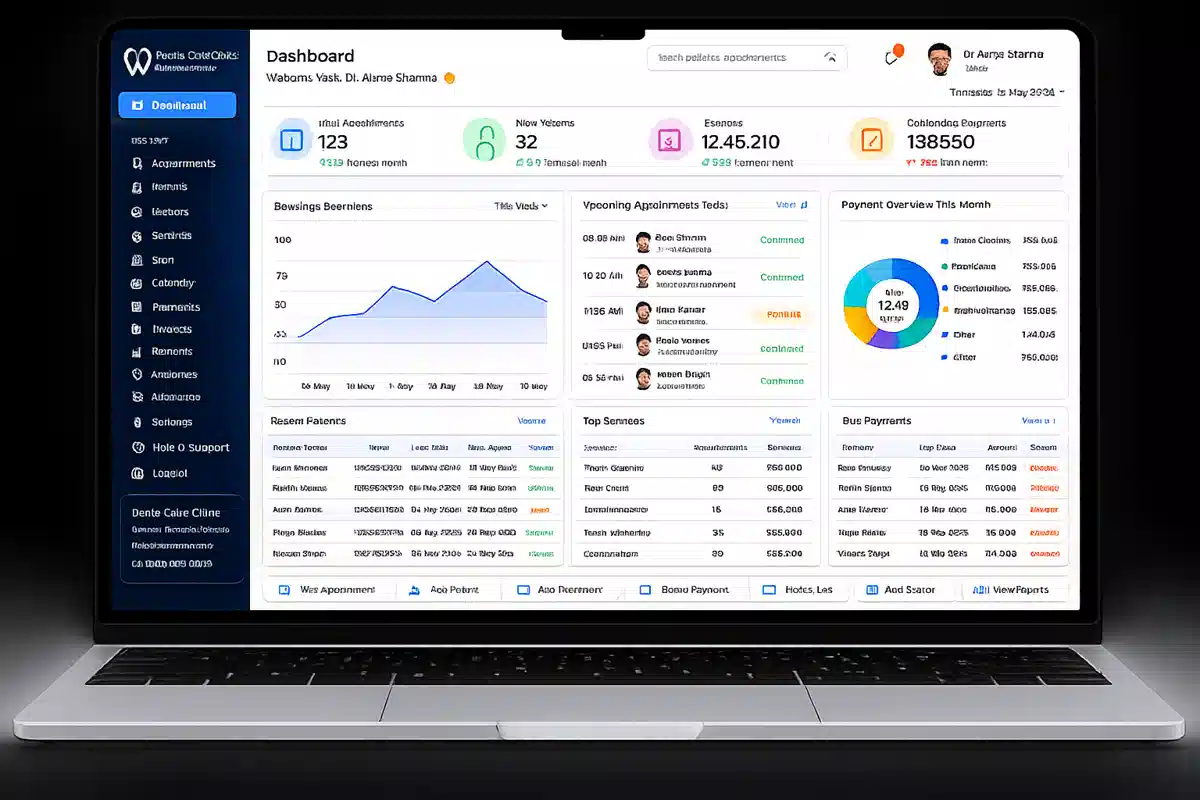
Healthcare Patient-Journey Testing
Accessibility testing covered a healthcare network’s websites, patient portal, apps and documents. The patient journeys included booking, intake, payment and starting a telehealth visit.
- 12 of 12 journeys passingPassed keyboard and screen-reader checks, including telehealth entry. Scope: accessibility testing and reporting.
- 12 journeysBooking, forms, results, payments and telehealth entry
- Manual testingKeyboard and screen-reader checks
- WCAG 2.2 AAAccessibility testing scope
Clinical Software Client Feedback
Feedback from the Dental Care Centre software project.
What impressed us most about SDLC Corp was their ability to understand our clinical requirements.
Telemedicine for Your Care Model
Adapt visit types, permissions and follow-up around the service your clinical team provides.
Connected providers
Hospitals & health systems
Connect virtual visits, specialty consultations and post-discharge follow-up with supported health-record systems and site-level access.
Outpatient care
Clinics & specialty practices
Combine booking, intake, live or asynchronous reviews, consultation notes and follow-up tasks for the approved specialty workflow.
Privacy-sensitive care
Behavioural health
Scope private consultations, group sessions, scheduling and restricted notes. Clinical teams define suitability, escalation and urgent-support routes.
Care beyond the clinic
Home care & monitoring
Connect caregiver participation and supported remote readings with review queues. Define consent, missing-data handling and who responds to alerts.
Product development
Digital health products
Validate the first care journey, clinical responsibilities and operating model before expanding into more services, regions or integrations.
Follow-up services
Pharmacy & lab follow-up
Connect approved prescriptions, orders and results with the consultation workflow where vendor access and regional rules permit.
Choose Your Delivery Model
Choose a delivery model around your scope, roadmap and internal capacity.
Defined release
Fixed-scope project
Agree requirements, deliverables, acceptance criteria, price and milestones before development. Changes follow an agreed review process.
Ongoing product
Dedicated team
Assign design, engineering, QA and delivery roles around a prioritised platform roadmap. Capacity and responsibilities are agreed for the engagement.
Additional capacity
Team extension
Add web, mobile, integration or QA specialists to your existing team, working within your tools, code review and release process.
The telehealth stack we build with
Select tools around your existing systems, data requirements and operating scale. Applicable security controls follow the HIPAA Security Rule from HHS.
| Area | Tools | Where it fits |
|---|---|---|
| Video and messaging | WebRTC, Twilio Video, Vonage, Agora, Amazon Chime SDK, Stream | Live visits, group sessions, interpreter joins and secure chat, tested on weak mobile networks |
| Interoperability | HL7 v2, FHIR R4, SMART on FHIR, CDA, DICOM, X12 | Reading from and writing to EHR, lab and imaging systems, tested against a sandbox first |
| Security and privacy | TLS, AES-256 at rest, MFA, role-based access, audit logs | Every app that stores or sends protected health information |
| Web and mobile apps | React, Next.js, React Native, Flutter, Swift, Kotlin; Node.js, NestJS, Python, Java, .NET, PostgreSQL | Patient, provider and admin apps that share one back end |
| Devices and RPM | Bluetooth LE, Apple HealthKit, Health Connect, MQTT, IoT gateways | Chronic care, post-op follow-up and home care, with alert rules set with clinicians |
| Cloud and DevOps | AWS, Azure, Google Cloud, Docker, Kubernetes, Terraform | HIPAA-eligible cloud services, infrastructure as code and automated backups |
| Testing and access | Playwright, Appium, axe, load tests, WCAG 2.2 AA | End-to-end tests of booking, visit and payment flows, plus screen reader and keyboard checks |
What affects telemedicine software cost
These six factors shape development effort and ongoing operating costs.
01
Visit types and user roles
More visit types, user roles and screens increase design, development and testing effort.
02
Video and messaging
Group visits, interpreters, recording and live captions add complexity beyond a basic one-to-one call.
03
Integrations
Each EHR, lab, pharmacy, payment or insurance link adds build and test work.
04
Compliance scope
HIPAA, GDPR and local data rules shape hosting, logging, consent and testing.
05
Devices and monitoring
Remote monitoring adds device links, data cleaning, alert rules and dashboards.
06
Platforms and support
Budget for the selected web and mobile platforms, hosting, vendor usage and support after launch.
Your proposal identifies supported integrations, data handling, weak-network testing, ownership and handover responsibilities.
Telemedicine Software Cost & Scope
Indicative prices for telemedicine platforms, modules, integrations and ongoing support. Initial scoping and a proposal are free.
Custom telemedicine platform
A defined first release covering patient and provider web workflows, administration, scheduling and agreed consultation functionality.
- Indicative price · USD
- $50,000
- Mobile apps and integrations scoped separately
Video consultation module
Waiting room, consultation permissions, video, audio, messaging, reconnection and testing using a third-party video provider.
- Indicative price · USD
- $30,000
- Communication vendor usage priced separately
Asynchronous consultation module
Specialty intake, attachments, clinician review queues, secure messaging and escalation for consultations without a live call.
- Indicative price · USD
- $40,000
- Review and escalation workflows agreed in scope
Patient and clinician apps
Both patient and clinician apps on iOS and Android, with defined screens, booking, visit access, clinician tasks and notifications.
- Indicative price · USD
- $40,000
- Screen list and backend interface agreed before development
EHR/EMR integration
A defined connection using an available, documented EHR or EMR interface, agreed mappings and integration testing.
- Indicative price · USD
- $2,000 per connection
- Complex mappings, vendor certification and migration quoted separately
RPM device-data integration
Limited device-data integration into an existing platform using a supported, documented device API and agreed data fields.
- Indicative price · USD
- $1,000
- Hardware excluded; a complete custom RPM system is quoted separately
Prescribing, lab and payment integrations
One supported prescribing, laboratory or payment-provider connection with defined transactions and integration testing.
- Indicative price · USD
- $2,000 per connection
- Vendor onboarding and usage fees quoted separately
Patient portal and scheduling
Defined booking, intake, consent and messaging workflows connected to an agreed backend.
- Indicative price · USD
- $10,000
- Portal features agreed in scope
Modernisation assessment
Code and security review, architecture assessment, integration inventory, migration strategy and a prioritised, costed remediation roadmap.
- Indicative price · USD
- $50,000
- Comprehensive existing-platform assessment; remediation implementation quoted separately
Maintenance and support
160 hours of allocated engineering capacity per month for agreed fixes, patching, monitoring or enhancements.
- Indicative price · USD
- $3,000/month
- Monday–Friday, eight-hour window in an agreed time zone; response targets below
Discovery and delivery plan
Requirements, workflow map, architecture outline, prioritised backlog and delivery estimate. Software development is excluded.
- Indicative price · USD
- $5,000
- Optional planning engagement
Support coverage and initial response targets
Monday–Friday, eight-hour coverage window in an agreed time zone. The 160 hours are monthly engineering capacity; availability follows the agreed coverage window.
| Request | Initial response target |
|---|---|
| Critical production outage | Within one covered hour |
| Major functional issue | Within four covered hours |
| Minor issue | Within one business day |
| Enhancement request | Triage within two business days |
These are initial response targets. Resolution is estimated after investigation. After-hours coverage is priced separately. The service agreement confirms coverage, escalation and service terms. Software support does not include clinical monitoring or emergency response.
Prices are indicative and in USD. Modules and integrations are not automatically included in the platform or app price. Your proposal confirms features, platforms, supported devices, deliverables and schedule. Taxes and third-party fees are excluded unless agreed.
Telemedicine Software Development FAQs
Answers about scope, costs, integrations, patient access, ownership and support.
A telemedicine software development company designs, builds and supports virtual-care software. The scope can include video visits, patient and clinician apps, scheduling, EHR integrations and remote monitoring, depending on your care model.
Choose an existing platform when it meets your visit, data and integration needs. Custom telemedicine software development suits workflows or product requirements that standard tools cannot support. We can also extend an existing platform. Compare licences, migration, ownership and operating costs before deciding.
Our telemedicine app development services cover patient and clinician journeys, supported integrations, testing and release preparation. The $40,000 indicative app offer covers both patient and clinician apps on iOS and Android. Backend services and third-party costs are included only as specified in your proposal.
We first check vendor interfaces and access rights. Where supported, we use HL7 v2, FHIR R4, SMART on FHIR or vendor APIs. Sandbox tests cover patient matching, mappings, failed updates and reconciliation. Vendor fees and approvals may be separate dependencies.
We define access, encryption, audit, retention and hosting controls for your use case. HIPAA responsibilities also depend on organisational practices and vendor agreements. Business associate and data-processing requirements are reviewed before using live patient data, alongside your clinical and legal review.
Delivery time depends on workflows, platforms, integrations, data readiness and vendor access. After reviewing these dependencies, your proposal confirms phased milestones and acceptance criteria.
Indicative prices are $50,000 for a custom platform, $30,000 for a video module, $40,000 for an asynchronous module or patient and clinician apps, and $10,000 for a patient portal. Integrations are $2,000 per connection. The pricing section lists remote monitoring, assessment and support offers. Final scope is confirmed in your proposal.
We test reconnection, device permissions, notifications and supported audio fallback on weak networks. Your clinical team defines when an interrupted visit must be rescheduled or escalated. Connection quality still depends on the device, network and communication provider.
The $1,000 indicative offer covers a limited device-data integration into an existing platform using a supported, documented API and agreed data fields. Hardware and a complete custom RPM system are excluded. Your clinical team sets alert thresholds and review responsibilities. Missing readings and device status remain visible. Continuous clinical monitoring or emergency response requires explicit agreement with the care provider.
We configure consent, caregiver or guardian permissions, recording policy and withdrawal handling for each journey. Your clinical and legal teams approve patient-location, clinician-eligibility and prescribing rules for each operating region.
We test booking, intake and visit entry with keyboard navigation, screen readers, captions and representative devices. Load testing uses agreed concurrency and vendor limits. You review findings and release acceptance before expanding the pilot.
We assess exports, permissions and data quality, then test sample migrations. Before release, we agree reconciliation, cutover, staff training, rollback and acceptable downtime. Vendor export restrictions are checked during scoping.
You own the custom source code and design files; cloud accounts stay in your name. Third-party licences retain their own terms. Handover includes release access and documentation. Maintenance and support is $3,000 per month for 160 hours of allocated engineering capacity. Support operates Monday–Friday in an agreed eight-hour window and time zone. An NDA can be signed before detailed discovery.
Maintenance and support costs $3,000 per month for 160 hours of allocated engineering capacity. Coverage is Monday–Friday in an agreed eight-hour window and time zone. Initial response targets during covered hours are one hour for a critical production outage, four hours for a major functional issue, one business day for a minor issue and two business days for an enhancement request. Resolution is estimated after investigation. After-hours coverage is priced separately.
No. Your care provider defines urgent-care routing, patient notices and escalation arrangements. Emergency capability or continuous clinical monitoring requires a separate, explicit service and operating scope.
- Contact Us
Let’s Talk About Your Project
What happens next?
- We review your requirements
- Strategy call with experts
- Clear roadmap & estimate
- NDA Protected
- Enterprise Grade Delivery
- Global Clients