

iGaming affiliate software helps casino and sportsbook operators manage affiliate tracking, commission rules, fraud checks, payout approvals, and performance reporting from one connected workflow. It gives teams a clearer way to track clicks, registrations, first deposits, player value, affiliate commissions, and payout activity without depending on disconnected tools.
Most vendors can demo those capabilities. Far fewer make them work cleanly once the affiliate program is live, deal structures get more complex, traffic quality changes, and finance needs a reporting trail it can actually trust.
Tracking gaps can turn into payout disputes. Build affiliate software with clearer tracking, commissions, fraud checks, and reporting.
Discuss Affiliate Software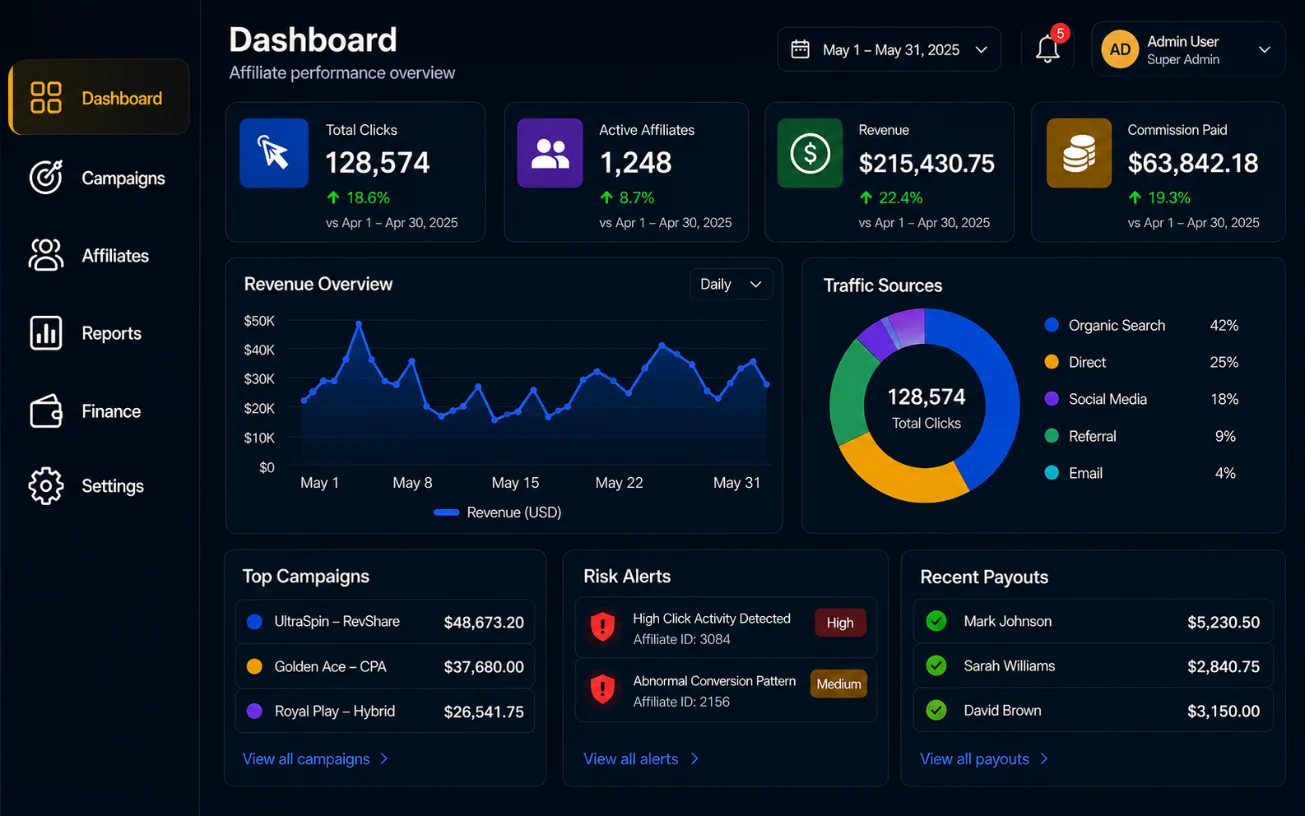
Key Takeaways
- Full affiliate journey tracking: Track clicks, registrations, first deposits, commissions, fraud signals, payouts, and reporting from one workflow.
- Operator-ready evaluation: Test attribution accuracy, commission logic, payout control, and finance-ready reporting before choosing a platform.
- Generic tools are risky: Basic affiliate tools often fail with CPA, RevShare, hybrid deals, NGR reporting, fraud review, and multi-brand visibility.
- Connected iGaming stack: Strong affiliate software should connect with CRM, wallet, KYC, payments, reporting, and back-office systems.
- Custom operator control: SDLC Corp helps operators build affiliate software workflows for tracking, commissions, fraud checks, payouts, and reporting.
Why Casino and Sportsbook Operators Need iGaming Affiliate Management Software
Casino and sportsbook operators do not need affiliate software only to track clicks. They need a system that connects affiliate traffic, registrations, first deposits, commission rules, fraud signals, payout approvals, and reporting into one reliable workflow.
Without that control, affiliate programs quickly create operational pressure. Teams start dealing with missing attribution, commission disputes, low-quality traffic, manual payout checks, and reporting mismatches between affiliate, finance, and leadership teams.
This is why iGaming affiliate management software should be evaluated as part of the wider operating stack. For teams building affiliate capability inside a broader platform decision, that often overlaps with choices around iGaming software development.
Which Affiliate Management Software Features Separate a Reliable Platform From a Risky One?
The fastest way to judge an affiliate management software vendor is to compare what strong software enables against what weak software tends to hide.
| Area | What strong software should offer | What weak software usually looks like |
|---|---|---|
| Attribution tracking | Clean click-to-deposit tracking across channels and partners | Numbers that drift across sources and become hard to defend internally |
| Commission management | CPA, RevShare, hybrid, tiered, and custom logic without spreadsheet patchwork | Standard deals work, but edge cases force manual fixes |
| Fraud and traffic quality | Early visibility into duplicates, self-referrals, suspicious activity, and low-value traffic | Broad fraud language with limited operational detail |
| Reporting | Partner, commission, and payout reporting that affiliate, finance, and leadership teams can all use | Dashboards look polished but become shallow during validation |
| Payout governance | Approval flows, review controls, and audit visibility before release | Payouts depend too heavily on manual checks |
| Integrations | Clean connection with CRM, reporting systems, player data, and the wider stack | The platform works in isolation and creates more work elsewhere |
What Should Operators Compare in Affiliate Management Software Vendors?
Most vendor sites highlight features. Fewer make it easy to compare how those features affect daily execution. This is where buyers should focus.
- Attribution confidence: Can the vendor explain how registrations, deposits, and postbacks stay consistent across affiliate views and internal systems?
- Commission flexibility: Can it support hybrid deals, tiering, exceptions, retroactive changes, and partner-specific rules without manual cleanup?
- Fraud and traffic-quality visibility: Does it surface suspicious activity before commission release or mostly after the fact?
- Finance-side usability: Can finance review, approve, and audit payouts without outside spreadsheets?
- Integration reality: Does the product fit the wider stack or create more reconciliation work after launch?
- Operational transparency: Is pricing quote-led, public, modular, or hidden until late in the process? Are rollout timelines public or only discussed in sales calls?
A useful affiliate platform should reduce reconciliation pressure, give finance cleaner payout validation, and make partner performance easier to defend internally. If the workflow still depends on exports, manual checks, and conflicting numbers, the software is not giving the operator enough control.
Why Operators Shortlist SDLC Corp for Custom iGaming Affiliate Software
For operators that want more than a stand-alone affiliate dashboard, SDLC Corp helps build affiliate software workflows inside a broader operator-controlled iGaming environment.
That means affiliate tracking, commission rules, fraud checks, payout approvals, reporting, payments, KYC, and back-office workflows can work together instead of sitting in separate systems.
After acquiring players through affiliates, operators can use CRM software for iGaming operators to improve player retention, segmentation, and lifecycle marketing.
Top Key Features
- Custom affiliate tracking: built for casino, sportsbook, poker, lottery, and sweepstakes operators that need cleaner visibility across clicks, registrations, first deposits, and player value.
- Flexible commission logic: supports CPA, RevShare, hybrid, tiered, and partner-specific commission workflows based on the operator’s commercial model.
- Connected payout control: helps finance teams review commissions, approve payouts, track payment status, and reduce manual spreadsheet checks.
- Fraud review workflows: supports checks for duplicate accounts, self-referrals, suspicious traffic, bonus abuse, and low-quality player activity before payout release.
- Broader iGaming alignment: useful when affiliate workflows need to connect with online casino software, white-label casino solution, or a full turnkey casino solution.
Pricing
- The service starts at $1,999/month.
- Final scope can vary based on integrations, reporting depth, commission complexity, support model, fraud controls, and wider platform requirements.

Which Affiliate Management Software Vendors Deserve a Place on a Serious Operator Shortlist?
This is a practical shortlist for operators comparing affiliate software on usability, control, and long-term fit, not a claim about overall market leadership.
| Provider | Best suited for | Starting price / commercial model | Where it stands out most | |
|---|---|---|---|---|
| 1 | SDLC Corp | Operators that want affiliate capability inside a broader custom or white-label iGaming stack | Starts at $1,999/month Final scope depends on integrations, reporting depth, commission logic, support model, and wider platform requirements. | Best suited for operators that want affiliate workflows tied closely to back-office reporting, payments, KYC, and wider platform control instead of using a stand-alone affiliate layer. |
| 2 | Affilka | Operators looking for an iGaming-focused affiliate platform with strong campaign tracking and payout tooling | Approx. $2,940/month Converted from listed €2,500/month. Setup fee listed as none. | Public positioning leans on built-in payment processing, in-depth reports, a flexible commission constructor, and detailed affiliate management for casino and sportsbook programs. |
| 3 | MyAffiliates | Higher-volume or more complex affiliate teams that need flexibility and reporting depth | Custom monthly subscription Commercial terms may vary by setup, traffic scale, support needs, and contract scope. | Strong on close-to-real-time reporting, custom commission structures, multi-tier and multi-channel tracking, plus clearer public pricing structure than many competitors. |
| 4 | Income Access | Operators that value broader affiliate program support alongside tracking and reward management | Approx. $2,700/month or 1 to 4% of GGR Converted from listed £2,000/month. Setup fee is approx. $6,080 if based on £4,500. | Stands out for customer-journey analysis, payments and commissions, campaign management, and configuration options for branding, language, and market-specific needs. |
| 5 | NetRefer | Operators that want an established iGaming affiliate platform with stronger data and tooling depth | Approx. $1,880/month Converted from listed €1,600/month. Setup fee is approx. $880 if based on €750. | Different from others through its AI-led positioning, BI/report builder, enhanced tracking, and long specialization in iGaming platform workflows since 2005. |
This shortlist is intended as a practical comparison for operators reviewing different affiliate software options based on workflow fit, control, pricing visibility, and operational priorities. Pricing is shown in approximate USD where public figures were listed in another currency. Final pricing can vary by setup, agreement, integrations, traffic model, and support needs.
iGaming Affiliate Software vs Generic Affiliate Tracking Software
Generic affiliate tracking software may work for simple lead generation or eCommerce sales, but casino and sportsbook operators need deeper control. iGaming affiliate software has to track player registrations, first deposits, player value, commission rules, fraud signals, payout approvals, and reporting across the full operator workflow.
| Area | Generic affiliate tracking software | iGaming affiliate software |
|---|---|---|
| Conversion tracking | Tracks a simple sale, signup, or lead event | Tracks clicks, registrations, first deposits, deposits, player activity, and revenue events |
| Revenue model | Works around fixed sale value or basic lead value | Supports GGR, NGR, deposits, bonuses, fees, chargebacks, and player value reporting |
| Commission logic | Usually supports simple CPA or percentage-based commission | Supports CPA, RevShare, hybrid deals, tiered commissions, custom rules, and negative carryover |
| Fraud checks | Focuses mainly on duplicate clicks, suspicious leads, or basic IP checks | Helps review duplicate accounts, self-referrals, bonus abuse, suspicious traffic, and low-value player patterns |
| Payout workflow | Often depends on exports, manual checks, or basic payout reports | Supports payout approval, finance review, holdback rules, commission status, and audit visibility |
| Compliance control | Usually limited to basic disclosure or campaign notes | Can support responsible gambling checks, creative approval, market rules, GEO controls, and affiliate records |
| Integration depth | Connects mostly with websites, CRM tools, or marketing platforms | Connects with PAM, PSP, CRM, KYC, wallet, BI, reporting, and back-office systems |
| Reporting use | Useful mainly for marketing teams | Useful for affiliate, finance, compliance, risk, and leadership teams |
This is why operators should not compare affiliate software only by price or dashboard design. The real value comes from workflow control, accurate data, cleaner payout validation, and fewer manual fixes across the affiliate program.
Where Do Operators Usually Choose the Wrong Platform?
Most wrong decisions begin with the wrong evaluation lens.
1. They overvalue the demo
A clean interface is useful. It is not proof of reporting depth, payout reliability, or commission flexibility. Many platforms look smooth until the first time finance needs to validate partner payments at month end.
2. They let affiliate teams evaluate in isolation
Affiliate software affects commercial teams, finance teams, and leadership reporting. If those users are brought in too late, the platform usually creates friction that could have been caught in evaluation.
3. They treat fraud as a secondary issue
That is risky. If traffic-quality controls are weak, the operator usually feels it later through wasted payouts, harder validation, and lower confidence in acquisition quality.
4. They compare feature lists instead of operating behavior
Every vendor can say it supports reporting, commissions, fraud tools, and integrations. The sharper question is what happens when the program grows, more brands are added, or partner deals stop being standard.
What Questions Expose Weak Vendors Early?
Use the demo to force specificity.
How is attribution validated across systems?
Ask how clicks, registrations, deposits, and conversion events remain consistent across the affiliate view, operator reporting, and finance-side validation.
How does the commission engine handle edge cases?
Do not stop at simple CPA or RevShare. Ask about hybrid deals, tiering, retroactive rule changes, exceptions, and partner-level overrides.
What can the platform actually show on traffic quality?
Ask how it surfaces duplicate accounts, self-referrals, suspicious patterns, and low-value partner activity before payment release.
Can finance approve payouts without external spreadsheets?
This question exposes weak back-office design quickly. If the answer gets vague, the operator is probably inheriting more manual work than the vendor wants to admit.
What changes when the program scales?
Ask what happens when partner volume rises, more brands are added, or more internal users need reporting and approval access.
How Should Operators Judge Affiliate Management Software Platform Fit?
A platform can be technically capable and still be the wrong fit. Operators should judge fit based on workflow, commercial complexity, reporting needs, and ownership expectations rather than demo polish alone.
Affiliate Management Platform Operating Model
A casino-only operator may need something different from a business running both casino and sportsbook products. Product mix changes reporting, partner behavior, and internal workflow. That is also where a wider sports betting app development company decision can start overlapping with affiliate tooling.
Affiliate Software Commercial Complexity
Some programs stay relatively simple. Others move into hybrid deals, tiered structures, and partner-specific exceptions. The platform should match the operator’s real commercial logic, not only the vendor’s easiest demo path.
Affiliate Workflow Pressure
As more teams rely on affiliate data, ambiguity becomes more expensive. Affiliate managers, finance users, and leadership stakeholders should not be working from different versions of the truth.
Affiliate Platform Ownership Expectations
Buyer expectations also vary. Some teams want a fixed SaaS workflow and fast activation, while others want deeper control, broader platform ownership, or affiliate capability inside a larger custom iGaming stack. That choice should be made deliberately, not accidentally.
Let’s review your affiliate workflow and platform fit
If you are comparing tools, dealing with reporting mismatches, or trying to improve attribution and payout control, send your requirements through our contact form.
Our team can review your setup and help you identify the gaps that matter most.
Final Thoughts
Ultimately, the best iGaming affiliate software is the one that stays usable when the work gets harder, when commissions get more complex, when finance needs cleaner approval logic, and when reporting has to stand up to real scrutiny.
Operators rarely regret choosing more control. They often regret choosing more presentation.
FAQs
1. What should iGaming operators look for in affiliate management software?
They should look for accurate attribution, flexible commission logic, fraud visibility, finance-ready reporting, payout governance, and integration fit with the wider operating stack.
2. Which affiliate management vendors are most visible in the market?
Commonly discussed names include SDLC Corp, Affilka, MyAffiliates, Income Access, and NetRefer in the context of operator evaluation, though they differ in product depth, service model, and broader stack fit.
3. Why is attribution accuracy so important?
Because weak attribution creates disputes, weakens partner trust, and makes commission validation harder across teams.
4. Why should finance be involved in vendor evaluation?
Because finance needs to validate commission logic, payout approvals, and audit trails before money is released.
5. Is public pricing common in this category?
No. Many vendors push buyers toward demos, contact forms, or quote-led scoping before exposing full commercial detail.
6. How much does affiliate management software cost?
Pricing depends on the vendor, integrations, reporting depth, commission complexity, support model, and wider platform requirements. Some providers use quote-led pricing, while broader custom setups can start from a monthly service model.
7. Should operators choose based on demo quality alone?
No. Demo quality matters, but it does not prove reporting depth, payout control, or finance-side usability once the program is live.