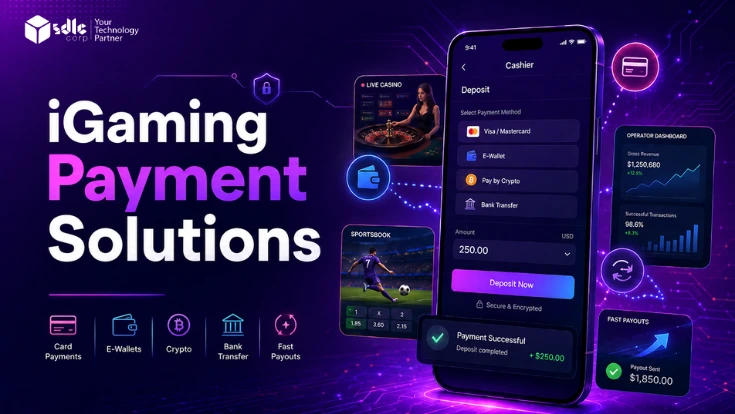
A strong payment experience helps iGaming platforms turn player intent into real revenue. When deposits, withdrawals, local payment methods, crypto payments, fraud checks, and payment status updates work smoothly, the platform creates confidence from the first transaction.
That is why modern iGaming Payment Solutions need to do more than process payments. They should connect the cashier, wallets, payouts, routing, risk checks, crypto flows, and reporting into one payment layer that supports smoother player journeys and scalable growth. For operators planning the wider platform stack, this payment layer should also connect cleanly with iGaming software development decisions from the start.
Key Takeaways
- Connected payment layer: Manage deposits, payouts, PSP routing, wallets, fraud checks, KYC, AML, and reporting from one workflow.
- Deposit recovery matters: Failed deposits waste acquisition spend before players reach gameplay.
- Faster payouts build trust: Faster payouts improve player confidence and reduce support pressure.
- Multi-PSP routing protects valid payments: Valid deposits get another path when one provider declines or fails.
- Crypto needs clear controls: Stablecoin and crypto flows need network selection, wallet tracking, AML checks, settlement visibility, and payout rules.
- Local payment methods drive conversion: Players trust different payment rails by region, so coverage should match market behavior.
Why iGaming Deposits Fail and How to Reduce Declined Deposits
Most operators notice the payment problem first when deposits do not go through. A player reaches the cashier, tries to pay, and leaves after one failed attempt. The cause may be weak routing, an underperforming PSP, bank decline, PSP downtime, KYC interruption, crypto network confusion, or no retry option.
That first failed payment can carry a bigger cost than it seems. Raconteur, citing BridgerPay research, reported that 62% of customers who experience payment failure during a transaction will not return to it or the business. For iGaming platforms, that means a failed deposit can waste acquisition spend before the player even reaches gameplay.
| Payment Problem | Business Impact |
|---|---|
| Failed deposits | Lost player intent and wasted acquisition spend |
| Slow payouts | Lower trust and fewer repeat deposits |
| Chargebacks | Direct loss, extra fees, and higher provider risk |
| Manual approvals | Delayed withdrawals and more support pressure |
| Missing local methods | Cashier drop-off in target markets |
How SDLC Corp Builds iGaming Payment Solutions for Gaming Platforms
SDLC Corp helps gaming platforms build payment systems that connect deposits, payouts, wallets, PSPs, fraud checks, KYC, AML, crypto, reporting, and reconciliation. For licensed casino operators, the same payment layer should support the wider online casino software environment instead of sitting as a disconnected gateway.
For regulated gambling markets, this also means designing payment flows around practical compliance needs such as PSD2, PCI DSS, GDPR, 3DS / 3D Secure, acquirer rules, merchant-of-record ownership, and market requirements linked to MGA, UKGC, Gibraltar, and Curaçao (Curacao) licensing.
The goal is simple. Payments should support the player journey, reduce operational gaps, and give teams better control over money movement.
Along with secure payment systems, operators can use iGaming CRM software to manage player communication, retention campaigns, and transaction-based engagement.
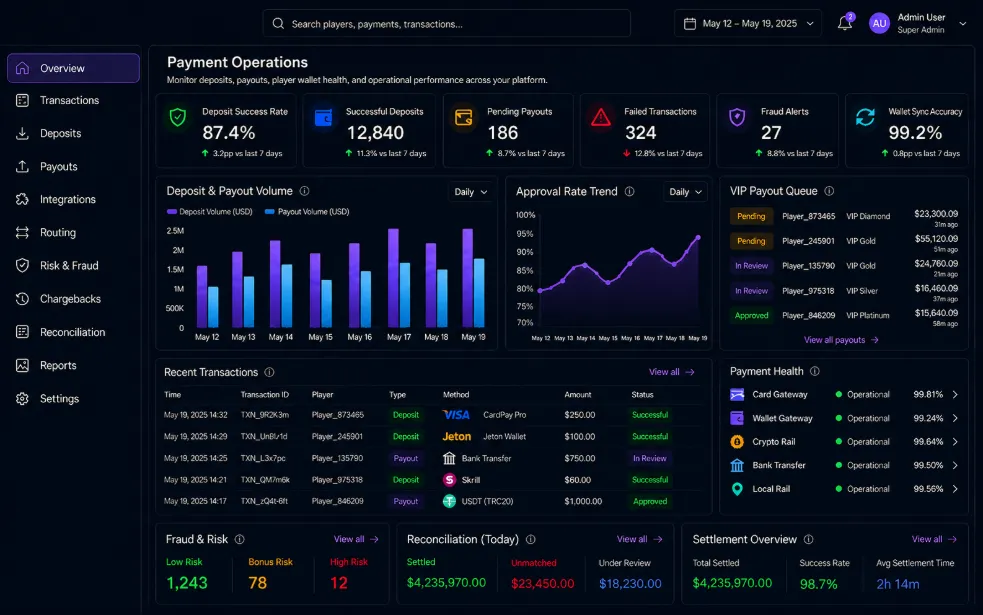
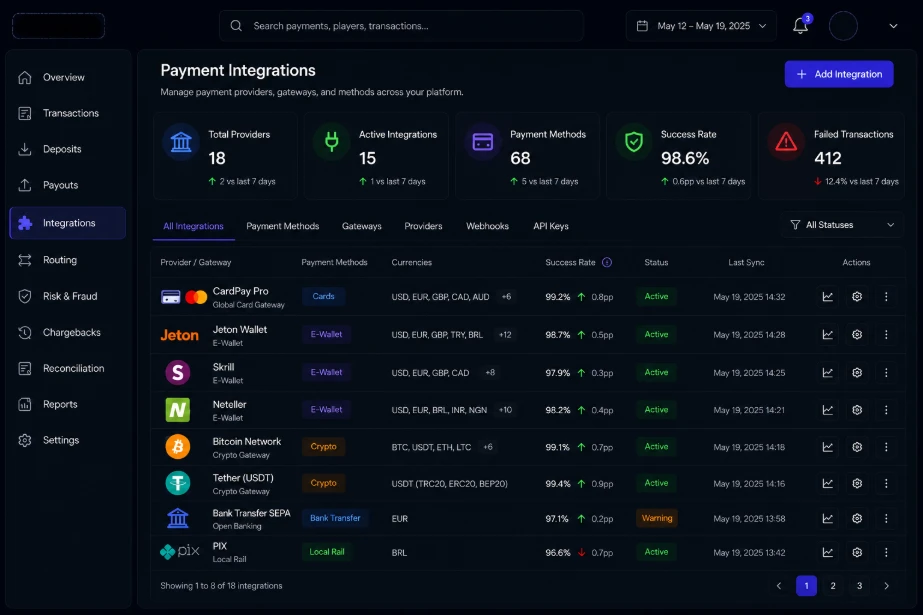
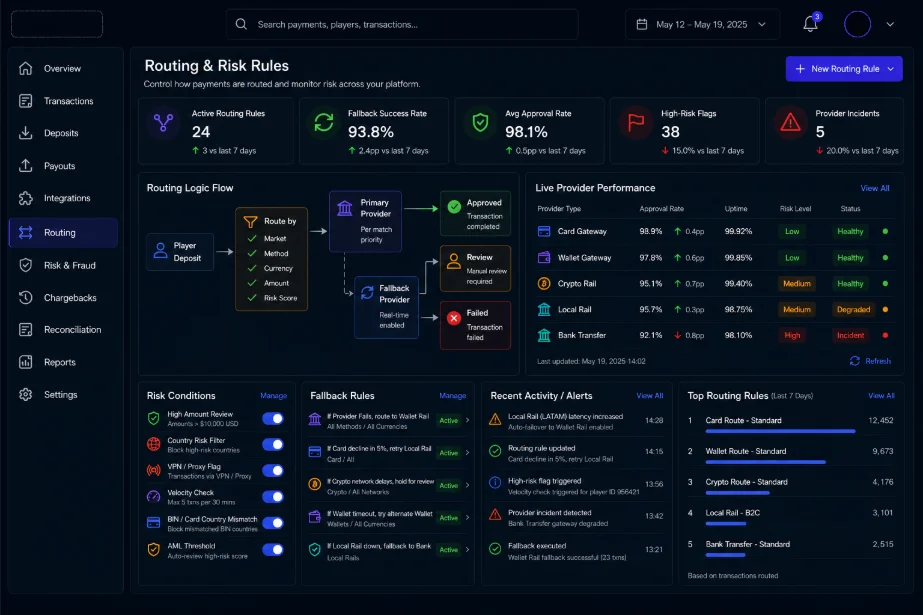
Example iGaming payment operations dashboard showing deposits, payouts, PSP routing, fraud checks, wallet sync, and reconciliation in one view.
What the Payment Layer Connects
Multi-PSP integration: SDLC Corp connects PSPs, fallback routes, and routing rules so more valid deposits can continue when one provider fails.
Cashier and wallet flows: deposits, withdrawals, balances, and bonus logic stay connected, giving players a cleaner payment journey instead of a broken handoff between systems.
Payout workflows: bank, wallet, and crypto payouts can move through approval rules that help operators speed up trusted withdrawals while keeping risk checks active.
KYC, AML, and fraud checks: player data, payment behavior, and risk signals work together so good players are not blocked while suspicious activity is reviewed earlier.
Crypto, fiat, and reporting: cards, wallets, bank rails, stablecoins, settlements, failed payments, and reconciliation stay visible to finance, support, and operations teams.
If failed deposits, delayed payouts, or payment reporting gaps are already affecting your platform, SDLC Corp can review the full payment journey and show where stronger control is needed.
Do not let failed deposits and payout delays keep leaking revenue
If players are already dropping at deposit, waiting on withdrawals, or raising payment tickets, the issue needs a system-level review before more traffic enters the same broken flow.
iGaming Payment Methods by Market: Cards, Wallets, Bank Rails & Crypto
Players do not trust the same payment methods everywhere. A card-heavy market may need strong Visa and Mastercard support. A wallet-heavy market may need Skrill, Neteller, PayPal, or Paysafecard. A bank-first market may need Trustly, open banking, or Pay by Bank. In crypto-friendly markets, USDT and USDC may also matter.
Paysafe highlights Skrill, Neteller, Paysafecard, 250+ payment methods, and 40+ currencies for iGaming payment coverage. Trustly positions its Pay by Bank solution for gaming platforms as a way to support instant deposits, faster withdrawals, and smoother player funding.
Operators may also compare provider fit across Stripe, Adyen, Worldpay, Checkout.com, and other PSP or acquirer relationships. The right choice depends on licensing, market coverage, approval rates, payout needs, chargeback exposure, and merchant-of-record responsibilities.
Most iGaming payment stacks need a balanced mix:
- Cards: Visa, Mastercard
- E-wallets: Skrill, Neteller, PayPal, Paysafecard
- Bank rails: Trustly, open banking, Pay by Bank
- Local methods: Pix, UPI, mobile money, local wallets
- Crypto: BTC, ETH, USDT, USDC
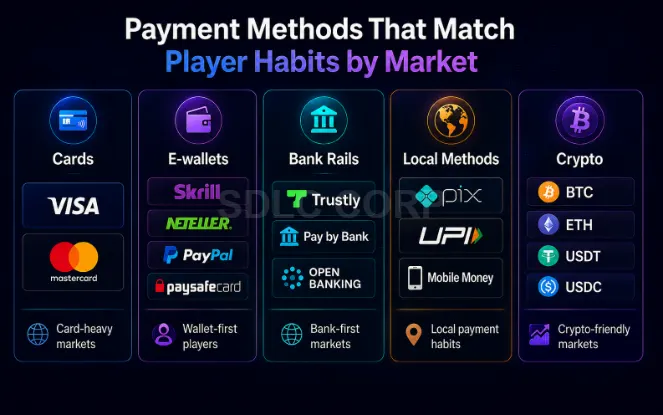
Before integration starts, SDLC Corp helps gaming platforms map payment coverage around market, licensing, settlement needs, risk rules, and player behavior. This keeps the payment stack focused on what players actually use instead of adding random providers. Operators planning a full launch can also align payment coverage with a turnkey casino solution so cashier, wallets, KYC, reporting, and back-office workflows are not scoped separately.
Multi-PSP Routing That Recovers Failed Deposits
A failed deposit should not always mean the player is lost. Many failures happen because the transaction goes to the wrong provider, the PSP is down, the bank declines the payment, or the platform has no backup route.
Multi-PSP routing gives valid deposits another chance. Instead of depending on one provider, the platform can route each transaction based on market, currency, payment method, transaction amount, provider uptime, 3DS / 3D Secure status, acquirer rules, and risk level. For sportsbook-led products, the same routing logic should connect with wallet, odds, settlement, and withdrawal flows inside sports betting app development.
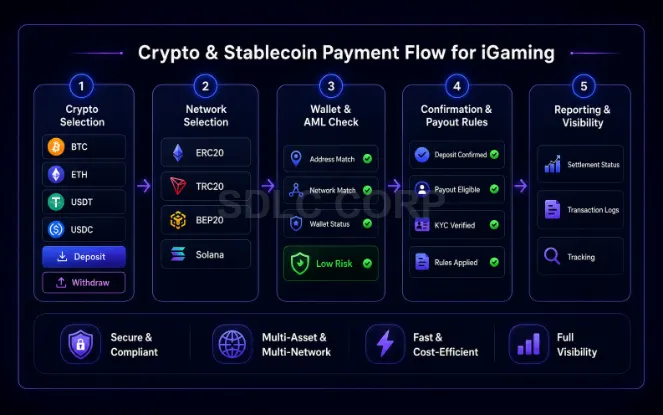
For this layer, we build routing rules inside the payment flow itself. The logic can check the player’s market, payment type, provider performance, and risk level before sending the transaction to the best available route.
A strong routing layer should send the deposit to the strongest route first. If one PSP declines or slows down, the same valid deposit can move through another approved route. Over time, operators can also track where approvals drop, where failures increase, and where routing rules need adjustment.
Fastest Settlement: Faster iGaming Payouts With Risk Control
Players do not judge a platform only by how fast they can deposit. They also remember how fast they can withdraw. A slow payout creates doubt, even when the game experience is strong.
PYMNTS reported that 79% of gamblers prefer instant payouts, while only 49% currently have access to them. That gap shows why payout speed can become a real trust advantage for gaming platforms.
Manual Approval Delays
Manual approval delays slow down genuine players when every withdrawal goes through the same review queue. A better payout flow should let low-risk withdrawals move faster while sending unusual or high-risk requests into review.
KYC and AML Checks Triggered Too Late
KYC and AML checks triggered too late can surprise players at the final payout stage. Operators need payment workflows that connect verification, player activity, and transaction behavior earlier in the journey.
VIP Withdrawals Stuck in Normal Queues
VIP withdrawals stuck in normal queues can damage trust with high-value players. A stronger payout setup should separate VIP withdrawals, apply clear approval rules, and still keep fraud and compliance checks active.
Crypto Payout Liquidity and Network Issues
Crypto payout liquidity and network issues need extra care. Large payout requests, network congestion, wrong-chain issues, or liquidity gaps can delay transactions and create support pressure.
Faster Payouts Still Need Risk Control
Faster payouts still need risk control. The goal is not to approve every payout instantly. The goal is to move trusted payouts faster while risky activity goes into review.
For operators, the right payout setup should balance speed, trust, fraud control, KYC, AML, and player communication so withdrawals feel reliable without weakening platform safety.
How SDLC Corp Handles Crypto and Stablecoin Payments for iGaming Platforms
Crypto payments can help iGaming platforms support players who prefer faster settlement, stablecoin options, and flexible payment rails. However, crypto also brings extra risk when the platform does not handle network selection, wallet tracking, AML checks, payout rules, and settlement visibility properly.
We help to build crypto and stablecoin payment flows inside the main cashier, not as a separate payment corner. For operators, the goal is not just to accept BTC, ETH, USDT, or USDC. The goal is to make crypto deposits and withdrawals clear for players while giving the platform stronger control over risk, settlement, and reporting.
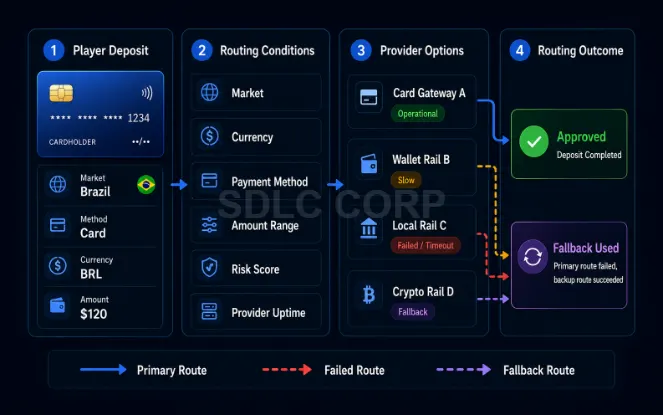
What Crypto Payment Flows Must Handle
- Multichain support for Bitcoin, Ethereum, Solana, and TRON
- Stablecoin support for USDT and USDC deposits or payouts
- Clear network selection so players do not send funds on the wrong chain
- Wallet tracking to connect deposits, withdrawals, and player accounts
- AML checks to flag risky wallet activity before payouts
- Settlement visibility so finance teams can track crypto movement clearly
Chainalysis reports that stablecoin transaction volume remains dominated by USDT and USDC, with USDT processing roughly $703 billion per month between June 2024 and June 2025. For iGaming platforms, this means stablecoins are becoming part of the broader payment mix, not just a niche crypto option.
Operators who treat crypto as a separate payment corner may face the same problems at settlement that they tried to avoid at deposit. A stronger setup gives players clearer deposit and withdrawal paths while helping the platform control wallet activity, payout risk, and crypto-related reporting.
When Payment Issues Turn Into Fraud and Trust Problems
Payment problems do not always stop at failed deposits or delayed payouts. Sometimes the bigger issue starts after the payment succeeds, when the wallet, bonus system, referral logic, KYC checks, and withdrawal rules are not connected properly.
Wallet Balance Delays
A player may complete a deposit but not see the balance update quickly. Even if the money is safe, the player feels the platform is broken.
This creates support tickets, weakens trust, and can stop the player from depositing again.
Bonus and Referral Abuse
Bonuses and referral rewards depend on clean payment and account data. If the system does not check deposits, device signals, referral patterns, and account history, users can exploit offers through fake or repeated accounts. Operators using affiliate traffic should also connect payment signals with affiliate management software for iGaming operators so suspicious acquisition, bonus, and payout patterns do not stay hidden.
This affects bonus cost, affiliate quality, and player acquisition ROI.
Withdrawal Rule Gaps
Withdrawals become risky when wallet balance, bonus status, KYC checks, and payment history do not match. A payout may be delayed, blocked, or approved without the right review.
For genuine players, this creates frustration. For operators, it creates fraud and compliance exposure.
Fraud Signals Inside Payment Behavior
Operators often face multi-accounting, mismatched payment details, VPN or IP masking, chargebacks, and quick crypto deposit-and-withdraw cycles. These signals should be checked during the payment journey, not after damage is done. Sumsub reported that iGaming fraud increased by an average of 64% year over year between 2022 and 2024, making payment safety a revenue issue, not only a compliance task.
For operators, the goal is clear: connect wallet status, bonus logic, KYC, AML, withdrawal rules, fraud checks, and audit trails so genuine players move smoothly while risky activity gets flagged early. SDLC Corp helps build this connected control layer so payment risk does not stay hidden between cashier, wallet, bonus, and payout systems.
Stop payment gaps before they become fraud, disputes, and support load
When wallet status, KYC, AML, bonus rules, and payout logic do not work together, small payment issues can quickly become operational risk. SDLC Corp can identify the weak points before they affect more players.
Also read: Operators planning sportsbook payment, wallet, risk, and reporting workflows can also review exposure guide on sportsbook management software.
Connected iGaming Payment Layer vs Basic Payment Setup
A basic iGaming payment setup may help a platform accept deposits and process withdrawals. But when traffic grows, operators need more control over routing, wallet accuracy, payout rules, fraud checks, crypto flows, compliance visibility, and reporting.
The difference is not about claiming one vendor is better than another. It is about whether the payment setup works as a narrow gateway connection or as a connected operating layer for regulated iGaming payments.
| Area | Basic Payment Setup | Connected iGaming Payment Layer |
|---|---|---|
| Deposits | Often depends on one main route | Supports fallback routing across approved providers when a valid payment fails |
| Cashier and wallet | Balance updates may delay or mismatch | Connects cashier, wallet, payment status, and transaction history |
| Payouts | Manual approvals can slow withdrawals | Uses payout rules, review triggers, and risk checks to move trusted withdrawals faster |
| Card authentication | May treat 3DS or 3D Secure as a separate gateway setting | Keeps 3DS, acquirer rules, and merchant-of-record responsibilities aligned with risk and compliance workflows |
| Crypto payments | Users may face wrong-chain or confirmation issues | Supports multichain deposits, stablecoins, wallet tracking, and AML checks |
| Fraud control | Risk checks may sit outside the payment flow | Connects payment behavior with player data, KYC, AML, fraud signals, and withdrawal rules |
| Reporting | Teams may check separate tools | Gives finance, support, operations, and compliance teams clearer payment visibility |
This comparison is not a provider ranking. It shows the operational gap between a basic gateway connection and a payment layer built to support deposits, payouts, player trust, fraud control, and regulated market operations.
What to Check Before Choosing iGaming Payment Solutions
Choosing iGaming Payment Solutions should not become a long gateway comparison. The real question is whether the payment layer protects deposits, payouts, fraud checks, local methods, crypto flows, and reporting as the platform grows.
If custom casino content is part of the roadmap, keep payments aligned with casino game development so wallet balance, gameplay access, and reporting do not break across teams.
Payment Selection Checklist
A clear checklist keeps the decision practical. It shows whether the platform needs a basic gateway fix or a connected payment layer built for operators.
When the answers are strong, teams can move faster with cleaner payment visibility, fewer support gaps, and a more trusted player journey.
Create a payment experience players can trust
SDLC Corp can help you plan a connected payment layer for deposits, payouts, routing, crypto, fraud checks, KYC, AML, and reporting, aligned with your platform roadmap.
FAQs
1. What are iGaming Payment Solutions?
iGaming Payment Solutions are payment systems built for gaming platforms. They help manage deposits, withdrawals, PSP routing, wallets, fraud checks, KYC, AML, crypto payments, and reporting in one connected payment layer.
2. Why do gaming platforms need more than a basic payment gateway?
A basic gateway accepts transactions, but iGaming platforms need more control. They need fallback routing, wallet sync, payout rules, fraud checks, compliance flows, crypto support, and finance reporting.
3. Why do gaming platforms need multiple payment providers?
Gaming platforms need multiple payment providers because approval rates can change by region, method, currency, and provider performance. If one provider declines or slows down, multi-PSP routing gives valid deposits another path.
4. Which payment methods should iGaming platforms support?
iGaming platforms should support payment methods based on market, licensing, player behavior, and payout needs. Common options include cards, e-wallets, bank rails, local payment methods, and crypto payments such as BTC, ETH, USDT, and USDC.
5. Why are faster payouts important for iGaming platforms?
Faster payouts build player trust and reduce support pressure. Players remember how quickly they receive winnings, and slow withdrawals can reduce repeat deposits.
6. Can iGaming platforms support both fiat and crypto payments?
Yes. A strong payment setup can support cards, wallets, bank rails, local methods, BTC, ETH, USDT, USDC, and multichain flows. Crypto should stay connected to KYC, AML, fraud checks, payout rules, and reporting.
7. How much does an iGaming Payment Solution cost?
The cost depends on the platform scope, number of PSP integrations, cashier flow, payout rules, crypto support, KYC/AML checks, fraud controls, reporting, and market coverage. A simple gateway integration costs less, while a full payment layer with multi-PSP routing, wallets, stablecoins, fraud checks, and reconciliation needs a larger build. SDLC Corp does not list one fixed public starting price, so the right estimate should come after reviewing the platform requirements.
8. Can SDLC Corp integrate payment solutions into an existing gaming platform?
SDLC Corp can integrate payment solutions into an existing gaming platform by connecting gateways, PSP routing, wallets, cashier flows, crypto payments, fraud checks, KYC, AML, payout workflows, reporting, and reconciliation.
9. Can one iGaming payment solution support both casino and sportsbook payments?
Yes! A single payment layer runs casino and sportsbook payments together — shared wallet, deposits, PSP routing, KYC/AML, and payouts — so balances and reporting stay consistent instead of running two disconnected stacks.