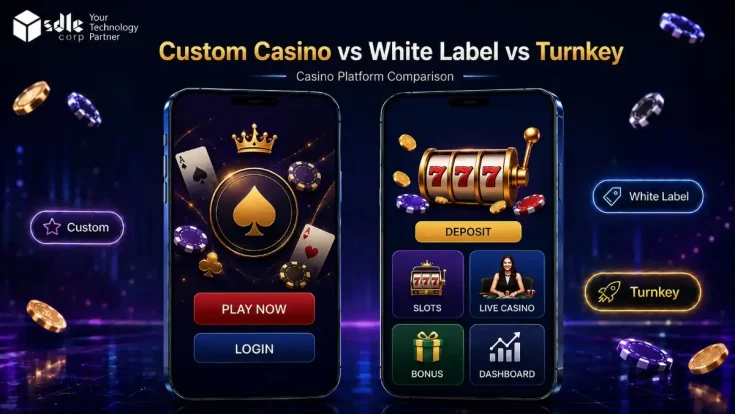
Quick Answer: Which Casino Launch Model Should You Choose?
| Your priority | Best model |
|---|---|
| Fastest branded launch with lower upfront cost | White-label casino solution |
| Full casino stack: wallet, payments, KYC/AML, CRM, back office | Turnkey casino platform |
| Unique game mechanics, custom RTP, proprietary IP | Custom casino game development |
| Stronger IP control and clearer project ownership | Custom casino game development |
| Testing a market with a small team | White-label casino |
| More back-office control and API access than white-label | Turnkey casino platform |
| Long-term player experience differentiation | Custom casino game |
Key Difference: Game Build vs Platform Launch Model
A custom casino game is a product or content build where game IP and source ownership should be defined in the contract. White-label and turnkey are platform launch models built on a vendor-supplied operating stack. They are not interchangeable, and choosing between them starts with understanding this distinction.
Decision Summary
White-label: Speed and lower upfront cost matter most. Turnkey: You need wallet, payments, KYC/AML, CRM, back office, and reporting from day one. Custom: Proprietary gameplay, IP control, and long-term product differentiation matter most.
Custom Casino Game
Build a game from scratch with a custom math model and owned IP. Stronger IP and project terms than platform models. Build timeline is longer than platform-based models.
White-Label Casino
Launch a branded casino on a pre-built platform. Games, wallet, and payments included. Usually the fastest path to a live branded casino.
Turnkey Platform
A full casino stack: wallet, KYC/AML, CRM, bonus engine, multi-PSP payments, back office, and reporting in one setup.
Custom Game vs White-Label vs Turnkey Platform
Scroll to see all columns on smaller screens.
| Criteria | Custom game | White-label | Turnkey platform |
|---|---|---|---|
| Primary purpose | Unique game or content build | Fast branded platform launch | Full operator casino stack |
| Launch speed | Slowest - 8–20 weeks min for game alone | Usually fastest | Medium |
| Source code | Operator-owned when contract terms include source ownership | None - platform is licensed | Partial to full - varies by vendor |
| Revenue share | Usually not part of fixed-fee custom builds | Common - percentage of GGR | Usually flat platform fees |
| Setup cost range | $30k–$150k+ depending on scope | From ~$15k setup | $80k–$300k+ depending on modules |
| Year-one total | Game + platform cost (separate) | $60k–$129k lean single market | $151k–$328k growth launch |
| Customization | Highest - full product control | Branding and lobby config only | Moderate to high |
| Game library | Build or integrate your own | Pre-aggregated from vendor | Aggregated, operator-configurable |
| Wallet and payments | Must be built or integrated | Included | Included, multi-PSP configurable |
| CRM and bonuses | Must be built or integrated | Basic, included | Advanced, included |
| KYC and AML | Must be integrated separately | Basic workflow, included | Advanced tooling, included |
| API access | Custom - full depth | Limited | Moderate to strong |
| RNG and QA | Documentation prepared for lab or regulator review | Managed by provider | Managed by provider |
| Exit risk | Low - operator owns the asset | High - check data export and migration terms | Medium |
| Differentiation potential | Highest | Lowest | Medium |
Choose by Situation
| Your situation | Best-fit model |
|---|---|
| No platform yet — need the fastest possible branded launch | White-label casino |
| Need full casino stack: wallet, KYC/AML, CRM, back office | Turnkey casino platform |
| Already have a platform — need exclusive branded game content | Custom casino game |
| Need a custom RTP, proprietary math model, or unique mechanics | Custom casino game |
| Testing a new market with limited resources | White-label casino |
| Need stronger IP control and clearer project ownership | Custom development |
| Need launch speed with real API access and back-office control | Turnkey casino platform |
| Land-based brand or established operator going online | Turnkey casino platform |
| Long-term player experience differentiation is the priority | Custom casino game |
Decision Guide: Pick Your Casino Launch Model
Answer six questions to narrow down the launch model that best matches your platform status, timeline, ownership goals, cost model, and operating capacity.
The three sections below explain when each model works best, what to watch for, and what to verify before signing.
When to Choose a Custom Casino Game Build
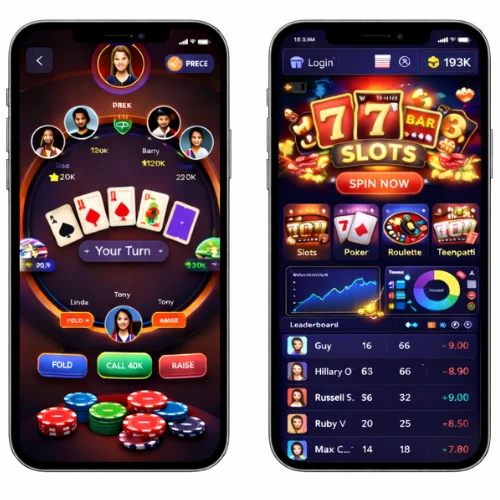
Custom casino games for web and mobile — slots, table games, multiplayer, and live front-ends.
Custom casino game development means building an original game with a proprietary math model and owned source code - harder for competitors to copy than off-the-shelf content. A build typically covers game design, RTP configuration, RNG integration, frontend and backend engineering, QA, and - where required - documentation for certification lab or regulator review.
- You need original game mechanics that off-the-shelf content cannot provide
- You want to own the game IP and control the product roadmap long-term
- You already have a platform and need exclusive branded content for it
- Your studio is building games for distribution or licensing to other operators
- Launch speed is the primary constraint - 8–20 weeks is the minimum build window
- You do not yet have a platform to operate the game on
- Budget is tight - custom development carries the highest upfront cost of the three models
Strengths
- Source code ownership available (depends on contract terms)
- Stronger IP and project terms than platform-based models
- Custom RTP and math model
- RNG documentation can be prepared for regulator review
- Strongest long-term differentiation
Limitations
- Longer build time than platform-based models
- Higher upfront development cost
- Certification support adds time for regulated markets
- Still needs a platform to operate
- Ongoing maintenance responsibility
When to Choose White-Label Casino Launch
A white-label casino gives an operator a pre-built, branded platform. The vendor supplies the game library, wallet, payment integrations, KYC/AML tooling, bonus engine, and back office. The operator focuses on brand, marketing, and players. Platform and game content are licensed - not owned.
- Time-to-market is the primary constraint and launch speed outweighs long-term ownership
- Your team has limited casino platform engineering experience
- You are testing market demand before committing to a larger platform build
- Lower upfront cost is more important than commercial control at this stage
- You need deep product customization - white-label platforms impose constraints that are costly to work around
- Revenue share on GGR erodes margins at scale - model 24-month cost before committing
- You need strong API access, player data ownership, or full backend control
Strengths
- Usually fastest path to launch
- Lower upfront cost
- Pre-integrated game library
- Wallet, payments, and KYC included
Limitations
- No IP or platform ownership
- Revenue share or recurring fees
- Limited API and backend access
- Provider controls the roadmap
- Migration later is complex
When to Choose a Full Casino Operating Stack
Turnkey casino platform: wallet, payments, KYC/AML, CRM, games, and back office in one setup.
A turnkey casino platform is broader and more configurable than a standard white-label setup. Beyond branding and game access, it typically includes a configurable wallet, multi-PSP payment integrations, KYC/AML workflow, CRM, bonus engine, risk and fraud tools, game aggregator access, back office, reporting dashboard, and API access. It usually launches faster than building from scratch but gives more operating control than white-label.
- You need a full casino stack from day one - not just a front-end game library
- You are a land-based casino group or established brand expanding online
- You need more API access and back-office control than white-label provides
- Your project requires multi-currency wallet and multi-PSP payment integrations
- Budget is tight - turnkey setup typically runs $80k–$300k+ before year-one operating costs
- You want full IP ownership of the platform - the vendor controls the core codebase
- Customization scope may be narrower than it appears - confirm with the vendor before signing
Strengths
- Full casino stack included
- Advanced CRM, bonus, and risk tools
- Multi-PSP payment integrations
- More API access than white-label
- Usually faster than building the full platform from scratch
Limitations
- Less unique than custom development
- Platform and support fees ongoing
- Customization scope varies by vendor
- Vendor controls the core roadmap
Casino Platform Cost by Launch Model
The figures below show indicative year-one ranges to compare cost impact by model. These ranges exclude gaming license fees, legal formation, staffing, and marketing. Source: casino software cost guide.
| Scope | Indicative year-one range | Typical for |
|---|---|---|
| Lean - one market, focused feature set | $60k–$129k | White-label entry, single market |
| Growth - wider payments, stronger back office | $151k–$328k | Turnkey or mid-tier white-label |
| Custom or enterprise - full control, multi-market | $313k–$730k+ | Custom platform or full turnkey build |
A revenue share of 20–25% on $200k/month GGR adds $40k–$50k/month in ongoing fees - more than most setup quotes. Model the 24-month total, not just the upfront cost. See: white-label casino cost guide.
Ownership, Control, and Exit Risk
| Factor | Custom | White-label | Turnkey |
|---|---|---|---|
| Source code | Operator-owned when contract terms include source ownership | None — platform is licensed | Partial to full - varies by vendor |
| Game IP | Operator-owned | None — licensed content | None - aggregated content |
| Player data | Operator-held | Shared or provider-held - check contract | Operator-held, typically |
| Revenue share | Usually not part of fixed-fee builds | Common - on GGR | Usually flat fees |
| API access | Custom, full depth | Limited | Moderate to strong |
| Exit complexity | Low - operator owns the asset | High - verify data export and migration terms | Medium |
| Roadmap control | Full | Provider-driven | Partial |
Data ownership: In some white-label agreements, player data is held by the platform provider. This affects CRM, retargeting, and what you can do if you migrate later. Clarify data ownership and export terms in writing before signing.
Compliance Responsibility by Launch Model
All three models can carry licensing obligations. Where responsibility sits - and how much compliance tooling comes pre-built - differs by model and by vendor.
Custom development requires the operator to handle platform licensing independently. RNG documentation and QA output can be prepared for lab or regulator review where required. White-label platforms usually include basic KYC/AML and responsible gaming tools, but whether the operator needs their own license or can operate under a provider sub-license varies - check this before signing. Turnkey platforms typically include broader compliance tooling, though licensing responsibility still varies by provider and jurisdiction.
In all three cases, licensing timelines run in parallel with platform and game development - not after. See: US iGaming compliance checklist.
Architecture Differences That Affect Model Choice
Scroll to see all columns on smaller screens.
| Layer | Custom game | White-label | Turnkey platform |
|---|---|---|---|
| Frontend | Fully custom | Branded template | Configurable or custom |
| Game backend | Custom - full control | Provider-controlled | Platform-controlled |
| Wallet | Must be built or integrated | Included | Included, multi-currency |
| Game aggregator | Optional integration | Included | Included, broad catalog |
| PSP integrations | Custom per gateway | Pre-integrated, limited selection | Multi-PSP, configurable |
| KYC and AML | Must be integrated separately | Basic workflow, included | Advanced tooling, included |
| CRM and bonuses | Must be built or integrated | Basic, included | Advanced, included |
| Reporting | Custom-built dashboard | Provider dashboard only | Operator dashboard, configurable |
| API access | Custom, full depth | Limited | Moderate to strong |
For platform architecture depth: scalable casino game architecture · online casino software.
Common Mistakes When Choosing a Casino Launch Model
- Choosing white-label when you need deep customization - you will hit platform limits within months and face a costly migration.
- Choosing custom development when launch speed is the top constraint - an 8–20 week game build plus separate platform setup takes time that white-label removes.
- Treating turnkey and white-label as the same product - they differ in API access, back-office depth, and configuration scope.
- Not reviewing exit clauses and data export terms before signing - hard to renegotiate after launch.
- Comparing only setup costs - model revenue share and platform fees over 24 months before deciding.
- Not checking PSP coverage in your target markets before committing to a platform.
- Underestimating certification timelines - RNG documentation and testing lab submissions add weeks or months for regulated markets.
- Not checking API access depth before assuming a platform is configurable enough for your needs.
- Skipping the exit strategy until after launch - data export and wallet migration terms are much easier to negotiate before go-live.
Vendor Questions to Ask Before You Sign
- Who owns the source code?
- Who owns player data?
- What is in the base package?
- What requires paid add-ons?
- Which jurisdictions are supported?
- Which PSPs are pre-integrated?
- What game aggregators are included?
- Can we migrate data later - how?
- What are the exit and termination clauses?
- Is there a revenue share — and on what basis?
- What API access depth is available?
- Is the wallet single or multi-currency?
- What is the platform uptime SLA?
- How are responsible gaming tools managed?
Real-World Casino Launch Scenarios
Three simplified examples showing how speed, ownership, and operating depth map to different model choices.
Situation: A new iGaming business with a small team wants to launch in a single market. Speed matters. The priority is to get live, test player acquisition, and validate demand before committing to a larger build.
Likely fit: White-label casino. Speed and lower upfront cost outweigh the revenue share trade-off at this stage. The team can focus on marketing and player acquisition rather than platform engineering.
Situation: An established casino operator already has its own wallet, back office, and game library. It wants a custom slot that no other platform carries - unique mechanics, a specific RTP, and owned IP.
Likely fit: Custom casino game development. The platform exists. What is needed is a specific game with proprietary mechanics and a signed IP agreement.
Situation: A land-based casino group wants to expand its brand online. It has budget for a complete setup and needs payments, KYC/AML, a CRM, and a back office - not just a front-end game library.
Likely fit: Turnkey casino platform. The group needs a full casino stack. Turnkey provides the wallet, payments, KYC/AML, CRM, and reporting needed to run the business end-to-end.
How SDLC Corp Supports Each Launch Path
SDLC Corp supports casino launches end to end - strategy, product consulting, architecture, game and platform development, wallet, payment and KYC/AML setup, QA, security review, certification-ready documentation, deployment, and post-launch optimization.
| If you choose | SDLC Corp can support with |
|---|---|
| Custom casino game | Game concept, math model, RTP setup, RNG documentation, frontend/backend build, QA, security review, launch preparation |
| White-label casino | Launch consulting, brand setup, lobby structure, payment/KYC configuration, back-office setup, go-live support |
| Turnkey platform | Wallet, CRM, bonus engine, multi-PSP payments, reporting, risk tools, compliance preparation, deployment, post-launch support |
End-to-end delivery support: planning, architecture, development, integrations, QA, launch, and post-launch optimization.
For a two-way comparison of white-label and turnkey: turnkey vs white-label online casino.
Verified client reviews are available on GoodFirms, and Clutch.
Frequently Asked Questions
Custom development builds a proprietary game with a custom math model and owned IP - closer to a product build than a platform launch. White-label provides a pre-built branded platform for fast launch. Turnkey delivers a full casino stack: wallet, payments, KYC/AML, CRM, back office, and reporting.
Typically 8–20 weeks depending on game type and scope. A slot with standard bonus features is toward the lower end. A multiplayer table game or live casino front-end is toward the higher end. Certification timelines for regulated markets are separate.
Costs vary by model. White-label usually has the lowest upfront setup, turnkey usually costs more because it includes a fuller operating stack, and custom or enterprise builds require the highest upfront investment. For detailed year-one pricing, see the casino software cost guide.
Not always. White-label focuses on fast branded deployment with limited configuration. Turnkey usually includes a broader stack - configurable wallet, multi-PSP payments, CRM, bonus engine, and API access. The distinction matters: turnkey gives more operating control, but exact scope varies by vendor.
Often yes — but it depends on the provider's terms around external game integration and exclusivity clauses. Verify before signing. Many operators use a white-label or turnkey platform as the operating base and build custom games on top for differentiation over time.
Licensing depends on jurisdiction, game type, business model, and player market. White-label and turnkey providers may include compliance tooling, but operators still need legal review before launch.
Custom development gives the most control - stronger IP ownership, full game logic, and lower vendor dependency than white-label or turnkey. Turnkey offers moderate control. White-label typically provides the least flexibility.
Custom development usually has the lowest game-level dependency when the contract gives the operator ownership of the game asset. Turnkey can reduce vendor dependency compared with white-label if the contract allows API access, data export, and deeper configuration. White-label typically carries the highest dependency risk - exit clauses and data export terms matter most here.
SDLC Corp's iGaming team can help you map out the right model for your goals, budget, compliance requirements, and timeline.
Talk through your optionsLicensing, compliance, and regulatory requirements vary by jurisdiction, game type, and business model. Cost ranges are planning estimates only and depend on scope, complexity, and external factors. This article is for information purposes only and does not constitute legal, financial, or regulatory advice. Consult qualified legal counsel or a licensing adviser before launch.