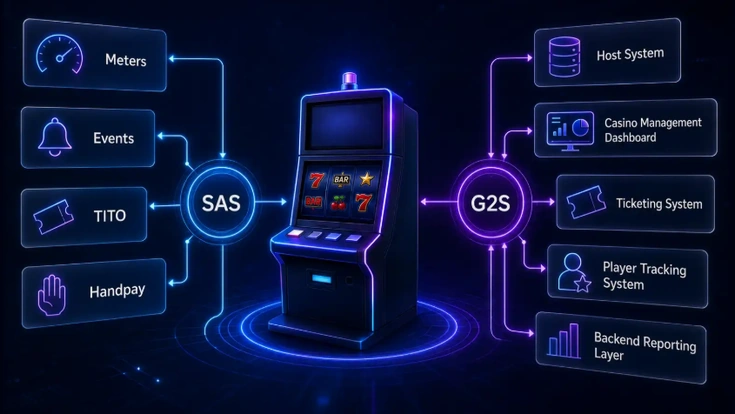
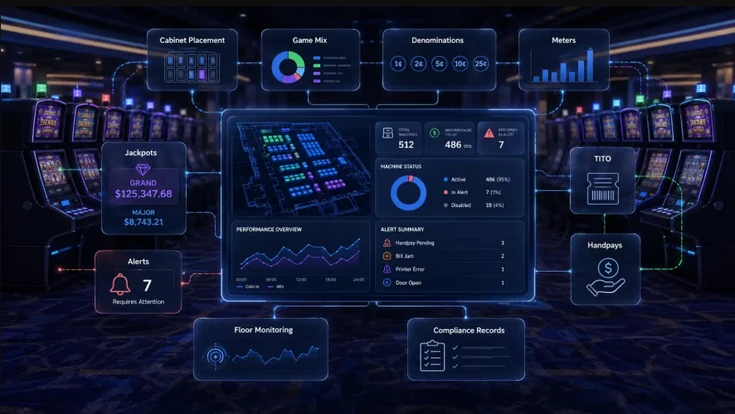
Casino floor slot machines connect games, tickets, jackpots, payments, alerts, and reports in one system. For smooth operations, the floor also needs suitable machine placement, stable connections, accurate records, and simple review processes. As a result, the casino becomes easier to manage, audit, and improve.
In simple terms: casino floor slot planning connects machine placement, game mix, denominations, player flow, meters, TITO, jackpots, alerts, and reports into one operating view.
This guide explains how operators plan slot floors, review machine records, and respond to issues.
Quick Summary of Slot Machines for Casino Floors
| Area | What It Means | Why It Matters |
|---|---|---|
| Casino floor slot machine | A regulated gaming cabinet placed in a casino slot floor area | It must support controlled game play, records, and review |
| Floor layout | How cabinets are grouped, spaced, accessed, and monitored | It affects visibility, player flow, attendant response, and support |
| Game mix | The balance of themes, cabinet types, denominations, and bet levels | It helps the floor serve different player segments |
| Meters and TITO | Machine value records and ticket-in or ticket-out activity | They support cashier, accounting, and reconciliation workflows |
| Handpays and jackpots | Events that often need attendant review and records | They affect player support, floor response, and reporting |
| Monitoring and reporting | Machine status, alerts, events, and performance views | They help operators review the floor and detect issues faster |
What Are Casino Floor Slot Machines?
In regulated gaming areas, casino floor slot machines operate as electronic gaming machines.
- Upright cabinets
- Slant-top cabinets
- Premium cabinets
- Progressive machines
- Video reel machines
- Multi-game machines
- High-limit cabinets
- Other approved formats
Each cabinet works inside a wider system. For example, it runs the game, accepts value, updates meters, prints tickets, records events, and reports its status GLI's standards library explains that gaming devices and systems are tested, reviewed, and reported against standards established by relevant gaming jurisdictions worldwide.
How Casino Slot Machines Differ From VGTs and VLTs
Although casino floor slot machines, VGTs, VLTs, and EGMs are related terms, they are not always used in the same way.
The article on VLT vs slot machines vs EGMs explains the broader terminology. In casino-floor use, the focus is usually on the approved slot cabinet, the local game configuration, the casino host environment, floor operations, and regulatory review.
| Machine Type | Common Placement | Operational Focus |
|---|---|---|
| Casino slot machine | Licensed casino floor | Cabinet placement, game mix, meters, TITO, jackpots, monitoring, and floor performance |
| VGT | Distributed venues where legal, such as truck stops, convenience stores, bars, or route venues | Venue setup, route monitoring, machine limits, revenue share, and distributed reporting |
| VLT | Lottery or centrally controlled terminal environment, depending on market | Central system connection, terminal activity, and lottery-style controls |
| EGM | Broad category for electronic gaming machines | Machine logic, records, meters, audit logs, and regulated operation |
For comparison with distributed venues, see VGTs for convenience stores and truck stops.
Casino Floor Layout and Machine Placement
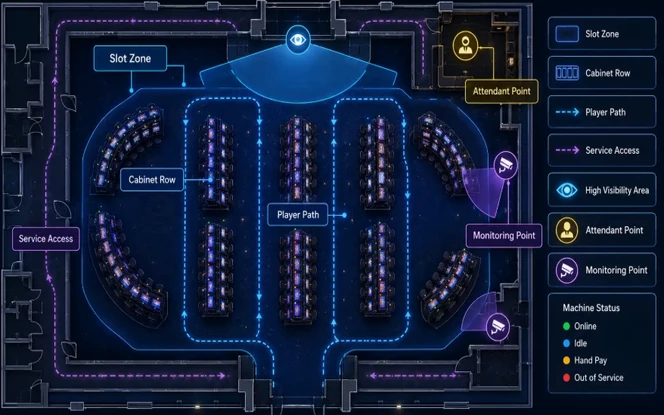
Floor-zone diagram: machine placement should support player movement, service access, cashier flow, and monitoring coverage.
First, placement changes how the whole floor works. A good location improves visibility, access, service speed, and player movement.
However, a reliable cabinet can still underperform in the wrong zone. Poor access, blocked paths, weak visibility, or a mismatched theme can reduce its value.
Placement Factors Operators Review
- Player walking paths
- Cabinet visibility
- Entrance and aisle proximity
- High-traffic areas
- Quiet or premium zones
- Attendant response distance
- Cashier or cage access
- Service access lanes
- Power and network access
- Camera and monitoring coverage
- Signage and notices
- Responsible gaming placement rules
Good floor planning helps operators manage the slot area without relying only on machine-level reports after problems occur.
Cabinet Types and Game Mix
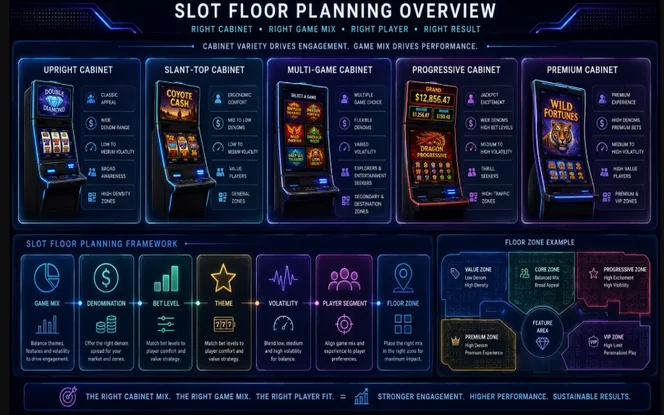
Similarly, more machines do not always create a better floor. The cabinet mix must fit the space, player group, zone, and operating goals.
How EGM slot machines work explains machine logic, RNG behavior, paytables, reels, meters, and payout events. On the floor, those technical details must fit the cabinet and game mix strategy.
Upright Cabinets
Common slot floor cabinets used across standard floor areas and theme zones.
Slant-Top Cabinets
Cabinets often used where seated play style, comfort, or premium floor feel matters.
Multi-Game Cabinets
Machines that may offer multiple approved games, themes, or denominations from one cabinet.
Progressive Cabinets
Machines connected to progressive prize behavior, jackpot tracking, and event records.
Game Mix Planning
- Theme and cabinet style
- Volatility and bonus behavior
- Minimum and maximum bets
- Denomination range
- Progressive participation
- Player-segment fit
- Zone performance
- Historical machine results
Denominations, Bet Levels, and Player Segments
In addition, bet levels shape both player experience and floor performance. Most casinos balance low, mid-range, premium, and high-limit play.
- Denomination range
- Minimum bet
- Maximum bet
- Lines or ways to win
- Bonus frequency
- Progressive participation
- Player session length
- High-limit area fit
- Theme preference
- Cabinet comfort
- Floor zone performance
- Historical meter data
Therefore, operators should not evaluate game mix only by gross win. Floor zone, player segment, cabinet age, theme strength, volatility, and uptime also affect the result.
Meters, TITO, and Cashbox Records
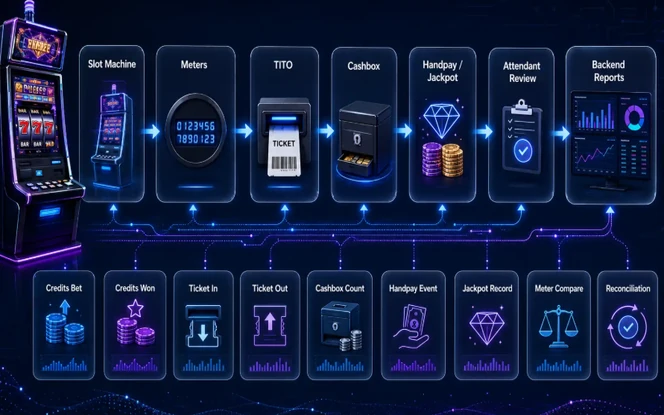
TITO lifecycle: each ticket should connect the machine event, validation record, printed value, redemption record, and final reconciliation.
Next, meters, TITO, and cashbox records show how value moves through each machine. Accounting and cashier teams use them to confirm the same transaction story. EGM accounting meters may track credits bet, credits won, games played, bill-in value, ticket-in value, ticket-out value, handpay values, jackpots, and other machine-level values.
TITO in slot machines supports ticket-in and ticket-out flow. This makes the ticket record, cashier record, and machine meter important parts of casino floor review.
Records Commonly Reviewed
- Credits bet
- Credits won
- Games played
- Bill-in value
- Ticket-in value
- Ticket-out value
- Cashbox count
- Cancelled credits
- Handpay value
- Jackpot value
- Meter compare results
- Reconciliation notes
If these records do not align, review the issue early. Otherwise, a small mismatch can become an accounting or guest-support problem.
First-Party Implementation Insight
In slot-floor systems SDLC Corp teams design for, three reconciliation failures receive the most attention:
- A ticket is printed, but the backend event arrives late or not at all.
- The machine meter and cashier redemption record use different transaction timing.
- A handpay or cancelled-credit event is recorded without complete attendant context.
For that reason, our workflows connect machine events, ticket records, meter snapshots, cashier actions, and attendant notes before closing an exception.
Handpays, Jackpots, and Attendant Workflows
Meanwhile, handpays and jackpots need a clear response path. Staff may need to verify the player, amount, machine state, and payout record.
Although rules differ by jurisdiction, the core requirement stays the same. Every machine event should connect to a documented floor action.
| Event | Floor Action | Record to Review |
|---|---|---|
| Handpay | Attendant response and payout review | Machine event, amount, time, cabinet, and payout record |
| Jackpot | Jackpot validation and player support | Event record, prize amount, game state, and report entry |
| Cancelled credit | Attendant or cashier handling | Cancelled credit meter and payout record |
| Machine lockup | Floor review and possible technical support | Fault event, audit log, and recovery action |
Good workflows reduce disputes, improve response time, and help accounting teams trace the event later.
Monitoring, Alerts, and Backend Reporting
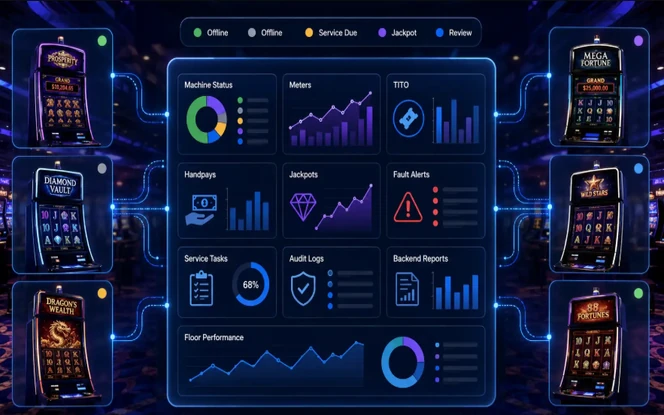
A central monitoring view helps teams separate urgent machine faults from routine operational events.
After deployment, a central dashboard turns machine events into clear operating actions. Teams can see faults, tickets, meters, jackpots, and service needs in one place. EGM monitoring and backend reporting systems explain how machine data can move into alerts, reports, reconciliation views, and operator dashboards.
This is especially useful on large floors. Operators can quickly find offline machines, service needs, meter exceptions, and unresolved events.
Common Monitoring Views
- Machine status
- Floor zone status
- Meter updates
- TITO activity
- Handpay events
- Jackpot events
- Printer faults
- Bill validator faults
- Communication alerts
- Door events
- Service tasks
- Performance reports
GLI-11 helps show why gaming device review can include records, meters, communication behavior, logs, and recovery behavior, depending on device scope and jurisdictional requirements.
Audit Logs and Compliance Records
In contrast, audit logs answer a different question: what happened, when, and who responded? They support technical reviews, disputes, controls, and inspections. EGM audit logs and event records may include door events, power resets, printer faults, bill validator issues, handpays, jackpots, configuration changes, critical memory issues, and communication failures.
Singapore's Gambling Regulatory Authority states that EGMs deployed in Singapore must be secure, reliable, and auditable. That is a useful way to think about casino floor records even when the exact rules differ by market.
- Door open and close events
- Power reset events
- Printer faults
- Bill validator faults
- Handpay conditions
- Jackpot records
- Configuration changes
- Communication failures
- Critical memory errors
- Recovery events
- Attendant actions
- Report review notes
Jurisdiction and Technical Review Examples
Because requirements differ by market, one approval does not automatically apply in another jurisdiction. Placement, ticket handling, meters, notices, and reporting rules can all change. Nevada Technical Standard 1 is useful for U.S. casino-floor context because it covers technical requirements for gaming devices and associated equipment, including integrity and meter-related areas.
Victoria's VGCCC technical standards page shows how some regions publish standards around gaming equipment and monitoring. Ontario's AGCO technical standards also show how gaming devices and gaming systems may be reviewed around technical integrity, public interest, and security.
| Market Example | What to Notice | Operator Lesson |
|---|---|---|
| Nevada, USA | Technical standards for gaming devices and associated equipment | Machine integrity, meters, records, and approvals are technical-control topics |
| Singapore | EGMs are framed around being secure, reliable, and auditable | Auditability should be part of floor operations planning |
| Victoria, Australia | Technical standards and monitoring topics are published for gaming equipment | Monitoring rules may be part of machine deployment review |
| Ontario, Canada | Gaming device and system standards focus on technical integrity and security | Floor machines and connected systems should be reviewed together |
Slot Floor Performance Reports
Finally, performance reports show where the floor is working and where it is not. Compare machines by zone, denomination, theme, cabinet, and uptime.
However, low activity does not always mean a weak game. Position, visibility, downtime, player traffic, cabinet age, and nearby competition can change the result.
- Coin-in or credits bet
- Credits won
- Games played
- Machine uptime
- Average bet
- Ticket activity
- Handpay count
- Jackpot activity
- Fault frequency
- Floor zone comparison
- Cabinet type comparison
- Game mix review
Performance reports become more useful when they are reviewed together with floor layout, machine status, and player movement.
Common Casino Floor Slot Issues
In many cases, slot-floor problems sit between systems rather than inside one game. The machine, staff workflow, cashier record, and backend report must agree.
Ticket Problems
Printer faults, unreadable tickets, duplicate review, or ticket record mismatches can create cashier and guest-support issues.
Meter Mismatch
Machine meters, backend records, and cashbox values may need review if values do not align.
Communication Gaps
A cabinet may continue showing local activity while the backend record is delayed or incomplete.
Delayed Attendant Response
Handpays, jackpots, lockups, and faults need clear alert routing and floor ownership.
Poor Placement Fit
A strong game can underperform if it is placed in the wrong traffic zone or cabinet cluster.
Missing Review Context
Reports are less useful when machine events, floor notes, and accounting records are not reviewed together.
Operator Checklist for Casino Floor Slot Machines
Check the full operating environment before a machine goes live or changes zones.
- Applicable jurisdiction
- Machine approval status
- Cabinet type
- Game theme
- Denomination setup
- Bet-level configuration
- Floor zone
- Player path
- Service access
- Monitoring coverage
- Cashier flow
- Attendant workflow
- Power and network readiness
- Security coverage
- Meter reporting
- TITO ticket flow
- Cashbox process
- Handpay workflow
- Jackpot review
- Door event logging
- Fault event logging
- Communication alerts
- Backend reporting
- Performance report view
- Game mix review
- Responsible gaming notices
- Audit log review
- Change control record
This checklist helps operators review the slot machine as part of a complete casino floor environment.
Build a Smarter Casino Slot Floor
Improve machine placement, TITO workflows, monitoring, reporting, and daily floor operations with a solution designed for your casino.
Talk to Our Casino ExpertsFAQs About Slot Machines for Casino Floors
Slot machines use software called a random number generator to choose each result. Every spin is separate and cannot be predicted.
Yes. Licensed slot machines use tested random number generators, so each spin produces an independent result.
The house edge is the casino’s built-in advantage. It varies by machine and is based on the slot’s payout percentage.
Important records include accounting meters, ticket-in and ticket-out values, cashbox records, handpay events, jackpot records, door events, fault events, audit logs, and backend reports.
TITO lets players insert and cash out tickets instead of using coins at the machine. It also creates ticket records for cashier review, meter comparison, and reconciliation.
These workflows cover larger wins or machine conditions that need attendant support, required identity checks, machine records, payout records, and backend reporting.
Audit logs help explain door openings, power resets, bill validator faults, printer problems, handpays, jackpots, configuration changes, and communication failures.
Yes. Rules may differ for machine approval, meter records, technical standards, reporting, ticket handling, responsible gaming notices, and operator reviews.
Floor layout affects machine visibility, player movement, service access, attendant response, monitoring coverage, and cashier flow.
Final Thoughts
A slot machine is only one part of the casino floor. Good operations connect placement, game mix, tickets, meters, jackpots, alerts, staff actions, and reports.
The best result is simple: the machine record, cashier record, floor action, and backend report tell the same story. When they do, the floor becomes easier to monitor, audit, and improve.