
A casino affiliate program helps online casino operators acquire players through review sites, comparison portals, streamers, media buyers, email publishers, and other affiliate partners. When built correctly, it becomes a measurable acquisition channel where payouts are tied to deposits, revenue, or qualified player actions.
However, a profitable online casino affiliate program needs more than CPA or RevShare offers. Operators need clear goals, compliant terms, accurate tracking, reliable payouts, fraud controls, and an iGaming software platform that can attribute traffic correctly. In practice, that means choosing the right iGaming affiliate program model, casino affiliate software, and casino affiliate tracking software before scaling traffic. This guide explains how to start a casino affiliate program in 2026, covering software, commissions, UK and US compliance, traffic quality, ROI, and scaling.
Key Takeaways
- A casino affiliate program, or wider iGaming partner program, should be built around player value, not traffic volume alone.
- CPA, RevShare, and Hybrid deals work differently, so payouts must match LTV, CAC, margin, and cash flow.
- The right casino affiliate tracking software should connect deposits, KYC, NGR, bonuses, chargebacks, fraud checks, and payouts.
- UK and US-facing programs need compliance rules before affiliates start promoting.
- Operators should validate traffic quality before increasing commissions, expanding the iGaming affiliate program, or entering new GEOs.
What Is a Casino Affiliate Program?
A casino affiliate program is a performance-based marketing partnership where an online casino pays affiliates for sending qualified players to the casino. Affiliates may promote the casino through review sites, comparison pages, streaming channels, paid campaigns, email lists, or niche communities.
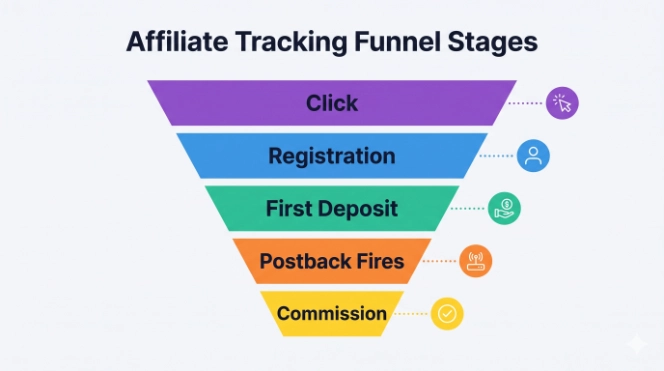
The operator gives each affiliate a tracked link, campaign ID, subID, or postback setup. When a player clicks that link, signs up, deposits, or generates revenue, the affiliate earns commission based on the agreed model. Common payout models include CPA, RevShare, Hybrid, CPL, and sub-affiliate rewards.
For operators, the goal is not just to get more traffic. A strong casino partner program should bring players who deposit, stay active, generate measurable revenue, and follow licensing, advertising, and responsible gambling rules.
For a deeper operator-side view of affiliate traffic types, partner quality, and commission strategy, see our Casino Affiliate Marketing: Operator Guide.
How a Casino Affiliate Program Works Inside an iGaming Affiliate Program Stack
A casino affiliate program works through attribution, player value, and commission rules. The affiliate sends traffic through a tracked link, campaign ID, subID, landing page, or server-to-server postback. The operator then checks which players registered, deposited, completed KYC, generated revenue, or created risk. An iGaming affiliate program should not rely on click tracking alone; it should connect player actions, revenue events, and payout approval in one workflow.
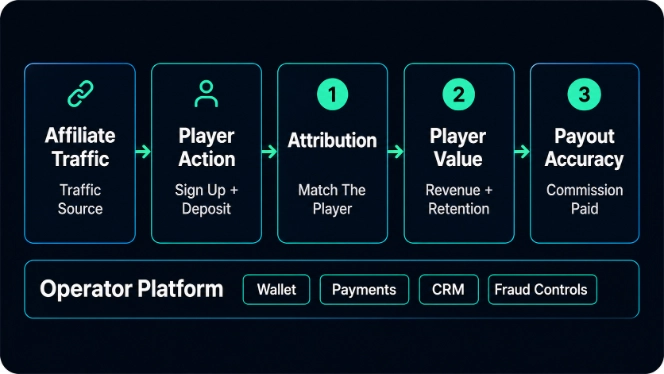
Attribution
The first job is to connect every player to the right affiliate, campaign, GEO, creative, and traffic source. This avoids confusion when payouts, bonuses, chargebacks, or fraud reviews begin.
Player value
The click is only the first signal. A strong setup should show which affiliates bring real depositing players, which campaigns create bonus abuse, and which traffic sources produce long-term NGR. This helps operators avoid paying for weak traffic while protecting high-value partners.
Payout accuracy
The tracking system should connect with the casino platform, wallet, payments, CRM, bonus engine, and reporting layer. That connection is what makes CPA, RevShare, Hybrid, and sub-affiliate payouts accurate. It also helps operators review chargebacks, refunds, restricted-GEO traffic, fraud signals, and payout approvals before commissions are released.
For operators, a casino affiliate program is not just a marketing channel. It is a controlled acquisition system where every partner can be measured by traffic quality, player value, compliance risk, and ROI.
Step 1: Set Goals, KPIs, and Budget Before Launch
Before choosing commission rates, affiliate software, or partner outreach, define what the program needs to achieve. The goal should not be “more traffic.” It should be tied to measurable business outcomes such as first-time depositors, player value, acquisition cost, affiliate-sourced NGR, and retention. This is also where the operator decides whether the setup is a single casino partner program or part of a wider iGaming affiliate program across multiple brands.

Define the business target first
A program built for fast market entry will not use the same structure as a program built for long-term margin. If the operator wants fast FTD volume, CPA or Hybrid deals may make sense. If the goal is stronger lifetime value, RevShare can work better because the payout follows player revenue over time.
This decision affects the commission model, payout rules, tracking setup, affiliate recruitment, and fraud review.
Track the numbers that decide profitability
Operators should track FTDs, blended CAC, player LTV, LTV:CAC ratio, affiliate-sourced NGR, and retention before affiliates start sending traffic.
These numbers show whether the channel creates real player value or only generates low-quality signups. For example, an affiliate with fewer clicks can be more valuable than a high-volume partner if their players deposit, return, and generate stronger NGR.
Set the payout limit before negotiating deals
CPA deals can create cash-flow pressure because the operator may pay commission before the player has generated enough value to recover the cost. RevShare reduces upfront pressure, but it requires accurate NGR tracking and more patience.
Before launch, define the monthly payout ceiling, the maximum acceptable CAC, and the minimum LTV:CAC ratio required before scaling.
Operator takeaway: set the business math before setting the commission offer.
Step 2: Build a Casino Brand Affiliates Want to Promote
Affiliates do not promote a casino only because the commission looks attractive. They promote brands that convert traffic, pay reliably, and protect their audience trust. If the casino has weak player reviews, slow withdrawals, unclear bonus terms, or a poor mobile journey, strong affiliates will avoid it.
Make the funnel ready for affiliate traffic
Before recruiting affiliates, the casino funnel should be ready to convert. That means a clear welcome offer, fast sign-up, smooth KYC, mobile-friendly pages, reliable payment methods, and a player journey that does not lose users before the first deposit.
Affiliates judge operators through performance. If clicks turn into registrations but registrations do not become deposits, EPC drops and the affiliate moves to another casino partner program.
Build payout trust early
Affiliate trust depends on payment accuracy and timing. Operators should define when commissions are approved, what counts as a qualified player, what deductions apply, and when affiliates get paid.
Late payments, unclear NGR calculations, or sudden commission changes can damage the program faster than a lower payout rate.
Fix player-facing issues before launch
Before launch, operators should test the online casino player journey: sign up, deposit, claim a bonus, complete KYC, contact support, and request a withdrawal. Any friction in that path can reduce conversion and hurt affiliate recruitment.
Operators building the casino platform itself should also make sure player accounts, wallet activity, payments, reporting, bonus controls, and back-office workflows are ready before affiliate traffic starts. See SDLC Corp’s Online Casino Software page for the platform layer behind that setup.
Casino Affiliate Program Planning
Plan the casino affiliate program before traffic goes live.
Align target GEOs, commission rules, tracking events, bonus controls, KYC signals, and payout approval before affiliates start sending players.
Plan Your Affiliate ProgramStep 3: Analyze Competitors and Choose Your GEOs
A casino affiliate program should not target every market from day one. Each GEO has different player value, licensing rules, payment behavior, traffic costs, affiliate competition, and advertising restrictions. Choosing the wrong market can make even a strong offer expensive to run.

Start with market fit
Operators should begin with markets where the casino can operate legally, accept payments smoothly, support players properly, and process affiliate payouts without friction. The same market check applies to any iGaming affiliate program that covers casino, sportsbook, or sweepstakes traffic under one acquisition strategy.
Tier-1 markets such as the UK, US, Canada, and parts of Europe can offer higher player value. However, they also bring stronger competition and stricter compliance requirements. Emerging markets may offer lower acquisition costs, but operators still need to check payment access, player value, language needs, local rules, and affiliate demand.
Study competitor affiliate offers
Before setting terms, review what competing casino brands offer affiliates in the same GEO. Look at CPA rates, RevShare percentages, Hybrid deals, payment frequency, negative carryover rules, bonus terms, landing pages, and affiliate support.
The goal is not to copy competitor rates. The goal is to understand what affiliates already expect, then create an offer the casino can support through its own margins and player value.
Match the GEO with the right affiliate type
SEO review sites often care about long-term RevShare, EPC, and brand reputation. Paid media buyers may prefer CPA because their spend is immediate. Streamers and creators may need custom landing pages, promo codes, and faster reporting. Community affiliates may need stricter compliance review.
GEO readiness checklist
- Legal access
Can the casino legally target this market?
- Payment flow
Can players deposit and withdraw smoothly?
- Affiliate payout
Can affiliates be paid in the right currency and schedule?
- Traffic source
Are SEO sites, streamers, media buyers, or communities active in this GEO?
- Compliance pressure
Are ad rules, bonus rules, or RevShare restrictions strict?
- Operator edge
Why should affiliates promote this casino over competitors?
Before moving forward, the operator should know which markets are worth entering, which affiliates influence those markets, and why those affiliates should promote this casino instead of another brand.
For broader acquisition planning beyond affiliates, see our iGaming Marketing: The Operator Growth Playbook.
Step 4: Choose the Commission Model and Reward Structure
The commission model decides how affiliates get paid, but it also decides how much risk the operator carries. A high CPA can attract affiliates quickly, but it can hurt cash flow if player quality is weak. A RevShare deal protects upfront spend, but it depends on accurate NGR tracking and long-term player value.
Casino affiliate commission model comparison
| Model | How it works | Best for | Main operator risk | Tracking requirement |
|---|---|---|---|---|
| CPA | Fixed payout after a qualifying first deposit or action | Paid media, volume affiliates, fast GEO entry | Paying before player value is proven | Minimum deposit, valid GEO, KYC, fraud-free activity |
| RevShare | Affiliate earns a percentage of player NGR | SEO affiliates, review sites, long-term partners | Disputes if NGR formula is unclear | Accurate NGR, bonus cost, chargebacks, refunds, adjustments |
| Hybrid | Smaller CPA plus smaller RevShare | Shared risk and reward | Higher payout complexity | CPA rules plus RevShare reporting |
| CPL | Payout for qualified lead or registration | Early funnel campaigns | Low-quality leads if rules are weak | Lead validation, source checks, fraud review |
| Sub-affiliate | Affiliate earns from affiliates they refer | Network growth | Low-quality partner recruitment | Partner hierarchy, approval rules, commission tree |
Set rates against margin, not competitor pressure
Operators should not copy competitor rates blindly. A commission offer must fit the casino’s player value, gross margin, bonus cost, payment fees, chargebacks, and retention.
Before setting rates, the operator should understand player LTV, CPA break-even, LTV:CAC ratio, the exact NGR definition, and how casino software cost affects payback. This matters most in RevShare deals, where bonuses, taxes, fees, refunds, fraud adjustments, and chargebacks may affect the final commission.
Use simple formulas before approving rates
- LTV:CAC ratio = player lifetime value ÷ acquisition cost
- CPA break-even period = CPA payout ÷ average monthly gross profit per player
- RevShare base = NGR after agreed deductions
The NGR definition should clearly state whether bonuses, taxes, payment fees, refunds, chargebacks, and fraud adjustments are deducted before affiliate commission is calculated. If these numbers are unclear, the program may look attractive on paper but lose money after payouts.
Use rewards to keep quality affiliates active
Base commission gets attention, but the reward layer keeps strong affiliates engaged. Operators can use tiered rates, milestone bonuses, faster payouts, no-negative-carryover terms, custom landing pages, early promo access, and dedicated affiliate support.
The goal is not always to offer the highest payout. The better goal is to offer a deal good affiliates trust and the operator can sustain.
Step 5: Choose Your Program Model and Casino Affiliate Software
Before launching, decide how the casino affiliate program will be managed and what technology will support it. This choice affects control, data ownership, margins, launch speed, reporting quality, and technical flexibility.
Program model comparison
| Model | Best for | Strength | Trade-off |
|---|---|---|---|
| In-house program | Operators with affiliate team and platform control | Full ownership of data, partners, terms, and payouts | Needs internal team and strong technology |
| Affiliate network | New brands needing faster affiliate access | Faster reach through existing partners | Less control, fees, and limited direct data ownership |
| SaaS affiliate platform | Operators that want faster setup without building from scratch | Ready tracking, reporting, and commission tools | Ongoing cost, provider limits, and data model dependency |
| Custom or integrated build | Custom casinos, white-label brands, multi-brand groups, complex GEOs | Strong control over tracking, player data, fraud logic, and reporting | Higher upfront build and integration planning |
Casino affiliate tracking software requirements
Casino affiliate software is not just a link tracker. A proper affiliate tracking system should connect affiliate traffic with registrations, deposits, NGR, bonuses, chargebacks, fraud checks, and commission payouts.
A serious casino affiliate software setup should support server-to-server postbacks, FTD attribution, NGR and RevShare calculations, multi-currency payouts, negative carryover rules, player-level reporting, fraud detection, and multi-brand or multi-GEO reporting.
For a deeper software-focused breakdown, see our guide to iGaming Affiliate Software for Operators.
Compare SaaS and custom build properly
Many operators use casino affiliate software platforms such as IREV, Affilka, PartnerMatrix, or Scaleo. Others choose a custom or integrated affiliate management system when they need more control over player data, payout logic, fraud signals, or reporting.
The software should support the program model, not force the operator to change its commercial strategy around tool limitations. For multi-brand groups, the same casino affiliate software may also need to support an iGaming affiliate program across casino, sportsbook, sweepstakes, and regional partner campaigns.
Where SDLC Corp Fits in the Casino Affiliate Program Stack
A casino affiliate program works best when tracking, player data, fraud checks, and payout logic are connected to the platform underneath. Many operators treat affiliate management as a separate marketing tool, but the strongest setup is usually deeper than that.
SDLC Corp helps operators build affiliate-ready casino platforms where the affiliate tracking system can connect with the wallet, CRM, bonus engine, KYC flow, payment system, reporting dashboard, and fraud controls. This matters because casino affiliate payouts depend on more than clicks. Operators need to know which player came from which partner, whether the deposit qualified, how NGR was calculated, and whether any bonus abuse, chargeback, or restricted-GEO risk exists.
For operators using a white-label casino solution, turnkey casino solution, sweepstakes casino software, or multi-brand setup, an integrated affiliate management system can reduce reporting gaps and payout disputes. It also gives the operator more control over commission logic, player-level reporting, subID tracking, fraud review, and long-term data ownership.
SDLC Corp Casino Affiliate Launch Framework
A strong casino affiliate stack should not sit away from the product. It should read the same player data that decides attribution, deposit quality, fraud risk, commission approval, and long-term affiliate value.
Operating workflow
01TrackConnect every partner touchpoint to the player journey.
Affiliate, campaign, subID, GEO, landing page, device, and registration data should move into one attribution view. This gives operators a clean base before payouts or optimization start.
- Affiliate ID
- SubID
- Landing page
- Player source
02ValidateCheck whether the player qualifies before commission is approved.
The system should verify deposit status, KYC result, market eligibility, bonus rules, traffic source, and restricted-GEO signals before a CPA, Hybrid, or RevShare payout is released.
- Deposit status
- KYC result
- GEO rules
- Traffic quality
03ScoreSeparate high-value partners from risky or low-quality traffic.
Operators can score traffic by NGR, retention, repeat deposits, bonus use, chargebacks, fraud signals, and payout disputes. This helps affiliate managers scale the right partners instead of only chasing volume.
- NGR
- Retention
- Bonus use
- Fraud signals
04PayApply commission logic with fewer disputes.
CPA, RevShare, Hybrid, tiered rewards, negative carryover, and custom payout rules should use verified data from the platform. This keeps commissions clear for both the operator and the affiliate.
- CPA rules
- RevShare base
- Tier rewards
- Payout approval
05RetainGive the best affiliates better reporting and stronger reasons to stay.
High-performing affiliates need transparent reports, faster support, reliable payouts, custom landing pages, and better reward tiers. The goal is to keep clean, profitable partners active for longer.
- Partner reports
- Custom pages
- Support
- Reward tiers
Connected platform layers
Tracks links, subIDs, creatives, GEOs, partners, and campaign-level performance.
Connects wallet, KYC, payments, CRM, bonus engine, fraud checks, and player activity.
Supports payout review, partner scoring, compliance checks, retention, and long-term data ownership.
Planning an affiliate-ready casino platform? SDLC Corp builds casino platforms, white-label casino solutions, sweepstakes casino software, sportsbook systems, and custom affiliate management modules that connect tracking, attribution, fraud controls, and payout workflows from the start.
Affiliate Tracking & Payout Control
Connect tracking, player value, and payout review in one workflow.
SDLC Corp can help structure affiliate attribution, subIDs, NGR reporting, fraud checks, and partner dashboards around your casino affiliate program.
Discuss Your Affiliate WorkflowStep 6: Get Licensed, Compliant, and Affiliate-Ready
Casino affiliate programs operate inside gambling rules, not normal eCommerce marketing rules. Before recruitment starts, operators should confirm where they can accept players, how affiliates may promote the brand, and which payout models are allowed in each market. These checks are especially important when a casino affiliate program sits inside a broader iGaming affiliate program that may include sportsbook or sweepstakes traffic.
Handle UK compliance before affiliates go live
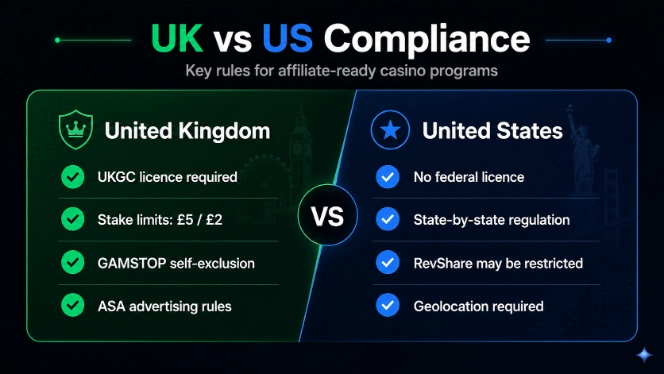
In the UK, operators need a UK Gambling Commission licence to offer real-money casino products to players in Great Britain. Affiliates may not hold the operator licence, but the operator remains responsible for third parties that promote on its behalf. See the UKGC guidance on affiliates or third parties.
Affiliate ads, landing pages, bonus claims, age messaging, and responsible gambling references must also follow UK advertising rules. Useful starting points include the UKGC page on advertising and marketing rules and the ASA’s guidance on gambling advertising.
For UK-facing programs, affiliate terms should cover 18+ messaging, responsible gambling language, bonus rules, GAMSTOP references, approved traffic sources, misleading ad restrictions, brand bidding limits, and content review rights. Operators should also account for online slot stake limits when reviewing slot promotions and bonus messaging. See the UKGC guidance on online slot stake limits.
Treat the US as state-by-state
The US has no single national online casino licence. Operators must check each target state for licensing, affiliate registration, geolocation, advertising, vendor approval, and payout restrictions.
RevShare can be restricted or closely reviewed in some regulated US markets, so many US-facing programs use CPA or flat-fee models. Useful regulator starting points include the NJ Division of Gaming Enforcement, PA Gaming Control Board, and MI Gaming Control Board.
Google also restricts gambling advertising and requires certification for eligible gambling or social casino ads. Operators using paid traffic or media-buying affiliates should review Google’s gambling and games advertising policy. For a deeper platform-compliance view, see our guide on how to secure a gambling licence for online casino apps.
Make the program materials compliance-ready
Compliance should appear inside the affiliate agreement, creative rules, payout terms, landing page standards, and content review process.
Before launch, prepare the NGR definition, payment schedule, minimum payout threshold, negative carryover policy, prohibited traffic rules, brand bidding rules, approved banners, landing pages, deep links, responsible gambling text, and affiliate sign-up page.
Affiliate marketing should also connect with retention. An iGaming CRM system can help operators segment affiliate-acquired players, monitor retention, and build source-level engagement workflows after the first deposit.
Be careful with sweepstakes casino promotion
Some operators consider sweepstakes casino models for a wider US audience, but the legal map is changing quickly. Sweepstakes should not be treated as a shortcut around compliance.
It still needs state-by-state legal review, clear promotional rules, proper player terms, and careful affiliate monitoring. The safest approach is to design compliance before affiliates start promoting, not after traffic starts flowing.
Step 7: Recruit, Track, Optimize, and Scale the Program
Once the offer, software, compliance rules, and affiliate materials are ready, move into launch. Start with quality before volume. A smaller group of trusted affiliates is easier to manage, validate, and protect than an open program with weak controls.
Recruit the first affiliates carefully
Start with 5 to 10 affiliates that match the casino’s target GEO, audience, and commission model. Strong early partners may include SEO review sites, comparison portals, streamers, content creators, media buyers, email publishers, and niche communities.
Outreach should explain why the casino converts, how payments work, which markets are supported, what creatives are available, and what traffic the casino affiliate program wants.
Make onboarding simple and transparent
The first affiliates need fast approval, clean tracking links, clear terms, creative assets, dashboard access, and a direct contact person. Slow onboarding or confusing reporting can push strong partners away early.
A good onboarding flow gives each affiliate commission terms, tracking links, subID rules, compliance rules, approved creatives, landing pages, payout schedule, and reporting access in one place.
Validate traffic before scaling
The first month should focus on validation, not aggressive scaling. Operators should check whether affiliate traffic turns into real player value. Good casino affiliate tracking software should make this review visible by affiliate, campaign, subID, GEO, and player cohort.
Important signals include EPC, registration-to-deposit rate, FTDs, player retention, repeat deposits, affiliate-sourced NGR, GEO compliance, bonus use, chargebacks, and fraud alerts.
Casino affiliate fraud review table
| Risk signal | What it may indicate | What operators should check |
|---|---|---|
| High clicks, low FTDs | Low-quality or misleading traffic | Landing page match, GEO, traffic source, paid campaign claims |
| Many accounts from similar IPs or devices | Self-referral, fake accounts, or bonus farming | Device fingerprinting, IP clusters, KYC overlap |
| Deposit followed by fast withdrawal | Bonus abuse or low-value player behavior | Bonus use, wagering pattern, withdrawal timing |
| Traffic from restricted GEOs | Compliance risk | GEO targeting, affiliate source, VPN patterns |
| Sudden traffic spike from one partner | Paid burst, bot traffic, or source change | Click-to-registration ratio, deposits, fraud alerts |
| High bonus cost with low NGR | Bonus hunters or weak player value | Bonus terms, wagering behavior, repeat deposits |
Bonus abuse is one of the most common risks in casino affiliate traffic because affiliates may send players who only want to exploit welcome offers. For a deeper prevention workflow, see our guide on bonus abuse in iGaming.
Scale only when ROI is proven
A profitable casino affiliate program is not the one with the most affiliates. It is the one where player value is higher than commission cost, fraud risk is controlled, and retention supports long-term revenue.
Before scaling, review LTV:CAC ratio, payback period, blended CAC, affiliate-sourced NGR, retention, partner-level ROI, and traffic quality by GEO and campaign.
Once the data proves that traffic is profitable, compliant, and repeatable, expand with better affiliates, new GEOs, tiered rewards, sub-affiliate options, stronger creatives, and improved reporting.
Realistic Timeline and Budget for Starting a Casino Affiliate Program
A casino affiliate program can launch faster than a full casino platform when the licence, payments, compliance structure, and platform basics are already ready. In that case, operators can often plan for 6 to 10 weeks to launch and validate the affiliate program layer.
If licensing, platform development, payment integrations, legal review, or custom affiliate tracking are still pending, the timeline can extend to several months. Operators still building the wider casino product can compare platform costs in our online casino software development cost guide.
90-day launch roadmap
- Weeks 1 to 2Planning and compliance review
Confirm GEOs, licence position, payout rules, affiliate limits, and responsible gambling requirements.
- Weeks 2 to 3Program design
Finalize commission model, qualified player rules, NGR definition, payout schedule, and affiliate terms.
- Weeks 3 to 6Software and tracking setup
Configure software, tracking links, S2S postbacks, FTD attribution, NGR reporting, fraud checks, and dashboard access.
- Weeks 5 to 7Creative and landing page setup
Prepare banners, deep links, approved bonus copy, compliance messaging, and affiliate sign-up page.
- Weeks 6 to 9Recruitment and onboarding
Reach out to first partners, approve affiliates, issue links, test reporting, and confirm payout rules.
- Weeks 8 to 12Validation and optimization
Test deposits, commissions, fraud alerts, EPC, FTD quality, NGR, retention, and partner-level ROI.
Budget bands
| Budget area | Lean setup | Growth setup | Custom or multi-brand setup |
|---|---|---|---|
| Affiliate software | SaaS starter plan | Advanced SaaS tier | Custom or integrated affiliate system |
| Legal review | Basic GEO review | Multi-GEO affiliate terms | UK/US/state-by-state legal review |
| Creatives | Basic banners and affiliate page | GEO-specific creatives | Multi-brand, multi-language creative library |
| Tracking | Basic dashboard | S2S postbacks, NGR, subIDs | Wallet, CRM, payments, bonus engine, and fraud integration |
| Operations | Founder or marketer handles partners | Dedicated affiliate manager | Affiliate team with regional support |
| Payout runway | Small CPA or Hybrid test budget | Monthly payout budget | Multi-GEO payout pool with tiered rewards |
The largest ongoing cost is usually the affiliate payout budget. CPA deals create faster upfront cost, while RevShare spreads commission over time but needs accurate NGR tracking and transparent reporting.
A realistic budget should include setup cost and payout runway. Without enough runway, the operator may recruit affiliates but fail to keep the program active long enough to measure real player value.
Common Mistakes That Kill Casino Affiliate Programs
A casino affiliate program can look strong on paper and still fail in execution. Most problems start when operators rush recruitment before the commercial, technical, and compliance foundations are ready.
- 01
Launching without clear KPIs
If the program does not define FTD targets, CAC limits, retention goals, and affiliate-sourced NGR from the start, it becomes hard to judge success. More traffic does not always mean better acquisition.
- 02
Recruiting before the casino converts
Affiliates will not keep sending traffic to a casino that has weak conversion, slow KYC, poor mobile UX, unclear bonuses, or withdrawal complaints. A better commission rate cannot fix a broken player journey.
- 03
Copying competitor commission rates
Competitor rates may look attractive, but they may not fit the operator’s margins. Commission models should be built around player LTV, bonus cost, payment fees, chargebacks, and retention.
- 04
Using vague NGR definitions
RevShare disputes often start because the NGR formula is unclear. Operators should define which deductions apply before commission is calculated, including bonuses, taxes, fees, refunds, fraud adjustments, and chargebacks.
- 05
Treating compliance as a later task
Affiliate traffic can create regulatory risk quickly. Operators need clear rules for GEO targeting, bonus claims, responsible gambling messaging, brand bidding, restricted audiences, and affiliate content review before partners start promoting.
- 06
Choosing generic affiliate software
Generic affiliate tools may track clicks, but casino programs need deeper logic. Without S2S postbacks, FTD attribution, NGR tracking, player-level reporting, fraud alerts, and payout controls, the program can become difficult to trust.
- 07
Ignoring payment and payout operations
An affiliate program depends on reliable money movement. If deposits, player withdrawals, commission payouts, PSP routing, or reconciliation are messy, affiliate trust drops fast. For payment-stack planning, see our guide on iGaming payment solutions.
- 08
Scaling before traffic quality is proven
A larger affiliate base also increases fraud risk, payout pressure, and compliance exposure. Operators should scale only after they know which partners bring clean, profitable, and repeatable player value.
Conclusion
A casino affiliate program works best when the operator has clear goals, compliant terms, accurate tracking, reliable payouts, and strong fraud controls. High commissions may attract affiliates, but clean data and player quality decide whether the program becomes profitable.
SDLC Corp builds affiliate-ready casino platforms, white-label casino solutions, sweepstakes casino software, sportsbook platforms, and custom affiliate management systems. If you are planning to launch a casino affiliate program, the right platform setup can make tracking, attribution, fraud control, and payout management easier from the start.
Casino Affiliate Program Consultation
Build a casino affiliate program with cleaner tracking and fewer payout risks.
Share your target GEOs, commission model, affiliate software plans, and launch timeline. We can help map the system and controls before launch.
Review Your Affiliate Program StackFrequently Asked Questions
Do I need a gambling licence to run a casino affiliate program?
If you operate the casino and accept real-money players, you need the correct gambling licence or legal route for each market you target. Affiliates may not always need an operator licence, but the casino operator is still responsible for how affiliates promote the brand.
How much does it cost to start a casino affiliate program?
The cost depends on the program model. Operators should budget for affiliate software or custom development, legal review, creatives, tracking setup, affiliate management, and ongoing payouts. SaaS tools may cost less upfront, while custom systems usually require more initial investment but offer stronger control.
Which commission model works best for casino affiliates?
There is no single best model. CPA works well for fast acquisition, RevShare works better for long-term player value, and Hybrid balances both. The right model depends on player LTV, margins, cash flow, traffic quality, and the operator’s risk tolerance.
Can I use generic affiliate software for a casino program?
Generic affiliate software is usually not enough for casino operators. A casino affiliate program needs casino affiliate tracking software with S2S postbacks, FTD attribution, NGR tracking, RevShare logic, multi-currency payouts, player-level reporting, fraud alerts, and compliance controls.
Is RevShare allowed for casino affiliates in the US?
It depends on the state. Online casino regulation in the US is handled state by state, and some regulated markets may restrict or closely review RevShare deals. Many US-facing operators use CPA or flat-fee models where RevShare creates regulatory or approval concerns.
How do operators detect casino affiliate fraud?
Operators should monitor bonus abuse, self-referrals, fake leads, VPN traffic, restricted-GEO traffic, abnormal click-to-deposit ratios, repeated device or IP patterns, chargebacks, and players who deposit only to claim a bonus. Fraud checks should be active before scaling affiliate traffic.
Is an iGaming affiliate program different from a casino affiliate program?
A casino affiliate program focuses on online casino traffic, players, and commissions. An iGaming affiliate program can be wider and may include casino, sportsbook, sweepstakes, or multi-brand partner campaigns under one affiliate management setup.
What is the difference between casino affiliate software and casino affiliate tracking software?
Casino affiliate software usually covers the full program workflow, including partner management, reporting, commissions, fraud checks, and payouts. Casino affiliate tracking software focuses more directly on attribution events such as clicks, registrations, FTDs, subIDs, postbacks, NGR, and player-level performance.