

Casino affiliate marketing works when operators pay for verified player value, not temporary traffic volume. The channel can scale acquisition, but only when tracking, payout rules, fraud checks, compliance, CRM, and NGR reporting work together.
The online gambling market is growing fast, from $97.7 billion in 2026 to a projected $202.8 billion by 2033, at an 11.0% CAGR, according to Grand View Research.
Acquiring the players behind that growth is getting harder through paid ads alone. Google requires gambling advertisers to meet local laws, country-specific rules, and certification requirements, while Meta allows online gambling ads only when advertisers follow local rules and platform requirements. As those gates tighten, casino affiliate marketing has become a core acquisition channel for operators: a performance-based way to reach high-intent players without betting the budget on impressions.
That is the opportunity. The catch is that this channel rewards operators who run it well and punishes weak attribution, loose fraud checks, and unclear payout rules. This guide explains which affiliate types pay back, where ROI comes from, which commission models to use, what tracking and KPIs matter, and how to build a scalable affiliate program without letting poor traffic quality damage margin.
Key Takeaways
- Affiliate volume is not enough: Operators should measure NGR, repeat deposits, retention, fraud risk, bonus cost, and player lifetime value by affiliate cohort.
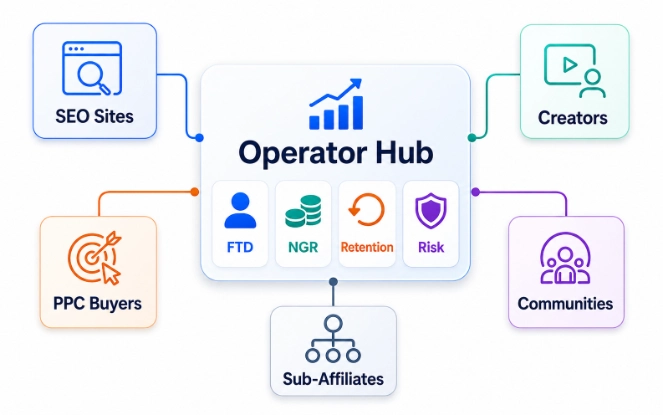
- The right partner mix matters: SEO sites, creators, PPC buyers, communities, and sub-affiliate networks need different payout rules and control levels.
- Commission models should follow player value: CPA, RevShare, and Hybrid deals only work when qualification rules, NGR definitions, and payout windows are clear.
- Build compliance into the program: Use GEO rules, creative approval, traffic-source controls, bonus wording, and responsible gambling language inside the workflow.
What Is Casino Affiliate Marketing?
Full operator-side definition
Casino affiliate marketing is a performance-based acquisition model where online casino operators partner with affiliates who promote their brand through review sites, comparison pages, paid media, streaming channels, communities, email lists, or other traffic sources.
Instead of paying only for impressions or clicks, the operator pays when referred traffic completes an approved action, such as registration, KYC approval, first-time deposit, or revenue-generating play.
For operators, the appeal is simple: affiliate marketing can connect the brand with players who already have gambling intent. A user searching for the “best online casino bonus” or watching a trusted casino streamer is often closer to conversion than a cold audience seeing a generic ad.
However, the model only works when tracking, payout rules, fraud checks, and compliance controls separate profitable players from low-quality traffic.
Best Casino Affiliate Types for Operators
Casino affiliate marketing is not one traffic source. It is a partner mix. The best operators do not recruit for volume alone. They recruit for player quality, clean net gaming revenue, and traffic they can control.
01SEO and Comparison Sites
SEO and comparison sites often bring high-intent players from reviews, rankings, and “best casino” searches. They are hard to win, but strong cohorts can justify RevShare once long-term value is proven.
02Streamers and Creators
Streamers and creators build trust faster than ads because the audience already follows them. Still, reach is not funded value. Test these partners by retention, repeat deposits, and NGR; Hybrid deals often balance upfront motivation with long-term quality.
03PPC and Media Buyers
PPC and media buyers can scale fast, but they need tight controls. Brand bidding, weak sources, and compliance risk can turn volume into lost margin. Use CPA with caps until the partner proves clean 30-day cohorts.
04Social and Community Partners
Social and community partners can send focused players from Telegram groups, Discord communities, or niche audiences. The risk is unapproved claims, weak age controls, or poor responsible gambling language. Keep approval strict and use CPA or Hybrid payouts.
05Sub-Affiliate Networks
Sub-affiliate networks can expand reach through one master partner, but visibility is lower. Use RevShare or Hybrid only when tracking can clearly separate sub-affiliate tiers, campaign IDs, and player quality.
The rule is simple: give more budget to partners who bring retained players, keep high-risk traffic under tighter controls, and never judge an affiliate only by first-time deposits. The right casino affiliate program pays for player quality, not temporary volume.
The Benefits of Casino Affiliate Marketing for Operators
For casino operators, affiliate marketing shifts more acquisition risk from upfront media spend to approved performance. Instead of paying only for exposure, the operator pays when affiliate traffic produces measurable player activity.
| Benefit | Why It Matters | Operator Control |
|---|---|---|
| You Pay for Outcomes, Not Exposure | Paid campaigns can charge for impressions, clicks, or traffic that never becomes a funded player. Affiliate commissions usually trigger only after an approved action, such as a qualified registration, first-time deposit, or revenue-generating activity. | Define qualification events clearly so customer acquisition cost is easier to control. |
| Affiliate Audiences Already Trust Them | A casino review site ranking for high-intent searches, or a creator with a loyal player community, carries trust that a banner ad rarely has. | Use approved claims, accurate offer details, and landing pages that match the affiliate promise. |
| It Helps New Brands Gain Visibility Faster | A new casino entering a crowded market may need months to build SEO traffic or paid-media efficiency. Affiliates can provide faster access to review pages, comparison sites, and player communities. | Start with controlled partners, caps, and validation windows before opening the program wider. |
| It Keeps Spending Tied to Performance | If an affiliate sends traffic that does not convert, the operator does not pay commission. The affiliate carries the upfront effort of building the audience. | Review NGR, retention, chargebacks, and fraud flags before increasing caps or commissions. |
Together, these benefits explain why affiliates play a major role in iGaming affiliate marketing. RAiG says affiliates are widely accepted to deliver 30% to 50% of player acquisition for UK gambling operators. Still, the channel remains profitable only when operators manage traffic quality, attribution, compliance, fraud, and player value with discipline.
How Casino Affiliate Marketing Improves ROI
Casino affiliate marketing improves ROI when operators stop treating every first-time depositor as equal. The model gives better cost control because the program ties commissions to approved player actions. Still, the real return comes from what happens after the player makes a deposit.
Control cost at the qualification level
Affiliate commissions usually trigger after an approved action, such as a first-time deposit, KYC approval, minimum deposit, or qualified play. This protects operators from paying only for impressions, clicks, or visits that never become funded players.
Measure what happens after the first deposit
If the program rewards only first-time deposits, it can attract volume without value. A better program reviews repeat deposits, retention, NGR, bonus cost, fraud risk, and lifetime value by affiliate cohort.
Match the commission model to lifetime value
CPA works when player value is predictable. RevShare helps operators avoid paying ahead of revenue. Hybrid deals balance both, while tiering rewards partners whose players retain longer and generate cleaner NGR.
ROI example: A $150 CPA can look fine at first deposit. But if the player only generates $80 in NGR after bonuses and payment costs, the operator loses money. If another affiliate sends fewer players who average $450 in NGR, that partner creates better ROI.
Done right, casino affiliate marketing ROI comes from retained-player quality after acquisition cost, bonus cost, and fraud risk. It does not come from buying more first-time deposits.
Casino Affiliate Commission Models: CPA, RevShare, and Hybrid
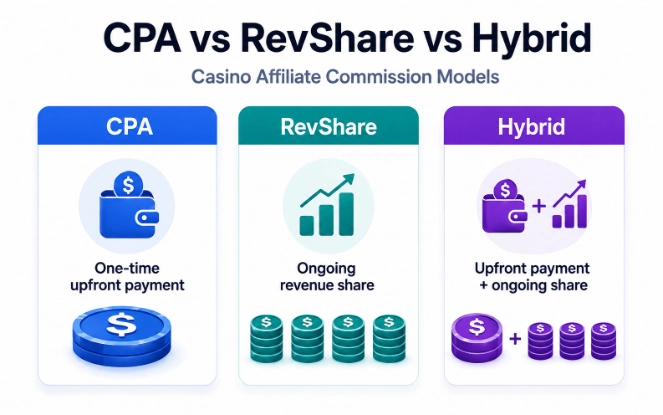
Most casino affiliate payout models use one of three structures: CPA, RevShare, or Hybrid. The right choice depends on how much upfront cost you can carry, how predictable your player value is, and how much risk you want to share with affiliates.
CPA: Cost Per Acquisition
In a CPA deal, the affiliate earns a fixed payout when a referred player completes an approved action. This is usually a first-time deposit, KYC approval, or qualified play.
CPA is useful for fast scaling and new-market launches because the operator knows the acquisition cost in advance. Use CPA when your qualification rules are strong and your average player value is predictable.
RevShare: Revenue Share
In a RevShare deal, the affiliate earns a percentage of the net gaming revenue generated by referred players. The payout continues while those players remain active, based on the contract terms.
RevShare aligns affiliates with player quality, but the contract must define NGR clearly, including bonuses, chargebacks, payment costs, taxes, and negative carryover rules.
Hybrid: CPA Plus RevShare
Hybrid combines a smaller upfront CPA with a lower RevShare percentage. The affiliate gets early cash flow, while the operator keeps part of the payout tied to long-term player value.
This model works well for strong affiliates who want upfront payment but can also deliver retained players. It needs clean tracking, validation, and payout reporting to avoid disputes.
| Model | Best For | Main Risk |
|---|---|---|
| CPA | Fast scaling and predictable player value | Overpaying for early churn |
| RevShare | Long-term retention and player quality | Margin swings and unclear NGR rules |
| Hybrid | Balancing upfront motivation with LTV alignment | Complex tracking and payout calculations |
Public affiliate offers show that CPA and RevShare rates vary by GEO, brand strength, licensing risk, traffic quality, and qualification rules. So operators should not copy market rates blindly. The right model should match real retention, bonus cost, fraud risk, and NGR per player.
Casino Affiliate Tracking, Attribution, and KPIs
Casino affiliate tracking is not only a reporting task. It is the system that shows which partners deserve payment, which cohorts create profit, and which traffic sources create risk.
When affiliates can drive a large share of acquisition, weak tracking becomes a margin problem. It can lead to wrong payouts, missed fraud signals, and poor partner decisions.
Track the Events That Trigger Payment
Clicks do not prove value. Operators should track the events that decide whether an affiliate gets paid: registration, KYC approval, first-time deposit, repeat deposit, wagering activity, bonus use, NGR, withdrawals, chargebacks, and risk flags.
Each affiliate link should carry subIDs for campaign, GEO, landing page, placement, creative, and offer. This helps operators separate profitable traffic from weak traffic under the same partner.
Server-to-server postbacks help here because connected systems confirm key events, not only the player’s browser. Google also notes that server-side tagging can improve data quality and privacy controls.
Treat Attribution as a Payout Rule
Affiliate attribution decides who gets paid when more than one partner touches the same player. Last-click attribution is simple, but it can over-reward deal pages or bonus pages that appear late in the journey.
Multi-touch attribution gives a fuller view, but it needs cleaner reporting. Before scaling, operators should define attribution windows, duplicate-player rules, payout lock periods, and cookie fallback rules.
A 7 to 30-day validation window can help catch failed KYC, chargebacks, bonus abuse, and early churn before operators release commissions. Write the payout lock period into the affiliate agreement instead of handling it case by case.
Measure Affiliate Quality, Not Just FTDs
Strong casino affiliate KPIs should separate payable traffic from profitable traffic.
| KPI Group | What to Track | Why It Matters |
|---|---|---|
| Payable traffic | Qualified FTD rate, KYC pass rate, duplicate accounts, chargebacks, fraud flags | Shows whether operators should pay the traffic |
| Profitable traffic | NGR per FTD, repeat deposit rate, D7/D30 retention, bonus cost ratio, LTV by affiliate cohort | Shows whether the traffic creates value |
The rule is simple: scale affiliates who bring clean 30-day cohorts, not just more first-time depositors. When this data sits in separate tools, operators can use iGaming CRM integration to connect affiliate events with player journeys, retention flows, and reporting.
How to Prevent Casino Affiliate Fraud and Improve Traffic Quality
Casino affiliate fraud is not always obvious. Bad traffic can still show registrations and first-time deposits. The real problem appears later, when players fail KYC, abuse bonuses, withdraw fast, create chargebacks, or disappear before they generate NGR.
For operators, the question is simple: should this traffic be paid, paused, or reviewed?
Use payout gates, not raw FTDs
A first-time deposit alone is too weak as a commission trigger. Add checks for KYC approval, minimum deposit, wagering activity, duplicate accounts, chargebacks, and early retention before releasing payouts.
Score traffic by behavior
Review each affiliate by second deposit rate, D7/D30 retention, bonus cost ratio, NGR per FTD, withdrawal speed, fraud flags, and responsible gambling alerts. If one partner keeps sending bonus-only players, it is poor traffic quality.
Control the source before traffic scales
Many problems start with vague affiliate terms. Require traffic-source disclosure and ban brand bidding, fake leads, misleading bonus claims, incentivized traffic, spam, VPN traffic, and undisclosed sub-affiliates.
Good casino affiliate fraud prevention protects margin by rewarding affiliates for real, retained players, not temporary numbers. For deeper bonus controls, see our guide on bonus abuse in iGaming.
Casino Affiliate Compliance and Licensing by Market
Casino affiliate marketing is legal only when the operator, affiliate activity, traffic source, and target market follow the rules of that market. In regulated markets, the affiliate may promote the brand, but the operator often carries the compliance risk.
The UK Gambling Commission says licensees must take responsibility for third parties they contract with. The ASA also states that primary responsibility for non-broadcast gambling affiliate marketing remains with the gambling operator.
That means affiliate compliance is not a legal footnote. Operators need to build it into the program from day one.
Operator Liability
Treat affiliates as an extension of the casino brand. If a partner uses misleading bonus claims, targets restricted audiences, or promotes in the wrong market, the operator may still face the compliance issue.
Operator control: approve affiliate creatives before they go live, monitor published pages, and keep the right to remove or suspend partners fast.
Responsible Gambling Rules
Affiliate content must follow the same safer gambling standards as the operator’s own marketing. The CAP Code requires socially responsible gambling marketing, with care to protect children, young people, and vulnerable people.
Operator control: give affiliates approved copy, required disclosures, bonus terms, age messaging, and responsible gambling language for each market.
UK and Europe Rules
In the UK and many European markets, operators must treat affiliate marketing as part of regulated customer acquisition. That means affiliate claims, bonus wording, landing pages, age messaging, and responsible gambling content need review before they go live.
Operator control: use market-specific affiliate rules for GEO targeting, bonus wording, landing pages, disclosure text, and payout eligibility.
US State Rules
The US is not one national online casino market. Rules change by state, and affiliate obligations can also depend on whether the partner is paid by flat fee, CPA, RevShare, or player activity.
In Pennsylvania, 58 Pa. Code § 807a.1 covers certain interactive affiliates paid by flat fee. The New Jersey Division of Gaming Enforcement has also described CPA, revenue share, and hybrid compensation models. Operators can use the American Gaming Association State of Play map as a starting point, then confirm the exact affiliate rules with legal counsel.
Operator control: check state rules before accepting traffic, paying affiliates, or launching campaigns. If a state requires registration, vendor review, or licensing, complete it before traffic goes live.
Market and Bonus Restrictions
One market may allow bonus language that another market restricts. Some markets limit “free” claims, welcome offers, urgency wording, or where gambling promotions can appear.
Operator control: create market-specific affiliate rules for GEO targeting, bonus wording, landing pages, and payout eligibility. Operators entering new markets should also review our guide on gambling licenses for online casino apps.
Paid Media and Platform Rules
If affiliates use Google, Meta, or other paid channels, they must follow platform gambling policies as well as local licensing rules. A traffic source that is not approved can create risk even if the player converts.
Operator control: require traffic-source disclosure and ban unapproved paid media, brand bidding, cloaking, spam, and grey-market traffic in the affiliate agreement.
The practical rule is simple: do not rely on affiliates to interpret compliance for you. Build the rules into the program through GEO blocks, creative approval, traffic-source controls, payout restrictions, and market-specific partner terms.
How SDLC Corp Helps Operators Build a Scalable Casino Affiliate Program
Operators do not build a scalable casino affiliate program by adding more partners first. They start by defining how the team approves traffic, validates players, releases commissions, and measures affiliate quality after the first deposit.
SDLC Corp helps operators design this structure around their market, casino platform, CRM, wallet, bonus engine, compliance rules, and reporting needs. The goal is to make the affiliate channel measurable before volume increases.
Start with Program Rules Before Tools
Operators should first define the commercial rules of the affiliate program. This includes CPA, RevShare, and Hybrid terms, qualification events, payout lock periods, negative carryover rules, traffic-source restrictions, and market-specific compliance requirements.
Without these rules, even a strong setup can create payout disputes or margin leakage. With them in place, the operator can decide whether to buy, white-label, or build the systems needed to support the program.
Connect Affiliate Data to Player Value
Affiliate performance should not stop at registrations or FTDs. The program should connect affiliate source data with player behavior, CRM segments, bonus usage, fraud signals, deposits, withdrawals, and NGR.
This is where operators can separate partners who bring real value from partners who only bring short-term traffic. SDLC Corp can support this by connecting affiliate events with iGaming CRM software, operator dashboards, player segmentation, payout validation, and revenue reporting.
Choose the Right Build Route
Some operators only need a fast setup to test affiliate demand. Others need branded partner portals, custom commission logic, multi-brand reporting, sub-affiliate tiers, and deep data integration inside a broader iGaming software development roadmap.
| Route | Best For | What SDLC Corp Supports |
|---|---|---|
| Buy and integrate | Fast launch and simple affiliate programs | Connect third-party tools with casino systems, CRM, wallet, and reporting |
| White-label | Branded partner portal with less build effort | Customize workflows, dashboards, CRM handoff, and payout validation |
| Build custom | Multi-brand control, custom logic, and deep integration | Build affiliate modules for tracking, commissions, fraud checks, BI, and retention data |
Make the route decision measurable: SDLC Corp maps the operator’s affiliate rules, platform dependencies, reporting needs, and compliance controls against a practical rollout checklist. This helps the team choose the right path without overbuilding too early or launching with weak payout controls.
| Framework Area | What SDLC Corp Reviews | Why It Matters |
|---|---|---|
| Platform and route fit | Review whether the operator needs a third-party integration, branded white-label portal, or custom affiliate module based on launch timeline, brand control, and internal resources. | Keeps the build route aligned with budget, timeline, and operational control. |
| Tracking and payout readiness | Confirm source IDs, postbacks, event mapping, duplicate rules, attribution windows, and payout-trigger events before affiliates go live. | Helps operators pay for verified player value instead of raw traffic. |
| Fraud and compliance controls | Connect KYC status, fraud flags, bonus rules, traffic-source restrictions, creative approval, and GEO rules into the affiliate workflow. | Reduces the chance of weak or non-compliant traffic becoming payable traffic. |
| Retention and reporting handoff | Map affiliate cohorts into CRM segments, NGR reports, D7/D30 retention views, and payout dashboards. | Shows which partners bring retained players, not only first-time deposit volume. |
For a deeper platform conversation, operators can review SDLC Corp’s online casino software capabilities and define affiliate workflow scope during discovery. This keeps the affiliate build tied to real system requirements, not generic feature lists.
For operators with an existing casino stack, affiliate tracking should also connect with the online casino software layer, including wallet events, bonus rules, payments, KYC status, and reporting.
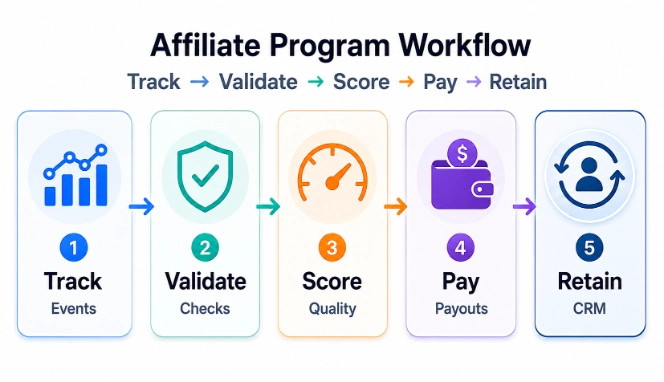
That means tracking the affiliate source, validating the player, scoring traffic quality, releasing payouts with control, and moving retained players into CRM journeys.
For operators comparing software features, our guide to affiliate management software for iGaming operators explains what a serious affiliate setup should include.
SDLC Corp helps casino operators design affiliate programs that connect acquisition, tracking, fraud control, CRM, and revenue reporting in one measurable flow. Whether the goal is a fast integration, a white-label partner portal, or a custom-built affiliate system, keep the focus clear: tie every affiliate payout to verified player value.
Final Thoughts
Casino affiliate marketing can drive strong growth, but only when operators look beyond first-time deposits. The real value comes from partners who bring retained players, clean NGR, and traffic that passes fraud and compliance checks.
When tracking, attribution, payout rules, CRM, and reporting work together, affiliate marketing becomes easier to scale and easier to control. Operators can see which partners are worth growing, which cohorts leak margin, and where they need better systems.
The goal is simple: build a casino affiliate program that does not just bring more players but brings the right players profitably.
Build a Casino Affiliate Program That Tracks Real Player Value
Want to launch or improve your casino affiliate program? SDLC Corp can help you plan, integrate, white-label, or build the systems behind a program that connects tracking, commissions, fraud checks, CRM, and revenue reporting.
Frequently Asked Questions
What is casino affiliate marketing?
Casino affiliate marketing is a performance-based way for online casino operators to acquire players through third-party partners. Affiliates promote the casino through review sites, comparison pages, media buying, streams, communities, or other channels. The operator pays when the referred traffic produces an approved result, such as a qualified registration, first-time deposit, or NGR.
How do casino affiliates get paid?
Casino affiliates usually get paid through CPA, RevShare, or Hybrid deals. CPA pays a fixed amount for an approved player action. RevShare pays a percentage of NGR from referred players. Hybrid combines a smaller CPA with ongoing RevShare.
What KPIs should operators track in casino affiliate marketing?
Operators should track qualified FTD rate, KYC pass rate, NGR per FTD, repeat deposit rate, D7 and D30 retention, bonus cost ratio, fraud flag rate, chargebacks, and lifetime value by affiliate cohort. These KPIs show whether traffic is payable and profitable.
How can operators prevent casino affiliate fraud?
Operators can reduce affiliate fraud with payout lock periods, KYC checks, device fingerprinting, IP checks, payment method checks, duplicate-account detection, traffic-source disclosure, and bonus-abuse controls. Commission rules should reward retained player value, not only raw FTD volume.
Is casino affiliate marketing legal?
Casino affiliate marketing is legal when the operator, affiliate, traffic source, and target market follow local gambling rules. Operators should review each market separately because licensing, bonus language, responsible gambling rules, and affiliate obligations vary by country, state, and payment model.
When should operators buy, white-label, or build their affiliate setup?
Operators should buy when speed matters most, white-label when brand control matters, and build custom when affiliate marketing is central to growth. A custom setup makes more sense when the operator needs multi-brand reporting, custom commission rules, deep CRM integration, or stronger fraud controls.