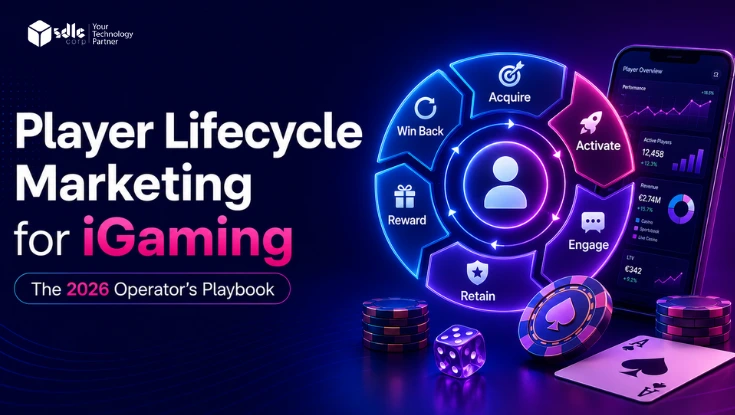
Player lifecycle marketing for iGaming is the strategy of guiding players from first visit to long-term engagement through acquisition, activation, retention, monetization, and reactivation. In practice, operators stop sending the same promotion to everyone and use behavior, stage, value, risk signals, and channel preference to decide what should happen next.
For casino and sportsbook operators, however, the biggest win is not the first deposit. The real goal is turning that first deposit into a second deposit, then into repeat play without bonus fatigue or compliance risk. This guide covers the five-stage lifecycle, CRM triggers, RFM segments, KPI formulas, and safer-gambling controls needed to run lifecycle marketing properly.
Key Takeaways
- Player lifecycle marketing moves each player through five stages: acquisition, activation, retention, monetization, and reactivation.
- Retention is the multiplier on acquisition spend. The first-to-second-deposit window is where most value is won or lost.
- Personalize on behavior, not demographics, and match the message to the moment and the channel.
- Segment with RFM, value tiers, and predictive scoring to decide who gets what and who gets nothing.
- Measure on NGR, retention, and player value, not opens, and build responsible-gambling controls into the system, not on top of it.
Why Player Lifecycle Marketing Decides Who Wins in 2026
In iGaming, acquisition and retention cannot be planned as separate jobs. However, every player acquired through paid search, affiliates, app flows, or organic discovery only creates value when the operator moves them into safe repeat play. In practice, that is harder than in normal eCommerce because real-money gambling ads need jurisdiction-level approval, such as Google gambling certification, and operator marketing must follow market rules such as the UK Gambling Commission advertising and marketing rules.
Player acquisition keeps getting more expensive
Casino and sportsbook growth teams face limits that most industries do not. For example, paid media is restricted by country, platform, licence status, creative rules, and age-gating. Also, affiliates need strict terms because the operator remains exposed when partners make misleading claims. When traffic is costly and tightly controlled, the operator cannot keep replacing churned players forever. The lifecycle has to turn each qualified registration into a real relationship. The same source-quality discipline should also connect with iGaming affiliate software.
Early retention is where the economics are won
The first weeks after a deposit decide whether a player becomes active or disappears. Therefore, the steepest drop-off usually sits between the first deposit and the second, because the welcome offer may create trial but not habit. A lifecycle program protects that window with onboarding, payment confidence, game discovery, personalized prompts, and early churn signals. Winning this moment raises the quality of the whole player base.
How Player Lifecycle Marketing Works
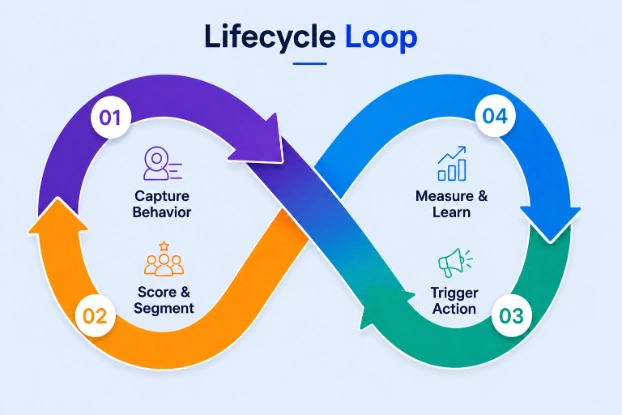
Player lifecycle marketing is a closed loop that runs continuously, for every player, in the background. Then, the same four steps repeat, and each pass makes the next one smarter. As a result, this becomes the engine behind any real iGaming lifecycle automation.
Capture behavior into one profile
Every action a player takes is written to a single player record.
- Registration, deposits, and withdrawals
- Games played, stakes, and session length
- Wins, losing streaks, and quiet spells
This unified profile is the foundation. However, if a player's data is scattered across the casino, sportsbook, and payment systems, none of the steps below work properly.
Score the player and place them in a stage
The system reads player behavior and assigns the player to a segment, such as a high-value regular or a cooling first-depositor. Then it predicts what may come next, such as a likely lapse or a move toward VIP. Good programs recompute this continuously, not once a month.
Trigger the right action automatically
The segment and the prediction decide the response. For example, that may be a personalized offer, reminder, reward, or re-engagement nudge. It also decides the channel, timing, and suppression rules, because sometimes the right action is to hold back.
Measure, then feed the result back
Every action is judged on whether it moved retention or value, not on opens. Then, the outcome updates the player's profile and informs the next decision, so the loop keeps learning.
Events worth tracking: registration_completed, kyc_verified, first_deposit, first_bet, second_deposit, withdrawal_requested, inactive_7_days, rg_risk_flag, and self_exclusion. Each one is a trigger point for the right message, or the right silence.
To see it in one player: she registers, deposits, plays once, then goes quiet for three days. Then, the system flags the cooling pattern, scores her as a churn risk, and emails her a game she actually played. As a result, she returns and deposits. In practice, the same logic applies to every player at once. This is the difference between lifecycle marketing and one promo blasted to the whole list.
The Five Stages of the Player Lifecycle
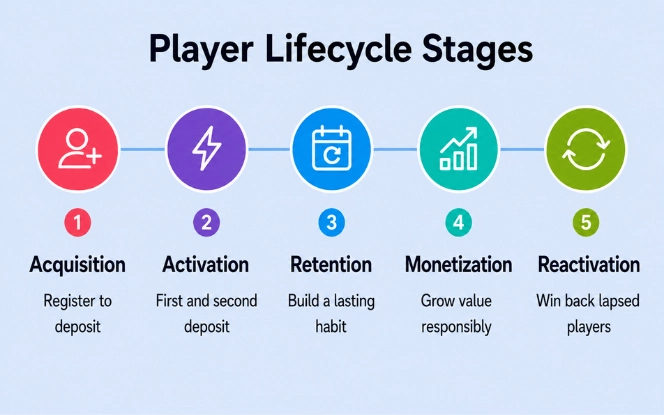
Most credible frameworks land on five stages, because they map to how players actually behave. However, some collapse the journey to three phases. Meanwhile, others stretch it to six milestone moments. Five stages are the most useful working structure, and the key milestones sit inside it.
The lifecycle is not a straight line. For example, a player can deposit once and vanish. Meanwhile, another can sit dormant for weeks, then return for a single event. Also, a third can jump straight to high value. The operator's job is to read each player's current stage and respond to it.
| Stage | Goal | Key trigger | Best channel | KPI that matters |
|---|---|---|---|---|
| 1. Acquisition | Turn a registration into a funded account | Registration completed, KYC verified | Email, on-site | Registration-to-first-deposit rate |
| 2. Activation | Earn the first and second deposit | First deposit, deposited-not-played, second deposit | Push, SMS, in-app | Second-deposit rate |
| 3. Retention | Build a lasting habit | Activity dip, post-withdrawal, new-game match | Email, in-app, push | D7 / D30 retention |
| 4. Monetization | Grow value responsibly | Rising stakes or frequency, VIP threshold | VIP manager, email | ARPU / ARPPU, VIP share of NGR |
| 5. Reactivation | Win back the right lapsed players | Dormancy window hit, churn-risk score | Email, SMS, push | Reactivation rate, reactivated LTV |
Stage 1: Acquisition and Onboarding
Most operators celebrate a registration. However, the smart ones know it is worth almost nothing yet. A sign-up is just intent, and intent fades fast. So the entire job of this stage is to convert that fragile intent into a funded account before it cools. If you win this, the lifecycle begins. If you lose it, the operator paid to acquire a name that never becomes a player.
Three things decide whether a registration becomes a deposit.
Make verification feel like progress, not a wall
KYC is where funded accounts quietly die. A player ready to deposit will not wait through a slow or confusing identity check. Therefore, streamline the flow with AI-based KYC, show clear progress, and keep manual reviews off the critical path. Treat every extra step as a leak, because it is one.
Welcome them with a sequence aimed at the first deposit
Registration should trigger a short onboarding flow on the channels they opted into. Then, explain the product, clearly show the welcome offer, and remove the next click of friction. Every message should point to one action: fund the account.
Carry the source signal into the profile
A player sent by a quality affiliate behaves differently from organic traffic, and they should be treated differently from the first message. Tag the acquisition source on the profile so activation can adapt from day one. The quality of that traffic is set upstream, which we cover in our casino affiliate marketing operator guide.
Measure the right thing: track registration-to-first-deposit rate and cost per funded player rather than cost per registration. Otherwise, counting registrations flatters the numbers. Instead, counting funded players tells the truth.
Acquisition & Onboarding
Plan the first-deposit journey before traffic goes live.
Align KYC, affiliate source tagging, payment events, and onboarding triggers so registrations move into funded accounts without losing momentum.
Plan Your Onboarding FlowStage 2: Activation and the Milestone Moments
A funded account is not a retained player. Instead, it is a player deciding whether to stay. However, that decision is not one moment. Rather, it is a chain of milestones, and each one is a fork between a habit forming and a player slipping away. As a result, most churn is set here, in the first days. So each milestone should become a trigger, with a specific, personalized message ready for each.
Here is the activation journey, trigger by trigger.
- 01
Just registered
Welcome the player and point to one clear next step. Set the tone before momentum fades.
- 02
Identity verified
Make KYC feel like progress, not a wall. Clear the last setup and the path to deposit.
- 03
First deposit
Trust is fragile here. Make depositing effortless, confirm it instantly, and send them straight to their first bet or spin. That trust also depends on fast, clear iGaming payment solutions.
- 04
Deposited, not played
Many players fund, then hesitate. Suggest a low-risk first action matched to what they browsed, and step in fast if they stall.
- 05
Second deposit
This is the signal that matters most. The bonus bought the first deposit. However, the second shows a player is sticking. Therefore, optimize for it, and meet cooling interest early with a timely, matched offer.
- 06
First win
A win feels great, and many players read it as a cue to cash out. Celebrate it, then give a reason to keep going responsibly.
- 07
First withdrawal
A fast, transparent payout builds trust, but it often signals a pause. Reinforce that trust, and give a small, timely reason to return.
- 08
Quiet for a few days
Cooling is an early churn signal. Fire a personalized re-engagement message before a quiet player becomes a lost one.
Measure the right thing: track second-deposit rate, time to first deposit, and first-week active days. The second-deposit rate is the single best early predictor of whether a player will last.
Stage 3: Retention and Engagement
Retention is the long middle of the iGaming player lifecycle. In practice, this is where most long-term value is created or lost. Therefore, the goal is simple to state and hard to execute: become the player's default choice without creating fatigue. Operators do that through always-on journeys, useful rewards, timely triggers, and personalization that makes each message feel relevant.
The campaigns that keep players active
- Loyalty program: tiered rewards, perks, and VIP care that give regulars a reason to stay.
- Lossback or cashback: responsibly-capped cashback that catches a frustrated player on a losing streak before they leave.
- Behavioral triggers: a re-deposit prompt after a withdrawal, a new-game alert matched to play history, or a nudge when activity dips.
- Reactivation triggers: early, automated win-backs the moment a player starts to cool.
A word on bonuses: rewards have their place, but retention built on constant bonus spend is fragile and expensive. The aim is durable engagement and value, not a base that only responds to the next free offer.
Personalization is the engine
Personalization is the difference between a message that engages and one that gets ignored. In practice, it means using each player's own behavior to decide what they see, what they are offered, and when they hear from the operator. For example, that behavior includes preferred games, stake levels, session patterns, and channels. However, generic one-size-fits-all blasts train players to tune out. Content built around the individual keeps them.
It works on two layers. First, personalized content and offers surface the games a player actually plays, then match the reward type, size, and terms to that player's value and behavior. Second, messaging uses the player's last action, preferred product, and next milestone instead of a fixed calendar. Stage 2 shows this in action. For the system behind those journeys, see What is iGaming CRM.
This is also where the market is heading. However, the retention trends shaping 2026 point one way: data-driven, player-individualized messaging, increasingly powered by predictive scoring and AI-assisted content. The operators who treat each player as an individual, not a list entry, are the ones who keep them.
What makes it work, not annoy
Two disciplines protect everything above. First, use gamification with intent: missions, tournaments, and tiers that reward genuine play patterns, mapped to the player's stage, not blasted at everyone. Also, respect cadence: frequency caps and channel preferences matter, because over-contacting players is one of the fastest ways to cause the churn the operator is fighting.
Measure the right thing: track D7 and D30 retention, including cohort retention, plus active days per month and churn rate. Retention curves, not open rates, tell whether any of this is working.
Retention & Engagement
Turn player behavior into timely retention journeys.
Connect lifecycle CRM, activity dips, withdrawal signals, loyalty milestones, offer rules, and frequency caps so players receive relevant messages without bonus fatigue.
Map Your Retention CRMStage 4: Monetization and VIP
In iGaming, revenue is not spread evenly across players. Instead, it concentrates hard. In many iGaming businesses, a small share of high-value players, often a single-digit percentage of the base, drives the majority of revenue. As a result, this changes the job of this stage. It is not about squeezing more from everyone. Rather, it is about identifying the highest-value players early, serving them well, and growing their value responsibly.
Spot VIPs by behavior, before they ask
Do not wait for a player to identify themselves as high value. However, their behavior already shows it: rising stakes, frequency, and deposit patterns. Then, flag those signals early, and route the player to a human VIP manager and the right program before a competitor does the same.
Grow value responsibly, or not at all
Monetization is where the line between good business and harm is thinnest. Therefore, affordability and safer-gambling signals must sit inside the VIP playbook, not beside it. For example, pushing bigger offers at a player who is showing risk signals is both an ethical failure and a regulatory one. Because of that, responsible handling is the strategy, not a constraint on it.
Use cross-sell to deepen value
A player who uses both the casino and the sportsbook is more valuable and harder to lose. Therefore, cross-promote where the behavior shows genuine interest, such as a sports bettor who plays slots between matches. However, do it because the data points to it, not because there is inventory to move.
Measure the right thing: track ARPU, ARPPU, VIP share of revenue, and retention among high-value players. Losing a handful of top players hurts more than losing hundreds of casual ones, so watch the top of the base closely.
Stage 5: Reactivation and Win-Back
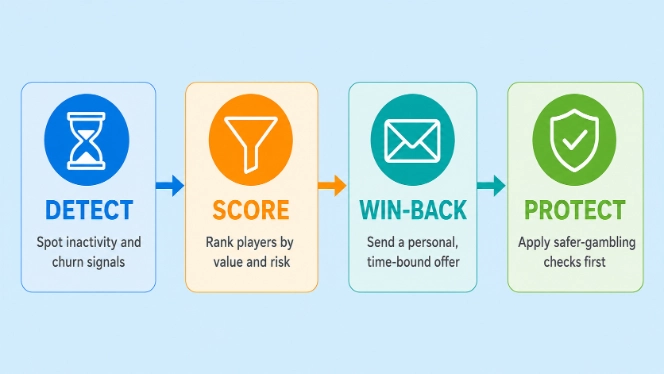
Every operator has a large group of players who once played and then stopped. On a typical platform, lapsed and churned players are often the biggest single segment of the base. That makes reactivation one of the highest-return things an operator can do, because these players already know the brand and once chose to deposit. The job is not to chase all of them. It is to win back the ones worth winning back and leave the rest alone.
Define churn before you fight it
Inactive means different things for different players. A daily bettor who goes quiet for a week is a warning sign. A monthly player at the same point is normal. Many operators define early dormancy around 30 days of no deposit or real-money activity, but the right window should vary by segment. Set lapse windows per segment, so dormant flags actually mean something.
Score dormant players before you target them
Do not blast every lapsed player with the same offer. Use past value, the likely reason they left, and churn-risk signals to decide who gets a win-back, what offer they get, and who is better left alone. A blanket reactivation campaign is expensive, converts poorly, and creates compliance risk.
Make the win-back personal and time-bound
A relevant "we miss you" beats a generic discount. Reference what they actually played, give a genuine reason to return, and put a clear time limit on it. The more it feels made for them, the better it works.
Protect players and control abuse
Reactivation offers attract bonus abuse in iGaming, and they carry real risk if aimed at someone who left to protect themselves. Suppression rules and responsible-gambling checks are not optional here. A player who self-excluded must never receive a win-back.
Measure the right thing: track reactivation rate, cost per reactivation, and the lifetime value of reactivated players. A cheap reactivation that churns again in a week is not a win.
Channels: Matching the Message to the Moment
Lifecycle marketing is not one channel. It is a coordinated stack, and each channel does a different job. The best operators do not pick a channel out of habit. They pick it to fit the moment and the player's preference, then sequence the channels instead of firing them all at once.
In-app and on-site
The highest-signal channel, for players who are already active. Use it for contextual nudges, surfacing the right game, and catching a player whose interest is cooling while they are still on the platform.
Push notifications
Fast and time-sensitive. Ideal for a live event starting, a bonus about to expire, or a win to celebrate. Powerful and easy to overuse, so reserve it for things that are genuinely timely.
The workhorse. Best for richer, personalized content, offers, loyalty updates, and full journeys. It is cost-efficient and pairs well with cross-sell. Email also delivers strong returns across industries, with the Data & Marketing Association putting the average at around $36 for every $1 spent.
SMS
High open rates, best saved for urgent, high-value moments. A stalled first deposit or a time-boxed win-back is a good fit. Use it sparingly, and stay compliant.
The principle ties the stack together. Match the channel to the moment and the player's preference, and respect opt-ins and frequency caps across every one of them. The right message on the wrong channel, or at the wrong frequency, still drives players away.
Player Segmentation: RFM, Value Tiers, and Personas
Every stage and every channel decision above depends on one thing. Operators have to know which players to treat the same and which to treat differently. That is what segmentation does. The strongest programs layer three lenses, each answering a different question.
RFM scoring: the workhorse
RFM scores every player on three axes, then combines them into a single picture.
How recently they played or deposited.
How often they play in a given period.
The net value they contribute, measured by NGR, not just deposits.
Score each axis from 1 to 5, and the operator gets segments that can be acted on at once. A high-recency, high-frequency, high-value player is a VIP to protect. A player who scores high on frequency and value but low on recency is slipping, and that is the highest-return moment to step in. Recompute these scores continuously over live data, not once a month in a spreadsheet.
| RFM tier | How to identify it | Lifecycle action |
|---|---|---|
| VIP / high value | Recent play, high frequency, strong NGR contribution | Protect with VIP care, tailored rewards, and risk-aware limits |
| Rising player | Recent activity with improving stakes, deposits, or session depth | Guide toward loyalty milestones and cross-sell only where interest is clear |
| At-risk value | Good past value but declining recency or frequency | Trigger a timely retention message before the player becomes dormant |
| Bonus-sensitive | Responds mainly to offers, with weak repeat play or low net value | Cap offer cost, test non-bonus engagement, and monitor abuse signals |
| Dormant / churned | No recent deposit or real-money activity inside the lapse window | Score for win-back value, suppress risky users, and avoid blanket campaigns |
Value tiers: align spend with worth
Group players by what they are worth and where they sit in the lifecycle, so spend follows value. Typical tiers run from VIP and mid-tier down to casual, at-risk, and churned. Each tier maps to a different play, from white-glove VIP care to a low-cost automated nudge.
Personas: the why behind the behavior
Segmentation tells who is valuable. Personas tell why they play, so the operator can target the behavior, not just the spend level.
Here is where many programs stop short. RFM and tiers describe what a player has already done. However, they do not tell what a player is about to do. Therefore, predictive, value-based scoring separates good from great. A churn-propensity model flags a player likely to lapse before it happens, and a value-trajectory model spots a rising player before they peak. So the team acts early instead of reacting late. For a wider view of scoring, automation, and risk signals, see AI in iGaming.
The real point is this: the same player data drives segmentation, personalization, messaging, and suppression. Get the data right, and every other part of the playbook gets sharper.
The KPIs and Player Value Formulas That Prove It Works
Lifecycle marketing fails when it is judged on opens and sends. Judge it on retention, revenue, churn, and player value instead. Each stage above names the metric that matters, and this table keeps the core formulas in one place.
| Metric | What it tells you | How to calculate it |
|---|---|---|
| Registration-to-FTD rate | How well sign-ups become funded accounts | First-time depositors ÷ registrations × 100 |
| Second-deposit rate | Whether activation is forming a habit | Players with 2+ deposits ÷ first-time depositors × 100 |
| D7 / D30 retention | Habit strength over time | Cohort still active on day 7 or 30 ÷ cohort size × 100 |
| Churn rate | The leak rate | Players lost in a period ÷ active players at start × 100 |
| ARPU / ARPPU | Value per player, or per paying player | NGR ÷ active players, or ÷ paying players |
| Player LTV | Total value to expect from a player | Monthly NGR per player ÷ monthly churn rate |
| Reactivation rate | How efficient win-backs are | Reactivated ÷ targeted dormant players × 100 |
Two views matter more than any single number. First, use the unit-economics check: a player is profitable only when LTV beats acquisition, bonus, servicing, and compliance costs combined. Second, use the cohort retention curve: track each month's new players as a group, not one blended figure, so the team can see whether this month's players are stickier than last month's.
Reporting note: calibrate these to your own reporting before relying on them, especially what counts as active and NGR versus GGR.
Compliance-Safe Lifecycle Marketing
Retention built only for growth will, sooner or later, message a player it should not. However, in 2026, that is not just bad practice; it is a financial and reputational risk. Therefore, the fix is to treat compliance as a design input, built into the system, not a disclaimer bolted on at the end.
Four rules keep a lifecycle program safe.
Suppress and cool down automatically
A player showing heavy or high-intensity activity should stop receiving promotional prompts before any campaign fires. Build the suppression into the engine, not the workflow.
Put safer-gambling signals inside segmentation
Risk indicators must be able to override any offer. A high-value churn target and a high-value at-risk player can look identical in the data, and the system has to tell them apart.
Gate offers by jurisdiction
Bonus terms, wagering limits, and messaging rules differ by market and change often. Enforce the right rules per player location automatically, instead of relying on a marketer to remember them.
Respect self-exclusion and limits absolutely
Self-exclusion and deposit-limit states must hard-block every lifecycle message. There is no exception for a good win-back offer, ever.
Handled this way, compliance is not a brake on growth. Instead, it supports it. Because players trust a safer operator, they stay longer, and clear, honest offers retain better than aggressive ones. Therefore, build the program around the current rules and player-protection standards, including the UK Gambling Commission customer interaction guidance, Google gambling ads policy, and the support resources at GamCare and BeGambleAware, plus the regulators in active markets.
What It Takes to Build a Player Lifecycle Marketing System
Every tactic in this playbook depends on the system underneath it. None of it works if the operator cannot see the player. Personalization, timing, suppression, and scoring all run on knowing who a player is and what they just did.
However, this is where most programs break: casino, sportsbook management software, payments, and KYC data sit in separate systems, so segments are built on stale data and triggers fire a day late. As a result, the campaigns may look fine while the fragmented view beneath them blocks performance.
If you are planning or upgrading a player lifecycle management program, this is the checklist that matters.
One record per player, pulling together deposits, gameplay, bonus history, KYC status, and channel preferences.
Player events are captured and acted on the moment they happen, not in tomorrow's batch.
Continuously recomputed segments and behavior-triggered journeys, so the loop runs without manual lifts.
Rules-based rewards matched to player value, with cost control built in.
Affordability and self-exclusion checks that can override any campaign.
Email, SMS, push, in-app, and VIP management working from the same profile.
Live visibility into NGR, retention, churn, reactivation, and segment value.
Whether the operator buys a specialist platform, builds a custom engagement layer, or runs a hybrid is a separate decision. The constant is that this layer sets the ceiling on how good lifecycle marketing can ever be.
How SDLC Corp Builds Player Lifecycle Systems
SDLC Corp helps iGaming operators build the data and engagement layer behind player lifecycle marketing. We connect casino, sportsbook, payments, KYC, CRM, bonus, reporting, and responsible-gambling systems so lifecycle campaigns can run from one real-time player view.
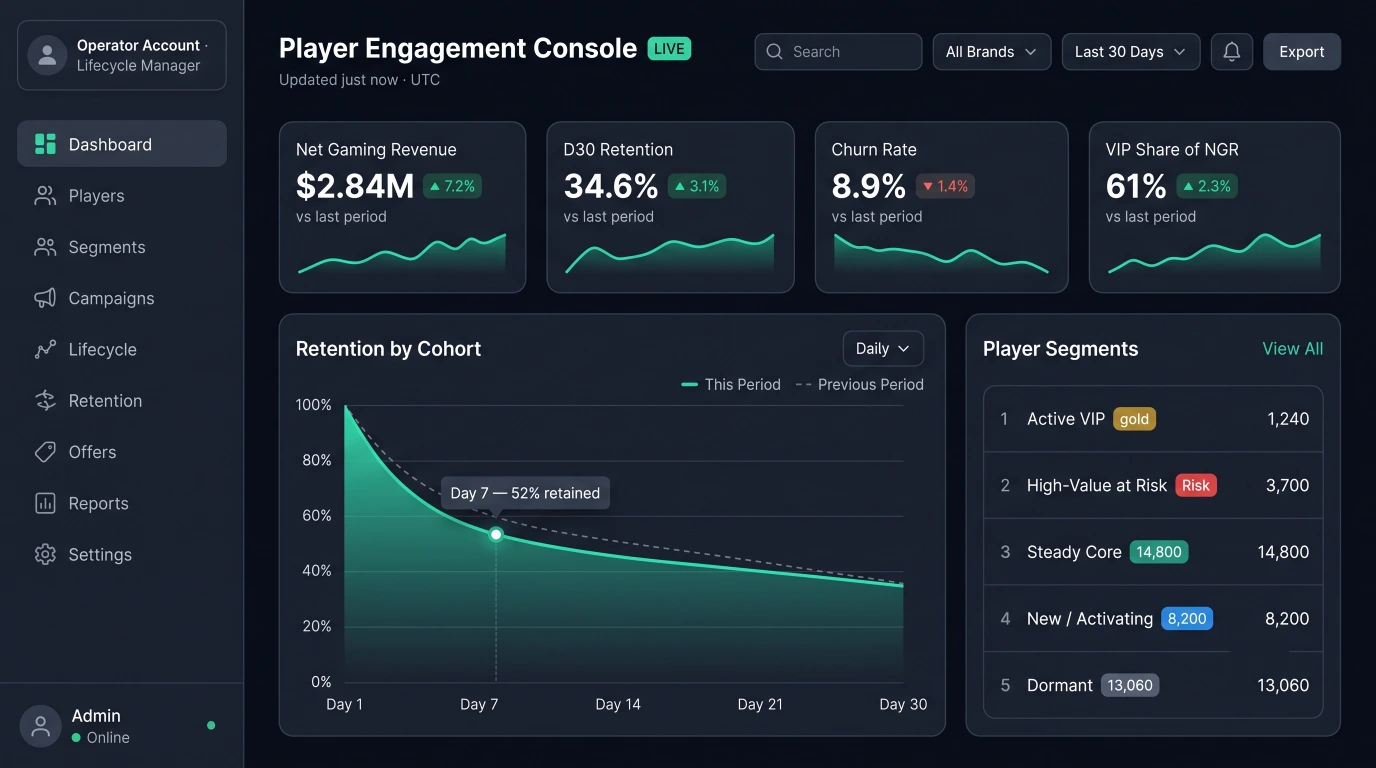
That means we can build, integrate, or extend the full stack.
Player Data, CRM, and Engagement Stack
Unify player data before you scale lifecycle campaigns. SDLC Corp connects casino, sportsbook, payments, and KYC into one real-time player profile, with the segmentation, bonus, and responsible-gambling engines your campaigns depend on.
PAM integration that pulls casino, sportsbook, payments, and KYC into one real-time profile, built on the online casino software and player-management layer.
A custom iGaming software development pipeline that turns player actions into triggers in minutes, which is the part most operators underestimate.
iGaming CRM software, bonus engine, segmentation, and responsible-gambling controls connected from day one rather than bolted together later.
Dashboards and reporting your team needs to see NGR, retention, churn, and segment value at a glance.
Whether you are launching a new platform, replacing a CRM that cannot keep up, or connecting systems that do not talk to each other, our teams can build the foundation your lifecycle marketing runs on.
Player Lifecycle System Build
Build the player-engagement layer behind the campaigns.
SDLC Corp connects player profiles, real-time event pipelines, lifecycle CRM, bonus logic, reporting, and responsible-gambling suppression into one operating system.
Discuss Your Player Engagement BuildConclusion: Build the System, Not the Campaigns
Player lifecycle marketing is not a campaign you launch. Instead, it is a system you run. As a result, the operators who win in 2026 are not the ones with the biggest bonus. They are the ones who read each player's stage, send the right message at the right moment, respect the limits, and measure on revenue, not opens.
Do that, and the gains compound. One-time depositors become regulars, and lapsed players come back instead of leaving for good. People see the campaigns, but the data and system beneath them decide whether any of it works.
Frequently Asked Questions
What is player lifecycle marketing in iGaming?
It is the practice of guiding each player through the stages of their journey and acting on each one based on their behavior. In practice, the stages are acquisition, activation, retention, monetization, and reactivation. Therefore, the goal is responsible lifetime value, not a single deposit.
What are the stages of the player lifecycle?
There are five. Acquisition is discovery and registration. Activation is the first deposit and first session. Retention is habitual play. Monetization is at its peak and VIP value. Reactivation is winning back lapsed players. Players move through them in no fixed order, so operators respond to each player's current stage.
Why is player retention so important in iGaming?
Because iGaming acquisition is expensive, restricted, and highly competitive. Retention makes that spend pay back by moving players from registration to first deposit, second deposit, repeat sessions, and reactivation. Strong retention also protects the base from bonus fatigue and avoidable churn.
How does personalization improve player retention?
It makes every message relevant, so players stop tuning out. By using each player's behavior, operators tailor the content, offers, and emails they receive. In practice, that means surfacing the games they play, matching offers to their value, and triggering email off their actions instead of a fixed calendar.
How do operators reduce player churn?
By acting early and specifically. Segment on behavior, personalize content and offers, trigger on real actions rather than a schedule, match the channel to the moment, and step in on high-value players the moment they show cooling signals. Over-messaging is itself a major cause of churn, so cadence matters as much as content.
What is RFM segmentation for casino players?
RFM scores each player on Recency, Frequency, and Monetary value. Combined, those scores create segments operators can act on, such as VIPs to protect, high-value players slipping toward churn, and dormant players to suppress. It decides who gets which message, offer, or hold-back.
What is an iGaming CRM, and how does it fit lifecycle marketing?
An iGaming CRM is the system that unifies player data and automates lifecycle communication across the journey. It runs real-time triggers, segmentation, bonus rules, channel orchestration, and responsible-gambling suppression for lifecycle marketing.
How is player lifetime value calculated in iGaming?
A simple working formula is monthly NGR per player divided by monthly churn rate. Therefore, calibrate the inputs to your own reporting, including what counts as active and NGR versus GGR, and validate against cohort data rather than one blended figure.