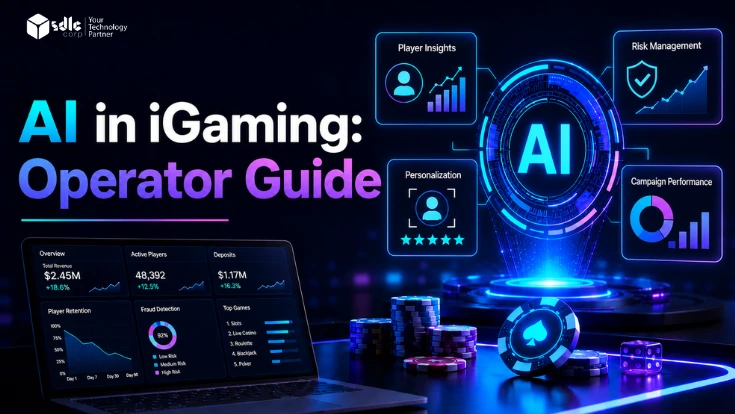
AI in iGaming works best when it helps operators make faster decisions, protect margin, improve player journeys, and keep risk teams focused on the cases that matter.
Casino and sportsbook teams make fast decisions every day. A player signs up, deposits, claims a bonus, places a bet, contacts support, or requests a withdrawal. Each action creates a signal that helps the platform decide what should happen next.
This is where AI in iGaming becomes useful for operators. It helps teams spot suspicious patterns earlier, shape offers with more care, route payments better, answer routine support faster, and flag risky play before it becomes a bigger compliance or revenue problem.
Key Takeaways
- AI works best when it is tied to a real operator workflow, not a vague promise or a disconnected tool.
- The strongest use cases improve risk control, retention, payments, support, trading decisions, and player protection.
- Operators should judge AI by lower risk, faster reviews, cleaner evidence, better retention, and less manual work.
- People still need to own sensitive decisions, including account closures, payment holds, disputes, and safer gambling actions.
- For most regulated operators, a hybrid setup is the safest path because it avoids full rebuilds and black-box tools.
Start with one AI workflow
Begin where the business case is clear, such as bonus abuse, payment review, CRM timing, support queues, or sportsbook exposure.
What Is AI in iGaming?
AI in iGaming means using machine learning, predictive analytics, automation, and generative AI to help online casino and sportsbook platforms make faster, safer, and more accurate decisions.
Every player action creates a signal. A player may sign up, deposit money, claim a bonus, place a bet, contact support, or request a withdrawal.
Instead of treating each action as a separate event, the platform can read those signals together and decide the next step with better context.
How AI Reads Operator Signals
Inside the platform, AI works like a decision-support layer. It studies player behavior, payment data, betting activity, support chats, bonus claims, and risk signals.
From there, the system can suggest the next action. It may allow the request, flag it, send it for review, personalize the offer, automate a basic response, or escalate the case to a human team.
Main AI Types Used in iGaming
Before choosing a tool, operators should separate the main AI types. Each type supports a different task, so teams should not treat every AI feature as the same thing.
- Machine learning studies past behavior and finds patterns that may point to fraud, bonus abuse, bot activity, linked accounts, or unusual player activity.
- Predictive analytics looks ahead and helps estimate churn, VIP growth, payment risk, sportsbook exposure, and campaign waste.
- Generative AI and AI agents support text-heavy work, such as drafting case notes, summarizing support chats, answering basic player questions, and helping teams move faster.
Where AI Creates the Most Value
Real value does not come from adding AI everywhere. It comes from applying it to workflows where speed, accuracy, and risk control matter most.
In practice, that means starting with the places where teams already lose time, margin, or visibility.
Why Data Safety Comes First
Player data should be protected before any AI workflow goes live. When the system reads behavior, payment activity, support history, and risk signals, it needs access control, data masking, audit logs, and clear review steps.
Handled this way, AI in iGaming is not just a trend or a chatbot feature. It becomes a practical layer that helps platforms use the data they already hold with better control, clearer decisions, and faster action.
Best Uses of AI for Operators
The best use cases are practical. They protect margin, reduce manual work, improve player value, or help teams act faster.
The key is to connect AI with the systems your teams already use. A trusted workflow matters more than another dashboard no one uses.
Player Behavior and Retention
The system watches how each person plays: the games they open, how often they deposit, the sessions they skip, and the offers they ignore.
That helps teams spot a player cooling off before they go quiet.
No two players behave the same way. A casino player may return for fast slots, while a sportsbook bettor may only care about weekend football.
These signals help teams shape what each player sees, including games, offers, messages, and timing.
Personalized recommendations also help players find relevant games and support faster when the logic is tied to real behavior, not generic segments.
Responsible use matters here. Promotional journeys should ease off when a player shows risk signals. In one internal retention build, a smarter bonus engine lifted retention by 29%.
Predictive CRM
Behavior data tells your CRM team what happened. Predictive analytics helps the team see what may happen next.
It can show who may churn, who may become a VIP, and which offer is likely to return value.
That head start changes campaign planning. Instead of sending broad offers to everyone, your team can spend on players who are worth retaining.
This is where AI CRM for iGaming operators becomes useful. It helps teams reduce wasted offers and avoid rewarding players who were already going to return.
The real value comes when AI changes the outcome, not when it gives credit to an action that would have happened anyway.
Fraud and Bonus Abuse Detection
Abuse no longer sits only at signup. It moves through deposit, bonus claim, gameplay, and cashout.
AI helps link those steps together so your team can see the full pattern, not just one account event.
For example, one device may open several accounts, claim the same welcome offer, move through low-risk wagering, and rush toward withdrawal.
A rule-based setup may catch only part of that journey. AI fraud detection in iGaming can flag the linked pattern before payout.
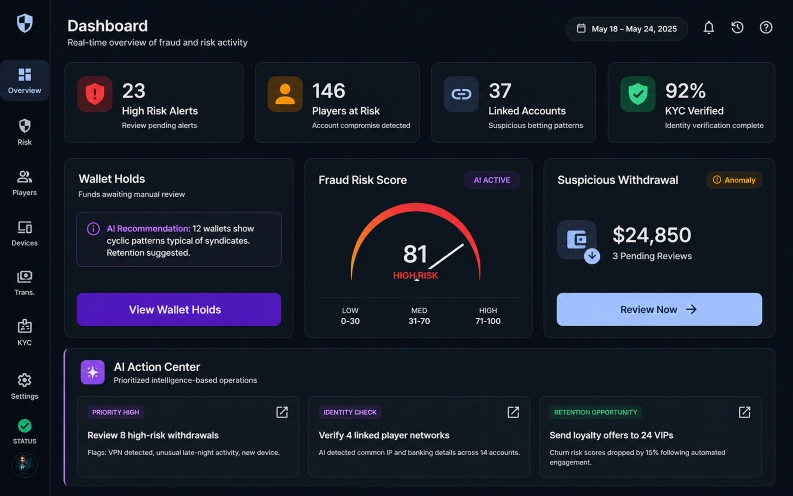
This matters because every blocked loss stays in your margin. Connecting device, bonus, gameplay and payment signals lets risk teams catch linked accounts before payout rather than after it.
Support Automation
During peak moments, support queues can grow fast. An AI chatbot can answer routine questions about bonuses, login issues, payout status, account help, and basic rules.
For players, the benefit is speed. They get help in seconds, in their language, without waiting through a long queue.
For the operator, the benefit is workload control.
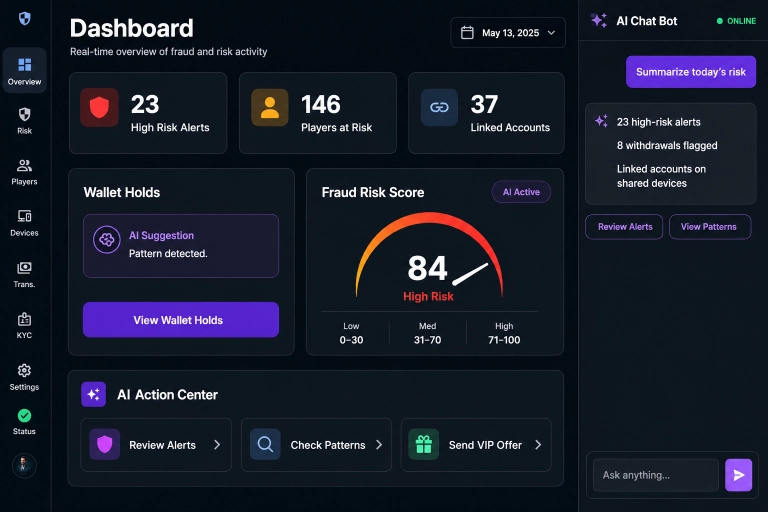
Escalation matters. When a question involves disputes, payment risk, harm signals, or regulatory issues, the chatbot should pass the case to a human with the full context attached.
Why Speed Matters for Operators
Across all of these use cases, the win is not clever technology for its own sake. It is speed.
Operators can act while the event is happening, not after the loss has already appeared in a report.
How AI Grows Revenue
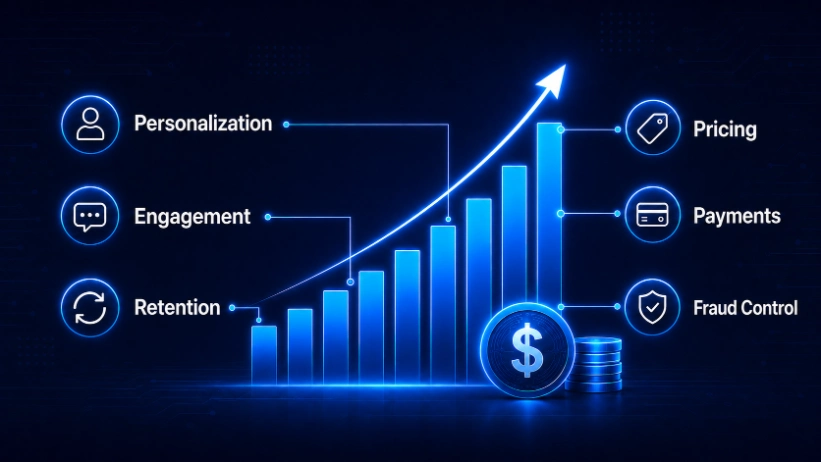
Revenue growth does not come from AI alone. It comes from better timing, sharper targeting, fewer failed payments, less bonus leakage, and faster action from your teams.
For operators, the goal is simple: increase player value while reducing hidden losses that weaken margin. A useful setup supports that goal inside daily revenue workflows.
Higher Player Value
Acquisition is expensive, so the real margin sits in what a player does after signup. A live player profile helps teams decide who needs a better offer, who needs support, and who should not be pushed harder.
McKinsey reports that personalization can lift revenue by 5% to 15% and cut customer acquisition costs by as much as 50%.
For iGaming operators, this does not mean sending more bonuses. It means sending the right offer to the right player at the right time, with risk controls in place.
Better Engagement From the Same Traffic
When the lobby, offers, and sportsbook markets match real player habits, users find what they came for faster. That can lift engagement without adding more ad spend.
Casino teams can improve game discovery. Sportsbook teams can surface relevant markets. CRM teams can time campaigns better, while support teams reduce friction before frustration turns into churn.
Smarter CRM Campaigns
CRM teams can move from broad campaigns to behavior-based journeys. Instead of treating every player the same way, they can act on churn risk, deposit patterns, game interest, and bonus response.
This improves campaign quality because the platform can separate valuable retention opportunities from risky bonus behavior. As a result, operators spend less on weak offers and focus more on players who can return long-term value.
Lower Payment Loss
A good player who gets declined at deposit may not come back. Smart payment routing can help recover failed attempts, improve approval rates, and speed up cashouts for genuine players.
At the same time, risky payouts can be held for review. That gives operators a better balance between player trust and fraud control.
Stronger Sportsbook Margin
On the sportsbook side, pricing support can help teams cover more markets than a manual desk can manage alone. It can also warn traders when exposure starts building in the wrong place.
That matters most in live betting, where delays, stale odds, and fast market movement can create margin pressure quickly.
Cleaner ROI Proof
The clean way to prove the lift is with a control group. Hold back a small group, compare results, and check whether the workflow created value or only rewarded players who were already likely to return.
This helps operators avoid buying tools based only on dashboard claims. It also gives leadership a simple answer: did this workflow reduce risk, increase value, or save team time?
How AI Protects Your Business
Growth does not matter if money leaks back out. The damage may come from bonus farms, account takeovers, chargebacks, weak identity checks, risky withdrawals, or player protection gaps.
Protection starts when the platform can connect signals across device, wallet, gameplay, betting, bonus claims, deposits, and withdrawals. Without that shared view, teams often see the problem too late.
Fraud Detection Across the Player Journey
A strong risk layer reads suspicious behavior across the full player journey. Fraud looks different across casino, sportsbook, and payments, so each area needs the right signals.
A casino risk pattern may involve linked accounts and repeated bonus claims. A sportsbook pattern may involve arbitrage, stale odds, or after-goal betting. In payments, the main concern may be account takeover, chargebacks, or risky withdrawals.
Fraud Signals by Vertical
Casino fraud, sportsbook abuse, and payment risk do not behave the same way. The table below shows how protection changes by vertical and why each area needs its own review flow.
| Where It Hits | The Fraud You Face | What the System Does |
|---|---|---|
| Casino | Bonus abuse and multi-accounting | Links related accounts and scores bonus claims before payout. |
| Sportsbook | Arbitrage and after-goal betting | Spots odd betting patterns the moment they appear. |
| Payments | Account takeover and chargebacks | Scores each transaction and holds risky payouts for review. |
Connected risk signals give reviewers the linked-account evidence they need before a payout leaves the platform.
KYC and AML Without Slowing Good Players
Verification teams need speed without weak checks. Low-risk players should move through quickly, while higher-risk cases should reach the right reviewer with clear reasons attached.
The strongest setup connects identity checks, sanctions screening, PEP checks, device signals, payment behavior, and transaction monitoring. When the risk is low, the player moves through with less friction.
Higher-risk cases should go to review with enough context for the analyst. That makes player verification, AML monitoring, and compliance reporting easier to manage.
Case notes can also be drafted for analysts, but serious decisions still need a trained person, reason codes, and an audit trail. This is especially important when the decision affects withdrawals, account access, AML escalation, or regulatory reporting.
Player Data Protection
Any new decision layer should never open a new data leak. Operators need clear rules for where player data is processed, who can access outputs, whether data trains a model, and how long logs are stored.
The UK Gambling Commission has already shown interest in how AI affects gambling regulation, data use, and consumer protection.
Because of that, the setup should include access controls, data masking, audit logs, vendor rules, and review steps for any automated decision that can affect a player.
Responsible Gaming Evidence
Player protection needs a careful balance. Rising stakes, chasing losses, unusual session length, sudden behavior changes, and repeated deposit patterns can all point to a case that needs attention.
Even then, the final sensitive call should stay with a trained person. AI should support the review, not replace the team responsible for player protection.
Our aim is to empower operators with insights, not overstep. We see it like a lane-keeping assistant in a vehicle, helping course-correct before harm escalates.
Rasmus Kjaergaard, CEO, Mindway AI, via SiGMA News
Used well, AI supports safer decisions, creates evidence, and helps teams act earlier. It should not replace human judgment in sensitive player protection cases.
The EU AI Act entered into force on 1 August 2024 and is scheduled to become fully applicable on 2 August 2026, with some exceptions. For operators, that makes audit logs, explainable alerts, and clear ownership more important.
Review risk controls
Make sure decisions around identity checks, payments, withdrawals, AML, and responsible gaming are explainable, logged, and reviewed by the right people.
How to Implement AI Into Your iGaming Platform
The safest rollout has two parts. First, choose the right build path. Then add one workflow without breaking the rest of the platform.
Implementation should not start with a random tool. It should start with one clear use case, such as fraud review, CRM automation, payment routing, player verification, or sportsbook risk control.
Step 1: Choose the Right Implementation Path
Operators usually have three choices: build in-house, buy a ready tool, or use a hybrid setup. The right path depends on data quality, team size, compliance needs, budget, and control over final decisions.
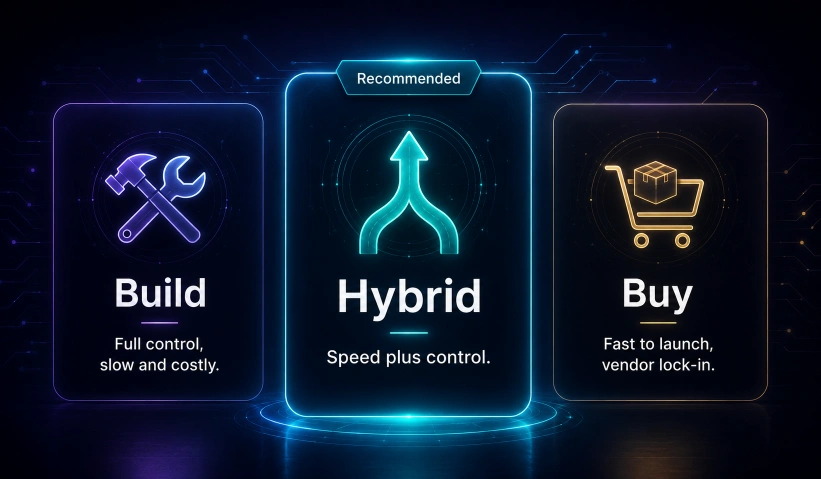
Use the comparison below to choose the path that fits your operating model. Speed matters, but clean integration, explainable decisions, and clear ownership matter just as much.
| Path | Best For | The Catch |
|---|---|---|
| Build | Large operators with in-house data and compliance teams. | Slow, costly, and you own every audit. |
| Buy | Operators who need a proven tool live fast. | Vendor lock-in and black-box decisions. |
| Hybrid | Most regulated casino and sportsbook operators. | Needs clean integration and clear ownership. |
Why Hybrid Works Best for Regulated Operators
A hybrid path often gives regulated operators the best balance. You can buy the hard parts, such as a fraud engine, risk model, or personalization tool, while keeping rules, thresholds, and final decisions under your own control.
This matters because regulators, compliance teams, and internal reviewers need clear reasons. They should understand why a player was flagged, why a payout was held, or why a player protection action was triggered.
Hybrid implementation also makes it easier to connect the model with existing player account, CRM, wallet, sportsbook, casino, payment, support, and reporting systems.
As an iGaming software development company, SDLC Corp can help operators add AI without forcing a full platform rebuild. Casino-first teams can also review our casino game development services.
Step 2: Roll It Out in the Right Order
Do not start with every workflow at once. Start small, prove value, and tune the system before expanding.
Once the build path is clear, the rollout should move in a controlled order. This keeps the first version useful without flooding teams with weak alerts.
- Start with one workflow Pick the biggest leak first, such as bonus abuse, failed payments, sportsbook exposure, fraud review, or churn.
- Fix your data first Create one player view and a live event feed before judging the model.
- Keep people on big calls Use human review for withdrawals, account closures, identity rejections, AML cases, and player protection actions.
- Tune thresholds slowly Start strict, review false positives, and adjust week by week with the operator team.
How to Avoid a Weak AI Rollout
The first version often over-flags. If alerts are too wide on day one, your queue fills with honest players. Then reviewers rush, and real abuse can slip through.
A smarter model is not always the fix. In many cases, better threshold tuning with fraud, risk, support, and compliance teams solves more than another dashboard.
This is why the rollout should be planned around workflows, not only features. Our AI development services can support data setup, workflow design, model integration, and rollout tuning.
What to Expect After Adding AI
Once the workflow is live, the gains usually show up in three areas: lower leakage, better player value, and less manual work.
The impact may not look loud at first. It becomes visible in cleaner queues, faster reviews, and fewer weak alerts.
Less Leakage From Abuse
Risk teams can catch bonus abuse, account takeover, risky withdrawals, and payment fraud earlier. Over time, weak alerts reduce, so reviewers can focus on real cases instead of checking normal players all day.
Better Player Value
CRM teams can spot churn signals, VIP growth, campaign waste, and bonus response patterns sooner. Casino teams can improve lobby order, while sportsbook teams can respond faster to exposure and market demand.
Cleaner Compliance Review
Identity checks, sanctions screening, duplicate account detection, AML monitoring, and document review become easier when the case reaches analysts with enough context and a clear audit trail.
Less Manual Work for Teams
Case summaries, ranked alerts, and suggested next steps can reduce repetitive checking across fraud, support, payments, compliance, and player protection workflows.
The team does not disappear. It gets cleaner signals and more time for the calls that need judgment.
The Bottom Line for Operators
AI in iGaming is not about chasing a trend. It is about acting faster on the things that already decide your month: abuse control, retention, payment success, support load, trading risk, and audit evidence.
Start where the problem is clear. Pick one workflow, prove the lift, and then expand. That is how AI stops being a buzzword and starts paying for itself.
When you are ready to map the first use case to your own platform, SDLC Corp can help you build around your existing setup.
Talk to our iGaming AI team
Map one workflow around the problem that matters most, whether that is abuse control, payment review, CRM timing, support queues, trading risk, or player protection.
Frequently Asked Questions
1. What is AI in iGaming?
AI in iGaming uses machine learning, predictive analytics, automation, and AI agents to help casino and sportsbook operators make faster decisions from player, payment, betting, and support data.
2. How can AI help iGaming operators?
It can spot suspicious patterns earlier, improve offer timing, route payments better, speed up routine support, highlight sportsbook exposure, and give review teams clearer evidence.
3. Can AI reduce fraud and bonus abuse?
Yes. It connects signals from devices, bonus usage, gameplay, payments, and withdrawals. That helps teams flag linked accounts and suspicious bonus journeys before payout.
4. How should AI support identity and AML checks?
It should help review identity signals, sanctions results, device behavior, transaction patterns, and risk notes. Higher-risk cases should still go to trained analysts with clear reason codes.
5. How can AI improve player retention?
It can read churn signals, deposit behavior, game interest, campaign response, and bonus risk. This helps teams send better offers while avoiding wasteful or risky promotions.
6. How does AI support responsible gaming?
It can monitor session length, deposit frequency, rising stakes, sudden behavior changes, and loss chasing. Sensitive cases should still be handled by trained people.
7. Should operators build or buy AI?
Most regulated operators should choose a hybrid path. They can use proven tools for speed while keeping rules, thresholds, risk ownership, and final decisions under their own control.
8. How much does it cost to add AI to an iGaming platform?
It depends on your platform, data setup, use case, and compliance needs. A single workflow costs far less than a full platform upgrade. For planning, see our guide on casino software development cost.