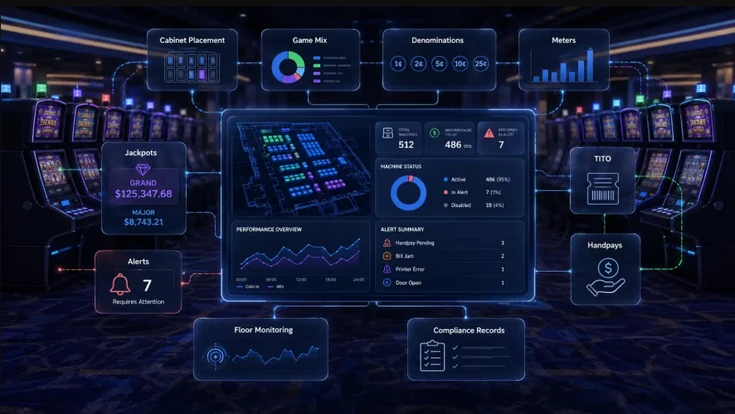
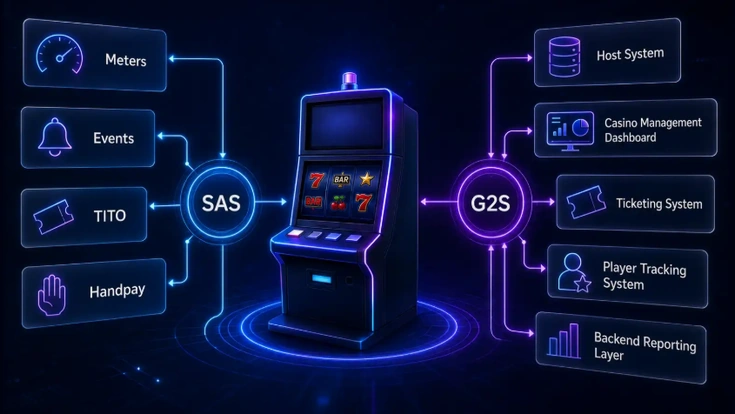
SAS and G2S protocols help slot machines and electronic gaming machines connect with casino systems. They allow machines to share ticket, meter, player, and game data with management, tracking, monitoring, and reporting platforms.
Quick Summary of SAS and G2S Protocols
| Area | What It Means |
|---|---|
| SAS | Slot Accounting System protocol commonly used for EGM-to-host communication |
| G2S | Game-to-System protocol used for structured game-to-system messaging |
| Used in | Slot machines, EGMs, casino systems, monitoring systems, ticketing systems |
| Main purpose | Move data between the gaming machine and host systems |
| Common data | Meters, events, vouchers, handpays, player tracking, machine status |
| Operator value | Reporting, monitoring, reconciliation, alerts, ticket review, system visibility |
Why Slot Machines Need Communication Protocols
An EGM can generate game results, update credits, print tickets, record events, and store meter values inside the machine. But operators often need this information outside the cabinet.
A host or casino management system may need to know:
- How many credits were wagered
- How many credits were won
- Whether a ticket was printed
- Whether a ticket was inserted
- Whether a handpay was triggered
- Whether the machine door was opened
- Whether the printer has a fault
- Whether the bill validator has an error
- Whether the machine is online
- Whether event records were received
Without a communication protocol, each machine and backend system would need custom communication logic. Protocols create a structured way for machines and systems to exchange information.
What Is SAS in Slot Machines?
SAS stands for Slot Accounting System.
In slot machines, SAS is commonly used as a communication protocol between an EGM and a host system. It is often associated with machine accounting, meter reporting, event reporting, ticketing, handpays, and machine status communication.
IGT's SAS protocol page references SAS protocol documentation and SAS 6.03, including updates over earlier SAS 6.02 errata and addenda.
In practice, SAS may support areas such as:
- Accounting meters
- Game meters
- Ticket-in records
- Ticket-out records
- Bill validator activity
- Handpay events
- Jackpot events
- Machine status
- Door events
- Printer events
- Progressive reporting
- Player tracking features, where supported
SAS is widely known in land-based gaming environments because many slot floors and casino systems have used SAS-based machine communication for years.
What Is G2S in Slot Machines?
G2S stands for Game-to-System.
G2S is a messaging protocol used for communication between gaming devices and gaming systems. IGSA's G2S committee describes G2S as a message protocol for game-to-system messages between gaming devices, gaming systems, and associated equipment.
G2S can support communication areas such as:
- Meter reporting
- Event reporting
- Game status
- Device status
- Voucher activity
- Player tracking
- Bonusing
- Progressive features
- Configuration messages
- Authentication messages
- System monitoring
- Software or content-related messages
The main idea behind G2S is to help gaming devices and systems exchange messages in a standard manner.
SAS vs G2S: Key Differences
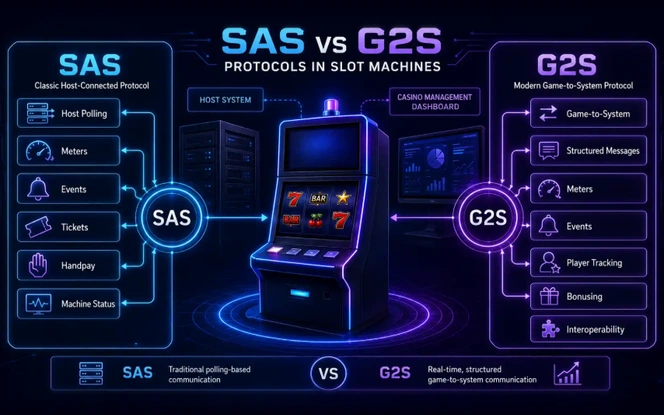
SAS and G2S both support slot machine communication, but they are not the same.
| Area | SAS | G2S |
|---|---|---|
| Full name | Slot Accounting System | Game-to-System |
| Communication style | Established EGM-to-host protocol | Structured game-to-system messaging protocol |
| Common use | Meters, events, tickets, handpays, machine status | Broader messaging between gaming devices and systems |
| Typical environment | Existing casino floors and host systems | More modern device-to-system communication models |
| Strength | Widely used and familiar in many slot environments | Designed for broader interoperability and extensible messaging |
| Review focus | Host polling, meters, event handling, ticket and status messages | Message structure, system interoperability, device/system communication |
SAS is often associated with established slot floor communication. G2S is often discussed as a more modern and extensible game-to-system communication standard.
That does not mean every casino floor should immediately replace SAS with G2S. The right protocol approach depends on machine support, host system support, jurisdiction, system architecture, operator goals, and vendor ecosystem.
How EGMs Communicate With Host Systems
A gaming machine may connect to a host system through a network, controller, floor system, or communication module.
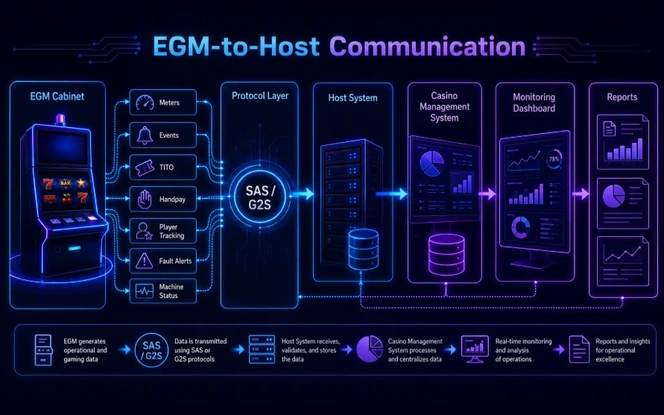
A simplified EGM-to-host flow may look like this:
The EGM records game, meter, ticket, or event activity.
The machine exposes supported data through the protocol.
The host system requests or receives that data.
The backend records the machine information.
The operator reviews the data through reports or dashboards.
Alerts or exceptions may be generated.
Reconciliation or investigation workflows use the records.
The communication layer sits between the machine and the operator's system view.
If that layer is weak, delayed, unsupported, or misconfigured, the operator may see reporting gaps, meter mismatches, missing events, delayed ticket records, or incomplete machine status.
Protocols and EGM Accounting Meters
Accounting meters are one of the most important data areas in EGM communication.
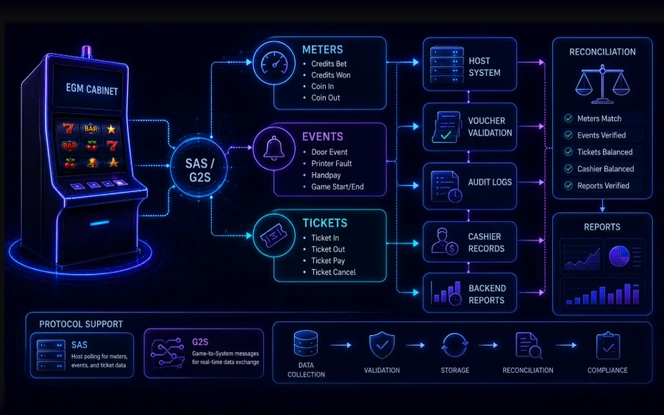
Meters may include:
- Credits bet
- Credits won
- Games played
- Ticket-in amount
- Ticket-out amount
- Bill-in amount
- Handpay amount
- Jackpot amount
- Cancelled credits
- Promotional credits, where supported
- Game-specific meters
- Denomination-related meters
EGM accounting meters help operators understand what value moved through the machine.
Protocols such as SAS and G2S help those meter values move from the machine to the host or reporting system.
Protocols and EGM Audit Logs
Audit logs and event records are another important communication area.
An EGM may record important events locally, such as:
- Main door open
- Logic door open
- Power reset
- Printer fault
- Bill validator error
- Ticket-out event
- Ticket-in event
- Handpay condition
- Configuration change
- Communication failure
- Machine fault
- Recovery event
EGM audit logs and event records help operators review the machine history.
SAS and G2S can support communication of machine events to host or monitoring systems, depending on the machine, system, and supported feature set.
Protocols and TITO
TITO means ticket-in ticket-out. It allows a player to insert a valid ticket into a machine and later cash out by printing a new ticket.
TITO in slot machines depends on a clean connection between:
- Ticket reader
- Ticket printer
- Machine credit balance
- Ticket validation system
- Meter records
- Event records
- Cashier or redemption system
- Host reporting
A TITO communication flow may involve:
A player inserts a ticket.
The machine reads the barcode.
The ticket is validated.
Credits are added to the machine.
Ticket-in meters update.
The player plays the game.
The player presses cashout.
The machine prints a ticket.
Ticket-out meters update.
The ticket record is available for redemption and reporting.
If the protocol or host connection fails at the wrong time, operators may need to review local machine logs, ticket validation records, backend records, and cashier records.
Protocols and Handpays
Handpays and jackpots are important because they often involve higher-value payout events and staff action.
Protocol communication may support:
- Handpay trigger records
- Handpay amount
- Jackpot events
- Attendant actions
- Machine lock status
- Payout completion status
- Related meter updates
- Backend event records
A handpay is not only a win event. It is also an operational workflow. The machine, staff, meters, event logs, and backend reports must stay aligned.
Player Tracking, Bonusing, and Cashless Features
Player tracking connects machine activity with a player account or loyalty identity, where supported.
A player tracking system may use machine communication to support:
- Card-in activity
- Card-out activity
- Player session status
- Points earning
- Tier tracking
- Rated play
- Bonusing
- Offers
- Player messages
- Service requests
Feature support depends on the machine, protocol version, host system, player tracking system, jurisdiction, and operator configuration.
If session records are incomplete, players may dispute points, rated play, or bonus eligibility.
Protocols and Bonusing
Bonusing features may rely on communication between the machine and backend systems.
- Promotional credits
- Mystery bonuses
- System-triggered bonuses
- Free play
- Loyalty awards
- Progressive features
- Tournament features
- Floor-wide campaigns
A bonus feature should not only appear on the machine. It should also be recorded correctly so the operator can review what was awarded, when it was awarded, and why it was awarded.
Protocols and Cashless or Funds Transfer Features
Some gaming environments may support cashless or funds transfer features. Depending on the system and supported protocol features, this may involve:
- Cashless wallet connection
- Funds transfer to machine
- Funds transfer from machine
- Account-based credit movement
- Player authentication
- Promotional credit movement
- Transaction logs
- Exception handling
Operators should review whether the machine, host, wallet, and reporting systems all record the same transaction history.
Protocols, Cabinet Components, and Game Outcomes
Protocols are not only about software messages. They also connect with physical cabinet components.
EGM cabinet components may include bill validators, ticket printers, player tracking readers, displays, button panels, touchscreens, logic boards, network modules, critical memory, door sensors, cash boxes, and secure compartments.
When one of these components produces an event, the machine may need to record it locally and send it to the host.
- A printer jam may create a local event and host alert
- A door opening may create an audit record
- A bill validator error may create a fault message
- A network issue may create a communication event
- A player tracking reader issue may affect session records
- A cash box event may support collection review
SAS and G2S protocols do not decide RNG outcomes. EGM RNG and game outcome testing are part of the machine's game integrity layer. Protocols are part of the communication layer.
The protocol does not create the win, but it may help report the records created by the win.
Common SAS and G2S Protocol Issues Operators Should Watch
Protocol issues can create operational confusion even when the game itself is working correctly.
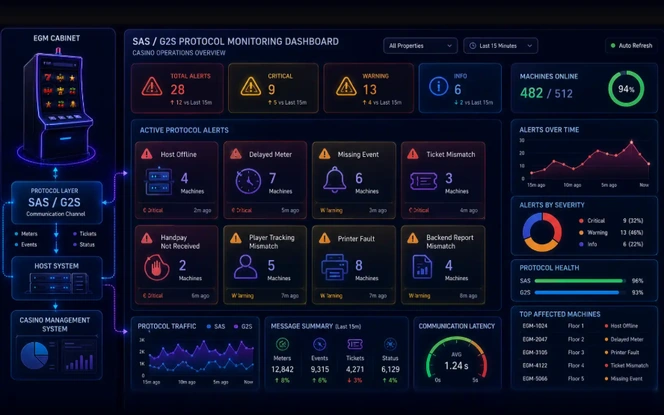
Common issues include:
- Machine not communicating with host
- Host polling issue
- Delayed meter update
- Missing event record
- Ticket record mismatch
- Handpay event not received
- Player tracking session mismatch
- Printer fault not visible in backend
- Door event not sent to host
- Machine status out of sync
- Protocol version mismatch
- Unsupported feature
- Host configuration mismatch
- Network interruption
- Incorrect meter mapping
- Backend report mismatch
These issues should be reviewed through machine logs, host logs, communication diagnostics, meter comparison, ticket records, and backend reports.
SAS vs G2S Migration Considerations
Some operators may run SAS-based environments. Others may use or evaluate G2S-capable systems.
A protocol migration or mixed-environment review should consider:
- Current machine support
- Host system support
- Protocol versions
- Regulatory requirements
- Vendor compatibility
- Meter mapping
- Event mapping
- Ticketing support
- Player tracking support
- Bonusing support
- Cashless support
- Reporting needs
- Testing requirements
- Staff training
Migration is not only a technical change. It can affect reporting, floor operations, service workflows, ticketing, and player account features.
Operator Checklist for SAS and G2S Review
Operators and product teams should review:
- Supported protocol version
- Machine compatibility
- Host system compatibility
- Meter reporting coverage
- Event reporting coverage
- Ticket-in support
- Ticket-out support
- Voucher validation flow
- Handpay event handling
- Jackpot event handling
- Printer event handling
- Bill validator event handling
- Door event reporting
- Player tracking support
- Bonusing support
- Cashless support, where applicable
- Backend reporting consistency
- Communication failure handling
- Message delay handling
- Duplicate message handling
- Protocol version mismatch risks
- Audit log comparison
- Reconciliation workflow
- Jurisdiction-specific requirements
This checklist helps operators review communication as part of the full EGM operating model.
Common Misunderstandings About SAS and G2S
SAS and G2S Do Not Decide Game Outcomes
Game outcomes are handled by the machine's RNG, outcome logic, paytable, and math model. Protocols help communicate records and status.
G2S Does Not Automatically Replace SAS Everywhere
A floor may still use SAS because of existing machines, host systems, certification, vendor support, or rollout risk.
Protocol Support Does Not Mean Feature Support
A machine may support a protocol but not every feature within that protocol. Operators should confirm exact feature support.
Meters Still Need Validation
Even if the protocol sends meter data, operators still need to confirm that meter mapping, timing, and backend reports are correct.
Communication Problems Can Look Like Accounting Problems
A backend mismatch may be caused by communication delay, message failure, mapping error, or host issue.
Need Help With SAS and G2S Integration?
Improve machine communication, meter reporting, TITO workflows, alerts, and backend visibility with a reliable protocol setup.
Talk to Our EGM ExpertsFAQs About SAS and G2S Protocols
G2S helps slot machines communicate with casino systems. It supports faster updates, accurate reporting, and smoother player services.
G2S is newer and supports more features, while SAS is widely used and reliable. Players usually notice little difference during normal gameplay.
Casinos use your player card to record play time, bets, and rewards. This helps them offer points, promotions, and personalized benefits.
SAS stands for Slot Accounting System. It helps slot machines send meters, events, ticket records, handpay information, and machine status to casino systems.
No. Both connect gaming machines with casino systems, but they use different communication methods and support different system environments.
No. The RNG and game software decide outcomes. SAS and G2S only send records, events, meters, and machine status to connected systems.
They can send ticket-in, ticket-out, voucher validation, ticket status, and meter information between the machine and casino systems.
Delayed, missing, or incorrectly mapped messages can make backend reports differ from machine records. Operators then compare machine logs, host logs, and meter data.
Not always. The decision depends on machine compatibility, casino system support, required features, regulatory rules, costs, and migration risk.
Final Thoughts
SAS and G2S protocols are the communication layer between slot machines and casino systems.
They help machines share meter values, event records, ticket activity, handpay events, player tracking information, device status, and reporting data with connected host systems.
For operators, protocol review should not be separated from the rest of the EGM operating model. It should connect with accounting meters, audit logs, TITO, cabinet components, player tracking, backend reporting, and reconciliation workflows.
A strong communication setup helps the casino floor operate with clearer records, faster issue review, stronger reporting, and better machine-to-system visibility.