
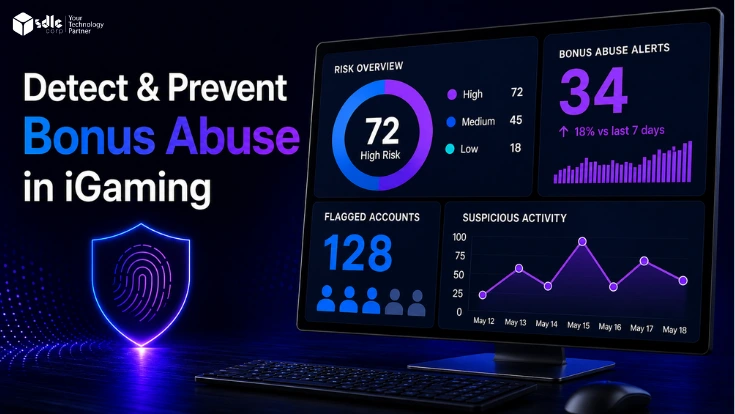
What Is Bonus Abuse in iGaming?
Bonus abuse in iGaming happens when players or fraud groups exploit promotional offers for unfair value. These offers include welcome bonuses, free spins, deposit matches, cashback, referral rewards, VIP rewards, and other player acquisition incentives.
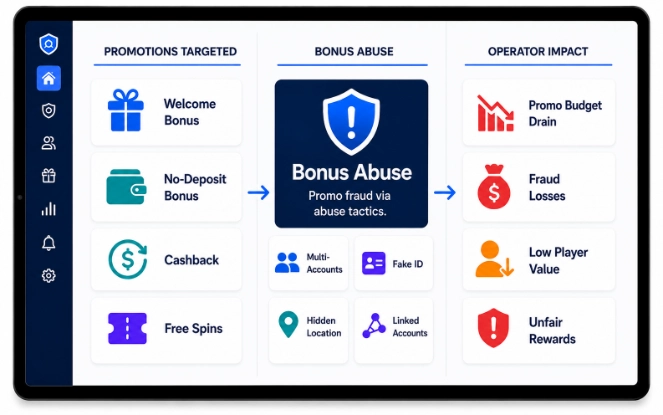
For iGaming operators, the issue is not the promotion itself. The real problem begins when users create duplicate accounts, use fake identities, hide their location, or coordinate activity across linked account networks. As a result, campaigns designed for real player growth can turn into promo abuse, weak acquisition data, and preventable revenue leakage.
Promotion Types Most Exposed to Bonus Abuse
In practice, casino bonus abuse and bonus fraud prevention usually connect to these promotion types:
Therefore, bonus fraud prevention is now tied to acquisition spend, bonus rules, wallet movement, risk scoring, and withdrawal workflows. It should not stay buried inside a manual fraud-team queue.
How Fraud Prevention Software Helps Stop Bonus Abuse
iGaming fraud prevention software helps operators catch promo abuse before it becomes a payout loss. Instead of checking one account at a time, it connects signals across identity, device, location, wallet activity, bonus claims, wagering behavior, CRM exclusions, and withdrawal requests.
Connected Signals Reveal Risk Earlier
This matters because bonus abuse rarely shows one clean red flag. A fake account may pass basic checks. A device may look new. A deposit may seem normal. However, when the platform connects these signals, it can detect linked accounts, repeated bonus claims, suspicious betting patterns, and risky withdrawal behavior much earlier.
Core Layers Behind Bonus Fraud Prevention
The strongest bonus abuse prevention systems usually combine six software layers:
- Device fingerprinting Detects linked accounts across devices, browsers, emulators, repeated login patterns, and multi-accounting behavior.
- KYC and liveness checks Stop fake users, synthetic identities, and duplicate accounts before bonus value is released.
- Behavioral analytics Tracks signup, deposit, bonus claim, gameplay, wagering activity, and withdrawal behavior.
- IP and VPN intelligence Flags proxies, residential proxy networks, risky IPs, location mismatches, and market-restriction abuse.
- Real-time risk scoring Combines fraud signals into a score that helps the platform allow, challenge, review, or block an action.
- Transaction monitoring Detects minimum deposits, fast wagering, bonus-only play, and quick withdrawal attempts.
Risk Scores Help Operators Act Faster
For a deeper view of how the machine learning side works, operators can review our breakdown of AI in fraud detection for online gambling. In this guide, however, the focus stays on bonus abuse prevention and how these layers connect with the rest of the platform.
Finally, the software helps the operator take the right action. A low-risk player continues without friction. A medium-risk player faces extra verification. A high-risk account gets blocked, held for review, or stopped from claiming another promotion.
How Operators Deploy Fraud Prevention Software in an iGaming Platform
Once operators understand the detection layers, the next question is practical. Where should fraud prevention software sit inside the iGaming platform? The answer depends on budget, market rules, bonus complexity, platform maturity, and how much control the operator needs over the bonus engine, wallet, KYC, CRM exclusions, and risk scoring.
Path 1: Off-the-Shelf SaaS Overlay
This is usually the fastest setup. The operator connects a third-party fraud tool to the existing platform through APIs. As a result, the business can add identity checks, device signals, IP risk, transaction monitoring, and basic promo abuse detection without rebuilding the full system.
This path works when speed matters more than deep control. For example, an early-stage operator using a white-label casino solution may need quick bonus fraud prevention before building custom platform logic.
Path 2: Custom-Built Fraud Layer
In this model, the operator builds a custom fraud layer around its own platform data. Therefore, the team gets more control over risk models, bonus rules, linked account detection, player behavior, reporting, and review workflows.
This path can work well for platforms with unusual mechanics. For example, operators building sweepstakes casino software may need custom controls for rewards, entries, redemptions, player eligibility, wallet movement, and abuse patterns.
Path 3: Integrated Platform Build
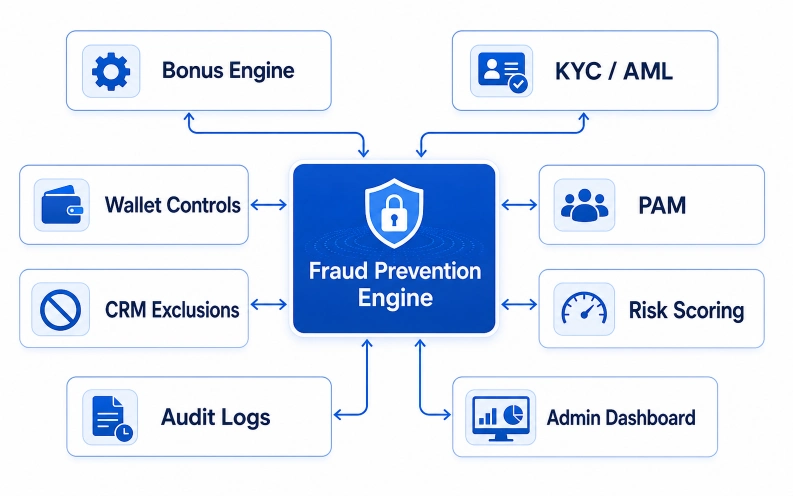
This is the strongest long-term setup for mature operators. Here, fraud prevention connects directly with the bonus engine, PAM, KYC/AML workflows, wallet controls, CRM exclusions, risk scoring, withdrawal checks, and admin dashboard.
A turnkey casino solution with integrated fraud controls gives operators better control over real platform actions. The system can stop a risky account from claiming a bonus, trigger extra KYC, hold a bonus-linked withdrawal, or exclude a player from future campaigns.
For multi-jurisdiction operators, the integrated model usually makes the most sense over time. It needs more planning upfront, but it gives much better control over bonus abuse in iGaming, player risk, market requirements, wallet rules, and long-term platform growth.
Software Controls Operators Need for Bonus Abuse Prevention
Fraud prevention software only works when it can act inside the platform. For operators, the most important controls are the ones that stop risky users before they claim, convert, or withdraw bonus value.
Bonus Rules Engine
Controls who can claim an offer, how wagering works, when the bonus expires, which player groups qualify, and when bonus abuse prevention rules should block access.
KYC and Risk Checks
Verifies real players through document checks, liveness verification, sanctions screening, identity matching, and ongoing risk review.
Wallet Controls
Separates bonus funds from cashable funds, tracks wagering progress, monitors wallet movement, and holds suspicious bonus-linked withdrawals.
PAM and CRM Signals
Connects account history, deposits, withdrawals, player limits, risk scores, linked account signals, and CRM exclusions in one profile.
Admin Dashboard
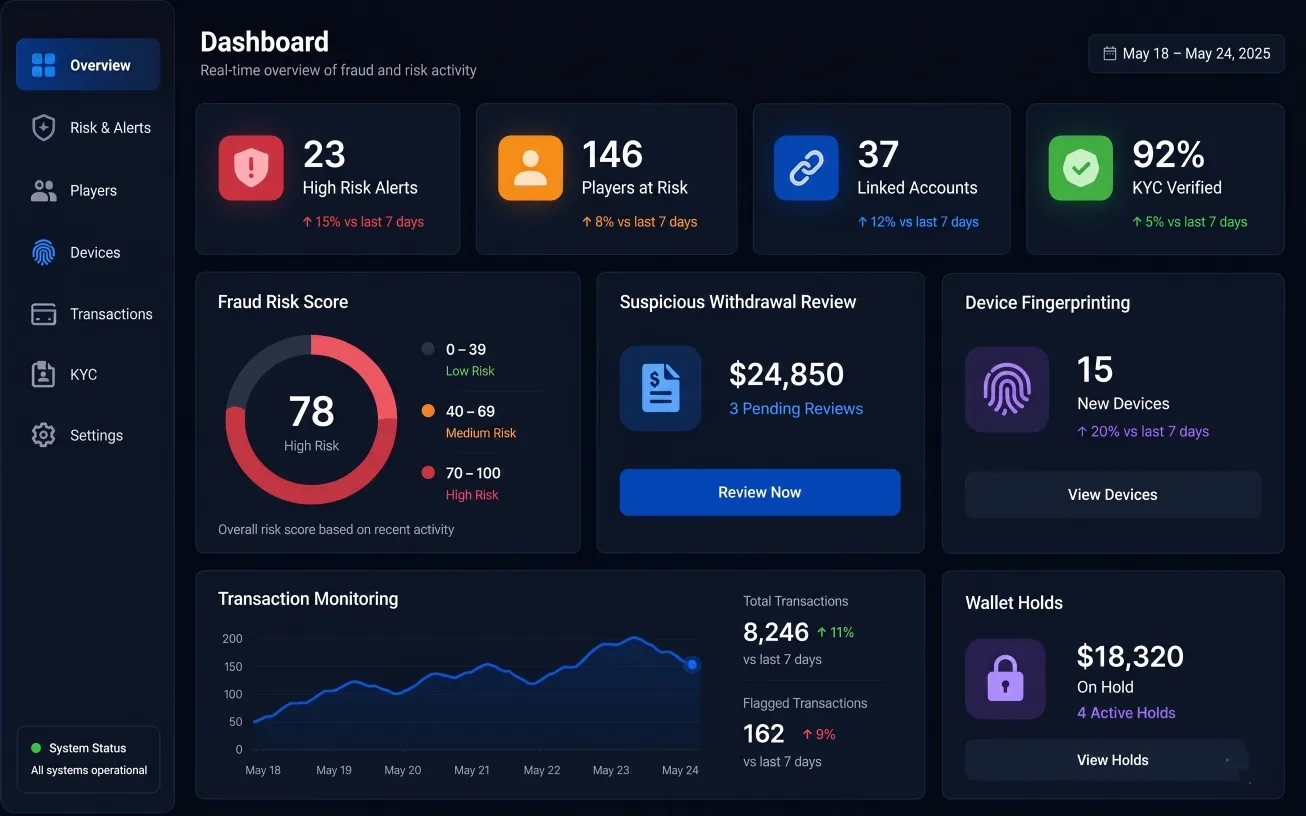
Shows risky accounts, blocked bonuses, promo abuse alerts, review queues, withdrawal holds, and clear decision reasons.
Audit Logs
Records why the software allowed, challenged, blocked, or reviewed each action for compliance, fraud investigation, and model retraining.
When these controls work together, operators move from manual reaction to software-led bonus abuse prevention. The platform can verify the player, check bonus eligibility, control wallet movement, block repeat offers, flag linked account networks, and record every key decision in the same flow.
How SDLC Corp Helps Operators Build Fraud-Ready iGaming Platforms
Bonus abuse prevention works best when fraud controls connect with the platform, not when they sit outside it. Therefore, SDLC Corp helps operators build fraud-ready iGaming platforms where bonus rules, KYC workflows, wallet controls, PAM data, CRM exclusions, risk scoring, audit logs, and admin dashboards work together as one system.
In one SDLC Corp deployment, an integrated fraud prevention layer reduced bonus abuse by 38% within months of going live. Player LTV increased by 22%, and fraud-related support tickets dropped by 46%.
SDLC Corp supports operators through iGaming software development services that can include:
- Custom bonus engine logicBuild promotion rules that match eligibility, wagering, expiry, player limits, risk scoring, and market requirements.
- KYC and AML integrationConnect identity verification, liveness checks, sanctions screening, duplicate account checks, and ongoing risk review.
- Wallet-level withdrawal controlsHold suspicious bonus-linked withdrawals, separate bonus funds from cashable balances, and reduce payout-stage promo abuse.
- PAM and player risk profilesKeep deposits, withdrawals, limits, account history, linked account signals, and risk scores connected in one view.
- CRM exclusions for risky usersStop flagged users from receiving reload offers, cashback, referral rewards, free spins, or VIP campaigns.
- Fraud dashboards and audit logsGive fraud, finance, marketing, and compliance teams a clear view of bonus abuse risk and decision history.
The same prevention logic can support casino, sportsbook, sweepstakes, poker, and casino game development projects where bonus mechanics differ but the control problem stays the same.
Bonus Abuse Prevention Software Checklist for Operators
Use this checklist to see whether your current iGaming platform can enforce bonus abuse prevention through software, not manual review alone.
If several items are missing, your current platform may expose bonus campaigns to preventable revenue leakage. A structured review can show which controls to add, integrate, or rebuild first across the bonus engine, KYC workflows, wallet rules, PAM data, CRM exclusions, withdrawal checks, and risk scoring layer.
Conclusion
Bonus abuse in iGaming can drain promo budgets, weaken campaign data, increase payout risk, and slow fraud reviews. However, operators can reduce that risk when platform controls work together.
When fraud prevention software connects bonus rules, KYC/AML workflows, wallet controls, PAM data, CRM exclusions, risk scoring, withdrawal checks, and audit logs, teams can detect risk earlier and protect genuine players with less friction.
Build a fraud-ready iGaming platform
Bring bonus rules, wallet controls, KYC, CRM exclusions, dashboards, and audit logs into one connected prevention workflow.
FAQs
1. What is bonus abuse in iGaming?
Bonus abuse in iGaming happens when players or fraud groups exploit welcome bonuses, free spins, deposit matches, cashback, referrals, or VIP rewards for unfair value. It usually involves fake accounts, duplicate identities, VPNs, linked account networks, multi-accounting, or wagering rule abuse.
2. How does fraud prevention software stop bonus abuse?
iGaming fraud prevention software connects signals across identity, device, location, wallet activity, bonus claims, wagering behavior, CRM exclusions, and withdrawals. It then scores risk in real time and helps the platform allow, challenge, review, or block each action.
3. Why are manual reviews not enough to stop bonus abuse?
Manual reviews stay useful, but they are mostly reactive. Fraud teams often review suspicious accounts after bonus value has already moved through the platform. As a result, software-led controls help detect risk earlier and reduce review pressure.
4. What is multi-accounting in iGaming?
Multi-accounting happens when one person or group creates many accounts to claim the same promotion repeatedly. Linked device signals, payment behavior, IP patterns, wallet use, bonus claim timing, or gameplay rhythm often reveal the network.
5. What software controls help prevent bonus abuse?
Important controls include device fingerprinting, document KYC with liveness, behavioral analytics, IP intelligence, real-time risk scoring, transaction monitoring, a bonus rules engine, wallet holds, CRM exclusions, audit logs, and an operations dashboard.
6. How much does it cost to add bonus abuse prevention to an existing iGaming platform?
The cost depends on platform architecture, integration depth, fraud logic, third-party tools, and the controls being added. A SaaS overlay through APIs is usually faster. However, a deeper integration with the bonus engine, wallet, KYC workflows, CRM, and risk scoring gives stronger control.
7. How do wallet controls help stop bonus fraud?
Wallet controls separate bonus funds from cashable funds, track wagering progress, and hold suspicious bonus-linked withdrawals. Therefore, they give operators a second protection layer before bonus value leaves the platform.
8. Can SDLC Corp build bonus abuse prevention into an iGaming platform?
Yes. SDLC Corp can help operators build or integrate platform controls including bonus engine logic, KYC/AML workflows, wallet rules, PAM data, CRM exclusions, real-time risk scoring, audit logs, fraud dashboards, and withdrawal checks.