Home / Blogs & Insights / What is iGaming CRM? A Complete Guide for Operators

What is iGaming CRM? A Complete Guide for Operators

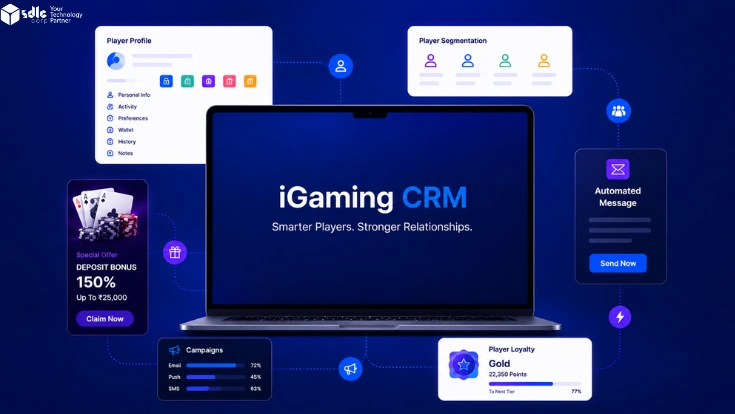
iGaming CRM system illustrating player segmentation, loyalty rewards, campaign automation, and customer relationship management.

Table of Contents

The global online gambling market is projected to exceed $153 billion by 2030, according to Statista, yet retaining a player costs five times less than acquiring a new one. Yet most iGaming platforms still spend more on acquisition than on keeping the players they already have.

An iGaming CRM changes that. It connects player data, automates lifecycle communication, and helps operators act on player behavior before churn happens. For operators building the full platform stack, the CRM layer should connect cleanly with iGaming CRM software from day one.

Key Takeaways

  • iGaming CRM is purpose-built: It handles real-time player events, bonus management, responsible gaming, and PAM integration that generic CRMs cannot do.
  • Player lifecycle coverage is non-negotiable: Your CRM must respond at every stage from registration to VIP, not just at the deposit moment.
  • Lottery CRM is different: Draw-based triggers, jackpot alerts, and retail-digital journey unification require a different logic than casino or sportsbook CRM.
  • PAM integration is the foundation: A CRM without native PAM integration works on stale data and creates compliance risk.
  • Small operators benefit too: A well-configured CRM automates what a full retention team would otherwise handle manually.

What Does iGaming CRM Actually Do?

iGaming CRM stands for Customer Relationship Management in online gambling. At its core, iGaming CRM is a system that collects player data, automates personalized communication, manages loyalty programs, and retains players.

Unlike a contact database, the platform acts as the always-on engagement engine behind your operation. Furthermore, rather than waiting for players to act, it reads behavioral signals and predicts what each player will do next. The result is the right message delivered at the right moment, without manual intervention.

How is iGaming CRM Different from a Standard CRM?

A standard CRM tracks contacts and deals. In contrast, an iGaming CRM tracks wagering events, deposit cycles, session frequency, game preferences, and responsible gaming signals.

The difference comes down to speed and specificity. Consider this: a player can log in, lose, and churn within 48 hours. Standard tools detect nothing during that window. An iGaming CRM, however, acts mid-session.

Why Every iGaming Operator Needs a CRM

Acquisition costs keep rising. Bonuses alone no longer build loyalty, and regulators now require proactive responsible gaming monitoring in most licensed markets. Fortunately, iGaming CRM solves all three at once.

By automating compliance workflows and reducing churn through early intervention, operators gain control across all three fronts simultaneously. Personalizing offers so they convert rather than drain margin is an additional benefit. Therefore, building iGaming platform compliance into your CRM architecture from day one prevents costly retrofitting later.

How iGaming CRM Software Works
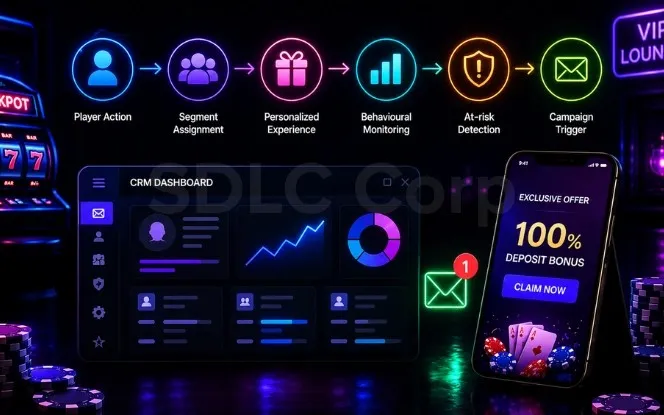
iGaming CRM software workflow showing player action real-time trigger segmentation automated campaign and outcome tracking for casino and sportsbook operators

iGaming CRM software connects to your platform and collects player data in real time. As a result, it fires automated responses based on what each player does.Every action a player takes, depositing, playing, going quiet, triggers a pre-configured response without any manual input from your team.

Step-by-Step: From Player Action to Campaign Trigger

Here is how a typical iGaming CRM responds to a player event.

  • First deposit. A player makes their first deposit and the CRM captures it immediately via PAM or payment processor.
  • Segment assignment. The player is placed into the correct segment based on your pre-configured rules.
  • Personalized welcome flow. A bonus, game recommendation, and onboarding email fire automatically within seconds.
  • Behavioural monitoring. The CRM tracks session activity, deposit patterns, and game preferences continuously.
  • At-risk detection. If the player goes quiet after seven days, the CRM flags them and launches a reactivation sequence before they consciously decide to leave.
Your team sets the rules once and the CRM executes at scale. Modern platforms use predictive analytics to improve player experience. The intelligence behind each trigger is what separates a strong CRM from a basic email scheduler.

iGaming CRM Platform Basics Explained

Every iGaming CRM platform runs on four core components working together.

Player profile database

All historical data including deposits, bets, sessions, game preferences, and communication history in one place.

Segmentation engine

Groups players dynamically by behavior. Segments update in real time as player activity changes.

Campaign builder

Creates automated player journeys based on triggers, channels, and timing rules without manual input.

Analytics dashboard

Connects campaign performance directly to player lifetime value (LTV) and net gaming revenue (NGR).

iGaming CRM vs Generic CRM: Key Differences
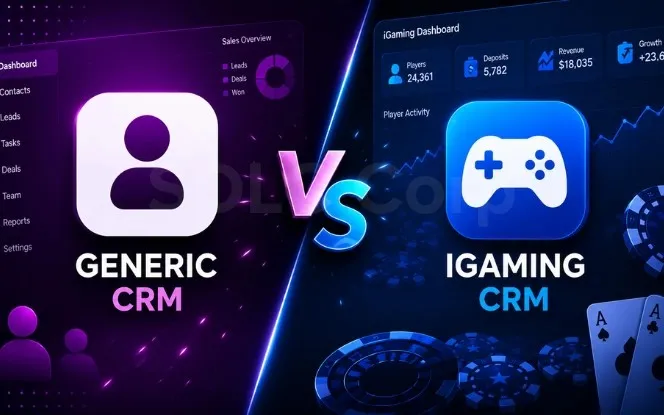
Generic CRM vs iGaming CRM comparison showing real-time triggers bonus engine responsible gaming suppression PAM integration and compliance for iGaming operators

Generic CRMs like Salesforce and HubSpot are built for sales pipelines. They were never designed to handle wagering events, bonus management, or real-time gambling compliance. The gap is not about feature count. It is about architecture.

What Generic CRMs Cannot Do in iGaming

FeatureGeneric CRMiGaming CRM
Real-time event triggersScheduled or delayedMillisecond response to live events
Bonus engineNot availableBuilt in with wagering requirement tracking
Responsible gaming suppressionManual build requiredAutomated, instant, audit-ready
PAM integrationCustom development neededNative connection out of the box
Jurisdiction complianceGeneric rules onlyMarket-specific campaign logic per licence
AML and KYC supportNot available nativelyIntegrated compliance triggers

Regulators such as the Malta Gaming Authority require operators to demonstrate real-time player monitoring and automated responsible gaming controls as part of their licensing conditions, requirements that generic CRMs structurally cannot meet.

Understanding regulatory compliance challenges in the iGaming industry makes clear why generic CRMs break under the weight of gambling-specific requirements. Operators who try to adapt Salesforce or HubSpot for iGaming routinely face months of custom development and compliance gaps that persist for years.

iGaming CRM Feature Checklist

A purpose-built iGaming CRM must deliver on seven core capabilities. If any one of these requires custom development on your platform, the system is not truly built for iGaming operators.

Real-Time Behavioural Triggers

The CRM must respond to player actions the moment they happen, because triggers that fire hours later miss the retention window entirely.

Player Segmentation Engine

Segmentation must go beyond basic demographics. Instead of static groups, the platform segments players by deposit frequency, game preference, stake level, session length, and churn risk score, updating each segment automatically as behavior changes.

Bonus Engine Integration

Bonus management handles free spins, deposit matches, and wagering requirement tracking without manual intervention. If your team is still calculating bonus eligibility by hand, that is a clear sign the CRM is not doing its job.

Multi-Channel Communication

Players live across email, SMS, push notifications, and in-app messages. Your CRM manages all four from one dashboard and determines which channel each player responds to best.

Compliance and Revenue Features

Responsible Gaming Controls and Compliance

Every iGaming CRM must include automated responsible gaming tools: spend limit monitoring, self-exclusion suppression, problem gambling flags, and cooling-off period enforcement. According to the UK Gambling Commission, responsible gaming controls are a mandatory licensing requirement for all regulated operators. Responsible gaming in gambling apps is not an optional feature.

VIP and Loyalty Programme Management

High-value players generate a disproportionate share of revenue. Your CRM needs tiered loyalty programmes, VIP-specific campaign logic, and escalation workflows. Loyalty programmes in online casino gaming drive long-term retention far more effectively than acquisition bonuses.

AI-Powered Churn Prediction and Analytics

Modern iGaming CRM platforms use machine learning to predict churn before it happens. The system assigns each player a risk score and triggers a reactivation sequence before the player consciously decides to leave. Campaign attribution then connects CRM activity directly to ARPU, NGR, and retention rate.

The Player Lifecycle: 6 Stages iGaming CRM Must Cover
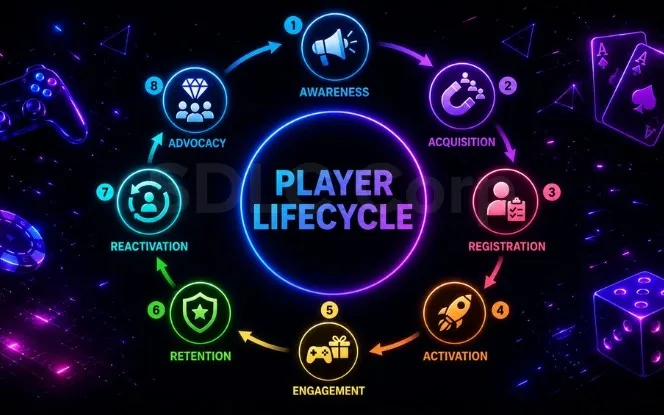
iGaming CRM player lifecycle diagram showing 6 stages from registration KYC and first deposit through active play at-risk detection churn recovery and VIP management

Every player moves through a predictable journey. Your CRM needs a specific strategy at each stage rather than treating all players the same.

StageCRM Action
Stage 1: Registration & KYCWelcome sequence fires. KYC status syncs automatically. Communication adjusts to verification level.
Stage 2: First Deposit (FTD)Personalized welcome bonus triggers within seconds. Game recommendation and onboarding email deliver immediately.
Stage 3: Active PlayBehavioral segmentation updates in real time. Game recommendations and cross-sell opportunities activate.
Stage 4: At-Risk & DecliningInactivity flag triggers. Reactivation sequence fires before the player makes a conscious decision to leave.
Stage 5: ChurnPlayer reactivation campaign for casino. Win-back campaign for sportsbook. Personalized by historical preference.
Stage 6: VIP & LoyalTiered rewards activate. Exclusive offers deliver. VIP activity drop triggers escalation workflow.

Also read: Best practices for player retention in real money games show that early intervention at Stage 4 dramatically improves recovery rates compared to waiting until the player has fully churned.

See how SDLC Corp implements lifecycle CRM into platform architecture in our casino game development case study.

Build your iGaming platform
Ready to Build a CRM-Integrated iGaming Platform?

Talk to SDLC Corp and get a platform where CRM, PAM, bonus engine, and responsible gaming connect from day one. Whether you are launching a casino, sportsbook, or lottery platform, our team builds the full stack.

CRM for Lottery Operators: What Makes It Different

Most iGaming CRM guides focus on casino and sports betting. Lottery operations have entirely different requirements and most CRM platforms handle them poorly.

Different from Casino CRM

Casino CRM responds to continuous real-time sessions. Lottery CRM operates on scheduled events: draws, jackpot announcements, ticket purchase windows, and result notifications.

Draw Triggers and Jackpot Alerts

Lottery CRM uses draw schedules as its primary trigger. Pre-draw reminders, jackpot threshold campaigns, and personalized result notifications fire automatically after every draw.

Retail and Digital Unified

A player who buys scratch cards at a retailer and purchases online lottery tickets is one player, not two. CRM must unify both journeys into a single player profile.

How Lottery CRM Differs from Casino CRM

Lottery players have longer gaps between interactions. A player might purchase tickets once a week, wait 72 hours for the draw result, and engage again only after seeing the outcome. Lottery CRM software must be built around these extended cycles, not the millisecond-reaction model used in casino CRM.

Draw-Based Triggers and Jackpot Notifications

Lottery CRM uses draw schedules as its primary trigger source. The system sends pre-draw reminders to players who purchased tickets in previous rounds. It also fires jackpot alert campaigns when prize pools cross psychological thresholds. Therefore, personalized result notifications reach both winners and non-winners automatically after each draw.

This requires a platform that understands draw-based event logic natively, not as a workaround built on top of casino CRM architecture.

Managing Retail and Digital Player Journeys Together

Many lottery operators run both retail and digital channels.A player who buys scratch cards at a retailer and also purchases online lottery tickets is one player, not two. In other words, CRM for lottery operators must unify both journeys into a single player profile. Consequently, operators get a complete view of each player regardless of channel.

Brazil's iGaming regulation guide highlights how lottery regulation differs across LatAm markets and why CRM compliance logic must adapt per region. Operators planning lottery CRM selection should align compliance rules with their licence jurisdiction from day one.

PAM and CRM Integration: Why It Matters
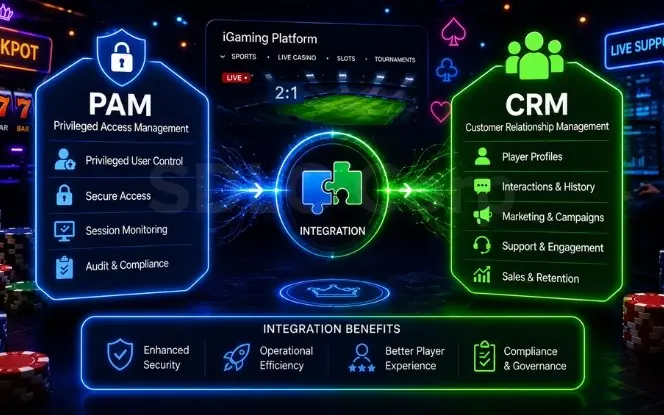
PAM and CRM integration architecture for iGaming platforms showing real-time player data flow deposits session events KYC status and responsible gaming campaign triggers

The single biggest reason iGaming CRM fails in practice is not a CRM problem. It is a data problem. Poor PAM integration means the CRM never receives the events it needs to act intelligently.

What is PAM in iGaming?

PAM stands for Player Account Management. It manages player registration, identity verification, deposits, withdrawals, game access, bonus tracking, and responsible gaming controls. PAM is the source of truth for all player activity on your platform.

What Breaks When PAM and CRM Are Separate

When PAM and CRM operate as disconnected systems, three things fail simultaneously.

Campaigns fire on stale data.

A player who self-excluded yesterday receives a bonus offer today because the CRM has not received the exclusion flag. This is a regulatory violation in most markets.

Segmentation becomes inaccurate.

The CRM places players in the wrong lifecycle stage because data is hours old. By the time a campaign fires, the player's actual state has already changed.

Bonus management breaks down.

The CRM cannot track wagering requirements accurately without real-time PAM transaction data. This leads to bonus abuse and margin leakage.

What Native PAM and CRM Integration Enables

Native PAM CRM integration means the two systems share a single data layer. Every PAM event instantly surfaces in the CRM.

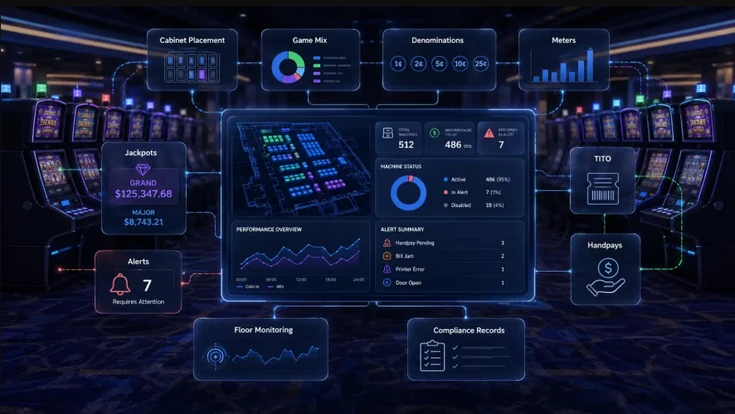
Deposits trigger campaigns within seconds.
Responsible gaming flags suppress all outbound communications instantly.
Bonus eligibility calculated automatically using real transaction data.
Player segments update in real time as behavior changes.
Understanding how gambling apps manage user data security makes clear why a disconnected PAM is not just an operational problem. In other words, it is a security and compliance risk. This is the difference between a CRM that reads yesterday's data and one that responds to what your players are doing right now.

How to Choose the Right iGaming CRM for Your Business

Choosing a CRM is one of the highest-impact decisions an iGaming operator makes. The wrong choice costs months of re-implementation and millions in retention losses. The right choice compounds over years.

What Small and Mid-Size Operators Need

Small and mid-size operators should prioritize fast implementation under 8 weeks. Pricing tied to active player count, rather than feature tiers, protects margin as you grow.

In fact, the core features you need are identical to enterprise operators. What differs is the implementation model. A customer success team that handles onboarding is essential, rather than leaving setup to your developers. The implementation model should always match your scale.

CRM for Operators in India, Africa and LatAm

India

UPI payment triggers, state-level compliance logic, and mobile-first player journeys are non-negotiable.

Africa

SMS and USSD-first channels, multi-currency support, and lottery-heavy player journey mapping define the requirement.

LatAm

Brazil's licensing framework, sports betting growth, and bilingual Portuguese and Spanish communication flows drive regional CRM needs.

Operators entering regulated markets should review the iGaming compliance checklist before finalizing their CRM selection to ensure campaign logic meets jurisdiction-specific requirements from day one.

CRM Implementation Timeline: Weeks 1 to 8

PhaseTimelineWhat Happens
Data connectionWeeks 1–2Player data flows into the CRM via PAM integration
Segmentation setupWeeks 3–4Core player segments built and validated against historical data
Campaign automationWeeks 5–6Welcome flows, reactivation, and responsible gaming workflows go live
Testing and optimizationWeeks 7–8A/B testing starts, analytics configured, baseline metrics established

Red Flags to Watch Out For

  • The vendor cannot demonstrate live iGaming event data in their product.
  • Your engineering team must build the PAM integration from scratch.
  • Responsible gaming suppression is manual or requires a support ticket.
  • Pricing scales based on features rather than player activity.

Conclusion

The operators who dominate player retention are not spending more. They are connecting smarter.

A purpose-built iGaming CRM gives you real-time triggers, bonus engine integration, PAM connectivity, responsible gaming compliance, and lifecycle automation across casino, sportsbook, and lottery in one connected system. Generic tools cannot replicate this. Disconnected systems cannot sustain it.

Every day without a proper CRM is a day your platform is reacting to churn instead of preventing it.

Build your iGaming CRM platform
Build Your iGaming CRM Platform with SDLC Corp

From PAM integration to bonus engine, responsible gaming controls to multi-channel automation, SDLC Corp builds iGaming platforms where every layer connects from day one. Talk to our team and get a platform built for retention, compliance, and scale.

iGaming CRM: Frequently Asked Questions

1
What is iGaming CRM?

iGaming CRM is a platform built specifically for online gambling operators. It automates player communication across email, SMS, and push notifications, manages loyalty programmes, and retains players across every lifecycle stage.

2
How does iGaming CRM software work?

iGaming CRM connects to your platform via API or direct PAM integration. It collects player events in real time, segments players automatically, and triggers pre-configured campaigns based on what each player does. The process runs without manual input.

3
What is the difference between iGaming CRM and a standard CRM?

Standard CRMs are built for sales pipelines and B2B contact management. iGaming CRMs are built for real-time event processing, bonus management, wagering requirement tracking, responsible gaming compliance, and PAM integration. Generic CRMs cannot do these without months of custom development.

4
What CRM features do sportsbook and casino operators need?

Casino operators need game session triggers, loss-streak interventions, and slot preference tracking. Sportsbook operators need live odds triggers, in-play bet event responses, and match-specific campaign automation. Both verticals need multi-channel communication, VIP management, responsible gaming controls, and churn prediction.

5
Do lottery operators need a CRM?

Yes. Lottery CRM uses draw-based triggers, jackpot threshold alerts, and ticket purchase reminders rather than session-based triggers. It also unifies retail and digital player journeys into one profile, which most casino-focused CRM platforms cannot do natively.

6
What is PAM and how does it connect to CRM?

PAM stands for Player Account Management. It handles registration, deposits, game access, and responsible gaming controls. PAM and CRM must share a direct integration so the CRM receives every player event in real time. Without this, your campaigns fire on yesterday's player data.

7
How long does iGaming CRM implementation take?

Purpose-built iGaming CRM takes 4 to 8 weeks. Generic CRM customization for iGaming takes 3 to 6 months and frequently fails to deliver real-time capabilities. Choosing a platform with existing iGaming integrations is the fastest path to value.

8
Can small iGaming operators benefit from a CRM?

Yes. iGaming CRM for small operators delivers proportionally higher value because smaller teams cannot manage player communication at scale manually. A well-configured CRM automates the work of an entire retention team. Choose a platform priced per active player rather than per feature tier.

ABOUT THE AUTHOR

Michael Klein

iGaming Expert

Michael Klein is an iGaming expert with 18 years of experience in the gaming industry. He helps businesses innovate and scale by applying cutting-edge strategies and technologies that drive growth, enhance player experiences, and optimize operations in the ever-evolving iGaming landscape.
PLAN YOUR SOLUTION

More Insights
You Might Find Useful

Explore expert perspectives, practical strategies, and real-world solutions related to this topic.

AI in iGaming operator guide featured image with AI dashboard, player insights, personalization, risk management, and campaign performance visuals

AI in iGaming: Operator Guide

Learn how AI helps iGaming operators improve fraud control, CRM,
Futuristic iGaming CRM banner showing a VIP player profile, predictive analytics dashboards, segmentation charts, and risk-check panels.

VIP Player Identification for iGaming CRM

VIP identification for iGaming CRM should detect emerging high-value players

White-label SaaS CRM, licensed self-hosted CRM, and custom CRM comparison for iGaming CRM ownership models

White Label vs Custom vs Licensed iGaming CRM

iGaming CRM · Ownership Models Choosing between white-label, custom, and

Let’s Talk About Your Product

Get expert guidance on scope, architecture, timelines, and delivery approach so you can move forward with confidence.

What happens next?