iGaming Marketing Channels and Services: What Each One Delivers
Real channel fit matters more than channel count. Operators can use iGaming SEO, affiliate marketing, paid media, CRM, creator campaigns, content, and community-led demand. However, the advantage comes from knowing what each channel should deliver before assigning budget.
Affiliate Marketing
Affiliate marketing remains one of the strongest acquisition channels in iGaming. Review sites, betting communities, and comparison pages already hold player attention.
However, operators should not judge affiliates only by first deposits. A partner sending 200 deposits means little if those players show weak retention, high bonus uptake, and poor NGR.
Therefore, affiliate-heavy operators should review partner quality inside the wider iGaming affiliate software workflow.
Best for: launch and growth-stage operators. Track: NGR per player, second deposit rate, D30 retention, bonus cost ratio, and KYC rejection rate.
SEO and Content Marketing
SEO brings high-intent players who are already comparing platforms, bonuses, payment methods, odds, and trust signals before choosing where to deposit.
Even so, the trade-off is time. Operators need technical foundations, market-specific landing pages, mobile UX, localised bonus terms, payment content, responsible gambling signals, and clear licence-aware messaging to compete. SDLC’s guide on gambling licences for online casino apps explains the compliance layer operators should consider before scaling campaigns.
Best for: long-term acquisition and compounding visibility. Track: organic registrations, first deposits, assisted conversions, and NGR by landing page.
Paid Search and Programmatic
Paid media moves fast during market launches, major sporting events, or seasonal casino campaigns. It also helps operators test demand quickly when compliance clearance is already in place.
However, the constraint is access. Google requires gambling advertisers to follow gambling and games policy requirements, while Meta requires authorization for online gambling and gaming ads. Google policy Meta policy
Best for: certified launches, event-led campaigns, and controlled acquisition tests. Track: CAC by campaign, registration-to-deposit rate, D7 retention, and source-level NGR.
Social and Influencer Marketing
Creators build trust before the offer. Streamers, tipsters, communities, and social pages can create familiarity in markets where direct advertising is limited.
Still, the real question is not reach. Operators need to know whether the creator sends retained depositing players who continue beyond the first promotion.
Best for: trust building, market education, and pre-offer brand recall. Track: FTD rate, D30 retention, NGR per creator, and repeat deposit behaviour.
CRM and Lifecycle Marketing
iGaming CRM automation becomes the retention engine after the first deposit. Email, SMS, push, and in-app messages should respond to player behaviour, not only calendar dates.
For example, a player who deposits but does not play needs a different journey from a player who plays often but skips the second deposit.
Because of this, iGaming CRM software becomes a growth system, not just a messaging tool.
Best for: second deposits, reactivation, VIP growth, and player lifetime value. Track: D7 retention, D30 retention, revenue per CRM flow, and churn recovery.
In-Platform Marketing
Every product surface is a marketing touchpoint. Lobby placement, game recommendations, loyalty progress, tournament alerts, and deposit prompts all shape player behaviour.
As a result, personalised in-platform experiences help players discover relevant games, return more often, and build stronger platform habits without extra media spend.
Best for: session depth, game discovery, loyalty progression, and repeat play. Track: game exploration, session frequency, deposit prompt conversion, and repeat deposits.
Community and Creator-Led Demand
Community creates repeated trust signals. Telegram groups, Discord communities, betting forums, tipster networks, and niche creator ecosystems keep the brand visible between sessions.
However, this channel does not always create clean short-term attribution. Instead, it builds familiarity before the offer moment, which can improve conversion and reduce churn later.
Best for: brand depth, mature markets, and repeated player touchpoints. Track: assisted conversions, returning direct traffic, referral quality, and retention lift.
How to Choose an iGaming Marketing Strategy by Stage and Market
Operator stage should decide channel priority. The biggest budget mistake is not always choosing the wrong channel. Instead, it is choosing the right channel at the wrong time.
For example, an affiliate-heavy strategy can work at launch, but it may become an expensive dependency at maturity.
Meanwhile, a CRM-led strategy can drive strong revenue at scale. However, it will not produce much in the first months if the player base is too small to segment.
| Stage | Timeline | Primary Channels | Budget Split | North Star Metric |
|---|---|---|---|---|
| Launch | 0 to 12 months | Affiliates, SEO foundations, in-platform basics | 80% acquisition / 20% retention | Registration to first deposit rate |
| Growth | 12 to 36 months | Affiliates, paid where certified, CRM, influencer | 60% acquisition / 40% retention | D30 retention and NGR per player |
| Mature | 36 months plus | CRM-led, community, in-platform, brand SEO | 40% acquisition / 60% retention | LTV to CAC ratio and player lifetime value |
Before scaling any channel, check the basics: local payment methods, KYC approval speed, mobile deposit UX, bonus terms, and campaign compliance. Otherwise, traffic cannot become revenue if the player journey breaks before deposit.
iGaming Player Acquisition and Retention Strategy
Retention quality decides whether acquisition is worth the cost. Two operators can both report 500 first deposits. However, the one with stronger D30 retention owns the better business.
This source is more likely to create repeat deposits, higher NGR, and stronger lifetime value.
This source may look strong at acquisition level. However, it becomes weak once bonus cost and churn are counted.
Retention is often shaped before the player reaches the platform. Therefore, the channel, offer, landing page, payment method, and expectation all influence whether a player returns after the first deposit.
If a source brings bonus hunters or low-intent traffic, no CRM flow can fully repair that problem downstream.
Before increasing acquisition spend, operators should review welcome offers, CRM exclusions, wallet rules, and bonus abuse controls together.
Three signals to read within 72 hours
- Registration to first deposit rate: Below 15% from day one can signal weak audience fit, offer mismatch, or funnel friction.
- Bonus uptake vs second deposit rate: High bonus claims with low second deposits often indicates bonus hunters instead of real players.
- First session game depth: Players who explore more than one category early usually show stronger retention behaviour.
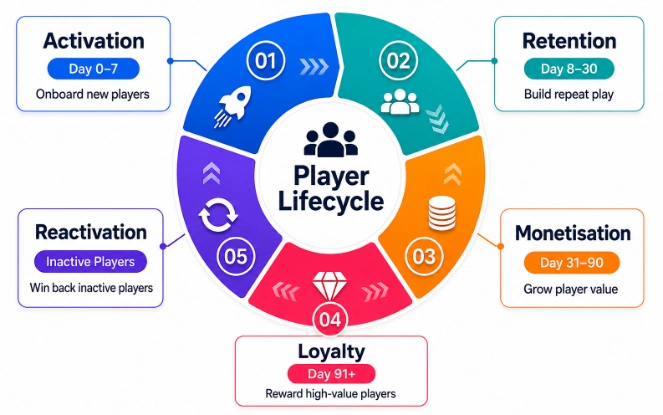
The 5 Player Lifecycle Stages Every Operator Must Map
Bonus abuse is a margin issue as much as a fraud issue. Bonus hunters register, deposit once, claim the welcome offer, and disappear. If campaigns are judged only on first deposits, these sources can look profitable.
However, the same sources often look damaging when judged by NGR, second deposit rate, D30 retention, KYC rejection rate, and bonus cost as a percentage of NGR.
That is why affiliate quality, CRM exclusions, wallet rules, and bonus engine logic should be reviewed together.
iGaming Marketing KPIs for Operator Growth and NGR
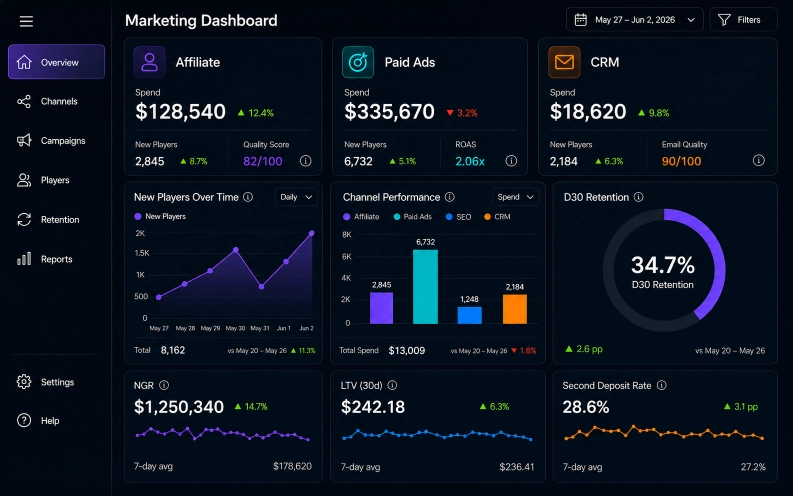
NGR by traffic source is the view most operators need first. It shows which campaigns, affiliates, and channels produce real value after costs are counted.
| KPI | What It Tells You | Healthy Range |
|---|---|---|
| Customer Acquisition Cost | What you actually pay per depositing player. | $250 to $500 casino / $500 to $800+ sportsbook. |
| Registration to First Deposit Rate | How well the funnel converts intent into action. | Above 25% is strong, below 15% needs attention. |
| Second Deposit Rate | Whether players want to return after the first session. | Above 50% is strong, below 35% needs attention. |
| D7 Retention Rate | How many players come back in the first week. | Above 35% strong, below 20% signals activation failure. |
| D30 Retention Rate | How many players remain active after a full month. | Above 25% is strong, below 15% is a serious problem. |
| Bonus Cost as % of Revenue | How much is being given away relative to revenue. | Below 30% is healthy, above 40% needs review. |
| NGR per Player | What each player is worth after all deductions. | Track by traffic source, not platform average. |
| LTV to CAC Ratio | Whether player lifetime value justifies acquisition cost. | Below 3:1 is unsustainable, above 5:1 is strong. |
GGR vs NGR: Why the Distinction Matters
Gross gaming revenue shows betting activity. It is total wagers minus winnings returned to players, so it helps operators understand volume but not true profitability.
Net gaming revenue shows business value after bonuses, affiliate commissions, payment fees, taxes, and other deductions are counted.
A campaign can look strong at the GGR level. However, it can still be unprofitable once costs are applied.
Therefore, marketing decisions should be based on NGR per player, NGR by traffic source, and LTV to CAC ratio, not deposit volume alone.
Operators with sportsbook products should also connect marketing KPIs with odds, exposure, and risk data. At scale, this can link into sports betting algorithm software workflows, especially when acquisition campaigns are tied to live event demand.
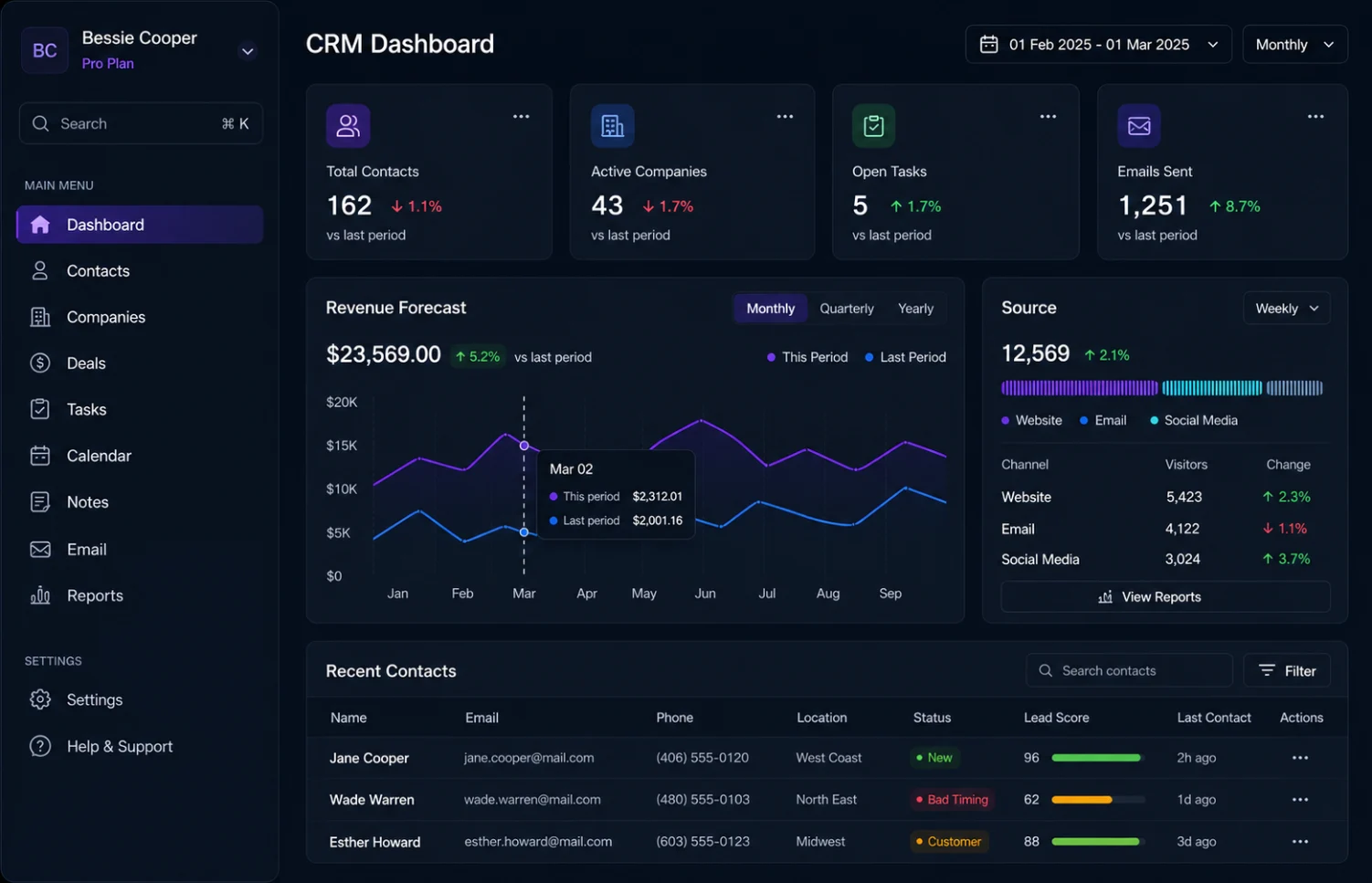
How SDLC Corp Helps Operators Build a Connected iGaming Marketing System
A connected growth system gives marketing teams real visibility. Without that connection, teams can see campaign activity but not real player value.
When affiliate tracking, CRM automation, bonus controls, wallet data, KYC workflows, and analytics sit in separate systems, blind spots form.
As a result, margin disappears because teams cannot clearly see which campaigns create retained value and which ones create leakage.
Shows which partners produce retained players, not only first deposits.
Triggers welcome, second deposit, reactivation, and VIP journeys based on player actions.
Helps control bonus exposure by linking wallet, KYC, source, and activity data.
Track CAC, LTV, NGR, second deposits, churn, and source-level performance in one operator view.
SDLC Corp builds and improves iGaming platforms where core growth systems work together.
That includes player account management, affiliate tracking, CRM automation, bonus engines, payment integrations, KYC and AML workflows, risk controls, and retention dashboards inside a connected online casino software or sportsbook platform.
Use this quick audit before scaling acquisition spend
- Can your team see which traffic sources produce retained players?
- Which CRM flows are driving repeat deposits?
- Do reports show which affiliates create positive NGR after bonuses and fees?
- Are bonus rules, wallet data, KYC workflows, and player analytics connected?
If the answer is no, more acquisition spend may only make the leakage harder to control.
SDLC Corp can help operators review CRM automation, affiliate tracking, bonus rules, payment flows, and NGR dashboards. As a result, decisions are based on player value, not traffic volume.
Build an iGaming marketing dashboard that tracks real player value
Connect acquisition, CRM, affiliate tracking, bonus rules, payments, KYC, compliance checks, and NGR analytics into one growth system built for iGaming operators.
Final Thoughts
iGaming marketing is not only a campaign problem. It is a system problem.
Operators grow more profitably when acquisition, affiliate tracking, CRM automation, payment flows, bonus rules, and NGR reporting work together.
However, if these layers are disconnected, more spend can increase traffic while hiding the real source of revenue leakage.
Before increasing budget, review whether your team can see retained players by source, second deposits by CRM flow, and bonus cost by campaign.
A connected iGaming software development approach helps operators tie marketing activity to real player value. It also prevents acquisition, retention, and reporting from becoming separate problems.
Frequently Asked Questions
1. What is iGaming marketing?
iGaming marketing is the system operators use to acquire players, convert them into depositors, and retain them long enough to generate sustainable net revenue.
It includes affiliate marketing, SEO, paid media, CRM automation, in-platform engagement, bonus campaigns, and compliance-led promotion.
2. Is iGaming marketing the same as iGaming affiliate marketing?
No. Affiliate marketing is one part of iGaming marketing.
A complete iGaming marketing strategy also includes SEO, paid media, CRM automation, social and creator campaigns, in-platform engagement, retention workflows, compliance checks, and NGR reporting.
3. How much does it cost to acquire an iGaming player?
As a directional benchmark, casino player CAC often ranges from $250 to $500 per depositing player.
For sportsbook operators, CAC can reach $800 or more during major event windows. However, the real cost rises when D30 retention is weak.
That happens because operators must keep spending to replace players who do not return.
4. What is the best iGaming marketing strategy for operators?
The best strategy depends on operator stage and market maturity.
Launch operators should focus on affiliate partnerships, SEO foundations, and deposit flow quality. Growth operators need CRM automation and source-level retention tracking.
Mature operators should prioritise LTV, NGR protection, and in-platform retention.
5. What is the difference between GGR and NGR in iGaming?
GGR is total wagers minus winnings returned to players.
NGR is GGR after deducting bonuses, affiliate commissions, payment fees, taxes, and other costs.
Therefore, NGR is more useful for marketing decisions because it shows real profitability.
6. Why do iGaming operators lose money even when first deposits increase?
A player who deposits once, claims a welcome bonus, and never returns can produce a net loss after acquisition cost, bonus payout, affiliate commission, and payment fees.
First deposits prove intent. However, second deposits prove value.
7. What KPIs should iGaming operators track for marketing growth?
The most important KPIs are CAC, registration to first deposit rate, second deposit rate, D7 retention, D30 retention, bonus cost as a percentage of revenue, NGR per player, and LTV to CAC ratio.
However, the most useful view is NGR broken down by traffic source.