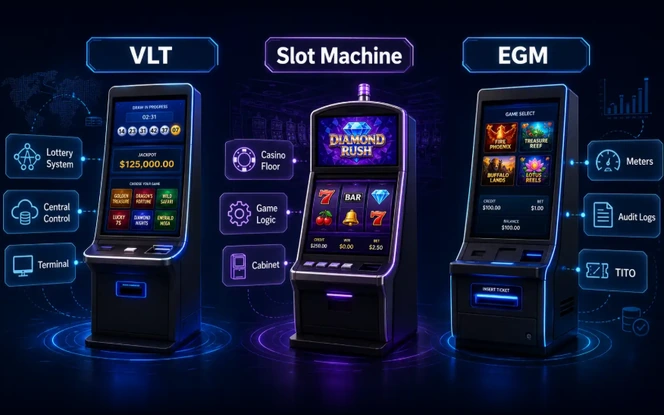
VLTs, slot machines, and EGMs may look similar to players. However, they can work differently behind the scenes. The main differences depend on game control, venue type, reporting, and local gaming rules.
In this guide, operators, product teams, compliance teams, and technical readers can compare VLTs, slot machines, and EGMs. When comparing VLT vs slot machines or VLT vs EGM terminology, look beyond the cabinet.
The more important questions are how the machine is controlled, reported, and approved.
Quick Summary of VLTs, Slot Machines, and EGMs
| Term | Simple Meaning |
|---|---|
| VLT | Video lottery terminal, often connected to a lottery or central system model |
| Slot machine | Casino gaming machine with approved game logic, meters, records, and reporting |
| EGM | Broad term for electronic gaming machine, including many cabinet-based gaming devices |
| Backend model | VLTs often involve central lottery systems, while slot machines often connect to casino host systems |
| Jurisdiction | Definitions and approval requirements vary by region and regulator |
| Operator value | Clear terminology helps with planning, procurement, compliance review, and reporting setup |
What Is an EGM?
An EGM is an electronic gaming machine. It is a broad technical and regulatory term for machines that support electronic gameplay in a regulated environment. EGMs may include:
- Slot machines
- Video poker machines
- Video lottery terminals
- Electronic table game terminals
- Multigame cabinets
- Casino-floor gaming machines
- Lottery-linked terminals
- Networked gaming devices
- Cabinet-based wagering terminals
- Other regulated electronic gaming devices
The term EGM focuses on the machine category rather than one game type. Therefore, a slot machine is usually an EGM, but not every EGM is a slot machine.
What Is a Slot Machine?
A slot machine is commonly used on casino floors. It presents reels, symbols, paylines, credits, wagers, wins, and bonus features through a cabinet or terminal. Modern slot machines use approved game logic and an RNG. They also store paytables and accounting meters. In addition, cabinet controls, ticket handling, event logs, and backend links support daily operations.
The deeper technical flow is covered in how EGM slot machines work. A casino slot machine usually connects to a host or casino management system. The system receives meters and events. It may also support TITO, player tracking, handpays, fault alerts, and reports.
What Is a VLT?
A VLT is a video lottery terminal. Its legal model varies by market because each regulator defines its own control and reporting rules. In New York, the Gaming Commission reports more than 17,000 VLTs across nine facilities. Each VLT and electronic table game connects to the Commission's centralized system, which tracks play and earnings. New York's video lottery page is a useful example because it clearly separates video lottery from commercial casino gaming and emphasizes centralized system tracking.
In Alberta, AGLC manages 6,000 VLTs in age-restricted, liquor-licensed venues. Standard retailers can operate up to 14 VLTs, while gaming entertainment centres can operate 15 to 49. See AGLC's VLT rules. In practice, a VLT may look similar to a slot machine. However, its operating model, central control, revenue model, approval process, and reporting setup may be different.
VLT vs Slot Machine: Key Differences
Although VLTs and slot machines can look similar, operators should compare the control model behind the cabinet.
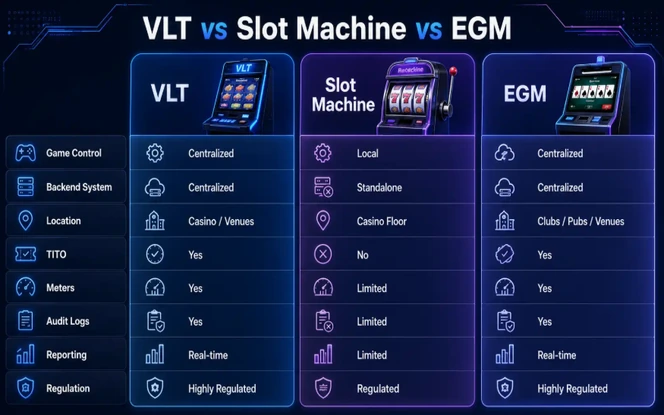
| Area | VLT | Slot Machine | EGM |
|---|---|---|---|
| Meaning | Video lottery terminal | Casino gaming machine | Broad electronic gaming machine category |
| Control model | Often linked to lottery or central system model | Usually approved local game logic with host reporting | Depends on device type and jurisdiction |
| Venue | Lottery facilities, route locations, bars, lounges, racetracks, or approved venues | Casino floors or approved gaming facilities | Any approved electronic gaming environment |
| Backend | Central lottery or terminal management system | Casino host, ticketing, monitoring, and reporting systems | Depends on machine class and system design |
| Records | Centralized play, terminal, and revenue records may be important | Meters, events, tickets, handpays, and backend reports | Machine records depend on the EGM type |
| Regulation | Often lottery or provincial/state gaming authority model | Casino gaming authority model | Broad regulatory category |
The key difference is not only the screen or cabinet. Instead, compare how the machine is approved, connected, monitored, and operated.
VLT vs EGM: Are They the Same?
A VLT can be an EGM because it is an electronic gaming device. However, VLT and EGM are not identical terms. EGM is the broader category, while VLT describes a more specific machine and operating model.
This distinction matters when teams compare machine suppliers, venue types, central systems, regulatory approval paths, technical testing, and backend reporting requirements.
How Game Outcomes Are Controlled
One of the biggest differences between VLTs, slot machines, and broader EGM models is game outcome control.
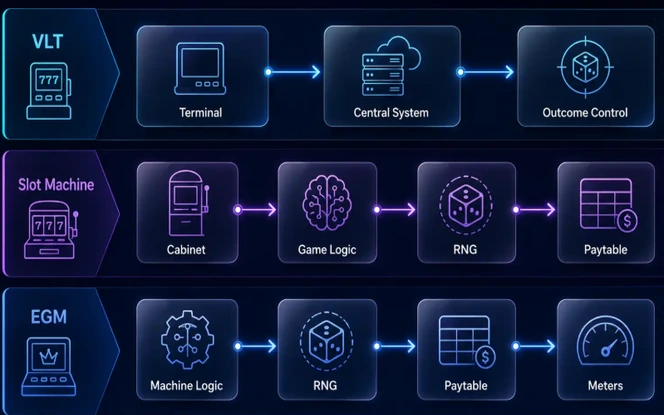
For a casino slot machine, the game result is usually handled inside the approved machine logic through RNG, outcome mapping, paytable evaluation, and meter updates. That technical flow is explained in EGM RNG and game outcome testing. VLT control follows the local regulatory model. In New York, the Commission's central system tracks game play and earnings. Other markets can use different outcome, validation, and reporting designs.
Two similar cabinets can use different outcome models. First, review the game logic and central system role. Then check approvals, technical standards, host links, and reports.
Backend Systems and Central Monitoring
VLTs, slot machines, and EGMs all need records. However, the backend model may differ.
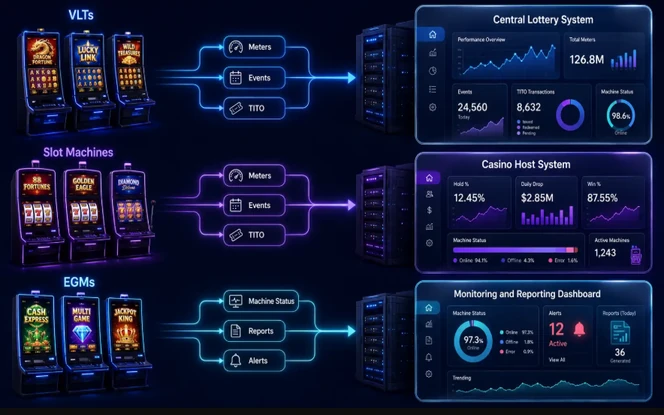
A VLT environment uses the central or terminal management system defined by its regulator. By contrast, a casino slot environment usually connects machines to a casino host. Separate services may handle TITO, player tracking, SAS or G2S messages, monitoring, and reports. EGM monitoring and backend reporting systems show machine status and accounting meters. They also capture events, tickets, faults, alerts, and reconciliation records. For slot machines, SAS and G2S protocols carry machine data to host systems. Common messages cover meters, events, tickets, handpays, and player sessions.
Delivery Experience: What We Test in an EGM Backend Integration
SDLC Corp builds casino management and EGM software. In our backend integration work, the most important test is not whether a machine appears online. It is whether the machine, host, ticket system, and accounting report tell the same story.
- Map every SAS or G2S event to a clear host status and operator action.
- Compare machine meters with host totals after cash-in, play, cashout, handpay, and reset tests.
- Test duplicate, delayed, and out-of-order messages before production launch.
- Confirm that TITO validation and redemption records reconcile across all connected systems.
Practical lesson: most integration defects appear at system boundaries. A clean event map and a repeatable reconciliation test catch them early.
Meters, TITO, Audit Logs, and Reporting
Next, operators should compare machines by how they record value and events. EGM accounting meters track credits bet and won. They also record ticket-in, ticket-out, handpays, jackpots, and other controlled values. TITO in slot machines links ticket insertion and validation to the player's credits. Cashout then creates a new ticket and redemption record. EGM audit logs and event records explain machine history.
Key records include door opens, resets, printer faults, validator errors, handpays, and configuration changes. For VLTs, similar ideas may apply, but the exact record structure, central system role, validation workflow, and operator responsibilities depend on the jurisdiction and terminal environment.
Where VLTs and Slot Machines Are Commonly Used
Another useful comparison point is deployment context.
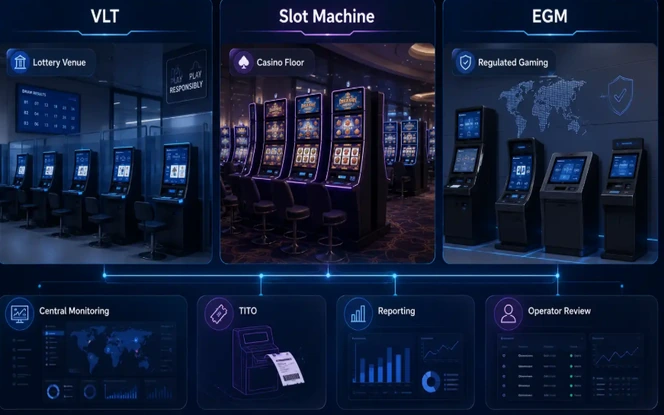
| Deployment Model | Common Setup | Typical Review Focus |
|---|---|---|
| VLT venue | Lottery-linked or centrally managed terminal environment | Central system, terminal control, revenue tracking, venue rules |
| Casino floor | Slot machines and other EGMs in approved casino space | Game approval, meters, TITO, handpays, monitoring, reporting |
| Route or distributed model | Approved terminals across multiple non-casino venues | Central monitoring, retailer rules, cash handling, terminal status |
| Broader EGM environment | Electronic gaming devices across regulated venues | Machine class, device rules, auditability, reporting, system integration |
Venue type also shapes the terminology. A VLT facility, casino floor, and distributed route environment may all use electronic cabinets, but their operating rules can be very different.
Cited VLT and Gaming Machine Data
These regulator figures show why local definitions matter. They also give operators useful planning benchmarks.
Great Britain's limits also differ by category. B3 machines have a £2 maximum stake and £500 maximum prize. Category C machines have a £1 maximum stake and £100 maximum prize. Check the Gambling Commission machine category guide before planning a venue or product.
Jurisdiction and Terminology Examples
VLT, slot machine, and EGM terminology changes by market. For this reason, operators should not rely on one definition for every region.
USA, New York
New York operates more than 17,000 VLTs across nine facilities. The Commission's central system tracks game play and earnings.
USA, Nevada
Nevada focuses heavily on gaming devices, technical standards, slot systems, accounting, and device integrity under its gaming regulatory framework.
Canada, Alberta
AGLC manages 6,000 VLTs. Retailers can host up to 14, while gaming entertainment centres can host 15 to 49.
Great Britain
The Gambling Commission sets category-based limits. B1, B3, and C machines each have different stakes, prizes, venues, and testing rules.
Singapore
Singapore's EGM standards emphasize that deployed EGMs should be secure, reliable, and auditable in the local regulatory environment.
Nevada's gaming regulations page lists technical standards for gaming devices and online slot systems. Great Britain's gaming machine categories and technical standards show how another regulated market classifies gaming machines. Singapore's EGM standards provide another example of local EGM requirements.
Common Misunderstandings
VLT and Slot Machine Are Always the Same
They may look similar, but the operating model, central system role, venue rules, and reporting model can be different.
EGM Only Means Slot Machine
EGM is broader than slot machine. It can include several types of electronic gaming devices.
The Screen Explains the Outcome Model
A cabinet screen does not reveal whether the result model is local, centrally connected, lottery-linked, or casino-hosted.
One Region's Definition Works Everywhere
Gaming terminology is local. The same machine style may be described differently across states, provinces, and countries.
Backend Reporting Is Optional
Reporting, meters, audit records, and reconciliation are key parts of the operating model, especially in regulated environments.
Operator Checklist for Comparing VLTs, Slot Machines, and EGMs
Before deployment, operators and product teams should review the following areas:
- Jurisdiction terminology
- Machine category
- Venue type
- Central system role
- Local game logic role
- RNG and outcome model
- Paytable and math review
- Meter coverage
- TITO or voucher model
- Ticket validation flow
- Audit log coverage
- Door and cabinet events
- Host system connection
- SAS/G2S or other protocol support
- Player tracking support
- Handpay workflow
- Backend reporting model
- Central monitoring model
- Reconciliation workflow
- Revenue reporting
- Venue responsibilities
- Retailer or operator rules
- Testing and approval process
- Change control process
Overall, this checklist helps teams avoid confusing a cabinet type with the full regulatory and operating model behind it.
Need Help Choosing the Right Gaming Machine Model?
Compare VLT, slot machine, and EGM requirements with clearer guidance on control systems, reporting, deployment, and compliance.
Talk to Our EGM ExpertsFAQs About VLTs, Slot Machines, and EGMs
VLTs are connected to a central lottery system, while slot machines usually operate inside casinos. EGM is a general term for electronic gaming machines, including slots and VLTs.
Licensed slot machines use random number generators, so every spin is independent. There is no reliable pattern or strategy that can guarantee a win.
Slot machine odds depend on the game’s payout rate and house edge. Winning combinations are possible, but the casino keeps a small mathematical advantage over time.
A VLT can be considered a type of electronic gaming machine because it is an electronic device used for regulated gaming. However, not every EGM is a VLT.
Yes. A modern slot machine is generally an electronic gaming machine. EGM is a broader category that can also include VLTs, video poker, and other electronic gaming devices.
Not always. VLTs often connect to a lottery or central system, while casino slot machines may connect to casino host, monitoring, ticketing, and reporting systems.
It depends on the jurisdiction and technical model. Some VLT environments rely heavily on a central system, while slot machines commonly use approved local game logic and machine records.
Operators should compare local rules, game control models, backend systems, meters, TITO flows, audit logs, protocol support, reporting needs, venue types, and approval requirements.
Gaming definitions and technical rules vary by location. Operators must follow the machine classifications, testing standards, reporting rules, and venue requirements set by the relevant regulator.
Final Thoughts
VLTs, slot machines, and EGMs overlap, but they are not always interchangeable terms. EGM is the broad technical category. Slot machine is the familiar casino-floor machine type. VLT usually points to a video lottery terminal model that may be tied to a lottery or central system environment. The safest way to compare them is to look beyond the cabinet. Review the outcome model, backend system, meters, TITO flow, audit logs, protocol support, venue type, jurisdiction, and approval process. Clear terminology helps operators make better decisions about machine selection, reporting, deployment, monitoring, and regulatory review.