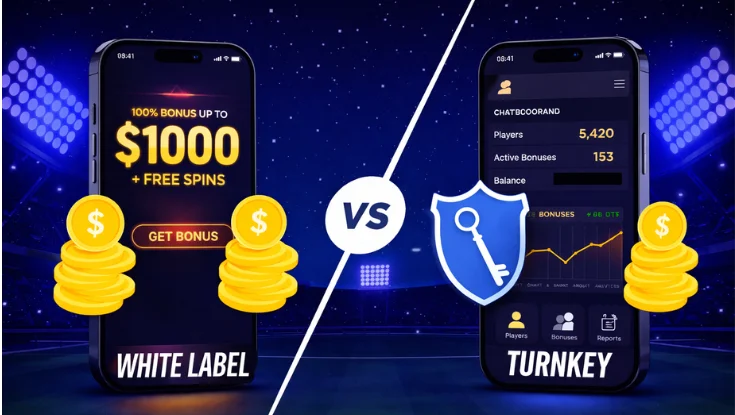

White-label online casino cost ranges from $15,000 to $150,000+ across the market. Vendors price using setup-only, monthly fee, or revenue-share models.
White-label online casino setup is priced as a one-time fee based on scope and integrations. Most builds land around $15k–$150k+ with a typical launch window of 4–12 weeks, once GEO, payments, game content, and compliance steps are confirmed. SDLC Corp offers a setup-only pricing option with no platform revenue share.
You may also need to account for: payment processing costs, KYC/AML vendor fees, game provider commercial terms, and jurisdiction-specific legal/licensing costs (varies by GEO).
White-Label Casino Setup Cost Snapshot (One-Time Fee)
These ranges reflect scope and integrations—not monthly fees or revenue share.
| Tier | One-time setup | Launch |
|---|---|---|
Starter scope Core build with limited integrations. | $15k–$40k | 4–8 weeks |
Expanded scope Most popular More payments/KYC options + reporting & promo tooling. | $40k–$90k | 6–10 weeks |
Premium Brand Deeper integrations, custom UX, and tighter delivery/SLA. | $90k–$150k+ | 8–12 weeks |

White Label vs Turnkey Online Casino (Which Model Fits?)
Use this quick comparison to choose the right delivery model before you scope integrations, compliance steps, and launch timelines.
White Label
Fastest launch- Best for: validating a market quickly, quick go-live
- Cost model: one-time setup fee (scope-based) — no monthly platform fee
- Ongoing costs: pass-through vendor fees (payments, KYC/AML checks, game provider terms, hosting)
- Control: configuration-led (feature set depends on the selected stack)
- Customization: branding/UI + configuration + agreed integrations
- Time to launch: typically 2–8 weeks once requirements are confirmed
Turnkey
More ownership- Best for: scaling ops + retention with deeper tooling and integrations
- Cost model: higher one-time setup fee (broader scope) + pass-through vendor costs
- Ongoing costs: payments, KYC/AML checks, game provider terms, hosting (support coverage may be scoped separately)
- Control: more control via deeper integrations and operational tooling
- Customization: broader than white label (ops, reporting, automation)
- Time to launch: typically 6–16 weeks depending on integrations and compliance workflow
What “White-Label” Really Includes (and Doesn’t)
This is the fastest way to see what’s usually included in a one-time setup — and what is typically scoped as an add-on or billed by third-party vendors.
- Platform setup: branding, configuration, environments, and launch checklist
- Admin/back office: roles, permissions, reporting basics, player management
- Game catalog connection: aggregator/provider connection (based on your chosen stack)
- Payments integration: integrate the agreed payment rails (e.g., cards/APMs), plus checkout configuration
- KYC/AML workflow: integration + basic flow setup (verification checks are usually vendor-billed)
- Responsible gaming: standard tools (limits, self-exclusion) and basic compliance settings (by GEO)
- Launch support: QA, deployment, and a defined post-launch support window (as agreed)
- More integrations: additional payment rails, extra KYC providers, fraud/risk tooling
- Deeper UI work: custom components beyond theme variables and standard layouts
- Advanced CRM/segmentation: automation, lifecycle journeys, real-time traits
- Data & BI: custom dashboards, exports, APIs, pipelines, warehousing
- Content expansions: more providers, premium catalogs, or bespoke/in-house games
- Native apps: iOS/Android (where permitted) vs web/PWA
- Premium support: 24/7 coverage, dedicated team, tighter response windows
Tip: When comparing vendors, ask them to confirm scope and exclusions in the SOW. $15,000–$150,000 setup (one-time, scope-dependent).

White Label Online Casino Cost Calculator
Use this white label casino cost calculator to estimate white label online casino cost including setup, year-one third-party costs, and total first-year budget based on GEO count, payment rails, KYC/AML scope, game content depth, customization, and support needs.
Your launch scope
Each market adds compliance, payment, and content scope.
Cards, APMs, e-wallets, crypto each add integration work.
Higher-compliance markets require more vendor coordination.
Live dealer and premium titles add provider agreements and certification steps.
Custom UX components increase setup cost more than add-ons.
Higher support tiers increase ongoing costs more than setup.
Estimated budget
Starter-style scope with one GEO, limited integrations, and standard vendor setup.
Main cost drivers
- Single GEO with limited compliance scope
- Standard payment integration (1–2 rails)
- Basic KYC workflow
- Starter content catalog
These figures are planning benchmarks, not fixed quotes. Actual pricing varies by market, provider stack, legal scope, and delivery requirements. All figures reflect SDLC Corp’s setup-only model — no monthly platform fee, no revenue share on GGR.
Calculator FAQs
It estimates setup cost and year-one budget using common planning variables such as GEO count, payment methods, KYC/AML complexity, content depth, customization, and support level. Each variable is scored and mapped to a Starter, Growth, or Full-scope budget band.
Yes. The year-one estimate includes likely third-party cost categories such as payments, KYC/AML checks, hosting, provider onboarding, and support coverage. These sit outside the platform setup fee and vary by vendor and market.
No. It is a planning tool that shows realistic budget ranges based on common scope variables, not a fixed vendor quote. Use it to frame early budget conversations and identify which variables drive the most cost in your specific launch plan.
Want a fixed scope estimate instead?
Request a QuotePricing Tiers by Scope
Actual quotes are scope-dependent. These three tiers reflect the most common operator starting points.
Proof-of-market launch with limited integrations and standard vendor setup.
- Aggregator base tier (no live dealer)
- 1–2 payment rails (cards + one APM)
- Standard KYC and payments workflow
- Light UI skin
- Small ops team assumed
Scaling acquisition and retention with stronger ops and live dealer.
- Aggregator + live dealer
- 8–12 payment rails; reconciliation add-ons
- Dedicated CRM/affiliates workflow
- Enhanced KYC/AML layer
- Multi-GEO compliance configuration
Premium brand experience with broader integration scope and advanced ops tooling.
- Aggregator + live dealer + premium providers
- iOS/Android apps or advanced PWA
- In-house creative + VIP ops workflow
- Premium support coverage option
- Custom UX components
Breakeven Estimate — Expanded Scope (Illustrative)
Planning model only. Actual figures depend on your GEO, operator agreement terms, and volume.
Swipe to compare pricing details.
| Item | Assumption | Amount (USD) |
|---|---|---|
| Setup fee | One-time delivery | $60,000 |
| Initial marketing | Launch campaigns | $80,000 |
| Monthly NGR | After bonuses, provider fees, taxes | $120,000 |
| Payment processing | ~5% PSP fees | −$6,000/mo |
| KYC/hosting/support | Fixed ops costs | −$8,000/mo |
| Monthly contribution | ~$106,000/mo | |
| Breakeven | (Setup + marketing) ÷ monthly contribution | ~1.3 months |
Businesses evaluating different deployment models should also compare our Casino Software Cost Guide for broader development pricing and the Turnkey Casino Solution page to understand the differences in ownership, customization, integrations, and long-term operating costs before selecting a platform.
Compare Starter vs Expanded scope in detail.
Get Scoped EstimateLine-Item Cost Breakdown
Each component below contributes to the setup fee. Scope depth per component — not the component count — is what moves the total.

Brand & Design
Low impactLight skin usually included. Premium re-skin adds to setup cost.
Game Catalog
Medium impactBase aggregator included. Live dealer and exclusives cost extra.
Payments Stack
High impactEach extra rail adds scope. Confirm MID ownership in the SOW.
KYC / AML
High impactStandard flow included. Sanctions/PEP and device risk add cost.
Marketing Tools
Medium impactBonus engine basic. Advanced CRM and affiliates are scoped separately.
Admin & Operations
Low impactStandard back office included. Fraud tooling and CDN are pass-through.
White-Label Casino Cost in 2026 — Budget Bands
Swipe to compare pricing details.
| Scope | Setup (one-time) | Est. year-one add-ons | Est. year-one total |
|---|---|---|---|
| Starter Single GEO · standard UI · 1–2 payment rails | $15,000–$40,000 | $12,000–$30,000 | $27,000–$70,000 |
| Growth 2–3 GEOs · live dealer · stronger payments | $40,000–$90,000 | $25,000–$60,000 | $65,000–$150,000 |
| Full-scope Multi-market · premium design · deep compliance | $90,000–$150,000+ | $50,000–$100,000+ | $140,000–$250,000+ |
Year-one add-ons include: payment processing, KYC/AML tooling, hosting/CDN, game provider fees, compliance tooling, and post-launch support. Planning benchmarks only — not binding quotes.
Pricing Model Comparison
Swipe to compare pricing details.
| Model | Setup cost | Ongoing fee | Best for |
|---|---|---|---|
| Setup-only SDLC Corp | $15k–$150k+ | Third-party pass-throughs only | Predictable TCO, no ongoing platform dependency |
| Monthly fee | $5k–$30k | $5k–$50k/month | Lower upfront budget, steady GGR |
| Revenue share | Low or zero | 10%–30% of GGR | Early-stage, uncertain GGR — becomes expensive above ~$50k/month GGR |
Hidden Costs of a White-Label Online Casino
Many first-time operators budget only for the platform setup fee. However, launching and operating a white-label online casino involves several ongoing third-party expenses that are usually billed separately from the initial platform implementation.
Swipe to compare hidden cost details.
| Hidden Cost | Why It Matters |
|---|---|
| Gaming licence | Required in regulated jurisdictions |
| Payment gateway fees | Charged on every player transaction |
| KYC & AML services | Identity verification and compliance checks |
| Game provider fees | Commercial agreements with game suppliers |
| Hosting & infrastructure | Cloud hosting, CDN, backups and monitoring |
| Technical support | Premium SLA or dedicated support plans |
| Marketing | SEO, affiliate marketing, paid advertising and promotions |
| Compliance updates | Regulatory changes and certification requirements |
Understanding these ongoing operational costs helps businesses estimate the true first-year investment instead of focusing only on the initial setup fee. Comparing vendors based on total cost of ownership usually produces a more accurate long-term budget.
What operators typically do not own in a white-label deal: the underlying platform software and IP, game RNG certificates, payment MIDs (unless negotiated), full player data portability rights, and core infrastructure. Confirm ownership, data export terms, and exit clauses before signing.
How the Setup-Only Model Works
The one-time setup fee covers delivery — branding, configuration, environments, integrations, QA, and launch. Ongoing costs sit entirely with third-party vendors, not the platform.
Four inputs drive your quote: GEO(s) and compliance scope · Payment rails · KYC/AML depth · Game mix. Lock these before requesting a quote.
SOW first. Request a statement of work with itemised deliverables and milestones before any commercial commitment.
Vendor Checklist & Launch Timeline
Confirm every item below in writing before signing. Aligned with a one-time setup model.
Implementation Timeline (2–8 Weeks)
Week 0–1 · Branding & Kickoff
Logo, palette, typography, domain setup, environments, sandbox access confirmed.
Weeks 1–2 · Integrations
Payments (commercial + technical), KYC vendor, game catalog onboarding, affiliate tracking setup.
Weeks 2–4 · Configuration & Build
Back office setup, compliance tooling, bonus engine, UI configuration, CRM workflows.
Weeks 4–6 · QA & Staging
End-to-end testing across payments, registration, compliance checks, and game loading. Stakeholder review.
Weeks 6–8 · Launch
Go-live. Starter scope can reach this in 2–4 weeks. Expanded and Premium require 6–10 weeks total.
Common Pitfalls
Frequently Asked Questions
Have a specific scenario? Talk to a white-label consultant.
What is the typical white-label online casino cost?
Cost depends on the pricing model:
Setup-only (SDLC Corp): $15,000–$150,000 one-time. No platform fee. Post-launch costs are direct vendor pass-throughs.
Monthly fee model: Lower setup + $5,000–$50,000/month platform charge.
Revenue share: Low or zero setup + 10%–30% of GGR. Exceeds setup-only cost at approximately $50,000/month GGR.
Scope — GEO count, payment rails, compliance depth, game mix — drives most of the variance in the setup fee.
How fast can I launch?
With a clear scope, most launches land in 2–8 weeks:
2–4 weeks (Starter): single GEO, standard UI, 1–2 payment rails, standard KYC
4–8 weeks (Expanded): more payment rails, live dealer, stronger CRM/reporting
6–10 weeks (Premium/multi-GEO): parallel integrations, full compliance stack
Parallel integrations — multiple PSPs, KYC vendors, affiliate platforms — compress the timeline but increase delivery cost.
Do I need my own licence?
Requirements vary by market:
Some providers can onboard you under their umbrella licence for certain markets
Many regulated markets require your own licence or a local partner model
Even where a licence is not required, player protection and AML obligations still apply
Confirm the licensing model for each target GEO before shortlisting providers.
Who owns the player data?
Ownership depends on the provider contract. Confirm before signing:
Legal data controller and processor roles per GEO
What you can export — KYC status, transactions, gameplay, CRM events
Export frequency and format — CSV, API, warehouse connector
What happens to player data on platform exit
Can I migrate off a white-label later?
Migration is possible — but only reliable if you negotiate export and portability terms upfront. The contract should cover:
Player data exports (daily snapshots and API access where available)
Wallet and ledger history format and retention period
Game and session history portability
Notice period and transition support obligations
Can I use my own payment processors?
Often yes — but validate before committing:
Who owns the MID and settlement accounts
Integration cost and ongoing support ownership
How reconciliation, refunds, and chargebacks are handled
Whether bringing your own PSP reduces bundled pricing benefits
How are chargebacks handled?
In most white-label agreements, chargebacks are the operator's cost — including fees and operational overhead. To reduce exposure:
Use stronger KYC and device/risk checks for high-risk traffic segments
Ensure cashier UX clearly communicates deposit, withdrawal, and limit rules
Confirm who manages dispute workflows and response timelines in the SOW
How do timelines affect cost?
Faster timelines do not always increase platform fees — but they can increase delivery and integration costs. Areas that commonly add cost:
Parallel integrations (multiple PSPs, KYC vendors, affiliate tracking simultaneously)
Faster compliance approvals requiring additional coordination
Compressed QA coverage across more integration points
Locking scope before work begins is the most reliable way to reduce delivery time and cost variance.
Is native mobile required?
No — most brands launch on responsive web or PWA first, then add native apps later. Native apps add cost because of:
App store review timelines and platform policy restrictions (varies by region)
Additional QA, device coverage, and release management overhead
Separate update cycles and store compliance requirements
Where do I start?
Lock four inputs first — these drive your quote more than any other factor:
GEO(s) and compliance requirements
Payment rails (cards, APMs, crypto if permitted)
KYC depth (ID verification, sanctions/PEP, device risk)
Game mix (aggregator base tier vs live dealer vs exclusives)
With these defined, request an itemised SOW from shortlisted vendors. An itemised statement of work is the only reliable basis for cost comparison.
What does the operator typically not own in a white-label deal?
In most white-label structures, the operator does not own:
The underlying platform software and IP — held by the vendor
Game RNG certificates — held by the platform or aggregator and not transferable on exit
Payment MIDs and settlement accounts — typically under the platform's entity unless negotiated
Full player data portability rights — export terms and formats vary by vendor
Core infrastructure — hosting, CDN, and architecture remain on the platform side
Migration terms, data export clauses, and notice periods matter as much as the setup fee when evaluating contracts.
At what GGR level does revenue share become more expensive than setup-only?
At 10% revenue share:
$50,000/month GGR = $5,000/month in ongoing fees ($60,000/year)
$100,000/month GGR = $10,000/month ($120,000/year)
$200,000/month GGR = $20,000/month ($240,000/year)
For most operators reaching consistent GGR above $50,000/month, a setup-only model delivers better long-term economics. Model the break-even point against your projected GGR before committing to a revenue share agreement.
Is a white-label casino cheaper than a turnkey casino?
A white-label casino generally requires a lower upfront investment because the platform, infrastructure, and many operational components are already available. A turnkey solution typically costs more initially but offers greater ownership, customization, and long-term flexibility.
What ongoing fees should I expect with a white-label casino?
Besides the initial platform setup fee, operators should budget for payment gateway charges, KYC and AML services, hosting, game provider agreements, technical support, licensing, compliance updates, and ongoing marketing expenses.