
United States:
Transform Digital LLC
44 Montgomery Street, Suite 300
San Francisco, CA 94104
SDLC Corp is a globally certified Odoo development company building Odoo ERP implementations, custom modules, and third-party integrations for businesses across 20+ countries. We cut operational overhead by up to 40% and get your team live in weeks, not months.
120+
97%
20+










Every engagement is scoped to your industry, business goals, and budget delivered by certified Odoo developers with hands-on Odoo experience.
Full Odoo 18 rollout with process mapping, data migration, user training, and go-live support for businesses of any size.
Custom workflows, branded portals, and industry-specific modules built to survive Odoo version upgrades without breaking your configuration.
Connect Odoo with Shopify, Salesforce, QuickBooks, Stripe, and 200+ platforms using REST APIs and official Odoo connectors.
Structured upgrade from Odoo 14, 15, or 16 to Odoo 18 — covering data mapping, module porting, regression testing, and cutover.
Engage certified Odoo developers on a dedicated, hourly, or project basis. Odoo 18 certified with 3+ years of delivery experience each.
SLA-backed support plans with 4-hour critical response — bug fixes, security patches, performance tuning, and version upgrades.
Module selection, ROI modelling, and phased rollout roadmap — delivered by certified Odoo consultants within 48 hours of your first call.
Role-based training for end users, admins, and developers — online and on-site programmes designed to drive platform adoption from day one.
SDLC Corp is ranked among the top Odoo development and implementation partners by Clutch, GoodFirms, and TopDevelopers.co. With 120+ delivered Odoo projects across 15+ industries, we bring both technical depth and sector-specific experience to every engagement — with a 97% client retention rate.
Every project includes a signed NDA, SLA delivery milestones, and transparent progress dashboards updated weekly.
A certified PM on every engagement — one point of contact from kickoff through go-live and post-launch support.
2-week sprint cycles with continuous UAT, stakeholder demos, and release notes — no surprises at go-live.
Scoped roadmap and cost estimate delivered within 48 hours of your first consultation. No commitment required.
Fixed-price, T&M, and dedicated team models. Odoo ERP at a fraction of SAP or Oracle implementation costs.
Critical issues responded to within 4 hours. Bug fixes, patches, and upgrades included in all support plans.
A structured, milestone-driven methodology used across 120+ Odoo projects on time, on budget, with measurable outcomes at every stage.
Business process analysis, Odoo module mapping, gap assessment, and a scoped roadmap within 48 hours.
System architecture, custom module development, integration planning, and UAT environment setup.
Agile 2-week sprints with continuous regression testing, performance checks, and stakeholder sign-off.
Phased cutover, end-user training, 30-day hypercare, and SLA-backed ongoing maintenance.
Odoo 18 brings 50+ integrated business apps — CRM, accounting, inventory, manufacturing, HR, e-commerce — on one open-source platform. With 15 million users worldwide and a 60–70% lower total cost than SAP or Oracle, it is the practical choice for growth-stage and enterprise teams alike.
Automated document extraction, invoice reconciliation, and smart approval routing cut manual processing time significantly.
Start with the apps your business needs — accounting, CRM, inventory — and activate additional modules as you scale.
Live dashboards, pivot tables, and scheduled reports across every business module — no separate BI tool needed.
Sync inventory, orders, and customers across Odoo, Shopify, and WooCommerce in real time — eliminating double entry.
Odoo's responsive interface works on any device. Field sales and warehouse teams stay connected even offline.
AES-256 encryption, two-factor auth, granular access controls, full audit trails, and compliance for HIPAA, SOX, and ISO 9001.
Our certified Odoo developers use Python 3, OWL, PostgreSQL, Docker, Kubernetes, and enterprise cloud platforms — building ERP solutions that are fast, secure, and upgrade-safe.
Our certified Odoo team has built industry-specific ERP configurations for manufacturing, retail, healthcare, and more — with domain expertise in each vertical.
MRP, BOM, work orders, OEE
POS, inventory, Shopify sync
HIPAA-compliant EHR & billing
Multi-warehouse, route optimisation
CRM, property & contract management
LMS, admissions, fee management
Odoo POS, kitchen display, franchise
Multi-currency, GAAP/IFRS, SOX
Proven outcomes from SDLC Corp's Odoo engagements — from custom module builds to full-scale multi-country ERP rollouts.
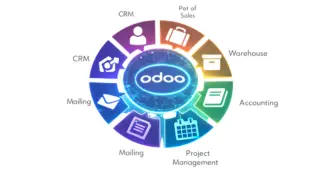
NETCOO partnered with SDLC Corp to replace 12 disconnected tools with a unified Odoo ERP — covering financial reporting, partner management, and operations.

Fitbar unified kitchen operations, inventory, and franchise management across 8 locations using SDLC Corp's Odoo customization services.

SDLC Corp built a localized Odoo POS solution with fiscal printer integration for 50+ Italian retail outlets, achieving full tax compliance at checkout.
Odoo 18 delivers enterprise ERP at 60–70% lower total cost — with faster rollout timelines and no per-module licensing.
| Feature | Odoo 18 | SAP B1 | NetSuite | MS Dynamics |
|---|---|---|---|---|
| Open-Source | ✓ Yes | ✗ No | ✗ No | ✗ No |
| Total Cost of Ownership | Very Low | High | High | Very High |
| Implementation Time | 8–16 weeks | 6–18 months | 6–12 months | 9–18 months |
| Per-Module Licensing | ✓ No fees | ✗ Yes | ✗ Yes | ✗ Yes |
| Built-In E-Commerce | ✓ Native | ✗ No | Add-on | Separate SKU |
| Mobile-First Interface | ✓ Native PWA | Limited | Limited | ✓ Yes |
| Customisation Ease | Very High | Medium | Medium | High |
| Community Ecosystem | 100K+ devs | Medium | Medium | Large |
Common questions about Odoo development, pricing, timelines, and our implementation approach.
An Odoo development company builds, customises, and implements Odoo ERP solutions. SDLC Corp is a certified Official Odoo Partner offering end-to-end Odoo 18 development, implementation, migration, integration, and support services worldwide.
Odoo ERP implementations range from around $10,000 for small businesses to $150,000+ for enterprise rollouts. SDLC Corp provides a detailed cost breakdown within 48 hours of a free consultation, with fixed-price and T&M options available.
Mid-market Odoo 18 implementations typically take 8–14 weeks. Enterprise rollouts run 16–24 weeks using our phased implementation methodology, which minimises disruption and accelerates user adoption.
Yes. Odoo connects with Shopify, WooCommerce, Amazon, Salesforce, QuickBooks, Stripe, PayPal, and 200+ platforms. Our Odoo integration team builds bidirectional sync that removes manual data entry across all connected systems.
Odoo Community is free and open-source with core ERP modules. Odoo Enterprise adds advanced features — mobile apps, studio, e-signatures, VoIP — on annual subscription. Read our full Odoo Community vs Enterprise guide or talk to our licensing consultants.
Our Odoo migration service covers data mapping, module porting, regression testing, and a structured cutover — zero data loss guaranteed. Most migrations from Odoo 16 or 17 complete in 4–8 weeks, depending on customisation volume.
Yes. Our Odoo support plans are SLA-backed with a 4-hour response for critical issues — including bug fixes, security patches, performance tuning, and version upgrades on monthly or annual contracts.
Odoo delivers enterprise ERP at 60–70% lower total cost than SAP, with implementation measured in weeks rather than months, no per-module fees, and open-source flexibility. See our full Odoo vs SAP comparison.
SDLC Corp has delivered Odoo ERP across manufacturing, retail, healthcare, logistics, real estate, education, food and restaurant, and finance — across 20+ countries with region-specific compliance configuration built into each rollout.
Yes. We provide managed Odoo hosting on AWS, Google Cloud, Azure, and Odoo.sh — with daily backups, SSL, performance monitoring, and security hardening. Contact us to discuss hosting options alongside your Odoo implementation.




United States:
Transform Digital LLC
44 Montgomery Street, Suite 300
San Francisco, CA 94104

United Kingdom:
30 Charter Avenue, Coventry
CV4 8GE Post code: CV4 8GF United Kingdom

United Arab Emirates:
Unit No: 729, DMCC Business Centre Level No 1, Jewellery & Gemplex 3 Dubai, United Arab Emirates

India:
715, Astralis, Supernova, Sector 94 Noida, Delhi NCR India. 201301

Qatar:
B-ring road zone 25, Bin Dirham Plaza building 113, Street 220, 5th floor office 510 Doha, Qatar
