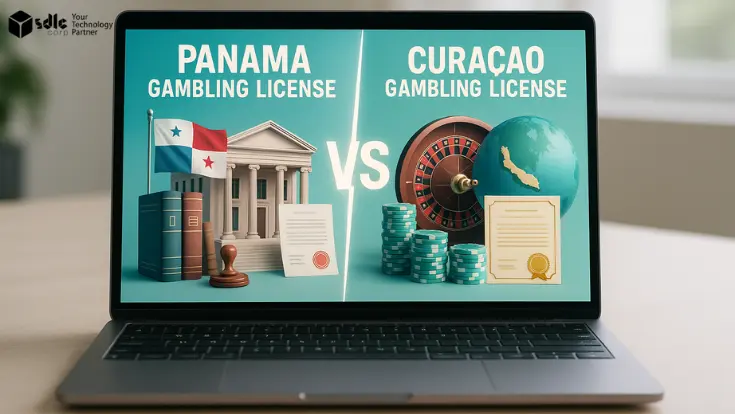
The Panama vs Curaçao gambling licence decision comes down to one question: do you need a faster, cheaper start (Curaçao) or a more structured jurisdiction with stronger Latin American commercial positioning (Panama)? Both are offshore licences — neither gives you EU market access or tier-1 Visa/Mastercard payment processing. But they are not interchangeable: Panama offers more regulatory substance and is often viewed more favourably by banking partners, while Curaçao under the new Gaming Control Board (GCB) framework is faster to obtain and marginally cheaper.
This guide gives you a direct side-by-side comparison with real cost figures, the key differences that actually affect operations, and a clear decision framework. For the full offshore vs EU jurisdiction picture, see our Europe gambling licence guide and our gambling licence overview guide.
Quick verdict — Panama vs Curaçao gambling licence
- Latin American market positioning matters
- Banking partners require more regulatory substance
- You want a longer-established legal framework (Law No. 32, 1977)
- Affiliate and B2B partners distinguish Panama from Curaçao
- You can absorb a heavier local setup (Panamanian S.A., local compliance)
- Budget allows $35,000–$80,000 in Year 1
- Launch speed is the priority (2–4 months vs 3–5)
- Budget is under $40,000 in Year 1
- Crypto-first payment model — Curaçao is widely adopted
- Lean startup team without capacity for heavier local setup
- Testing product-market fit before heavier compliance investment
- Target markets do not specifically value Panama over Curaçao
Panama vs Curaçao — direct comparison with real figures
| Factor | Panama (JCJ) | Curaçao (GCB) |
|---|---|---|
| Regulator | Junta de Control de Juegos (JCJ) | Gaming Control Board (GCB) — new 2024 framework |
| Application fee | $2,000–$10,000 | ~$3,300 (ANG 6,000) |
| Annual licence fee | $10,000–$20,000/yr | ~$19,000/yr (ANG 34,000) |
| Total Year 1 (all-in) | $35,000–$80,000 | $22,000–$40,000 |
| Timeline to licence | 60–90 days approval (3–5 months total) | 2–4 months total |
| Corporate requirement | Panamanian S.A. + local compliance officer | Curaçao entity + local managing director |
| GGR tax | 0% on offshore revenue (territorial tax) | 0% |
| Regulator reputation | Tier 2 — more established framework | Tier 2 — improving post-2024 reform |
| Banking / card access | Marginally better — Panama banking infrastructure stronger | Limited — crypto and alternative payments common |
| Crypto-friendly | Yes — Panama open to crypto operations | Yes — widely used for crypto casinos |
| Latin America positioning | Strong — Panama is a LatAm financial hub | Recognised but Caribbean-based |
| EU market access | No — offshore only | No — offshore only |
| Compliance burden | Moderate — more local setup required | Light-moderate — less local substance required |
| Application language | Spanish (certified translations required) | English |
| Legal framework age | Since 1977 (Law No. 32) | Reformed 2024 (GCB replaces old master licence model) |
| Best for | LatAm-focused operators, more banking credibility, structured setup | Fastest offshore launch, crypto-first, lean startups |
The differences that actually affect operations
Banking — Panama edges ahead
Panama's status as a major international financial centre gives Panama-licensed operators marginally better access to banking relationships than Curaçao-licensed operators. Panama City hosts over 60 licensed banks with strong international connectivity. That said, gambling operators are still classified as high-risk merchants globally — neither Panama nor Curaçao gives you Visa/Mastercard tier-1 card processing. If mainstream card payments from EU players are essential, Malta MGA is the correct jurisdiction. Within the offshore tier, Panama's banking relationships are generally more accessible than Curaçao's.
Latin America — Panama's structural advantage
For operators targeting LatAm markets — Brazil, Mexico, Colombia, Argentina, Peru — Panama's position as a LatAm financial hub provides meaningful commercial credibility. A Panamanian JCJ licence signals regional alignment in a way a Caribbean offshore licence does not. Payment partners, affiliates, and sports partnerships operating in LatAm tend to be more comfortable with a Panama licence than with Curaçao. If LatAm is not a priority market, this advantage is irrelevant.
Curaçao's 2024 reform — what changed
Many older Panama vs Curaçao guides describe Curaçao's old master licence / sub-licence model where operators could obtain a sub-licence from a master licence holder in days. That model no longer exists. Since 2024, all operators must apply directly to the Gaming Control Board (GCB) with their own licence application. This makes Curaçao more formal — more similar to Panama in process rigour than the old guides suggested. The speed advantage Curaçao retains over Panama is now 1–3 months rather than the weeks the old model appeared to offer.
Application language and local counsel
Panama's JCJ process is conducted in Spanish — applications, licence conditions, and correspondence are all in Spanish. Certified translations are required for non-Spanish documents. A Panama-licensed gaming attorney is essential, not optional. Curaçao's GCB process is conducted in English, which reduces the friction for international operators and shortens the document preparation timeline.
Neither licence gives global market access. Panama and Curaçao are both offshore licences. In any country with its own national gambling licensing regime (Germany, Netherlands, UK, Sweden, USA by state), operating without a local licence is illegal regardless of your Panama or Curaçao approval. Do not assume an offshore licence is sufficient for regulated markets — always verify the legal position in each target country before acquiring players there.
Which licence fits your business model?
- Primary target markets are in Latin America
- Banking partners specifically require more jurisdictional substance
- Affiliate network or B2B relationships distinguish between Panama and Curaçao
- Brand positioning requires a longer-established regulatory story
- Budget allows $35k–$80k Year 1 all-in and team can manage Spanish-language legal process
- Planning to operate in Panama's timezone and regional ecosystem
- Launch speed is critical — need to be live within 3 months
- Year 1 budget is under $40,000
- Crypto-first payment model
- Target markets treat Panama and Curaçao equivalently (most do)
- Team is English-speaking and cannot support Spanish legal process efficiently
- Testing product before committing to a higher-cost jurisdiction
The two-stage approach: Some operators launch on Curaçao first (faster, cheaper) and transition to Panama once the business is generating revenue and a LatAm expansion is planned. This is a viable strategy — the key is ensuring Curaçao-era operations are compliant from day one, as a regulatory issue under Curaçao can complicate a subsequent Panama application. If you plan to apply for a higher-tier licence (Malta MGA) later, the same logic applies regardless of which offshore licence you start with.
What changed in 2024 — why old Panama vs Curaçao comparisons are outdated
- Curaçao's master licence model is gone: Most online content comparing Panama and Curaçao was written under the old Curaçao framework where operators obtained sub-licences from master licence holders (CEG, CIL, etc.) in as little as a few weeks. The new GCB framework requires direct operator applications with full documentation, background checks, and a portal-based process. The speed difference between Panama and Curaçao is now weeks, not months.
- Curaçao's compliance expectations have risen: The GCB's new framework includes more formal AML, KYC, and responsible gambling requirements than the old sub-licence model. Evaluating Curaçao as a "no compliance" shortcut is no longer accurate.
- Panama's FATF standing has improved: Panama was placed on the FATF grey list in 2019 and removed in 2023 after implementing AML reforms. This has strengthened Panama's international banking relationships and reduced the reputational headwind operators previously faced when opening bank accounts under a Panama corporate structure.
- Both are now more similar in process: The gap between Panama and Curaçao in terms of compliance rigour has narrowed since 2024. The practical differences now are primarily cost, timeline, language, and LatAm positioning — not a structured-vs-unstructured divide.
Application process comparison
| Stage | Panama (JCJ) | Curaçao (GCB) |
|---|---|---|
| Entity formation | Panamanian S.A. — 1–2 weeks | Curaçao NV/BV — 2–3 weeks |
| Document preparation | 2–4 weeks — in Spanish + certified translations | 2–3 weeks — in English |
| Application filing | Physical + digital filing with JCJ | Portal-based filing with GCB |
| Due diligence review | 30–60 days | 30–60 days |
| Licence issuance | 60–90 days post-submission | 60–90 days post-submission |
| Total project timeline | 3–5 months | 2–4 months |
| Local counsel required? | Essential — Spanish process, JCJ relationships | Recommended but more manageable without |
Building a Panama or Curaçao-licensed iGaming platform?
SDLC Corp develops iGaming platforms with compliant architecture for both Panama JCJ and Curaçao GCB requirements — KYC/AML systems, geolocation controls, responsible gambling tools, and technical documentation. See our iGaming software development services.
FAQ — Panama vs Curaçao gambling licence
Is Panama or Curaçao better for a gambling licence?
Neither is objectively better — they suit different operators. Panama suits operators who need stronger Latin American commercial positioning, marginally better banking access, and a longer-established legal framework, and who can absorb a heavier local setup ($35k–$80k Year 1, Spanish-language process). Curaçao suits operators who need maximum speed (2–4 months), lower cost ($22k–$40k Year 1), and are building a crypto-first or lean startup model where LatAm positioning is not a priority. For a full offshore vs EU comparison, see our gambling licence overview guide.
Which is cheaper — Panama or Curaçao?
Curaçao is cheaper. Curaçao Year 1 all-in cost: approximately $22,000–$40,000. Panama Year 1 all-in cost: approximately $35,000–$80,000. The difference comes from Panama's higher legal advisory cost (Spanish-language process, local counsel required), heavier corporate setup (Panamanian S.A. with local compliance officer), and slightly higher annual licence fees. The cost gap is meaningful at launch but narrows in subsequent years as setup costs do not recur.
Which is faster — Panama or Curaçao?
Curaçao is faster. Curaçao total timeline: 2–4 months under the new GCB framework. Panama total timeline: 3–5 months. The approval period itself is similar (60–90 days for both once a complete application is filed), but Panama's corporate setup and document preparation take longer due to the Spanish-language process and heavier local structure requirements. Important: old comparisons showing Curaçao as a "weeks not months" option are based on the now-defunct master licence / sub-licence model. For the current Curaçao process, see our Curaçao iGaming licence guide.
Can I serve EU players with a Panama or Curaçao licence?
In EU countries without nationally regulated online gambling markets, you may be able to serve players under an offshore licence — but you must verify the legal position in each country. In EU countries with their own national licensing requirements (Germany, Netherlands, Sweden, Denmark), operating without a local licence is illegal regardless of your Panama or Curaçao approval. An offshore licence does not give you EU market access. For EU market access, Malta MGA is the appropriate base licence. For detail on the Curaçao vs MGA decision, see our Curaçao vs Malta comparison.
Is Panama better than Curaçao for Latin American markets?
Generally yes. Panama is a major international financial hub in Latin America — a Panamanian JCJ licence carries stronger regional commercial credibility than a Caribbean offshore licence for operators targeting Brazil, Mexico, Colombia, Argentina, or Peru. Payment partners, affiliates, and B2B relationships in LatAm tend to be more comfortable with Panama licensing. If LatAm is not a target market, this advantage does not apply and Curaçao's lower cost and faster timeline make it the more practical choice. For the full Panama licence detail, see our Panama gambling licence guide.