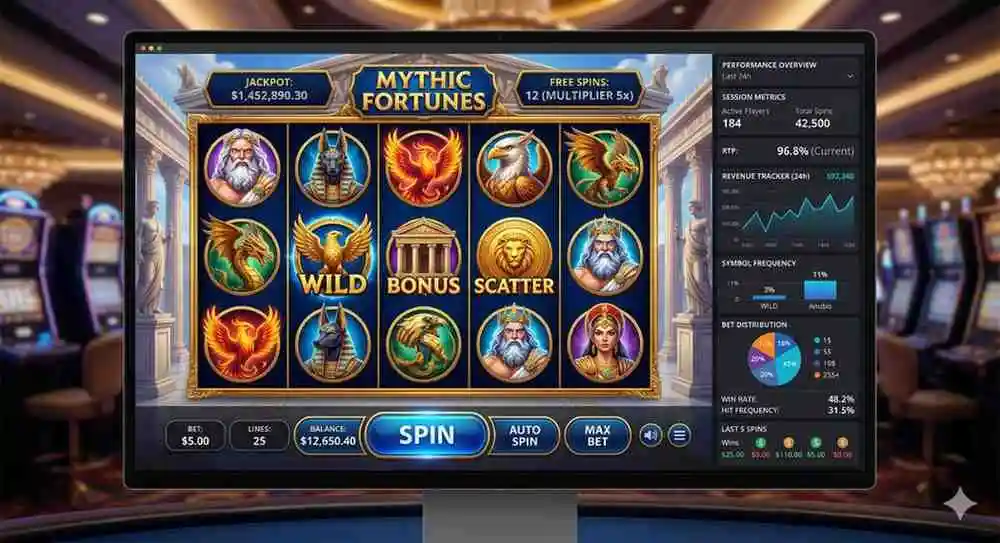
The house edge is one of the most important ideas in casino gaming because it explains how a game can feel exciting for players while still remaining commercially sustainable for operators over time. It is not a prediction of what will happen on your next spin or hand. Instead, it is a long-run mathematical expectation built into the rules, payout structure, and pace of play.
For players, understanding the house edge helps compare games more realistically. For operators and product teams, it shapes how odds, rewards, bonus features, and session design work together. This guide explains how house edge, RTP, volatility, and game design choices connect in practice.
1. What the House Edge Actually Means
The house edge is the percentage of total wagers a casino game is designed to retain over the long term. If a game has a 5% house edge, that means the game is built to keep about $5 for every $100 wagered on average across many rounds of play.
That does not mean a player loses 5% on every individual bet. Short sessions can produce anything from a quick win to a sharp loss. The house edge only becomes visible when you look at large numbers of bets over time, which is why fast games and long sessions increase overall exposure to it.

This distinction between short-term variance and long-term expectation is what makes the concept useful. It helps explain why two players can have very different sessions even when the underlying game math never changes.
2. House Edge, RTP, and Volatility Are Different Metrics

House edge and RTP describe the same math from opposite directions. If a game has a 96% RTP, its house edge is 4%. That relationship is simple, but it still leaves out another important factor: volatility.
Volatility describes how wins and losses are distributed during play. Two games can share the same RTP and still feel very different if one pays small amounts frequently and the other pays larger amounts less often. For a deeper explanation of the payout side of this equation, see how RTP influences casino game mechanics.
3. How Game Rules and Payout Tables Create the Edge

The house edge is not added after a game is built. It comes from the rules and payout model themselves. Reel strips, paytables, side bets, commissions, bonus triggers, jackpot contributions, and even the number of decision points in a session all affect the final expected return.
That is why game design is a balancing exercise. A product can offer attractive bonus features or higher headline payouts, but those choices still need to fit inside a sustainable mathematical model. Strong casino products feel entertaining on the surface while remaining internally consistent underneath.
4. Why Skill Matters in Some Games More Than Others

Some casino games give players more room to influence outcomes than others. In blackjack, video poker, or poker-style formats, player decisions can improve results and reduce the effective advantage of the house. In slots, keno, or roulette, the outcome is driven much more heavily by pre-set rules and randomization.
This difference matters because it changes how players should evaluate a game. A lower house edge can be meaningful, but it is even more useful when the player has decisions that help preserve that advantage. In purely chance-based games, the emphasis shifts toward entertainment value, bankroll management, and session pacing.
5. Bonus Features Change the Experience More Than the Math

Bonus rounds, multipliers, free spins, and progress systems can make a game feel more generous, but they do not automatically improve player value. In most regulated game models, those features are already accounted for inside the overall return profile.
What they do change is the rhythm of play. Features can make sessions feel more immersive, extend time on device, and increase emotional engagement. That is why the best analysis of a casino game looks beyond surface excitement and asks how rewards, pacing, and transparency work together.
6. Transparent Odds Build Trust

Players make better decisions when rules, payouts, and return information are easy to find and easy to understand. Clear paytables, visible RTP information, and straightforward explanations of special features make a game easier to trust.
For operators, transparency is not just a compliance issue. It is also a product-quality issue. Games that communicate odds clearly tend to create better expectations, fewer support disputes, and a more credible long-term brand position.
Conclusion
FAQs
What is the house edge in a casino game?
The house edge is the percentage of total wagers a casino game is expected to keep over the long run. It describes the game’s built-in mathematical advantage, not the result of any single session.
Is the house edge the same as RTP?
No. RTP shows how much a game is expected to return to players over time, while house edge shows how much the game keeps. If RTP is 96%, the house edge is 4%.
Does a lower house edge mean I will win more often?
Not necessarily. A lower house edge improves long-term value, but volatility still affects how often wins appear and how large they are. Two games can have similar house edges and feel very different in actual play.
Which casino games usually have lower house edges?
Games such as blackjack, baccarat banker bets, and some video poker formats are often considered lower-edge options compared with many slot machines or high-risk side bets. Exact figures still depend on the rules and game version.
Can skill reduce the impact of the house edge?
In some games, yes. Strategy-based decisions in blackjack or video poker can improve results and lower the effective edge. In purely chance-based games, players cannot change the underlying math.
Do bonus rounds or free spins remove the house edge?
No. Bonus features can change the way rewards are delivered and make the game feel more engaging, but they are normally built into the overall payout model rather than sitting outside it.
Why does game speed matter so much?
The faster a player moves through rounds, the more total wagers are exposed to the house edge. That is why pace of play can have a major effect on expected losses over time.
Why is transparent RTP or payout information important?
It helps players compare games more accurately and set realistic expectations. For operators, clear odds and paytable information also support trust, compliance, and a better overall product experience.