Home / Blogs & Insights / How to Start an Online Casino With a Panama License

How to Start an Online Casino With a Panama License

How to Start an Online Casino with a Panama License

Table of Contents

 Panama licence guide · 2026

A Panama online casino license issued by the Junta de Control de Juegos (JCJ) is one of the most widely used offshore gambling licences globally. It allows operators to run online casinos, sportsbooks, poker rooms, and other gambling services for international players with minimal taxation on foreign-sourced revenue. This guide covers how to obtain the licence, what it costs, how to structure your company, and how to launch a compliant casino operation under Panama's regulatory framework.

This guide is for
Operators evaluating Panama as a licence jurisdiction
Entrepreneurs comparing Panama vs Curacao vs MGA
Investors assessing offshore casino launch costs
Teams planning a tax-efficient casino operation
Developers scoping a JCJ-compliant platform build
Operators expanding from Curacao to a recognised licence
$40,000
Initial licence fee (JCJ)
One-time
$20,000
Annual renewal fee
Per year
7 years
Licence validity period
Up to 20 years max
1-2 months
Application timeline
After company formation
Part of the complete guide: For the full global step-by-step guide to starting an online casino, see: How to Start an Online Casino.
Request a Proposal

What Is a Panama Online Casino License?

A Panama online casino license is the official authorisation issued by the Junta de Control de Juegos (JCJ) — Panama's Gaming Control Board — that allows an operator to legally provide remote gambling services under Panamanian law. The JCJ was established in 1947 and has been issuing online gambling licences since 2002 under Resolution No. 65.

This JCJ licence permits operators to offer: online casino games, sports betting, poker, bingo, slot machines, and other games of chance. There is no restriction on the types of gambling products you can offer under a single licence — all permitted activities can be covered by one authorisation, which simplifies your operating structure and reduces costs compared to jurisdictions that require separate licences per vertical.
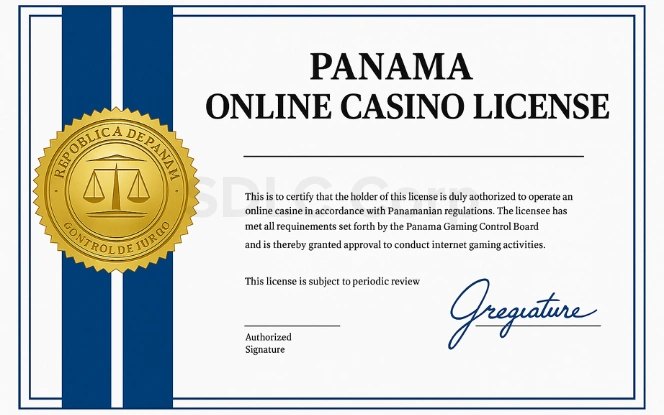
Panama online casino license certificate JCJ

Key facts about the Panama JCJ licence

  • Issuing authority: Junta de Control de Juegos (JCJ), under the Ministry of Economy and Finance of Panama
  • Legal basis: Resolution No. 65 (2002) — online gambling; Law No. 23 (2015) — AML/KYC requirements
  • Licence duration: Up to 7 years per issuance; maximum 20 years total with renewals
  • Initial fee: $40,000 USD (one-time application and licence fee)
  • Annual renewal: $20,000 USD per year from year one
  • Server hosting: International servers permitted — no requirement to host in Panama
  • Player market: International players permitted; domestic Panama players also permitted since September 2020
Panama licences are structured as Administration/Operation Contracts with the JCJ rather than traditional licences — but they function identically as regulatory authorisations for all practical purposes.

Advantages of a Panama Gambling License

The Panama offshore gambling licence (JCJ) is one of the most cost-effective and operationally flexible offshore gambling licences available. For operators targeting international markets outside the EU, it offers a combination of advantages that few competing jurisdictions match at the same price point.

AdvantageDetailOperator impact
Territorial taxationIncome from players outside Panama is fully exempt from corporate income tax, sales tax, VAT, and withholding taxOperators serving only international players can operate near tax-free
Low licence cost$40,000 initial + $20,000/yr — significantly cheaper than MGA ($25,000+/yr) or UKGC ($25,000-100,000/yr)Lower barrier to entry for new operators
Server flexibilityNo local server hosting required — international data centres permittedChoose optimal hosting for latency, cost, and redundancy
Broad product scopeSingle licence covers casino, sportsbook, poker, bingo — no separate permits needed per productReduces complexity and cost for multi-vertical operators
Fast company formationSociedad Anonima (S.A.) formation takes approximately 2 weeks; 100% foreign ownership permittedQuick corporate setup before licence application
Banking infrastructureOver 100 international banks operate in Panama; iGaming-friendly banking availableBetter banking access than many other offshore jurisdictions
Political and economic stabilityUSD-pegged currency, no exchange controls, stable government since 1989Reduced business risk compared to smaller offshore jurisdictions
20-year maximum termLicence can be renewed for up to 20 years total — reduces recurring licence renewal overheadLong-term operational certainty
The territorial taxation principle is the biggest commercial advantage. An operator holding a Panama online casino license who serves only players outside of Panama pays no corporate income tax, VAT, or withholding tax on those revenues. Only the fixed $20,000/yr licence renewal fee applies — not a percentage of revenue.

Types of Panama Gambling Licences

The JCJ issues several categories of gambling licence in Panama. Most operators seeking a Panama casino license apply for the Online Gambling License (also called the Remote Gaming License), but understanding all available types helps operators structure their business correctly.

Licence typePermitted activitiesBest for
Online Gambling LicenseOnline casinos, sports betting, poker, bingo, lottery, and other remote gambling — for players internationallyMost online casino operators — the standard choice
Casino LicensePhysical casino operations within hotel and resort properties in PanamaLand-based operators or hotel casino operators
Sports Events Betting Agency LicenseRetail and online sportsbook operationsStandalone sportsbook operators
Type A Slot Machine LicenseSlot machine parlours (salones de maquinitas)Physical slot parlour operators
Bingo Hall LicenseBingo hall operationsBingo operators
B2B Software/Supplier RegistrationGame software providers and equipment suppliers serving Panama-licensed operatorsSoftware developers and game studios

For operators building an online casino software platform or launching a white-label casino, the Online Gambling License is the correct licence type. The single licence covers all remote gambling products without requiring separate permits per game category.

Step-by-Step: How to Obtain a Panama Online Casino License

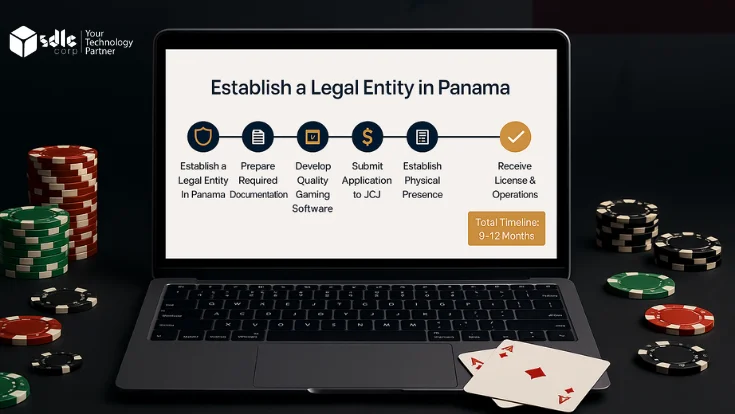
The Panama online casino license application process is straightforward compared to EU regulated markets, but requires careful documentation preparation. The entire process from company formation to licence issuance typically takes 3-5 months.
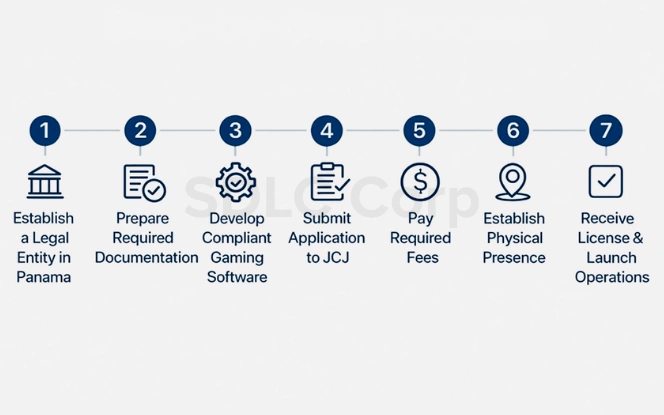
Panama casino license step by step process
Step 1

Register a company in Panama (Sociedad Anonima)

Operators must incorporate a Panamanian company before applying for a gambling licence. The most common structure is Sociedad Anonima (S.A.) — Panama's equivalent of a limited company. Key characteristics: 100% foreign ownership permitted; shareholder names do not need to be publicly disclosed (privacy benefit); minimum three directors required; formation takes approximately 2 weeks and costs $2,000-$5,000 including legal fees. The S.A. must have a registered address in Panama and at least one local director or nominee director.

Step 2

Open a Panamanian bank account

A business bank account in Panama is required before submitting the licence application. Panama has over 100 international banks and is one of the most iGaming-friendly banking jurisdictions in the Americas. Budget 4-8 weeks for bank account approval. You will need: proof of company incorporation, business plan, source of funds documentation, KYC for all directors and beneficial owners, and a reference letter from your current bank.

Step 3

Prepare your application documentation

The JCJ application requires comprehensive documentation. Key documents include: detailed business plan including target markets, revenue projections, and marketing strategy; personal background checks and CVs for all directors and shareholders; proof of financial capacity (minimum recommended: $100,000 in accessible capital); AML and responsible gambling policy documents; technical documentation on your gaming software and RNG; and a declaration of the server locations to be used.

Step 4

Submit application to the JCJ and pay the licence fee

Submit the completed application package to the Junta de Control de Juegos along with the $40,000 licence fee. The JCJ reviews the application, conducts background checks on all principals, and may request additional documentation. The review process takes approximately 1-2 months from submission of a complete application. Incomplete applications significantly extend the timeline.

Step 5

Register your gaming software with the JCJ

All gaming software and RNG systems must be registered (not pre-approved) with the JCJ. This is a registration process, not a technical certification requirement — but your software must meet standard iGaming fairness requirements. Partner with a reputable RNG-certified game provider to ensure your game portfolio meets JCJ registration requirements.

Step 6

Establish your local presence

Licensed operators under the Panama JCJ framework must maintain a physical presence in Panama — typically an office or registered business address with at least one local employee or representative. This can be managed through a local corporate services provider. Budget $5,000-$15,000/year for registered office and nominee services.

Step 7

Implement compliance systems

Before accepting players, implement all required compliance systems: KYC and age verification (18+); AML transaction monitoring per Law No. 23 of 2015; responsible gambling tools including self-exclusion, deposit limits, and session limits; monthly financial reporting system for JCJ submissions. See: casino development services for GDPR and AML-compliant platform builds.

Step 8

Launch and maintain ongoing compliance

Once licensed, submit monthly reports to the JCJ covering player deposits, wagers, account balances, and GGR figures. Pay the 10% GGR tax monthly if you have operations within Panama. Maintain your local presence and keep all documentation current. Annual licence renewal costs $20,000 and requires proof of continued compliance.

Key Requirements for a Panama Online Casino License
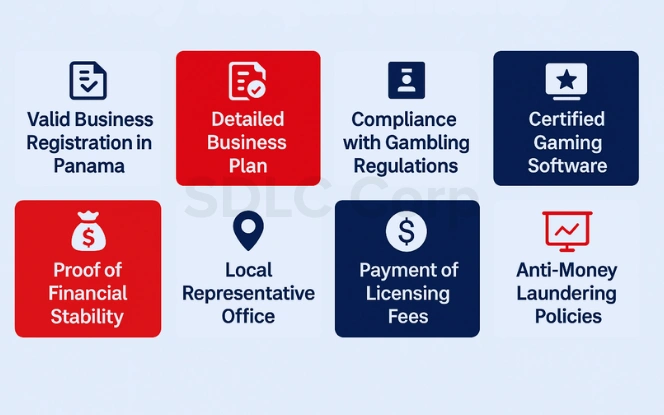
Panama casino license key requirements

Corporate requirements

  • Registered Sociedad Anonima (S.A.) in Panama
  • Minimum three directors (can be nominees); 100% foreign ownership permitted
  • Physical office or registered address in Panama
  • Local representative or appointed power of attorney
  • Active Panamanian bank account

Technical and server requirements

  • Server location must be declared to the JCJ — no requirement for local hosting
  • All gaming software must be registered with the JCJ before live operation
  • RNG certification from a recognised testing laboratory (eCOGRA, BMM, iTech Labs) is strongly recommended
  • SSL/TLS encryption on all player-facing pages and payment flows
  • Audit log capability for all player transactions and game results

Financial and reporting obligations

  • 10% GGR tax on operations within Panama — paid monthly by the 10th of the following month
  • Monthly financial reports to JCJ: player deposits, wagers, account balances, and GGR
  • Annual financial statements — statutory audit required if capital exceeds $100,000 and annual revenues exceed $50,000
  • Maintain sufficient working capital to cover player liabilities at all times

AML and player protection (Law No. 23 of 2015)

  • KYC identification required for all players before account activation
  • Transaction monitoring for suspicious activity — mandatory reporting to Panama's Financial Analysis Unit
  • Age verification — minimum age 18; must prevent underage gambling
  • Responsible gambling tools: self-exclusion, deposit limits, session limits, and links to support services including GamCare and BeGambleAware
  • Clear communication of gambling risks and responsible gambling resources

Panama Gambling Laws and Regulations

Panama's online gambling regulatory framework is built on a series of national resolutions and laws rather than a single consolidated gambling act. Understanding the key instruments helps operators structure their compliance programme correctly.

Legal instrumentScopeOperator impact
Resolution No. 65 (October 2002)Primary regulation for online gambling — establishes the Online Gambling License and operational rules for remote gamingCore licence framework — defines what is permitted and how operators must report
Law No. 2 (1998)Foundation gambling law — established the JCJ's regulatory authority and general gambling frameworkEstablishes the JCJ's legal mandate to issue licences and supervise operators
Law No. 23 (April 2015)Anti-money laundering, terrorist financing, and proliferation financing preventionRequires KYC, transaction monitoring, SAR filing, and AML programme implementation
Resolution No. 25 (August 2020)Permitted Panama-licensed operators to accept domestic Panama players for the first timeExpanded addressable market — operators can now serve both international and domestic players
Resolution No. 92 (1997)Regulation of land-based slot machine operations (Type A)Relevant for operators with both online and physical gaming assets

Panama's regulatory approach is generally operator-friendly — the JCJ focuses on ensuring operators are financially solvent, KYC-compliant, and operating transparent reporting systems, rather than imposing prescriptive product restrictions like the German or Swedish frameworks.

Taxation for Panama-Licensed Online Casinos

The Panama casino license offers one of the most favourable tax structures of any gambling jurisdiction globally. The territorial principle of taxation — Panama only taxes income earned within Panama — is the primary commercial driver for operators choosing this jurisdiction.

Tax typeRateApplies to
Corporate income tax (foreign)0% — full exemptionAll revenue from players outside Panama
Gambling tax (GGR)10% of GGROperations within Panama only
Dividend tax (domestic income)10% (registered shares); 20% (bearer shares)Dividends from Panama-sourced income only
Dividend tax (foreign income)5%Dividends from foreign-sourced income
VAT / Sales tax0% — exemptOnline gambling services to non-residents
Withholding tax0% — no withholdingPayments to foreign service providers
Annual licence fee$20,000 USD fixedAll licensed operators regardless of revenue
The tax advantage in practice: A Panama-licensed operator generating $5M in annual GGR from international players pays only the $20,000 fixed licence renewal fee — zero revenue-based tax. The same revenue under an MGA licence would incur 5% gaming tax ($250,000/yr). Under UKGC it would incur 21% Remote Gaming Duty ($1,050,000/yr).

Tax reporting requirements

  • Monthly GGR tax payments (where applicable) by the 10th of the following month
  • Monthly reports to JCJ: player deposits, wagers, account balances, and GGR breakdown
  • Annual financial statements for companies exceeding $100,000 in capital or $50,000 in annual revenue
  • All accounting and tax calculations must be denominated in US dollars (USD)

Panama vs Curacao vs MGA — Jurisdiction Comparison

For operators evaluating offshore and mid-tier gambling licences, the three most commonly compared options are Panama, Curacao, and MGA Malta. Each has a distinct risk/cost/credibility profile. The right choice depends on your target markets, budget, and long-term brand strategy.

FeaturePanamaCuracaoMGA Malta
Initial fee$40,000$15,000-$20,000EUR 25,000+
Annual fee$20,000$5,000-$10,000EUR 25,000+
Timeline2-3 months1-2 months4-6 months
Player trustModerateLow-moderateHigh
Payment processor accessGoodLimitedExcellent
Game provider accessGoodGoodExcellent
EU market accessNoNoPartial (not DE/SE/NL directly)
Tax on foreign GGR0%0%5% gaming tax
Compliance burdenModerateLowHigh
Banking qualityVery good (100+ banks)DifficultGood
Territorial tax exemptionYes — foreign income tax-freeYesNo — 5% applies globally

When to choose the Panama online casino license

  • You are targeting international markets outside the EU and do not need EU-specific payment processors
  • You need better banking access than Curacao typically offers but cannot yet afford MGA compliance costs
  • You want a long-term licence (7-year terms, up to 20 years) that reduces renewal overhead
  • You want a single licence covering casino, sportsbook, poker, and bingo without separate permits
  • You are building a multi-licence strategy — Panama as the offshore base while pursuing MGA or UKGC for EU market access later
Comparing Panama vs Curacao for your specific launch?

SDLC Corp's iGaming team advises operators on jurisdiction selection, platform architecture, and compliance setup across all major licences.

Talk to our team

Platform and Launch Planning for a Panama-Licensed Casino

Obtaining your Panama casino licence runs in parallel with — not before — your platform selection and build. Starting both workstreams simultaneously reduces your total time to launch by 6-10 weeks.

Choose your platform model

White-label casino solution

Ready-to-launch platform, 4-12 weeks. Pre-integrated payment gateways, game providers, and KYC/AML tools. Fastest route to market with a Panama licence. Full source code available on request.

View white-label
Turnkey casino solution

Your own licence, vendor-built platform. More control, 3-6 month delivery. Best for operators who want full brand ownership under their Panama licence from day one.

View turnkey
Custom casino development

Full-stack platform built to your specification. Complete source code ownership. For operators planning a multi-market, multi-licence expansion beyond Panama.

View custom build

Key launch requirements for Panama-licensed operators

  • Payment gateways: Panama-licensed operators have better payment processor access than Curacao. Support credit cards, e-wallets (Skrill, Neteller, PayPal), bank transfers, and crypto. All crypto accounting must be converted to USD for JCJ reporting.
  • Game providers: Most major game studios will work with Panama-licensed operators. Sign directly with Pragmatic Play, Evolution Gaming, and NetEnt or use a game aggregator for faster multi-provider integration.
  • KYC system: Must be built into the platform from day one — not added post-launch. JCJ requires player identity verification before account activation.
  • Mobile optimisation: Over 65% of online casino traffic globally comes from mobile devices. Your platform must be mobile-first. See: online casino software options.

Common Challenges and How to Overcome Them

Starting an online casino with a Panama gambling license involves predictable challenges. Understanding them in advance allows you to build mitigation into your launch plan rather than discovering them post-application.

ChallengeWhy it occursSolution
Banking delaysSome international banks remain cautious about new iGaming operators regardless of licenceEngage Panama-specialist banking consultants early. Maintain clean source-of-funds documentation. Consider EMI accounts as a bridge while primary banking is approved.
Player trust gap vs MGA/UKGCPlayers are less familiar with the JCJ than Malta or UK regulatorsDisplay licence number prominently. Obtain RNG certification (eCOGRA or iTech Labs). Publish transparent payout percentages. Build trust through fast withdrawals and responsive support.
EU market exclusionPanama licence does not grant access to regulated EU markets like Germany, Sweden, NetherlandsUse Panama as an offshore base for international markets. Pursue MGA or market-specific EU licence when revenue justifies the cost. Plan a multi-licence strategy from the outset.
Incomplete documentation at applicationJCJ applications are rejected or delayed most often due to incomplete or inconsistent documentationEngage a gaming lawyer with JCJ experience before submitting. Prepare AML, responsible gambling, and technical documentation professionally — not with templates.
Local presence logisticsMaintaining a physical Panama office can be costly for foreign operatorsUse a reputable Panama corporate services provider for registered office, nominee directors, and annual compliance filings. Budget $5,000-$15,000/yr for these services.

Realistic Timeline for Launching a Panama-Licensed Casino

The total timeline from initial planning to first player accepted typically runs 4-7 months for a Panama casino license launch. The table below shows the parallel workstreams and where dependencies occur.

PhaseDurationActivitiesCritical path?
Planning and funding2-4 weeksBusiness plan, market selection, team setup, funding confirmationNo — can overlap with company formation
Company formation (S.A.)2-3 weeksIncorporate Sociedad Anonima, appoint directors, register locallyYes — required before bank account and licence application
Bank account opening4-8 weeksSubmit banking application, KYC documents, business plan to Panama bankParallel with platform selection
Platform selection and contract2-4 weeksEvaluate white-label vs turnkey vs custom, sign vendor contractNo — run in parallel with company formation
Document preparation3-4 weeksAML policy, RG policy, technical docs, business plan, KYC for principalsYes — must be complete before JCJ submission
JCJ licence application4-8 weeksSubmit application, pay $40,000 fee, respond to JCJ queriesYes — critical path item
Platform build and integration4-12 weeksPlatform configuration, game integration, payment setup, KYC integrationParallel with licence — should complete before licence issuance
Soft launch and QA2-3 weeksTesting, payment flows, KYC end-to-end, responsible gambling toolsYes — required before going live
Run platform build in parallel with licensing. The most common cause of delayed launches is operators who wait for their licence before starting the platform build. With Panama's relatively predictable 1-2 month application timeline, you can confidently start platform development immediately after submitting the application.
 FAQ

Frequently Asked Questions

Common questions on Panama gambling licence costs, timeline, taxation, and compliance requirements.

How much does a Panama online casino license cost?

A Panama online casino license costs $40,000 USD as an initial one-time fee, plus $20,000 USD per year as an annual renewal fee from year one. Additional costs include company formation in Panama ($2,000 to $5,000), legal and documentation fees ($5,000 to $20,000), local office and nominee services ($5,000 to $15,000 per year), and platform development. Total first-year cost including all setup typically ranges from $80,000 to $120,000 excluding platform costs.

How long does it take to get a Panama gambling license?

The Panama gambling license application typically takes 1 to 2 months from submission of a complete application to issuance. The full process from company formation to licence receipt takes 3 to 5 months. Company formation (Sociedad Anonima) takes approximately 2 weeks. Bank account opening takes 4 to 8 weeks and should be started immediately after company formation.

What is the JCJ and who issues the Panama gambling license?

The JCJ is the Junta de Control de Juegos, Panama's national Gaming Control Board established in 1947. It operates under the Ministry of Economy and Finance of Panama. The JCJ issues all gambling licences in Panama, supervises licensed operators, conducts compliance inspections, and enforces the gambling regulatory framework including Resolution No. 65 of 2002 for online gambling.

What is the territorial taxation principle for Panama casinos?

Panama applies a territorial principle of taxation: income earned from activities or players outside Panama is fully exempt from corporate income tax, VAT, sales tax, and withholding tax. This means a Panama-licensed operator serving only international players pays no income-based tax on their gambling revenues - only the fixed $20,000 per year annual licence renewal fee. A 10% GGR tax applies only to operations within Panama itself.

Can I accept players from any country with a Panama casino license?

Panama's regulations do not restrict which countries you can accept players from at the licence level. However, you must comply with the laws of each country where your players are located. You are required to implement geo-blocking for countries where online gambling is illegal. Research your target markets thoroughly and consult a gaming lawyer for each jurisdiction you plan to accept players from.

Do I need to host my servers in Panama?

No. Panama does not require operators to host their gaming servers locally. You can use international data centres in any country. However, the server location must be declared to the JCJ when submitting your licence application and must be updated if you change hosting providers after the licence is issued.

Can Panama-licensed casinos accept cryptocurrency payments?

Yes. Panama's regulations do not prohibit cryptocurrency payments. Operators can accept Bitcoin, Ethereum, USDT, and other cryptocurrencies. However, all accounting, tax calculations, and JCJ reporting must be denominated in US dollars. Operators must ensure their banking partners permit cryptocurrency conversions and must maintain AML compliance for all crypto transactions including blockchain transaction monitoring.

What is the difference between a Panama license and a Curacao license?

The main differences are: Panama costs more ($40,000 initial vs $15,000 to $20,000 for Curacao) but offers significantly better banking access (100+ international banks in Panama vs difficult banking for Curacao-licensed operators), longer licence terms (7 years vs 1 year), and stronger brand recognition. Both offer 0% tax on foreign-sourced income. Panama is typically chosen by operators who need reliable payment processing and banking relationships. Curacao is chosen primarily for lowest possible entry cost.

What type of company do I need to form in Panama for a gambling license?

The most common structure is a Sociedad Anonima (S.A.) - Panama's equivalent of a limited company or corporation. Key features: 100% foreign ownership permitted, shareholder names do not need to be publicly disclosed (privacy benefit), minimum three directors required (nominees permitted), formation takes approximately 2 weeks, and the S.A. must have a registered address in Panama. Foreign operators typically use a local corporate services provider for formation and ongoing administration.

Does a Panama gambling license allow me to operate in regulated EU markets?

No. A Panama online casino license does not grant market access to EU-regulated markets such as Germany, the Netherlands, Sweden, or the UK. Each of those markets requires a separate local licence. Many operators use Panama as their primary offshore licence for international markets while pursuing EU licences separately when revenue justifies the compliance cost. For EU market access, see our guide on how to start an online casino in Europe.

Panama online casino license development SDLC Corp

Ready to start your Panama-licensed online casino?

SDLC Corp provides end-to-end casino development for operators launching under a Panama gambling licence. Platform build, game integration, KYC/AML compliance setup, and launch support. Full source code ownership. No revenue share.

MK
Michael Klein
iGaming Strategy Expert - 18 years in the gaming industry
Specialises in offshore and regulated casino market entry, licensing strategy, and iGaming platform selection. Has advised 50+ operators on Panama (JCJ), Curacao, MGA, and UKGC licence launches.

Contact Us

Share a few details about your project, and we’ll get back to you soon.

Let's Talk About Your Project

ABOUT THE AUTHOR

Michael Klein

iGaming Expert

Michael Klein is an iGaming expert with 18 years of experience in the gaming industry. He helps businesses innovate and scale by applying cutting-edge strategies and technologies that drive growth, enhance player experiences, and optimize operations in the ever-evolving iGaming landscape.
PLAN YOUR SOLUTION

More Insights
You Might Find Useful

Explore expert perspectives, practical strategies, and real-world solutions related to this topic.

AR vs VR Game Development

AR vs VR Game Development: Which Is Right for Your

Top AR Game Development Companies in India

Top AR Game Development Companies for India SDLC Corp —

Let’s Talk About Your Product

Get expert guidance on scope, architecture, timelines, and delivery approach so you can move forward with confidence.

What happens next?