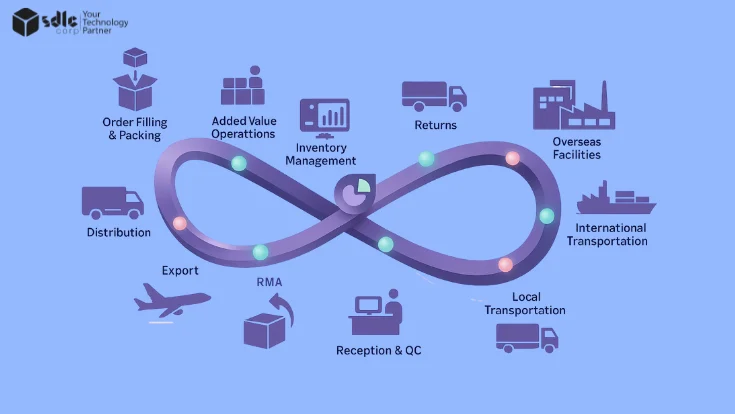
Introduction
Modern supply chains demand real-time visibility, automation, and faster decision-making. Traditional systems often fail to support this complexity, pushing businesses to adopt smarter, integrated platforms. This is where Odoo for Supply Chain provides a powerful advantage by unifying procurement, warehousing, logistics, and manufacturing into one intelligent ecosystem. For expert implementation, many organizations trust this leading Odoo development company
Furthermore, rising customer expectations and global disruptions require supply chains to operate with greater accuracy and agility. Odoo helps enterprises achieve this through automation, predictive analytics, and end-to-end synchronization, enabling faster responses and more resilient operations.
1. End-to-End Supply Chain Visibility with Odoo for Supply Chain

In modern supply chains, visibility is no longer a luxury it is the defining factor that determines operational resilience, decision-making speed, and customer satisfaction. Odoo for Supply Chain centralizes every process procurement, inventory, manufacturing, warehousing, logistics, and finance into a unified, real-time ecosystem that eliminates blind spots and prevents fragmented decision-making.
Organizations transitioning from legacy systems often struggle with isolated data, manual tracking, and inconsistent reporting. Odoo solves this by creating a single digital command center, helping enterprises anticipate disruptions, monitor performance, and maintain synchronized operations across multiple departments.
How Odoo Builds a Unified, Real-Time Supply Chain Control Tower
Odoo for Supply Chain integrates all modules under one architecture, allowing seamless data flow across teams. This results in:
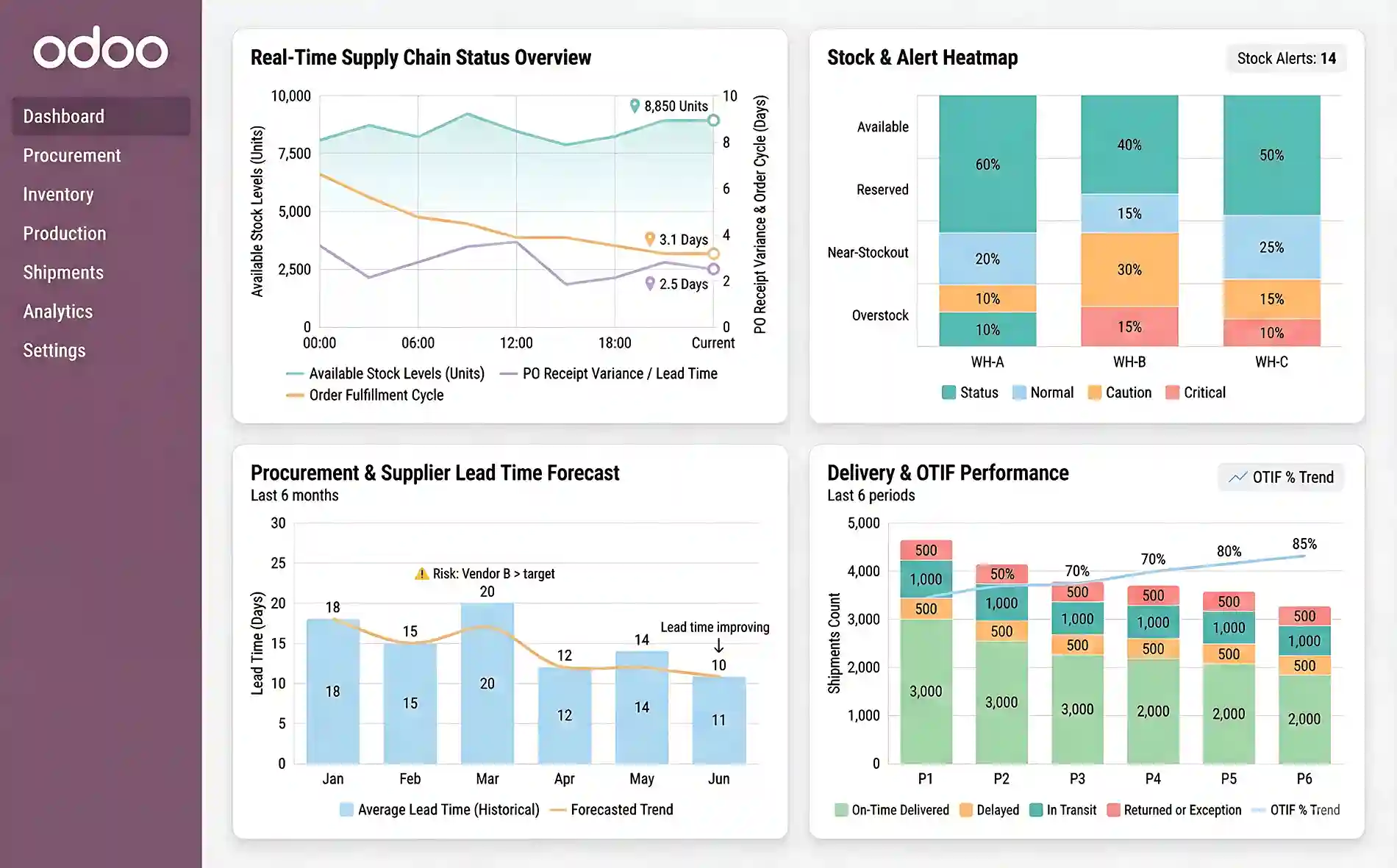
- Centralized dashboards covering procurement, stock, orders, production, and delivery timelines
- Real-time alerts and notifications for stock shortages, delays, and supply risks
- Live tracking of purchase orders, vendor lead times, and supplier reliability
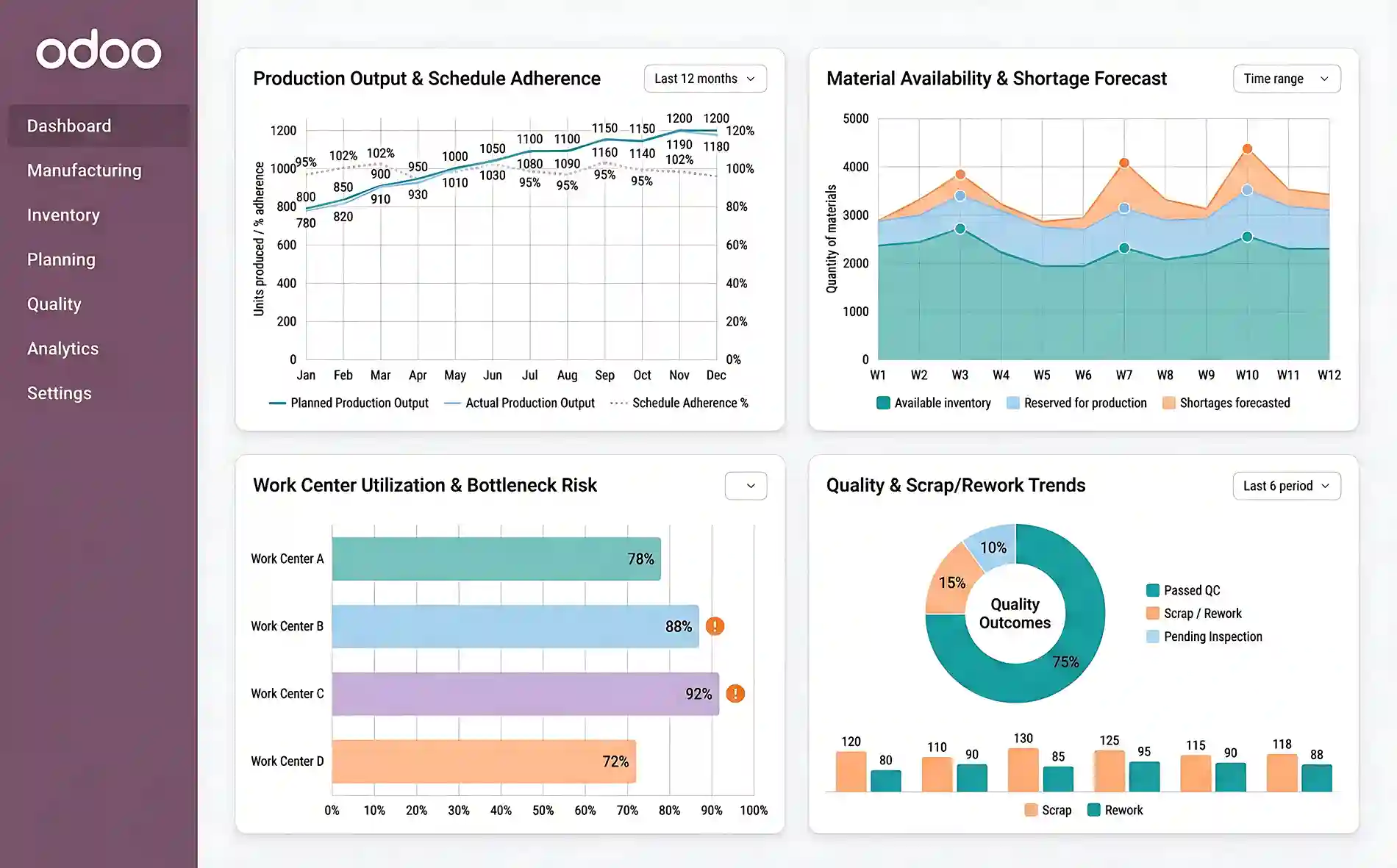
- Instant visibility of production progress, work center loads, and material availability
- Complete synchronization between warehouse, logistics, and distribution workflows
This ecosystem functions as a supply chain control tower, offering insights that would otherwise take days or weeks to compile manually.
Why Real-Time Visibility Is Critical for Enterprise Supply Chains
The complexity of today’s supply chains global suppliers, fluctuating demand, rising transportation costs makes visibility essential. With Odoo, companies can:
- Predict disruptions before they occur
- Respond quickly to inventory or supplier issues
- Optimize procurement and reduce emergency purchases
- Improve OTIF (On-Time In-Full) delivery performance
- Enhance collaboration across departments and partner networks
- Make data-backed decisions instantly rather than relying on outdated reports
Visibility directly impacts profitability. Companies with poor visibility often suffer from stockouts, excess inventory, production delays, and logistics inefficiencies—all of which Odoo helps eliminate.
Strategic Insight for Enterprises
A supply chain that operates without real-time visibility is essentially blind. With Odoo for Supply Chain:
- Decision-makers move from reactive management to predictive planning
- Teams operate with synced information rather than guesswork
- Leaders gain a holistic, always-updated snapshot of global operations
- The organization becomes more agile, scalable, and resilient
Odoo’s visibility framework forms the foundation for advanced supply chain transformation, enabling AI forecasting, automated workflows, and strategic decision intelligence across the enterprise.
Table 1: Location Types in Odoo Inventory
| Location Type | Description | Usage in Supply Chain |
|---|---|---|
| Vendor Location | Virtual source of goods from suppliers. | Tracks incoming liability; counterpart to Goods Receipt. |
| View Location | Hierarchical parent (e.g., “Warehouse A”). | Organizing zones/aisles; distinct from storage. |
| Internal Location | Physical storage (Shelf 1, Bin A). | Where inventory physically resides and is valued. |
| Customer Location | Virtual destination for sold goods. | Tracks goods leaving asset accounts; counterpart to Delivery. |
| Inventory Loss | Counterpart for corrections. | Balances stock adjustments during cycle counts. |
| Production | Virtual location for manufacturing. | Consumes raw materials and produces finished goods. |
| Transit Location | Temporary holding for transfers. | Tracks goods moving between two warehouses (Inter-warehouse). |
2. Advanced Inventory Optimization & Real-Time Stock Intelligence in Odoo for Supply Chain

Inventory plays a pivotal role in supply chain success. Too much inventory leads to frozen capital, excessive carrying costs, and warehouse inefficiencies. Too little causes stockouts, production halts, and dissatisfied customers. Odoo for Supply Chain solves both extremes by offering a highly intelligent, automated, and predictive inventory management ecosystem.
Unlike legacy tools that rely on manual updates and static safety-stock rules, Odoo provides live stock intelligence, synchronized across warehouses, production units, sales channels, and procurement. This enables supply chain leaders to operate with absolute clarity, ensuring inventory levels always align with demand, capacity, and supplier performance.
Real-Time Inventory Visibility Across All Locations
Odoo unifies every warehouse, stock zone, and staging area into one centralized view. This ensures that teams can:
- Track live inventory levels across all sites
- Monitor real-time stock movements, reservations, and transfers
- Identify material shortages before they impact production
- Predict replenishment needs based on actual consumption
- Ensure accurate ATP (Available to Promise) commitments
This level of visibility eliminates the guesswork that commonly disrupts procurement and manufacturing flows.
Intelligent Replenishment Powered by Data-Driven Rules
Odoo for Supply Chain automates inventory replenishment using dynamic, configurable rules that adapt to demand patterns. Key capabilities include:
- Min–max reorder rules
- Demand-based replenishment using consumption history
- Vendor lead-time considerations
- Auto-generated Purchase Orders or Manufacturing Orders
- Forecast-adjusted stock triggers
This transforms inventory management from reactive to predictive, ensuring that materials are replenished exactly when needed without overstocking.
AI-Driven Forecasting & Strategic Stock Planning
One of Odoo’s most powerful capabilities is its ability to forecast demand using AI models. These forecasting tools help organizations understand:
- Seasonal demand fluctuations
- Sales velocity trends
- Production consumption rates
- Vendor reliability and buffer stock requirements
- Long-term demand growth
The platform calculates optimal safety stock, ensuring that fluctuations do not halt operations.
For deeper insight into real-time inventory and perishables, explore this reference:Improving Perishable Supply Chains with Odoo’s Real-Time Data
Barcode/RFID-Driven Accuracy for Zero Errors
Odoo integrates with barcode scanners, RFID readers, and smart warehouse devices to execute operations such as:
- Picking
- Packing
- Goods receipt
- Putaway
- Inventory adjustments
- Stock transfers
This reduces human error, improves traceability, and accelerates warehouse throughput.
ATP & CTP — Delivering Accurate Commitments
Odoo’s ATP (Available to Promise) and CTP (Capable to Promise) algorithms allow companies to promise accurate delivery timelines based on:
- Current stock
- Expected replenishments
- Production capacity
- Supplier lead times
This ensures customer commitments remain reliable and operationally feasible.
3. Strategic Procurement & Supplier Management with Odoo for Supply Chain

Procurement is the foundation of an efficient supply chain. Poor supplier quality, inaccurate lead times, delayed deliveries, and unclear cost structures can create massive downstream disruptions. Odoo for Supply Chain elevates procurement from a transactional function into a strategic, data-driven, and automated process that ensures material availability, cost efficiency, and supplier performance transparency.
Modern procurement demands more than issuing purchase orders. It requires end-to-end visibility, supplier collaboration, contract compliance, and intelligent automation all of which Odoo delivers through its integrated procurement ecosystem.
Unified Procurement Workflows & Automated Purchasing
Odoo standardizes purchasing operations by connecting procurement with inventory, production, sales, logistics, and financial modules. This ensures that procurement decisions are always aligned with real-world requirements.
- Automatic Purchase Order (PO) creation when inventory reaches thresholds
- RFQ automation driven by forecasted demand
- Vendor comparison based on pricing, lead time, and reliability
- Approval hierarchies for controlled spending
- Integrated contract and SLA management
With automation, procurement teams focus less on manual tasks and more on supplier strategy and cost optimization.
Supplier Performance Monitoring & Scorecards
Supplier quality directly impacts the supply chain. Odoo provides deep visibility into supplier performance through real-time analytics, enabling companies to measure:
- On-time delivery rates
- Lead time accuracy
- Purchase price history and trends
- Quality inspection pass/fail rates
- Response time to RFQs and queries
These scorecards help enterprises negotiate better contracts, eliminate unreliable vendors, and strengthen supplier partnerships.
Lead Time Intelligence & Predictive Procurement
Odoo dynamically analyzes supplier lead times to adjust procurement timelines and ensure material availability. This includes:
- Predicting late deliveries
- Adjusting safety stock based on reliability
- Auto-updating lead times based on real performance
- Suggesting alternative suppliers when delays occur
This predictive insight reduces emergency purchases and production downtime.
End-to-End Vendor Collaboration & Communication
Odoo simplifies communication through built-in vendor portals that enable suppliers to:
- View purchase orders
- Submit delivery confirmations
- Upload invoices
- Update expected delivery dates
- Share quality documentation
This real-time collaboration eliminates email overload and accelerates decision cycles.
Seamless Integration with Inventory & Manufacturing
Odoo ensures that procurement does not operate in isolation:
- Inventory levels automatically trigger RFQs
- Bill of Materials (BoM) shortages generate purchase needs
- Manufacturing lead times influence order scheduling
- Changes in sales forecasts adjust procurement volumes
This integration ensures procurement is always aligned with production and demand planning.
Strategic Impact on Supply Chain Operations
With Odoo for Supply Chain, procurement becomes:
- Predictive instead of reactive
- Transparent instead of fragmented
- Data-driven instead of subjective
- Collaborative instead of siloed
Organizations leveraging Odoo achieve:
- Better supplier relationships
- Reduced procurement cycle time
- Lower purchase costs through strategic negotiation
- Higher production reliability
- Significantly fewer supply disruptions
For additional reading on optimizing procurement inside Odoo, explore: Optimizing Supply Chain Management with Odoo ERP
4.Manufacturing, MRP & Production Excellence with Odoo for Supply Chain

Manufacturing is the heartbeat of the supply chain. Any disruption—material shortages, machine downtime, inaccurate schedules, or quality failures—creates costly ripple effects throughout procurement, logistics, and customer delivery. Odoo for Supply Chain integrates a highly advanced Manufacturing (MRP) engine that synchronizes production planning, material availability, work orders, capacity scheduling, quality control, and maintenance into a unified operational workflow.
With Odoo, manufacturers transition from reactive, fragmented production processes to predictive, data-driven, and continuous-flow manufacturing, ensuring product availability and operational stability.
Integrated MRP Engine for Real-Time Production Orchestration
Odoo’s MRP module connects every step of the production cycle, ensuring manufacturers always know:
- What materials are needed
- When they are required
- Which work centers are available
- What capacity constraints exist
- How long each manufacturing phase will take
This integrated approach reduces manual intervention and replaces spreadsheet-based planning with automated, real-time intelligence.
Accurate Production Planning with Master Production Schedule (MPS)
Odoo’s MPS tool enables planners to build optimized production schedules based on:
- Forecasted demand
- On-hand inventory
- In-transit materials
- Supplier lead times
- Work center capacity
- Sales commitments
The system highlights material shortages, recommends procurement actions, and adjusts schedules automatically—ensuring uninterrupted production.
Material Requirements Planning (MRP) that Prevents Stockouts
One of the biggest challenges in manufacturing is ensuring material availability. Odoo’s MRP engine:
- Breaks down the Bill of Materials (BoM)
- Calculates exact component requirements
- Checks stock availability
- Generates replenishment requests
- Recommends transfers, production, or purchasing
This prevents stockouts, eliminates last-minute procurement, and ensures all materials arrive in sync with production needs.
Strategic Impact on Supply Chain Resilience
With Odoo for Supply Chain, production operations achieve:
- 20–40% faster production scheduling
- Significant reduction in production downtime
- Lower scrap and rework rates
- Improved yield and efficiency
- Enhanced customer fulfillment reliability
- Seamless alignment between procurement, inventory, and manufacturing
Manufacturing becomes streamlined, predictable, scalable, and quality-centric, strengthening the entire supply chain.
Explore more on Odoo’s role in complex manufacturing environments:The Role of Odoo in Complex Manufacturing Supply Chains
5. Warehouse Optimization & Fulfillment Automation with Odoo for Supply Chain

Warehousing is no longer a passive storage function—it is a strategic execution center that determines speed, accuracy, and cost efficiency across the supply chain. As customer expectations rise and fulfillment timelines shrink, companies need highly coordinated, technology-enabled warehouse processes.
Odoo for Supply Chain transforms warehousing into a fully automated, data-driven operation through optimized routing, real-time inventory movements, barcode-enabled accuracy, and intelligent fulfillment workflows. By integrating warehouse operations with procurement, manufacturing, and logistics, Odoo ensures seamless flow from inbound to outbound activities.
Real-Time Warehouse Visibility & Intelligent Stock Movements
Odoo provides live visibility into every stock zone, staging area, and picking location. Warehouse teams gain instant access to:
- Current stock availability by bin, lot, or serial
- Real-time picking progress and fulfillment queues
- Incoming shipments, expected deliveries, and delays
- Stock aging, rotation rules, and utilization metrics
- Automated replenishment signals for critical zones
This eliminates manual checks, significantly reducing time spent locating materials and preventing misplacements.
Comparison Table Traditional Warehouse vs. Odoo-Optimized Warehouse
| Functionality | Traditional Warehouse | Warehouse with Odoo for Supply Chain |
|---|---|---|
| Inventory Tracking | Manual, error-prone | Real-time, barcode-enabled |
| Picking Methods | Basic picking only | Batch, wave, cluster & zone picking |
| Routing | Static, inefficient | Smart routing with automated paths |
| Replenishment | Reactive, delayed | Automated triggers based on demand |
| Visibility | Limited to spreadsheets | Full dashboard with live updates |
| Accuracy | Medium | Very high (near-zero errors) |
Advanced Picking Methods for Faster Fulfillment
Odoo offers multiple picking strategies to match operational priorities:
- Batch picking for high-volume, similar orders
- Wave picking aligned with dispatch schedules
- Cluster picking to optimize routes across multiple orders
- Zone picking to balance workload across warehouse staff
- Cross-docking to send goods directly from receiving to outbound
These workflows minimize travel time, reduce labor cost, and accelerate fulfillment.
Automated Replenishment & Stock Level Optimization
Odoo continuously monitors stock levels and triggers replenishments based on:
- Minimum/maximum stock thresholds
- Forecasted demand
- Supplier lead times
- Production requirements
- Historical consumption patterns
This ensures that pickers always have adequate stock in forward pick locations, reducing delays.
Inbound & Outbound Coordination for Zero Bottlenecks
Odoo integrates receiving, quality checks, picking, packing, loading, and dispatch into one coordinated workflow. Companies benefit from:
- Scheduled receiving with ASN visibility
- Automated quality control during receipt
- Packing logic based on weight, dimensions, or destination
- Loading workflows optimized for delivery routes
- Real-time shipping and carrier integration
This minimizes congestion, increases dock productivity, and ensures error-free outbound operations.
Warehouse KPIs & Performance Analytics
Odoo offers deep insights into warehouse performance with KPIs such as:
- Order picking accuracy
- Dock-to-stock time
- Average pick path distance
- Inventory turnover
- Warehouse cost per order
- Order cycle time
- Employee productivity metrics
These insights help leaders refine layout design, improve labor allocation, and strengthen SLA adherence.
6. Logistics, Transportation & Distribution Management with Odoo for Supply Chain

Transportation and distribution are the most expensive, time-sensitive, and operationally complex components of any supply chain. With rising freight costs, unpredictable routes, carrier delays, and increasing customer expectations, enterprises must adopt intelligent logistics systems that unify shipment planning, fleet management, carrier integration, and delivery tracking.
Odoo for Supply Chain transforms logistics from a fragmented, manually coordinated function into a fully automated, real-time, and data-driven distribution engine. It integrates transportation planning, fleet operations, shipping workflows, and last-mile execution—ensuring smoother deliveries and complete visibility from the warehouse to the customer’s doorstep.
Unified Logistics Operations for Seamless Movement of Goods
Odoo connects all logistics operations dispatching, routing, packaging, labeling, carrier selection, and tracking into one centralized system. This eliminates manual interventions, duplicate data entry, and disjointed communication between warehouse teams, fleet managers, and external carriers.
With Odoo logistics workflows, organizations can:
- View all ready-to-ship orders in one dashboard
- Assign shipments to carriers or internal fleets effortlessly
- Track delivery status in real time
- Generate shipping documentation and labels automatically
- Manage freight costs, route details, and delivery exceptions
This holistic coordination significantly reduces delays, errors, and logistics bottlenecks.
Advanced Route Planning & Optimization
Route efficiency impacts delivery costs, customer satisfaction, and utilization of fleet resources. Odoo provides dynamic route planning capabilities that analyze:
- Delivery locations
- Distance and travel time
- Vehicle capacity
- Fuel efficiency
- Traffic patterns (using external integrations)
- Priority shipments
Based on these factors, Odoo creates optimized routes that reduce travel time, limit fuel consumption, and increase daily delivery capacity.
GPS Tracking & Real-Time Delivery Monitoring
Odoo supports integration with GPS devices, telematics platforms, and third-party logistics tools. This enables enterprises to:
- Track vehicle movement throughout the route
- Monitor driver activity and performance
- Receive alerts for delays or deviations
- Visualize delivery progress on an interactive map
- Provide customers with real-time shipment updates
This transparency strengthens customer trust and improves service reliability.
Freight Cost Management & Carrier Selection
Managing freight spending is one of the biggest challenges in logistics. Odoo helps organizations:
- Compare carrier rates instantly
- Select the most cost-effective or fastest carrier
- Automate freight cost allocation to specific shipments
- Track historical freight spending for budgeting
- Negotiate better rates with data-backed insights
Enterprises gain better control over transportation budgets and reduce costly overruns.
Automated Shipment Labeling & Documentation
Odoo generates all shipping documents automatically, including:
- Shipping labels
- Packing slips
- Bills of lading (BoL)
- Export/compliance documents
- Delivery notes
This ensures compliance, eliminates manual paperwork, and accelerates dispatch operations.
Last-Mile Delivery Optimization
Last-mile logistics is often the most expensive segment, accounting for up to 50% of total shipping costs. Odoo enhances last-mile management through:
- Real-time driver assignment
- Proof-of-delivery (POD) via mobile devices
- Customer notifications for delivery windows
- Geolocation-based delivery confirmation
- Automated route adjustments for missed or failed deliveries
This ensures high delivery accuracy, shorter turnaround times, and a smoother customer experience.
7. Demand Forecasting, Planning & Predictive Analytics in Odoo for Supply Chain

Demand forecasting is the strategic brain of the supply chain. Without accurate projections, companies face stockouts, excess inventory, rushed procurement, production delays, and inflated logistics costs. Odoo for Supply Chain elevates forecasting to a new level by leveraging historical consumption, seasonal patterns, AI-driven algorithms, and cross-functional data.
The result is a predictive supply chain capable of anticipating customer demand, aligning production capacities, improving procurement accuracy, and optimizing inventory levels before disruptions occur.
AI-Driven Demand Forecasting for Smarter Decision-Making
Odoo’s forecasting engine analyzes multiple parameters, including:.
- Historical sales
- Seasonal fluctuations
- Customer buying behavior
- Promotions and marketing spikes
- Manufacturing throughput
- Supplier lead times
- Market volatility trends
The system then generates precise demand predictions that drive production schedules, procurement actions, safety stock levels, and replenishment decisions.
This helps companies stay ahead of demand instead of reacting to it.
Integrated Sales, Inventory & Manufacturing Forecast Alignment
Forecast accuracy improves significantly when departments are synchronized. Odoo ensures that:
- Sales forecasts trigger procurement and manufacturing
- Inventory data blocks overproduction or under-stocking
- Supplier lead times dynamically adjust forecast validity
- Work center capacity shapes production schedules
- Logistics availability aligns with delivery commitments
This integrated forecasting eliminates the bullwhip effect where small demand fluctuations cause exponential upstream distortions.
Predictive Planning for Procurement & Production
Odoo links forecasting directly to purchasing and manufacturing workflows:
- Automatic creation of purchase suggestions
- Production scheduling based on forecasted quantities
- Material availability validation
- Forward planning of manufacturing cycles
- Strategic supplier engagement based on future needs
This allows procurement teams to negotiate long-term contracts and manufacturing teams to plan shifts, equipment usage, and workforce allocation.
Strategic Impact on the Supply Chain
Enterprises using Odoo for forecasting achieve:
- 30–50% reduction in stockouts
- Lower excess inventory and holding costs
- More stable supplier relationships due to long-term planning
- Higher production efficiency, fewer stop-start cycles
- Improved customer satisfaction through reliable fulfillment
- Optimized logistics capacity aligned with demand patterns
A predictive supply chain not only reacts to demand it shapes it.
Conclusion
Odoo for Supply Chain empowers organizations to operate with greater accuracy, agility, and real-time intelligence across procurement, inventory, manufacturing, warehousing, and logistics. By unifying these functions into a single connected ecosystem, Odoo helps businesses reduce delays, optimize resources, and strengthen overall supply chain performance. Its automation and predictive insights enable teams to respond quickly to market changes and maintain consistent service levels.
To achieve the best outcomes, enterprises often rely on experienced partners who understand both technical implementation and industry-specific workflows. SDLC Corp’s Odoo Consulting Services offer structured methodologies and proven expertise to ensure smooth deployment, scalable configurations, and long-term efficiency improvements across the supply chain.
FAQs
1. How does Odoo for Supply Chain improve operational visibility?
Odoo unifies procurement, inventory, manufacturing, warehousing, and logistics into one real-time system, giving teams full visibility into stock levels, supplier performance, production status, and delivery timelines. This helps reduce delays and supports faster, data-driven decision-making.
2. Can Odoo for Supply Chain support multi-company and global operations?
Yes. Odoo supports multi-warehouse, multi-currency, multi-language, and multi-company setups, making it ideal for organizations operating across different regions with diverse regulatory and operational requirements.
3. Does Odoo offer demand forecasting for supply chain planning?
Yes. Odoo uses AI-driven forecasting to analyze past demand, seasonality, and lead times, helping businesses optimize stock levels, plan procurement, and align production with market needs.
4. How does Odoo improve warehouse and logistics performance?
Odoo automates picking, packing, routing, and replenishment while offering barcode/RFID accuracy and carrier integration. This speeds up fulfillment, reduces errors, and improves delivery reliability.
5. Why is SDLC Corp the best choice for Odoo for Supply Chain or Odoo For Enterprises implementation?
SDLC Corp excels due to its extensive experience, industry-specific knowledge, and technical expertise. Their proven consulting methodology and strong record of successful Odoo project delivery ensure scalable, efficient, and customized implementations.
6. Is Odoo customizable for different supply chain industries?
Yes. Odoo can be tailored for manufacturing, retail, FMCG, automotive, pharmaceuticals, and more through configurable workflows, custom modules, quality rules, and integration options.
7. Can Odoo integrate with external logistics and 3PL systems?
Yes. Odoo integrates seamlessly with 3PLs, carriers, GPS systems, and warehouse automation tools using APIs, enabling smooth coordination between internal operations and external logistics partners.