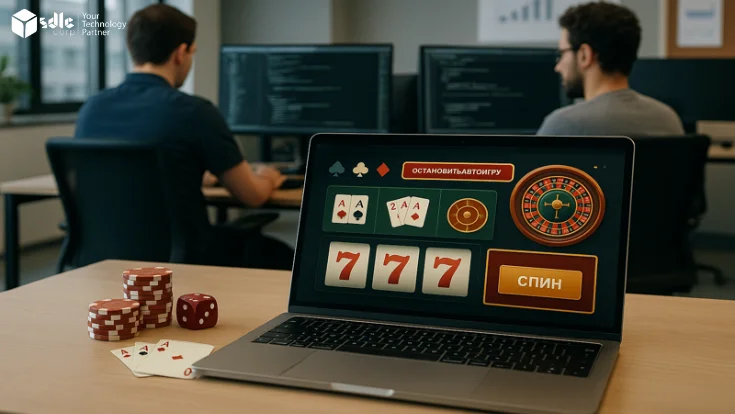

Compare casino software providers in the UK
Start by separating the platform you operate from the game content you integrate and the engineering services you commission. This guide helps UK operators, including London-based teams, compare those roles and check the relevant licensing, technical and delivery requirements.
SDLC Corp publishes this guide and is included as a custom-development option. The profiles describe different supplier roles; they are not a ranking or confirmation of current licence status. Check the contracting legal entity and the products covered before commissioning work.
Which type of casino software do you need?
- Platform and player-account systems: accounts, wallets, operator controls, reporting and integrations.
- Live casino content: dealer-led tables and game shows supplied through approved integrations.
- RNG game content: slots and virtual table games, obtained directly from studios or through an aggregator.
- Custom engineering: development and integration work against a defined scope and ownership agreement.
Ask each supplier which components it provides, which require another contract, and who controls product design, development and ongoing operation. A game-content licence does not provide the same scope as a complete operating platform.
Check licensing against the actual delivery arrangement
The UKGC’s remote gambling software licence covers manufacturing, supplying, installing or adapting gambling software through remote communication. Its gambling software guidance explains how product control and the contractual arrangement affect which development parties need a licence. Do not assume every contractor or payment component has identical requirements.
For applicable remote operating licences, LCCP condition 2.2.1 governs the manufacture, supply, installation and adaptation of gambling software. Verify the legal entity, licence status and activity against the UKGC register and your delivery model.
Request the relevant game and RNG test evidence. For player-facing information, RTS 3 addresses rules and information about the likelihood of winning. Check the applicable standards and evidence rather than relying on a blanket RTP percentage or a vendor’s claim that a platform is automatically compliant.
Casino software providers by role
Compare the scope of each offering before comparing commercials. Product descriptions below link to the providers’ own pages; current licence status must be verified separately.
SDLC Corp offers custom casino platform development and integration work. Define the product scope, contracting entity, responsibilities and ownership terms before commissioning a build.
EveryMatrix describes CasinoEngine platform and aggregation options, including content management, reporting, lobby tools and APIs. Ask which platform, wallet and content components are included in the proposed arrangement.
Evolution’s product catalogue includes live dealer tables and game shows. Assess it as a content supplier and establish the integration, contracting and market-availability requirements for the titles you need.
Play’n GO publishes a catalogue of slot and table-game content. Confirm the specific titles, game configurations, integration route and permissions available for your operating arrangement.
Playtech describes player-account management, payments and gaming products including casino, live casino, poker and bingo. Request a component-level proposal rather than assuming every product is included.
Pragmatic Play describes slots, live casino and other content delivered through an API. Confirm the content available to your business, its integration route and the relevant legal entities and approvals.
How to shortlist a provider
- Establish the scope: platform, game content, aggregation and custom engineering are separate purchase decisions.
- Check the contracting entity: confirm applicable licence activities and the responsibilities of each delivery party.
- Test the product: review wallet reconciliation, failed transactions, reporting, access controls and player-protection workflows.
- Compare the full proposal: include integration fees, content agreements, infrastructure, testing, ongoing support and exit arrangements.
- For London-based teams: confirm UK working-hour overlap and any on-site workshop requirements. A supplier serving London does not necessarily have a London office or delivery team.
Related casino software guides
For more detail on specific aspects of casino platform selection and development:
Frequently asked questions
Choosing casino software for a UK operating model
Use the same Great Britain licensing and technical checks as other operators serving that market. Compare the supplier’s role, proposed delivery team, UK working-hour overlap and any required local attendance.
No. Check the precise contracting legal entity, current licence status and permitted activity against the UKGC register. A brand name or a product page is not sufficient evidence.
The UKGC’s gambling software guidance considers the product, ultimate control and contractual arrangement. Establish the responsibilities of the manufacturer, supplier, operator and any engineering contractor for your specific delivery model.
Use the current UKGC fee schedule and a scope-specific delivery proposal. Fees and timing depend on the licence activity and application or project circumstances; a fixed figure for every provider or operator is misleading.
The UKGC prohibits credit-card payments for online casino gambling, including routes through money-service businesses. Check the funding controls used by your payment and e-wallet providers.
Ask the supplier to demonstrate the workflows required by the operator’s applicable licence conditions, authorised integrations, decision records and handling of failures. Agree who operates and updates these controls after launch.
Player-protection and payment workflows to verify
Financial vulnerability checks: LCCP condition 3.4.4 defines the applicable licences, public-record checks, relevant threshold, risk assessment and recordkeeping. These checks should not be described simply as a universal affordability test. Map the current condition to the operator’s workflow.
Self-exclusion: LCCP condition 3.5.5 requires applicable licensees to participate in the national multi-operator self-exclusion scheme. Agree on authorised integration, account restrictions, error handling and operational responsibility.
Payments: the UKGC’s credit-card guidance explains the ban for online casino gambling, including controls around credit-card funds routed through e-wallets. Verify the actual funding path with the payment provider.
Turn each applicable obligation into a testable acceptance criterion. Agree who monitors changes, maintains integrations and retains evidence after launch.
Custom development or a white-label platform?
A white-label proposal may bundle platform functionality, content integrations and managed services. Establish which legal entity operates the business, which responsibilities remain with you, how data can be exported and what happens when the agreement ends.
A custom build offers more control over implementation, but you must define responsibility for engineering, licensing, testing, infrastructure, third-party agreements and operations. Software ownership and any revenue-share terms belong in the contract.
Compare both options against the same requirements and acceptance criteria. Neither a custom build nor a white-label package automatically establishes permission to operate.
Explore online casino software development or our white-label casino solution to discuss a scoped proposal.
Planning a UK casino platform?
Discuss the platform components, integration boundaries, operator workflows and delivery responsibilities your project needs.