Choosing among the top mobile app development companies in the USA means finding a partner that suits your business, not identifying one universal winner. However, companies that build similar applications can still differ in engineering depth, integration capability, delivery approach, and long-term support.
Instead of ranking vendors by popularity, this guide compares mobile app development companies using consistent business-focused criteria. As a result, decision-makers can assess which partner fits their product complexity, industry requirements, operational goals, and long-term growth strategy.
Quick Answer
No single mobile app development company is right for every project because priorities, technical requirements, and product strategies vary. Therefore, this guide evaluates providers through public evidence such as case studies, engineering capabilities, platform expertise, integrations, security practices, and delivery maturity. In addition, it helps buyers shortlist partners for MVPs, enterprise modernization, regulated applications, or long-term product engineering.
Key Buyer Insights
- A polished portfolio demonstrates design capability, but it does not prove enterprise delivery maturity.
- Prioritize projects with similar integrations, compliance needs, or business workflows over unrelated app volume.
- Compare estimates using the same scope, including discovery, QA, release planning, and post-launch support.
- Clarify source-code ownership, repositories, documentation, and knowledge transfer before signing.
Top Mobile App Development Companies in the USA
This guide includes specialist mobile engineering firms as well as larger enterprise consulting organizations because buyers need different delivery capabilities. For example, enterprise transformation programs may benefit from broader consulting expertise. By contrast, standalone product teams often prioritize specialist mobile app development agencies.
SDLC Corp

Enterprise teams can consider this provider when secure mobile products must connect with ERP, AI, cloud platforms, or operational systems.
SDLC Corp supports enterprise mobile applications, workforce mobility, API integration, mobile QA, deployment, and long-term product support. Therefore, it suits organizations that need a mobile application to work reliably with wider business systems and transformation programs.
- HQ: San Francisco, California
- Primary services: Enterprise mobile applications, workforce mobility, mobile QA, API integration, and app deployment
- Technical expertise: Flutter, React Native, native iOS, native Android, secure APIs, ERP integration, and AI-enabled applications
- Industries: Manufacturing, supply chain, healthcare, financial services, gaming, and retail
- Key consideration: Strong choice for complex enterprise apps requiring secure integrations and long-term product support
Plan Your Mobile App Project
Define the platform, architecture, integrations, security, timeline, and support model.
Coherent Lab
Businesses seeking flexible offshore development support for custom native and cross-platform mobile applications may find Coherent Lab a suitable option.
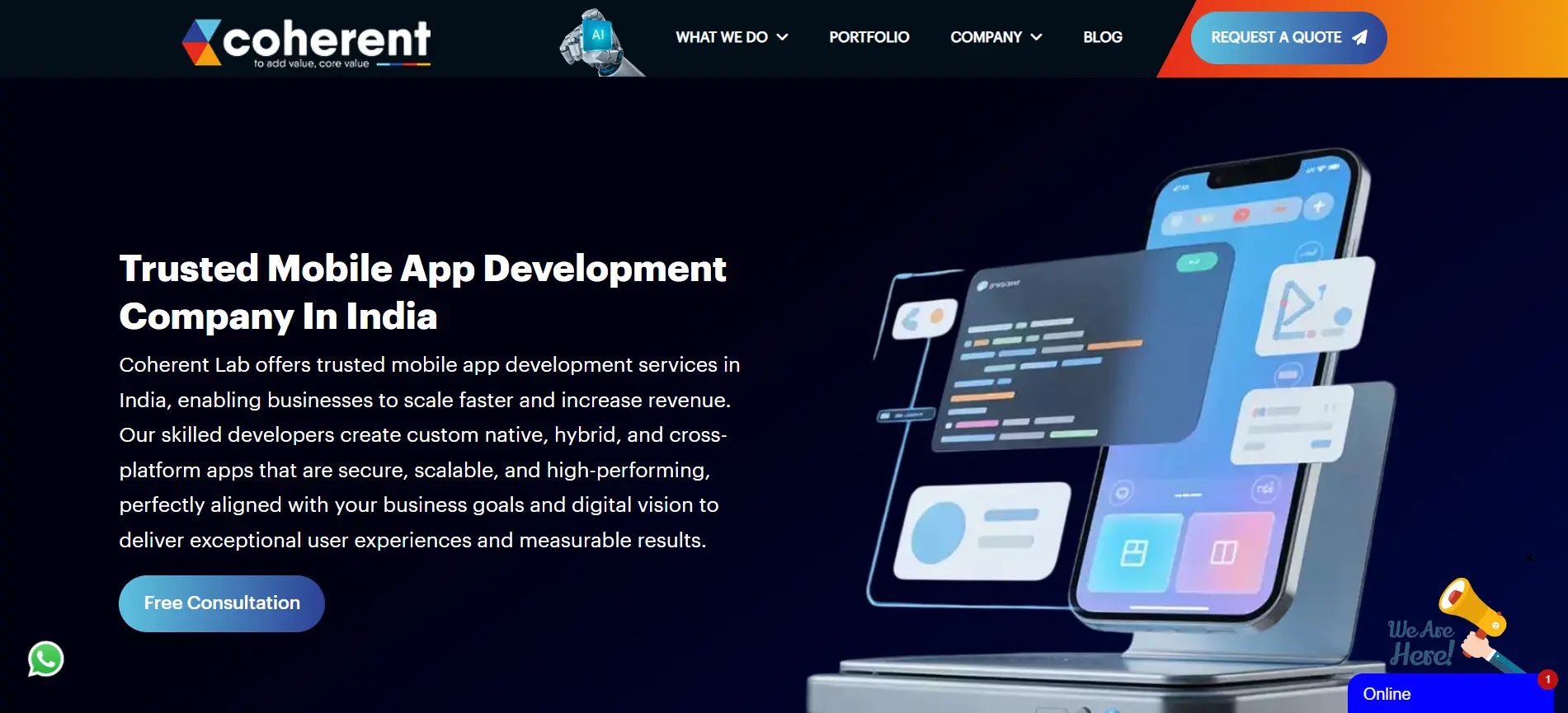
Coherent Lab provides mobile app development services for businesses building custom iOS, Android, Flutter, and React Native applications. Its team also supports app modernization, API integrations, product consultation, and ongoing development, making it relevant for startups and growing businesses that need flexible offshore engineering support.
- HQ: Jaipur, India
- Primary services: Custom mobile app development, iOS and Android development, Flutter, React Native, app modernization, API integration, and product consultation
- Technical expertise: iOS, Android, Flutter, React Native, Node.js, Java, Python, cloud integration, APIs, and modern mobile architecture
- Industries: Healthcare, finance, eCommerce, travel and hospitality, real estate, manufacturing, and retail
- Key consideration: Best suited to businesses comfortable with an offshore delivery model and looking for flexible mobile development, modernization, and ongoing technical support
ArcTouch

Connected-device programs are a strong match for enterprises building apps around wearables, IoT devices, or wider digital ecosystems.
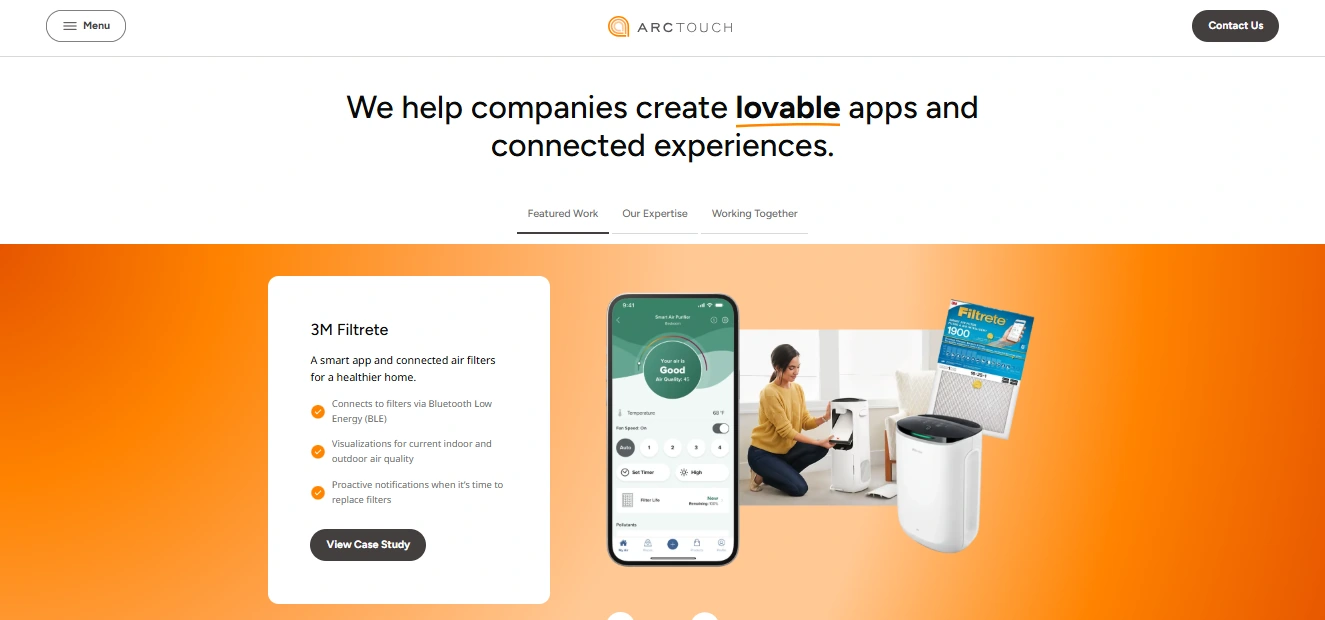
ArcTouch focuses on connected mobile applications, wearables, IoT products, mobile UX, and quality assurance. In particular, it suits businesses whose apps must work across devices, services, and connected customer experiences.
- HQ: San Francisco, California
- Primary services: Connected mobile applications, wearable apps, IoT products, mobile UX, and quality assurance
- Technical expertise: Flutter, React Native, native iOS, native Android, wearable technology, and IoT integration
- Industries: Automotive, hospitality, retail, connected products, and smart-device ecosystems
- Key consideration: Suitable for businesses building apps connected to wearables, devices, or multiple digital products
Mercury Development

Mid-sized and large businesses can consider it when they need mobile, wearable, backend, maintenance, and release capabilities.
Mercury Development provides mobile development, wearable applications, backend integration, QA, publishing, and maintenance. Moreover, it can help buyers that need support beyond initial development and expect regular operating-system and app-store updates.
- HQ: Aventura, Florida
- Primary services: Mobile app development, wearable applications, backend integration, QA, publishing, and maintenance
- Technical expertise: Native iOS, native Android, Flutter, React Native, wearable technology, and mobile backend systems
- Industries: Fitness, fintech, healthcare, media, retail, and IoT
- Key consideration: Confirm responsibility for app maintenance, operating-system updates, and release management
Publicis Sapient

Large enterprises may prefer this option when mobile modernization forms part of a wider transformation program.
Publicis Sapient combines enterprise mobility, application modernization, product design, cloud integration, and quality engineering. Consequently, it aligns better with large and complex programs that need formal governance and broad transformation support.
- HQ: Boston, Massachusetts
- Primary services: Enterprise mobility, application modernization, mobile product design, cloud integration, and quality engineering
- Technical expertise: Native iOS, native Android, APIs, cloud-enabled mobile platforms, and enterprise architecture
- Industries: Banking, automotive, healthcare, travel, commerce, and consumer brands
- Key consideration: Better suited to large digital transformation programs requiring formal governance
Fueled

Consumer brands may choose this provider when product design, launch quality, and mobile experience are central priorities.
Fueled supports mobile strategy, consumer app development, UI/UX, backend integration, and application optimization. In addition, it fits brands that need a design-led mobile product and close coordination between product, design, and engineering teams.
- HQ: New York, New York
- Primary services: Consumer app development, mobile strategy, UI/UX design, backend integration, and application optimization
- Technical expertise: Native iOS, native Android, mobile product design, API connectivity, and performance optimization
- Industries: Consumer technology, media, fintech, healthcare, retail, and hospitality
- Key consideration: Confirm which designers, developers, and project managers will remain assigned after kickoff
Concepta Technologies

AI-enabled or compliance-sensitive business applications can make this provider relevant to mid-market teams.
Concepta Technologies develops AI-enabled mobile applications, business apps, cloud-connected products, API integrations, and mobile QA. For this reason, it is relevant to organizations that need a business-focused mobile product with stronger attention to security and compliance evidence.
- HQ: Orlando, Florida
- Primary services: AI-enabled mobile applications, business apps, cloud-connected products, API integration, and mobile QA
- Technical expertise: Native iOS, native Android, artificial intelligence, cloud platforms, and mobile backend integration
- Industries: Healthcare, government, logistics, hospitality, and financial services
- Key consideration: Request relevant security, privacy, and compliance evidence before beginning a regulated project
Atomic Object

Custom engineering, clear documentation, and long-term application ownership make it relevant to mid-market organizations.
Atomic Object supports custom mobile software, product design, backend integration, testing, maintenance, and long-term support. Therefore, it can fit organizations that value a structured engineering process and want a clear path to internal ownership.
- HQ: Grand Rapids, Michigan
- Primary services: Custom mobile software, product design, backend integration, testing, maintenance, and long-term support
- Technical expertise: Native iOS, native Android, cloud-connected applications, automated testing, and custom software engineering
- Industries: Medical technology, manufacturing, logistics, education, and operational software
- Key consideration: Review its documentation, knowledge-transfer process, and long-term application ownership model
Utility

Growth companies can consider it for AI-enabled digital products, commerce apps, or mobile customer experiences.
Utility works on AI-powered mobile products, product strategy, design, backend integration, commerce apps, and optimization. As a result, it suits growing organizations that need product thinking together with mobile engineering.
- HQ: New York, New York
- Primary services: AI-powered mobile products, app strategy, product design, backend integration, commerce apps, and optimization
- Technical expertise: Native iOS, native Android, artificial intelligence, digital commerce, APIs, and mobile product engineering
- Industries: Healthcare, digital media, retail, financial services, and emerging technology
- Key consideration: Ask for references from projects matching your required scale, integrations, and industry complexity
Goji Labs

Startup and mid-sized teams may find it useful when validating an MVP before scaling the product.
Goji Labs focuses on product strategy, MVP development, UX/UI design, backend integration, testing, and product scaling. Therefore, it is well suited to teams that need structured validation and a flexible path from concept to a scalable product.
- HQ: Los Angeles, California
- Primary services: Startup MVP development, product strategy, UX/UI design, backend integration, testing, and product scaling
- Technical expertise: React Native, native iOS, native Android, rapid prototyping, APIs, and mobile product design
- Industries: Digital health, education technology, nonprofits, SaaS, and fintech
- Key consideration: Well suited to startups and mid-sized companies needing product validation and flexible development
How We Evaluated Mobile App Development Companies
Rather than relying on awards, marketing claims, or review counts, each company was evaluated through verifiable public evidence. Specifically, the review prioritized engineering capability, documented customer implementations, platform expertise, technology partnerships, security practices, and long-term delivery maturity. These factors influence project success more than brand visibility alone.
Mobile App Partner Fit Model
The evaluation areas below carry equal weight because successful mobile app projects depend on balance. In other words, product strategy, engineering execution, industry alignment, delivery reliability, and lifecycle support should be reviewed together.
No single capability can make a mobile app project successful on its own. Therefore, review the complete delivery model before creating your shortlist.
- Product StrategyDiscovery, user needs, business goals, platform decisions, and a realistic product roadmap.
- Engineering ExecutionArchitecture, mobile frameworks, integrations, testing, performance, and maintainable code.
- Industry AlignmentRelevant workflows, compliance expectations, security risks, and operational requirements.
- Delivery ReliabilityClear estimates, team continuity, governance, reporting, QA, and release management.
- Lifecycle SupportMonitoring, maintenance, operating-system updates, enhancements, and knowledge transfer.
Evidence Standards and Editorial Disclosure
- Official company resources, technology partner directories, and published case studies were treated as primary evidence.
- Independent reviews were used only as supplementary context rather than primary evaluation criteria.
- SDLC Corp's affiliation with this publication is disclosed transparently.
- Company order follows the editorial sequencing policy explained below.
Ranking Rule: Editorial Sequencing
Companies in this guide are not ranked from best to worst. Instead, they appear in editorial order and are organized around distinct buyer-fit categories and common business scenarios. Therefore, the numbering supports navigation only and should not be read as an overall recommendation for every organization.
Mobile App Development Company Comparison Matrix
Enterprise buyers rarely select a mobile app development service based on one capability alone. Therefore, use this matrix to compare delivery focus, engagement stage, ideal buyer profile, and the most important point to review before technical discussions begin.
| Company | Delivery Focus | Delivery Stage | Ideal Buyer | Review Before Selection |
|---|---|---|---|---|
| SDLC Corp | Enterprise Mobility | End-to-End | Enterprises modernizing ERP, AI, and business applications | Platform expertise |
| Coherent Lab | Native & Cross-Platform Apps | Build, Modernize & Support | Startups & Growing Businesses | Offshore delivery model |
| ArcTouch | IoT & Connected Apps | Full Lifecycle | Enterprise | Project scope |
| Mercury Development | Wearables & Mobility | Build & Maintain | Mid-Large Business | Support model |
| Publicis Sapient | Enterprise Modernization | Strategy to Delivery | Large Enterprise | Governance fit |
| Fueled | Consumer Apps | Design to Launch | Consumer Brands | Team structure |
| Concepta Technologies | AI Business Apps | Design to Deploy | Mid-market | Compliance needs |
| Atomic Object | Custom Engineering | Discovery to Support | Mid-market | Long-term ownership |
| Utility | AI Digital Products | Strategy to Launch | Growth Companies | Relevant references |
| Goji Labs | MVP Development | MVP to Scale | Startups | Scalability |
Turn Your Shortlist Into a Clear Mobile App Plan
Define the product goals, platforms, integrations, security requirements, delivery model, budget, timeline, and support expectations before development begins.
Which Mobile App Development Partner Fits Your Business?
| Buyer Type | Main Priorities | Suitable Partner Profile |
|---|---|---|
| Startup or MVP Team | Validation, speed, flexible scope, and founder access | Product-led mobile specialist |
| Small or Mid-Sized Business | Integrations, scalability, maintenance, and budget control | Flexible end-to-end development partner |
| Enterprise | Governance, architecture, integrations, security, and lifecycle support | Full-lifecycle engineering company |
| Regulated Organization | Security controls, auditability, privacy, and domain experience | Domain-experienced delivery partner |
The right mobile app development partner depends on the role the application plays within the business, not simply on the provider's size or service labels.
For example, a specialist mobile app development agency may suit a standalone product. By contrast, a full-lifecycle engineering partner may be better equipped for applications connected with ERP, CRM, cloud platforms, or wider transformation programs.
Therefore, match the partner to your product's technical complexity, operating requirements, governance expectations, and long-term roadmap.
Red Flags When Choosing an App Development Company
No Discovery Phase
Delivery estimates are provided before business processes, technical dependencies, and success criteria are validated.
Unrealistic Timelines
The proposal overlooks integrations, testing, security validation, approvals, or app-store review requirements.
No Architecture Discussion
The conversation focuses on UI while ignoring data flows, integrations, scalability, and maintainability.
Security Addressed Too Late
Security is treated as a final review rather than being included throughout architecture, development, and testing.
Unclear Ownership Terms
Source code, repositories, documentation, deployment assets, and intellectual property are not clearly assigned.
No Operational Readiness Plan
Monitoring, maintenance, release management, security updates, and incident response are missing from the proposal.
Practitioner Insight
Successful mobile app projects are rarely delayed by coding alone. Instead, discovery workshops, integration planning, data mapping, and stakeholder alignment often influence delivery success more than development speed.
Final Recommendation
First, shortlist two or three partners whose documented experience matches your application's complexity instead of choosing only by price or brand recognition. Next, request architecture walkthroughs, comparable case studies, implementation methodology, delivery governance, and post-launch support plans before making a final decision.
Finally, the strongest mobile app development partner should demonstrate repeatable delivery capability backed by verifiable customer outcomes, not just an impressive portfolio.
Build a Mobile App That Can Grow With Your Business
Clarify your platforms, architecture, integrations, security, release process, and long-term support model before choosing a development partner.
Frequently Asked Questions
First, compare relevant case studies, technical expertise, delivery process, security practices, integration experience, and post-launch support.
In particular, prioritize architecture expertise, integration capability, governance, scalability, security, documentation, and long-term maintenance.
Generally, cost depends on application complexity, platform choice, integrations, UX requirements, testing, security, deployment, and support scope.
For example, choose a product-focused company with strong discovery, rapid prototyping, flexible scope, founder collaboration, and experience scaling MVPs.
As a result, comparison helps buyers identify the provider that best matches their budget, technical needs, industry requirements, delivery expectations, and growth plans.