
Choosing a reliable online casino software provider starts with comparing operational fit, not just game access or setup cost. The right provider should support your target market, payment structure, compliance needs, reporting, back-office workflows, and long-term growth. In practice, the best choice is the provider that gives your business the control, flexibility, and support needed for real operations.
Key Features to Compare in Online Casino Software
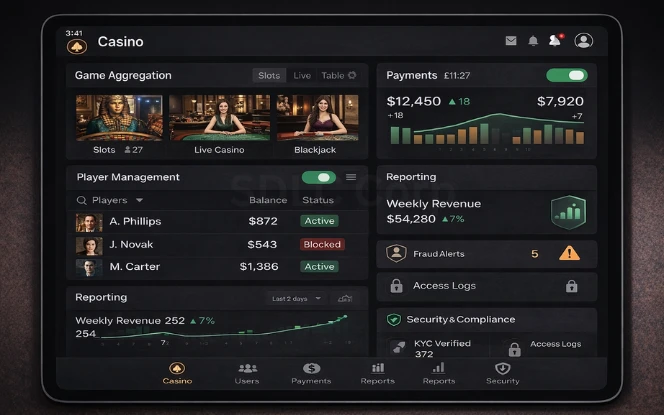
The right software should support daily operations through reliable payments, reporting, player management, and back-office control.
Game Aggregation System
This layer connects the platform to slots, table games, live dealer content, and other game categories through one or more provider integrations. Buyers should review both content access and the level of control available for catalog setup, game visibility, and provider expansion.
Player Account Management
The player account management layer handles registration, login controls, balances, profiles, session activity, restrictions, and account-level monitoring. As a result, this area is central to daily operations because it supports both player servicing and admin oversight.
Payment Gateway Support
Payment support covers deposits, withdrawals, transaction handling, and payment-status visibility. In practice, a strong setup should support the methods used in the target market and provide clear operational visibility across payment activity. Where relevant, this may also include crypto-related payment support.
Back-Office and Reporting
The back-office area gives operators access to dashboards, reports, player-activity views, transaction records, content controls, and day-to-day management tools. Because of this, it is one of the most important parts of the platform, as it affects how efficiently the business can monitor and run operations.
Security and Compliance Controls
Security and compliance coverage should support account verification, risk monitoring, permissions management, fraud detection, and data protection. However, buyers should review how these controls work in practice rather than relying only on broad sales claims.
Online Casino Software Models: White Label vs Turnkey vs Custom
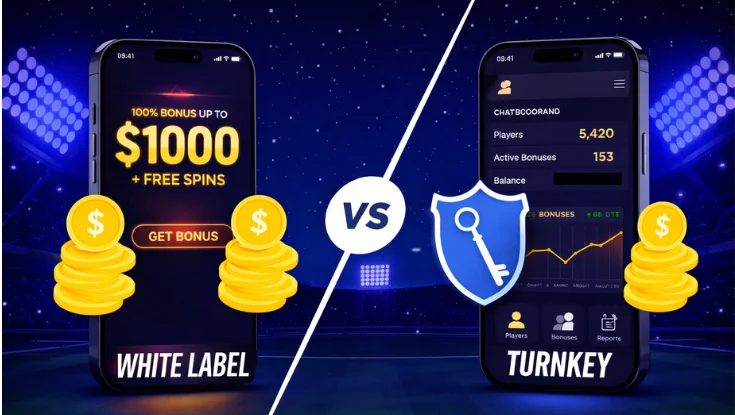
Before comparing providers, buyers should identify which software model fits their launch plan. This matters because many vendors offer overlapping features, but the delivery model changes cost, control, flexibility, and operating responsibility.
White Label Casino Software
White label casino software is a prebuilt launch model designed for businesses that want a faster route to market with lower setup complexity. It usually works best for operators who value speed and packaged delivery over deep system control.
Typical strengths
- Faster launch path
- Lower upfront cost
- Reduced technical setup
- Structured delivery model
Typical limitations
- Less platform control
- Lower customization freedom
- Greater dependency on the provider
Turnkey Casino Solutions
Turnkey casino solutions provide a broader operating setup with more flexibility than white-label models. As a result, they usually suit operators who want more control across integrations, configuration, and business operations without building the full platform from scratch.
Typical strengths
- More operator control
- Better integration flexibility
- Broader operating coverage
- More room for long-term expansion
Typical trade-offs
- Higher cost than white label
- More setup involvement
- Greater post-launch responsibility
Custom Casino Platform Development
Custom casino platform development is built around specific business requirements and is usually chosen by operators that need full product control, custom workflows, or a distinct technical setup.
Typical strengths
- Full feature control
- Greater ownership flexibility
- Better fit for custom operational requirements
- Stronger long-term independence
Typical trade-offs
- Longer delivery time
- Higher build cost
- More complexity across planning, integrations, and maintenance
White Label vs Turnkey vs Custom: Key Differences
Each model offers a different balance of launch speed, control, cost, and operational responsibility.
| Solution Type | Cost Level | Customization | Time to Launch | Best Fit |
|---|---|---|---|---|
| White Label | Lower | Low | Faster | Startups and fast-launch operators |
| Turnkey | Medium to High | Medium to High | Moderate | Operators needing more control |
| Custom Platform | High | High | Longer | Businesses with advanced requirements |
Explore Related Casino Software Guides : Top Casino Software Providers
What Makes an Online Casino Software Provider Reliable?
Reliability depends on platform stability, operational support, integration depth, and how well the system performs after launch.
- Licensing and Regulatory Readiness: Check whether the provider can support the legal, reporting, account-control, and payment requirements linked to your target market.
- Game Providers and Content Management: Review available game categories and how easily content can be added, organized, featured, restricted, and updated.
- Payment Coverage: Compare supported payment methods, transaction visibility, withdrawal handling, reconciliation support, and crypto-related options if relevant.
- Back-Office Depth: Review reporting access, transaction records, player visibility, content tools, permissions, and daily admin usability.
- Platform Scalability: Make sure the platform can support growth in users, transactions, content volume, and market expansion.
- Security Standards: Check account protection, permissions, monitoring, fraud visibility, and data-handling safeguards.
- Support Structure: Review issue handling, update support, maintenance coverage, escalation flow, and post-launch assistance.
Provider Comparison Checklist
Before selecting a vendor, buyers should review the following points carefully:
- Which software model fits the business: white label, turnkey, or custom
- Whether the provider can support the target market and operating requirements
- How strong the back-office and reporting controls are
- Which game providers and payment methods are available
- How much control the operator has over content, configuration, and workflows
- What level of dependency remains after launch
- What support, maintenance, and update coverage is included
- How pricing is structured across setup, infrastructure, support, and expansion work
Online Casino Software Providers Commonly Compared by Buyers

SDLC Corp
SDLC Corp provides B2B casino software and platform services covering player account systems, payment integrations, reporting, game connectivity, and back-office operations. As a result, buyers usually review it when looking for a connected platform setup with operational control and broader delivery support.
- $25–$49 / hr
- 500+
- Est. 2000
- Delhi, India
- 4.8 / 5

SoftSwiss
SOFTSWISS is widely known in the iGaming technology market and is often reviewed for casino platform delivery, crypto-related capability, and automation-focused operating tools.
- Rev-share / WL fee
- 1,000+
- Est. 2009
- Minsk / Malta
- 4.7 / 5

BetConstruct
BetConstruct offers a broad gambling technology stack across multiple product areas. It is often considered by buyers looking for flexible setup options and wider business expansion potential.
- WL / Turnkey / API
- 5,000
- Est. 2003
- London, England
- 2.5 / 5

Slotegrator
Slotegrator is commonly associated with API-based integrations and modular platform delivery. It is often reviewed by buyers who want an integration-led route to launch.
- WL / Turnkey / APIgrator
- 120+
- Est. 2012
- Europe
- 3/ 5

SoftGamings
SoftGamings is frequently considered for white-label and turnkey routes. It is commonly associated with packaged launch models, game integrations, and payment support.
- WL / Turnkey
- 501–1,000
- Est. 2007
- Riga, Latvia
- 3 / 5

Evolution Gaming
Evolution is best known for live casino and game-content products. However, buyers may review it strongly for live dealer capability, but they should still verify whether the wider operating stack meets their needs for player management, payments, reporting, and back-office control.
- B2B rev-share
- 4,000+
- Est. 2006
- Riga, Latvia
- 4.9 / 5
Steps to Choose the Right Casino Software Provider
Choosing the right provider starts with clear business requirements, careful platform review, and realistic long-term planning.
- Define the Target Market: Identify the target audience, region, and business model first, since these factors affect licensing, payments, compliance, and content strategy.
- Choose the Right Delivery Model: Decide whether white label, turnkey, or custom development fits your budget, timeline, and required level of control.
- Verify Operational Fit: Check whether the platform supports player accounts, payments, content control, reporting, and admin-side workflows.
- Review Integrations Carefully: Evaluate game providers, payment methods, and how easily integrations can be added or adjusted later.
- Request a Live Demo: Use the demo to review back-office usability, reporting access, transaction visibility, and player-account handling.
- Assess Long-Term Support: Review issue handling, maintenance coverage, upgrade support, and the provider’s post-launch service structure.
Common Mistakes to Avoid During Provider Selection
Early mistakes in provider selection can lead to weak control, higher dependency, and avoidable operational issues later. Because of this, buyers should assess each provider carefully before making a final decision.
- Choosing Only on Price: A lower quote may reduce upfront cost, but it can also mean weaker controls, lower support depth, or greater long-term dependency.
- Ignoring Compliance Fit: If legal and operating requirements are not reviewed early, launch plans can slow down later and create avoidable risk.
- Overlooking Back-Office Quality: Weak reporting and admin controls can create daily operational problems after launch.
- Not Planning for Growth: The platform should support future growth in users, transactions, content, and broader business requirements.
- Underestimating Support: Weak support can affect uptime, issue resolution, updates, and overall business continuity.

Conclusion
Choosing an online casino software provider should come down to how well the platform supports real business operations. The right solution should give you the control, flexibility, and support needed to launch efficiently, manage daily activity, and scale with fewer operational limits.
Explore Related Casino Software Guides : Top Casino Software Providers in the USA
Online Casino Software Provider FAQ - Key Buyer Questions Answered
How do I choose a reliable online casino software provider?
Choose a provider based on how well the platform meets your business requirements. Compare the back-office system, payment workflows, reporting tools, integration options, support model, and the level of operational control available after launch.
What makes an online casino software provider reliable?
A reliable provider delivers stable platform performance, secure payment handling, strong reporting, dependable support, and consistent back-office usability. Reliability also depends on whether the platform can support long-term operations without creating technical or operational limitations.
How do I compare casino software providers?
Compare providers based on software model (white label, turnkey, or custom), platform control, integration options, back-office usability, payment handling, reporting depth, and support coverage. A live demo can help assess how the system works in real operations
What is the difference between white-label and turnkey casino software?
White-label casino software is designed for faster launch with a more managed setup and lower operational control. Turnkey casino software provides broader control, more flexibility across integrations and operations, and a more independent platform structure.
Do I need a license to run an online casino?
Yes, in most regulated markets, a valid license is required to operate legally. The exact requirement depends on the target jurisdiction, business model, and the markets you plan to serve.
Can I start a crypto casino with online casino software?
Yes, many platforms support crypto-related payment flows. However, the setup depends on the business model, target market, compliance approach, and the provider’s technical capabilities.