UK Sports Betting · UKGC · Entain · In-Play
Developing a betting app like Sky Bet is one of the most technically demanding software projects in the consumer app space. Sky Bet — owned by Entain plc and holding UKGC licence 38905 — isn't just a form that accepts bets. It's a regulated financial product processing thousands of wager requests per second, updating live odds in under 500ms, and settling payouts to 4 million UK accounts within the same business day. Because this is such a demanding space, understanding what truly makes a betting app like Sky Bet succeed is the first step.
This guide is written for operators, entrepreneurs, and product teams who need an accurate picture of what building this platform actually requires — architecture decisions, licensing obligations, data feed integrations, and realistic costs. For a broader overview, see our complete guide to betting app development. If you want to build a betting app like Sky Bet specifically, read this before writing a line of code.
1. What Makes Sky Bet the Benchmark
Sky Bet's dominance in the UK market comes from three product decisions that most betting app clones overlook: real-time Cash Out across every market, Bet Builder (same-game multi-selection bets), and same-day Faster Payments withdrawal. These aren't UX polish — they are complex engineering challenges that require dedicated system design from day one.
Sky Bet is the UK's most downloaded sportsbook app because it reduced the time from app open to bet confirmed to under 15 seconds. Every navigation decision, every data contract, and every infrastructure choice serves that single conversion metric.
- In-play betting accounts for over 60% of Sky Bet's bet volume — real-time odds is the core product, not a feature
- Cash Out (full, partial, auto) is available across pre-match and in-play for all major sports
- Bet Builder allows same-game multi-leg selections — complex to price correctly due to correlation between outcomes
- GAMSTOP integration is mandatory for UKGC licence holders — account creation triggers a real-time self-exclusion check
2. Define Your Market and Betting Niche
Before selecting a tech stack or applying for a licence, your most important decision is which market you are entering. Sky Bet targets UK recreational bettors across football, horse racing, and cricket. That market is saturated and requires a UKGC licence that takes 4–8 months to obtain. A new operator has more viable entry points.
Questions to answer before development starts
- Jurisdiction: UK (UKGC), EU (MGA/Malta), India (skill-game exemption), Africa (BCLB/NLC), or global (Curaçao for MVP validation)?
- Sport vertical: Full sportsbook, football-only, cricket exchange, esports, or US DFS?
- Revenue model: Margin on odds (sportsbook), exchange commission (like Betfair), or subscription DFS?
- Real money or social: Real-money requires a gambling licence. Social/play-money does not but monetises very differently.
Fastest path to market: A Curaçao-licensed single-sport sportsbook targeting one African or Asian market can launch in 16–20 weeks at a fraction of UKGC cost. Use it to validate product-market fit before pursuing a regulated EU or UK licence.
3. Architecture Blueprint — Before You Build

The most costly mistake in betting app development is starting the UI before finalising the data model. A betting platform has strict financial consistency requirements that standard CRUD architectures cannot meet: a bet placed during a live event must always be settled against the exact odds at the moment of placement — never at odds 100ms later when the request is processed.
Core architecture decisions
- Bet ledger: Use an append-only event-sourced ledger, not a standard mutable database. Every state change (placement, void, settlement) is a new record — never an update.
- Wallet: Atomic transactions only. Deposit, bet deduction, settlement credit, and withdrawal must all be ACID-compliant and race-condition-proof.
- Odds engine: Build vs buy. In-house pricing requires a trading team. Most new operators license a managed odds feed (BetRadar) and focus engineering on platform, not odds-making.
- Cash Out engine: Requires real-time P&L calculation per open bet against current live odds. This is one of the hardest features to retrofit — if you want Cash Out at launch, design for it from day one.
- Risk management: Automated liability caps per market. Without this, a mispriced market exposed to sharp bettors will create losses faster than manual intervention can stop.
4. Core Features for a Sky Bet-Class Platform

Every feature below is a product decision with significant engineering cost. Prioritise based on your launch market and available timeline — not on what Sky Bet has after 20 years of development.
5. Technology Stack for Production Betting Platforms
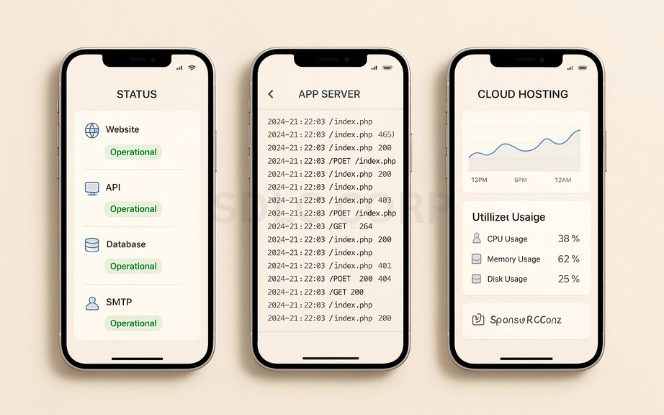
Sky Bet runs on a microservices architecture where each domain — odds, wallet, risk, account, promotions — is independently deployed and scaled. For most new operators, a modular monolith deployed to Kubernetes is more practical at launch. The stack below is production-grade without requiring a 50-person engineering team.
6. Licensing and Regulatory Compliance

Licensing is not an administrative step — it shapes every major architecture decision. The licence you hold determines which payment gateways will process your transactions, which jurisdictions you can accept players from, and what technical controls you must implement before launch.
Critical: Operating a betting service to UK customers without a UKGC licence is a criminal offence under the Gambling Act 2005. UK banks and app stores require a valid UKGC licence before onboarding or listing you.
| Licence | Market | Timeline | Cost (approx.) | Key Requirements |
|---|---|---|---|---|
| UKGC | UK only | 4–8 months | £10k–£25k + annual fees | GAMSTOP, AML policy, RG tools, ICO registration, affordability checks |
| MGA (Malta) | EU + global | 3–6 months | €25k–€35k + €25k annual | AML, responsible gambling, technical audit, local office |
| Curaçao | Global (excl. UK/US/FR/NL) | 4–8 weeks | $15k–$25k | Basic AML, no RG mandate — good for MVP validation only |
| AGCO (Ontario) | Ontario, Canada | 3–6 months | CAD $10k + rev share | Responsible gambling framework, Ontario-specific player protection |
7. UI/UX Design — Optimising for Bet Conversion

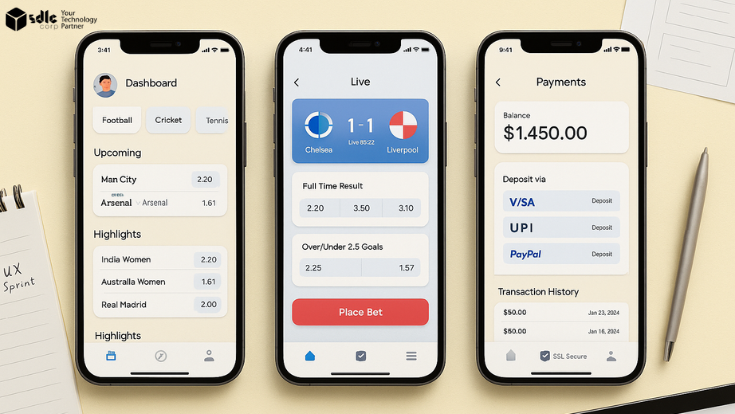
Sky Bet's entire mobile UI is optimised around one metric: time from app open to bet confirmed. Their navigation is sport → event → market → bet slip → confirm — no more than 3 taps. This is the product of years of A/B testing and conversion analysis, not aesthetic preference.
Design principles that directly affect conversion
- Odds always visible in list view: Never make a user tap into an event to see the current price. Win/Draw/Lose displayed inline per event row.
- Bet slip persistence: The slip must survive app backgrounding, incoming calls, and device sleep. A user who adds selections and leaves the app should return to exactly their slip.
- Numeric keyboard for stake entry: This is broken in a surprising number of first builds. Stake input must always trigger a numeric keyboard — not QWERTY.
- Live event badge: Sky Bet uses a green "LIVE" indicator. Live events generate significantly higher bet-per-impression rates than pre-match events.
- Dark mode first for evening sports viewing: The majority of bets are placed in evenings during matches. Design your primary theme for dark-room, mobile viewing conditions.
8. Real-Time Data Feeds and Odds Processing

The odds feed is the heartbeat of any sportsbook. Sky Bet uses Sportradar — the same provider that holds official data deals with the Premier League, UEFA Champions League, and the NFL. The data feed choice affects both your technical architecture and your commercial positioning.
Data provider options
- Sportradar / BetRadar: Most comprehensive. Official feeds from 80+ sports bodies. BetRadar's managed odds product means you don't need an in-house trading desk — they make the prices, you accept the bets. Best option for new operators.
- Stats Perform / Opta: Strong on football, rugby, and US sports. Used by Premier League clubs for internal data. Pricing competitive to Sportradar.
- OddsAPI / TheSportsDB: Lower cost, suitable for MVP prototype or social betting. Not reliable enough for real-money production at scale.
Backend requirement: Your odds service must consume feeds via WebSocket (not HTTP polling), cache current state in Redis, and stamp each incoming bet with the exact odds at request receipt time — not at database write time. This is the most common source of settling disputes and financial errors in early-stage platforms. Read our deep-dive on how to integrate live odds in a sports betting app.
9. Testing and Quality Assurance
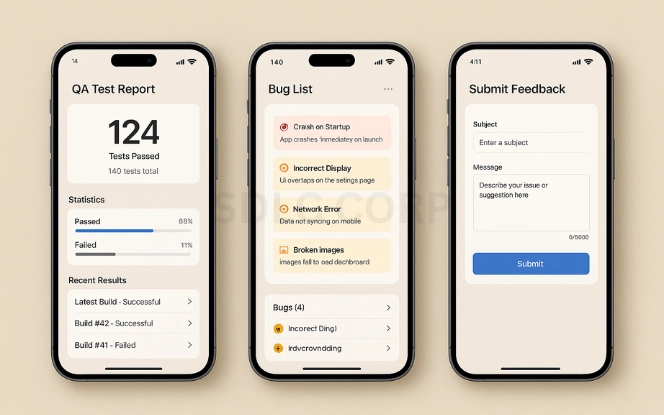
Betting platforms carry a higher QA burden than almost any other app category. A misaligned payout calculation or a wallet race condition isn't a UX bug — it's a financial liability and potentially a regulatory incident that must be reported to your licence authority. See our full breakdown of top challenges in betting app development for more on this.
Test categories specific to betting platforms
- Settlement accuracy: Every bet type — single, accumulator, each-way, Asian handicap, BTTS — must be tested against a reference settlement calculator. Do not rely solely on your own engine for validation.
- Odds race conditions: Simulate placing 500 bets on the same selection at the moment odds change. Every bet must settle at the odds that existed when the bet was received — never post-change odds.
- Wallet concurrency: Simulate 1,000 simultaneous bet placements from a single account. The balance must never go negative. Standard database isolation levels are often insufficient here.
- Match-day load test: Simulate 10–20× baseline traffic. Champions League and Grand National fixtures drive spikes that expose every unresolved performance issue simultaneously.
- GAMSTOP / self-exclusion: A self-excluded account must not be able to deposit, place bets, or receive promotional communications — test all three vectors explicitly.
10. User Acquisition and Growth Strategy

Sky Bet's marketing is anchored in football sponsorships (Sky Bet EFL Championship) and TV advertising during live sports — channels that are inaccessible at launch-stage budget. However, there are acquisition channels where new operators consistently outperform incumbents.
- Affiliate marketing: CPA or revenue-share deals with tipster sites, odds comparison aggregators (OddsChecker, Oddschecker), and sports media publishers. These affiliates deliver high-intent, converting users — Sky Bet pays £50–£100 CPA for qualified UK depositors via affiliate channels.
- Welcome bonus: "Bet £10 get £30 in free bets" is the UK market standard. Your promotions engine must handle wagering requirements, bonus expiry, and abuse detection correctly — mismanaged welcome bonuses create compliance exposure.
- SEO content: Match-specific pages ranking for "Liverpool vs Arsenal best odds" and "Premier League top scorer betting" convert immediately before kick-off. Sky Bet publishes 20–30 pieces of odds-led SEO content per week.
- Push re-engagement: A notification at kick-off — "Manchester City are 1-0 up — Cash Out available at £18.40" — drives 3–5× higher session rates than generic promotions.
11. Post-Launch Operations and Compliance
Launching is the beginning of a continuous compliance and operational obligation that has no equivalent in standard app categories. A licensed sportsbook operates under ongoing regulatory scrutiny that requires dedicated resource from day one.
- Monthly UKGC returns: Gross gambling yield, customer complaints, and safer gambling interventions must be reported monthly. Late or inaccurate returns trigger investigations.
- AML source-of-funds reviews: High-frequency large depositors must trigger automated source-of-funds requests. Your compliance software (SmartKYC, Napier, or in-house) handles this at scale.
- Odds feed maintenance: Data providers change API versions. Your engineering team must track provider changelogs and update integrations — a broken odds feed during the Grand National is a severe operational and reputational incident.
- App store policy changes: Apple and Google periodically update gambling app requirements. In 2023 both required new account deletion workflows. Operators who missed the deadline had their apps removed.
- Trading (if in-house): In-play odds require human traders monitoring liability across all open markets simultaneously. Without trading resource, use BetRadar's managed product.
12. Cost to Build a Betting App Like Sky Bet

Development cost scales with regulated features, real-time infrastructure, and compliance requirements. The figures below cover custom development with a specialist agency. They exclude licence fees, data feed subscriptions, and operational staffing — budget an additional 30–40% of development cost for year-one operational overhead. For a full cost breakdown by component, see our betting app development cost guide.
| Scope | What's Included | Investment | Timeline |
|---|---|---|---|
| MVP Sportsbook | Single sport, pre-match only, basic wallet, Curaçao licence support, iOS + Android | $40,000 – $80,000 | 14–20 weeks |
| Mid-Tier Platform | Multi-sport, in-play betting, Cash Out, full wallet, MGA or UKGC licence integration | $80,000 – $160,000 | 20–32 weeks |
| Sky Bet-Equivalent | Full sportsbook + casino, Bet Builder, live streaming, UKGC compliance, affiliate platform, CRM | $160,000 – $400,000+ | 32–52 weeks |
| White-Label Route | Licensed platform from SBTech, Kambi, or Amelco — fastest time to market | $25,000 – $60,000 setup + rev share | 8–16 weeks |
Costs not included above: UKGC licence (£10k–£25k application + annual fees), BetRadar/Sportradar data licensing ($3k–$15k/month), payment processor setup, and compliance officer staffing. A complete year-one budget for a UKGC-licensed sportsbook typically runs $250,000–$600,000 total including development, licence, data, and operations.

Pre-Development Checklist
- Confirm your target jurisdiction and begin the licence application before starting development — the licence shapes every architecture decision
- Evaluate white-label vs custom build — for some operators, a licensed white-label with revenue share is faster to revenue than a custom platform
- Sign commercial terms with your odds data provider before committing to a development timeline — Sportradar/BetRadar lead times can affect your launch date
- Design Cash Out into the bet ledger from day one — it cannot be retrofitted cheaply into an existing settlement system
- Appoint a gambling compliance consultant to run parallel to development — regulatory review of your platform is mandatory before going live
- Configure load testing to simulate match-day spikes (10–20× baseline) before soft launch — not after the first incident
- Engage a GAMSTOP technical partner early if targeting UK — the integration has stricter latency requirements than most teams anticipate
Frequently Asked Questions
How do I develop a betting app like Sky Bet?
Start with jurisdiction selection and licence application — this determines your architecture, payment providers, and KYC obligations. Then spec the four core systems: bet ledger, wallet, odds feed integration, and Cash Out engine. Development of a production-grade platform takes 20–52 weeks depending on scope. SDLC Corp's iGaming development team handles full-cycle delivery from architecture specification through App Store launch.
What are the must-have features of a Sky Bet-class sportsbook?
In-play betting with sub-500ms odds updates, Cash Out (full, partial, auto) across all markets, Bet Builder (same-game multi-leg selections), same-day wallet withdrawals via Faster Payments, GAMSTOP integration for UK compliance, a promotions engine covering free bets and odds boosts, and a risk management layer to cap liability exposure per market. UKGC operators additionally require affordability check workflows and monthly regulatory returns.
What does it cost to build a sports betting app?
An MVP sportsbook (single sport, pre-match, Curaçao licence) costs $40,000–$80,000 over 14–20 weeks. A mid-tier platform with in-play and Cash Out runs $80,000–$160,000. A full Sky Bet-equivalent platform with UKGC compliance, Bet Builder, and CRM is $160,000–$400,000+. Budget an additional 30–40% for year-one operational costs: licence fees, Sportradar data subscription, payment processor setup, and compliance staffing.
Which tech stack is best for a betting app?
React Native or Flutter for mobile, Next.js with WebSocket for web, Node.js or Go for backend services, PostgreSQL for the bet ledger and wallet (ACID compliance required), Redis for live odds caching, Kafka for event streaming, and AWS EKS with Kubernetes autoscaling. BetRadar or Sportradar for odds data feeds. Onfido or Sumsub for KYC. GAMSTOP REST API for UK self-exclusion.
Do I need a UKGC licence to offer betting to UK customers?
Yes — operating without a UK Gambling Commission licence is a criminal offence under the Gambling Act 2005. UK banks, Apple, and Google require a valid UKGC licence before processing payments or listing your app. The application takes 4–8 months and requires an AML policy, responsible gambling tools, GAMSTOP integration, and ICO registration. Start the application in parallel with, not after, development.
How long does betting app development take?
MVP with single sport and pre-match betting: 14–20 weeks. Platform with in-play, Cash Out, and full wallet: 20–32 weeks. Full-feature Sky Bet-equivalent with UKGC compliance and casino: 32–52 weeks. Licence applications (4–8 months for UKGC) should be initiated at the start of development, not on completion, to avoid a gap between technical readiness and regulatory approval.