Indie RPG · RPG Maker MV/MZ · Unity 2D · Psychological Horror
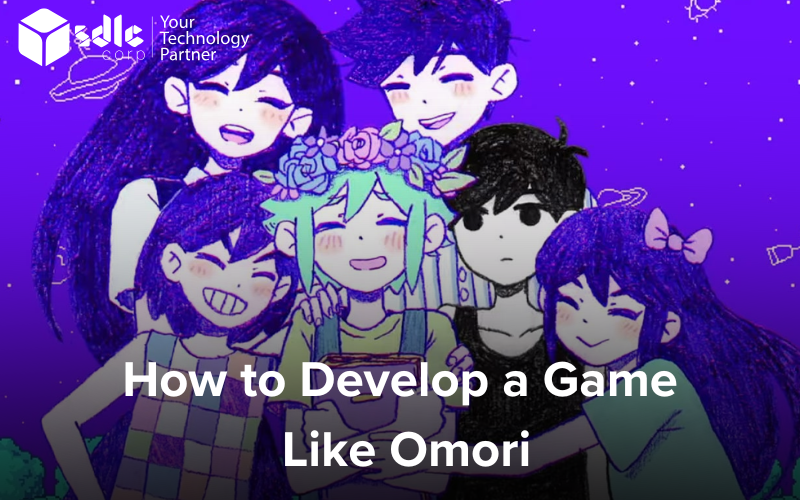
This game is a psychological horror RPG developed solo by OMOCAT using RPG Maker MV, released in 2020 after a six-year development. It has sold over 1 million copies on Steam and built one of the most dedicated cult followings in indie gaming — not through high production value, but through emotionally precise storytelling, a dual-world structure that mirrors the protagonist's psychological state, and a combat system where emotions themselves are the mechanics.
If you want to develop a game like Omori, you are building a narrative-first RPG where every design decision — colour palette, music tempo, enemy names, menu transitions — serves the story's psychological themes. This guide covers the mechanics, tools, art approach, and realistic costs for building an Omori-inspired title in 2025.
How this differs from our other game guides: Our Free Fire guide, PUBG guide, and GTA guide cover action games requiring dedicated servers, large teams, and $200k–$1M+ budgets. An Omori-style psychological RPG is a different category — a solo or small-team project ($15k–$80k) built in RPG Maker or Unity 2D, where the primary craft is writing and emotional design, not physics or multiplayer networking.
1. Why Omori Works — The Design Principles
Step 1 — Design AnalysisThe game's critical and commercial success comes from a design philosophy that most RPGs avoid: the game mechanics reinforce the psychological themes, they don't just run alongside them. The emotion combat system isn't a gimmick — it's a metaphor for how trauma and suppressed emotion shape our reactions. The dual-world structure isn't two separate game modes — it's the same narrative told from inside and outside a dissociative state.
- Mechanic-as-metaphor: Every system serves the story. The emotion triangle (Happy beats Angry beats Sad beats Happy) maps to real emotional dynamics. When the protagonist suppresses emotion to maintain his dream world, the combat system reflects this. Build your mechanics with the same intentionality.
- Colour as psychological indicator: The dream world is saturated — bright whites, soft pastels. The real world is near-monochrome. This colour language is established early and paid off throughout. It requires no text — players understand the psychological state shift from the palette alone.
- Silence as design: Omori uses silence and empty space deliberately — long walks through featureless corridors, menus that hang just a beat too long. This discomfort is intentional. Your RPG should design its silences as carefully as its dialogue.
- The unreliable narrator: Players gradually realise the dream world's internal logic doesn't match reality. Designing this requires careful information architecture — what the player sees vs what is true must be tracked at the narrative level throughout the entire game.
2. Must-Have Features in a Game Like Omori
Step 2 — Feature SetEmotion-Based Combat System
Characters cycle through emotional states — Happy, Angry, Sad — which form a rock-paper-scissors advantage system. Happy beats Angry, Angry beats Sad, Sad beats Happy. Each state also affects attack power, defence, and available skills. Implementing this requires a state machine per character with modifiers applied to damage calculations and skill availability checks each turn. Emotional state changes can be triggered by attacks, skills, or scripted story events — the system must support both.

Branching Narrative & Multiple Endings
Omori has three endings (Sunny Route, Hikikomori Route, True Ending) determined by exploration choices made throughout the game. The branching is not dialogue-tree-based — it's driven by whether the player engages with the real world or retreats into the dream world. Technically this requires a flag system tracking player engagement with real-world content. At key decision points, the flag totals determine which ending triggers. Design your flag architecture before writing a single branching line — retrofitting it is expensive.

Pixel Art & Hand-Drawn Cutscenes
The game uses 16-bit-style sprites for gameplay with hand-drawn still images for emotionally significant moments — confessions, trauma reveals, major confrontations. This mixed-media approach is both an artistic choice and a practical budget decision: hand-drawn stills cost less than animated cutscenes but deliver higher emotional impact than pixel art alone. Commission your hand-drawn cutscenes from your character designer, not your sprite artist — the two require different skills.

Memory Flashbacks & Non-Linear Storytelling
The game deploys memory sequences that interrupt the present-day narrative to reveal backstory. These sequences use distinct visual treatment (higher contrast, distorted audio) to signal their psychological nature. Technically each flashback is a separate map with custom parallax and audio settings, triggered by script. Your engine must support mid-game scene transitions that preserve the player's position, inventory, and flags in the originating map.

Hidden Side Quests & Lore Depth
The world rewards exploration with emotional lore, not just mechanical rewards. Hidden NPCs reveal backstory fragments. Optional boss fights contextualise the main narrative. This design requires content that is psychologically coherent even when the player doesn't see it — the world must feel like it has existed before the player arrived. Design your side quest content as primary narrative, then make it optional rather than designing optional filler.

Dual-World Structure
The dream world (Headspace) is bright, safe, populated with friendly companions. The real world (Faraway) is grey, sparse, threatening. Transitioning between them is the game's central mechanic and its central metaphor. Each world requires a distinct tileset, music library, NPC dialogue set, and lighting configuration. In RPG Maker this means two complete map trees with scripted transitions. In Unity, two scene configurations sharing a common data layer.
3. Art Direction — The Two Worlds
Step 3 — Visual DesignThe visual identity is defined by the contrast between its two worlds. This contrast is not decoration — it carries the game's core psychological argument. Your art direction must establish the same clarity of visual language from the first frame.

The visual techniques that make this duality work: a consistent but distinct colour palette per world applied uniformly across tilesets, character sprites, and UI elements; environmental storytelling in object placement (childhood toys in corners, empty picture frames); and screen transitions that are themselves emotionally loaded (fade to white for dream entry, abrupt cut for trauma triggers).
4. Technology Stack
Step 4 — Tech StackThe right tool depends on your team's experience and your target platform. Omori was built in RPG Maker MV — a deliberate choice that constrained the toolset and focused the team on content rather than engineering.
5. Development Process for a Narrative RPG
Step 5 — ProcessNarrative RPG development is story-first, not engine-first. The process differs from action game development because the critical path runs through writing and emotional design, not technical systems.
- 1. Write the full story before building anything. Know every ending, every flag, every revelation before opening RPG Maker or Unity. the six-year development was largely this phase. The narrative architecture must be complete before maps are built — a map designed around an early draft ending will be wrong when the ending changes.
- 2. Build the emotion system prototype. Before art, before maps — get the combat state machine working with placeholder graphics. Playtest it for 20 hours minimum. The emotion triangle must feel intuitive and strategically interesting before you commit to building content around it.
- 3. Build one complete chapter end-to-end. A single chapter with correct art, music, dialogue, and mechanics — before building any other chapter. This vertical slice reveals integration problems early: does the dialogue system handle font size correctly, does the music transition at the right emotional beat, do the flag triggers fire in the right order.
- 4. Commission art and music in parallel. Once the vertical slice is approved, art and music can be produced concurrently. Provide your artists with a palette guide per world (specific hex codes) and a reference sheet for each character's emotional range. Music must be composed with adaptive states in mind — not after the levels are complete.
- 5. Closed playtesting for emotional impact. This genre requires emotional playtesting, not just QA. Find players unfamiliar with the story and observe where they feel confused vs moved vs bored. Emotional pacing problems (too many sad scenes in a row, trauma reveal too early) only surface with fresh eyes.
6. What Makes Omori's Art Direction Work
Step 6 — Art DirectionOmori's art achieves something rare: the pixel sprite style that signals "safe indie game" and the horror imagery that subverts that safety are produced from the same aesthetic register. The horror doesn't replace the cute — it corrupts it. This requires precise artistic discipline.
- Consistent sprite resolution: All characters at the same pixel height per world. Inconsistent sprite scaling breaks the visual grammar. Establish your character sprite dimensions (e.g., 48×48 pixels) and enforce them for every character, every animation frame.
- Limited palette per location: Each map in Omori uses a constrained colour palette — typically 8–16 colours. This forces coherence and makes palette shifts between dream and real world legible at a glance. Aseprite's palette lock feature enforces this during production.
- Hand-drawn cutscenes as reward: Reserve your hand-drawn art for maximum emotional impact moments. Over-using them reduces their effect. They appear at roughly 8–12 points across 20+ hours of content. Each one should be an artistic statement, not an illustration.
- Typography as emotional design: The menu font, dialogue boxes, and title screens are integral to its aesthetic. Use a custom or carefully selected pixel font consistently. Menu UI in a psychological RPG is not neutral — the typeface and box styling contribute to tone.
7. Challenges in Developing a Psychological Horror RPG
Step 7 — Challenges- Narrative-emotional balance: Too much trauma without relief causes player fatigue and abandonment. Too much relief undermines the weight of trauma. The pacing alternates deliberately — light exploration sections between heavy narrative beats. Map this rhythm explicitly in your story document before building levels.
- Multi-ending flag architecture: Branching narratives with 3+ endings require careful flag design. Flags that affect ending must be set by natural gameplay decisions, not explicit choices. If players feel they are "choosing an ending," the illusion breaks. Test every flag path with a dedicated QA spreadsheet, not mental tracking.
- Mental health content responsibility: Omori deals with grief, depression, dissociation, and survivor's guilt explicitly. This content requires a content warning system (shown before first play), consultation with a mental health professional during writing, and a sensitivity reader before finalising scripts. The Steam and App Store require appropriate content ratings for this material.
- Emotion system balance: The Happy/Angry/Sad triangle must be exploitable but not trivially so. Playtesters will find dominant strategies — Happy-locking all enemies is a common discovered exploit in Omori-style games. Build emotional resistance mechanics (some enemies are immune to emotion shifts, some actively resist) to maintain strategic depth.
- Scope creep in narrative games: Story-driven games are particularly vulnerable to scope expansion — one more NPC conversation, one more flashback, one more optional boss. Omori took 6 years partly due to this. Define your chapter count, ending count, and total map count before development starts and treat them as hard constraints.
8. Cost to Develop a Game Like Omori
Step 8 — InvestmentOmori-style psychological RPGs have the most accessible cost floor of any genre on this site. A solo developer with RPG Maker skills can produce a meaningful game. A small professional team can produce a commercial-quality title. The constraint is not budget — it is writing quality and emotional authenticity.
| Scope | What's Included | Investment | Timeline |
|---|---|---|---|
| Solo / Micro-Indie | RPG Maker MZ, one developer, original pixel art (self-created or commissioned), 5–8 hours of content, single ending, Steam release | $5,000 – $20,000 | 12–24 months |
| Small Team Indie | RPG Maker MZ or Unity 2D, writer + developer + pixel artist + composer, 10–20 hours, 2–3 endings, hand-drawn cutscenes, Steam + Itch.io | $25,000 – $60,000 | 18–36 months |
| Commercial Indie | Unity 2D, full team (writer, developers, artist, composer, QA), 20–30 hours, 3+ endings, voice acting, console port, full marketing budget | $60,000 – $150,000 | 24–48 months |
| Omori Equivalent | The team grew over 6 years. The game launched with a ~$203k Kickstarter plus years of solo work. Full commercial quality with original soundtrack. | $80,000 – $200,000+ | 3–6 years |
The real cost driver in this genre is time, not tools. RPG Maker MZ licence costs $79.99. Unity is free under $200k/year revenue. The budget is primarily writer, artist, and composer fees — and the primary timeline driver is narrative revision cycles. Budget 30–40% of your writing time for rewrites after playtesting.
9. Monetisation for an Indie Psychological RPG
- Steam premium purchase ($10–$20): The game launched at $19.99. Premium pricing sets quality expectations and pre-selects committed players. The psychological RPG audience is willing to pay for quality narrative experiences — do not price at $4.99 hoping for volume.
- Kickstarter / crowdfunding: The Kickstarter raised $203,000 in 2014. Crowdfunding validates demand, funds production, and builds a community before launch. For a psychological RPG, the campaign pitch must communicate emotional depth — a demo chapter is more effective than a trailer.
- Itch.io: Indie-focused platform with a strong psychological horror and narrative RPG community. Lower visibility than Steam but 0–10% revenue share (vs Steam's 30%). Good for demo releases and early access builds to build community pre-launch.
- OST sales: Omori's soundtrack by bo en and Pedro Silva sold separately and became a standalone commercial success. Commission music specifically for separate release — tracklist order, album art, and liner notes matter for OST sales. Bandcamp is standard for indie game OSTs.
- DLC / additional content: Post-launch story DLC extending the narrative or adding new routes. Community hunger for more content is evident — a well-received base game creates appetite for additional story content that commands premium pricing.
- Merchandise: Official merchandise includes plushies, pins, and art books. Merchandise works when characters have strong visual identities — a key reason to invest in distinctive character design even on a limited art budget.
Pre-Development Checklist
- Write the complete narrative — all endings, all flag paths — before opening your engine. Story changes after maps are built cost 3–5× as much as story changes in a document.
- Prototype the emotion combat system with placeholder art before commissioning any assets. The system must feel strategically interesting before content is built around it.
- Define your world colour palettes (specific hex codes) before commissioning a single pixel of art. Apply them as hard constraints — every tileset, every sprite, every UI element must conform.
- Add a content warning screen covering depression, grief, and self-harm themes before the first scene. Required for Steam rating and app store approval in most territories.
- Build your flag architecture in a spreadsheet before any scripting. Map every flag to every outcome. Share it with your writer — narrative decisions and technical flags must be authored together.
- Commission original music with adaptive state support in mind. Hand the composer your emotional beat sheet, not just a genre reference.
- If building an action game instead, see our Free Fire guide — the engine, team, and budget are entirely different.
Frequently Asked Questions
How do I develop a game like Omori?
Start with a complete narrative document covering all endings and flag paths before opening any engine. Then prototype the emotion combat system in RPG Maker MZ or Unity 2D. Build one complete chapter end-to-end as a vertical slice before producing the full game. Omori was built solo in RPG Maker MV over 6 years — a small team (3–5 people) can reach a commercial indie release in 18–36 months with the right process. SDLC Corp's Unity team delivers narrative RPG development including custom combat systems and branching dialogue architecture.
How much does it cost to develop a game like Omori?
A solo micro-indie with RPG Maker costs $5,000–$20,000. A small team indie with original pixel art, music, hand-drawn cutscenes, and 2–3 endings runs $25,000–$60,000. A full commercial release with Unity 2D, voice acting, and console ports is $60,000–$150,000. Omori itself was backed by a $203k Kickstarter and years of solo development before that. The cost driver is writing and art time, not engine or tool licences.
Is RPG Maker or Unity better for an Omori-style game?
RPG Maker MZ for teams prioritising narrative content delivery speed — it handles turn-based battle, dialogue, and maps out of the box, so you reach playable story content faster. Unity 2D for teams that need custom mechanics beyond RPG Maker's capabilities (custom animation systems, live 2D, complex state machines) or targeting mobile with high performance requirements. Omori used RPG Maker MV — the tooling constraint focused the team on story rather than engine features.
How does the emotion-based combat system work technically?
Each character holds a current emotional state (Happy, Angry, Sad) stored as an enum or integer. On each action, the game checks the attacker's state against the defender's state and applies a multiplier (advantage/disadvantage) to the damage calculation. State changes are applied via skill effects or scripted events — they use the same modifier system as buffs/debuffs. In RPG Maker this is implemented via custom plugin and state effects. In Unity via a ScriptableObject-based state machine with modifier hooks into the combat calculator.
How long does it take to develop a psychological RPG like Omori?
Solo developer with RPG Maker: 2–5 years for a commercial-quality release. Small team (3–5 people): 18–36 months. The project took 6 years from public announcement to release, though much of that was solo work plus scope expansion. The primary timeline driver in narrative RPGs is writing and revision — not programming. A game with 20+ hours of content and 3 endings requires a large volume of original writing, all of which needs multiple revision passes.