Unity 3D · Mobile-First · India · SEA · LatAm
Free Fire has crossed 1 billion downloads — more than any other mobile battle royale game in history. Developed by Garena, it dominates mobile gaming in India, Southeast Asia, and Latin America because it was designed for devices and networks that PUBG and Fortnite were not: mid-range Android phones, 4G connections, and players who want a full match in under 12 minutes.
If you want to develop a mobile battle royale like Free Fire, you are not building a Fortnite clone on mobile. You are building a purpose-engineered battle royale that runs smoothly on a Redmi Note with 3GB RAM, loads in under 30 seconds, and delivers a complete competitive experience without a high-end device. This guide covers every technical, design, and commercial decision with the precision that a serious studio or operator needs before committing budget.
On cost: The cost figure frequently quoted online for "a game like Free Fire" is $10k–$100k. This is for a prototype or simple mobile game — not a production-quality battle royale. A genuine production-quality battle royale with real-time multiplayer, matchmaking, anti-cheat, dedicated servers, and a live ops system costs $150,000–$500,000+. We cover the real breakdown in Step 11.
1. Why Free Fire Is the Right Model to Study
 Step 1 — Market Analysis
Free Fire's dominance is a product of deliberate engineering constraints. Garena built it specifically for the hardware realities of emerging markets — the game runs on Android devices with 1GB RAM, requires only 700MB of storage, and is optimised for network conditions where a 50ms ping is aspirational rather than guaranteed.
These constraints are also the opportunity. The global mobile gaming market is projected to reach $272 billion by 2030, and the highest growth is in markets where Free Fire already leads: India, Brazil, Indonesia, Vietnam, Thailand. Building a battle royale for this audience means engineering for accessibility, not spectacle.
- India: Its largest market by active users. Tier-2 and Tier-3 city players on sub-$150 Android devices. Strong esports ecosystem via Free Fire India Series.
- Southeast Asia: Indonesia, Vietnam, Thailand, Philippines — dominant market share. Local esports leagues with prize pools in hundreds of thousands of dollars.
- Latin America: Brazil is Free Fire's second-largest market globally. Spanish and Portuguese localisation is mandatory for LatAm operators.
- Why this matters for new studios: These markets are price-sensitive (monetise via smaller frequent purchases) and community-driven (Discord, WhatsApp groups for squads). Your game architecture and marketing must reflect this.
2. Define Your Niche Within the Battle Royale Genre
 Step 2 — Audience & Niche
Free Fire did not try to out-spec PUBG. It out-executed PUBG on a specific dimension: accessibility on low-end hardware. Every new battle royale must find its own dimension to own.
Positioning decisions before development starts
- Map size: The game island is smaller than PUBG's Erangel. Smaller map = more combat per minute = better for shorter sessions. Decide your match duration target (8 minutes? 15 minutes?) and design the map around it.
- Player count: Free Fire uses 50 players vs PUBG's 100. Fewer players means less server load per match, lower hosting cost, and faster match completion. This is a cost and design decision simultaneously.
- Character abilities: The character system (each character has a unique active/passive skill) creates a hero-shooter layer that Fortnite and PUBG don't have. This is a major differentiator — decide early whether you build this in.
- Monetisation posture: Cosmetics-only (like Free Fire) vs pay-to-win vs battle pass only. The model is aggressive cosmetic monetisation with no pay-to-win mechanics. This is the correct model for a trust-building launch in competitive markets.
Fastest differentiation angle: A battle royale built specifically for cricket culture — cricket-themed skins, IPL stadium maps, Indian commentary — would have immediate cultural traction in India where no major player has localised at this depth.
3. Architecture for a Mobile Battle Royale
 Step 3 — Architecture
Battle royale architecture has requirements that typical mobile game architectures do not: authoritative game servers (the server runs the game, not the client), real-time state synchronisation for 50 simultaneous players, and anti-cheat enforcement at the server level. These are not features you add later — they define the system from the first line of code.
- Authoritative dedicated servers: Every player action is validated server-side. Clients send inputs (move, shoot, loot) — the server confirms outcomes. This is the only architecture that can enforce anti-cheat reliably. Client-authoritative alternatives (peer-to-peer, client-side physics) will be exploited within weeks of launch.
- Matchmaking service: Skill-based matchmaking (SBMM) queue with region selection, latency-based server assignment, and bot filling for off-peak hours. AWS GameLift or Photon Fusion handle the infrastructure; you build the matchmaking logic.
- Zone/circle logic: The shrinking zone is a discrete game state broadcast to all clients every N seconds. This is simpler than it sounds architecturally, but zone calculation must be server-authoritative and tamper-proof.
- Loot spawning: Deterministic server-seeded random loot placement — the same map seed produces the same loot every time, allowing replay validation and anti-cheat comparison.
- Low-end device optimisation: LOD (Level of Detail) switching at different player counts. Draw call budgets per frame. Texture streaming to avoid memory spikes on 2GB RAM devices. These are not optional for this audience.
4. Core Features of a Battle Royale Game
 Step 4 — Feature Set
5. Technology Stack
 Step 5 — Tech Stack
6. Game Design, Graphics, and UI/UX
 Step 6 — Design
The visual style is stylised realism — not photorealistic (too demanding) and not cartoon (lower perceived value). Characters and environments use a slightly exaggerated, colourful aesthetic that looks good even when rendered at reduced quality on a mid-range device. This is a deliberate design choice, not a limitation.
Mobile game design constraints
- Draw call budget: Target under 100 draw calls per frame on low-end devices. This means aggressive batching, atlasing, and LOD — not simply "make it look good and optimise later."
- Control layout: The virtual joystick + fire button layout is industry-standard for a reason — it's optimised for thumb reach on 5–6 inch screens. Don't innovate on controls until you've validated the standard layout works first.
- HUD readability: Health bar, ammo count, zone timer, and minimap must be readable in direct sunlight on a phone screen. Test on an actual device outdoors — not in a dark room.
- Onboarding / tutorial: Free Fire's tutorial guides new players through a safe combat scenario before their first real match. A player who loses their first 5 matches without understanding why will uninstall. Budget 4–6 weeks of dedicated tutorial design and testing.
7. Monetisation — How Free Fire Makes Money
 Step 7 — Revenue
Free Fire generated approximately $1.1 billion in revenue in 2022 — virtually all from cosmetic in-app purchases. The game is free to play and has no pay-to-win mechanics. Understanding why this model works is essential before you design your economy.
- Diamond currency: The game uses "Diamonds" as the premium currency purchased with real money. This layer of abstraction reduces the psychological friction of spending — players think in Diamonds, not rupees or reais.
- Gacha / loot boxes: Character and weapon skin draws. The "Luck Royale" gacha system drives large portions of revenue. Note: Several markets (Netherlands, Belgium) have banned gacha mechanics — if targeting Europe, check regulations before implementing.
- Battle Pass: Seasonal pass (~30 days, ~£/$/R 100–200 equivalent). Free tiers provide content for non-paying players; paid tiers deliver premium skins and currency. Pass renewal drives monthly recurring revenue.
- Limited-time events: Exclusive skins available for 72 hours drive FOMO purchases. These are the single highest-revenue events in The game's calendar — typically 3–5× daily revenue on the first 48 hours of a major skin drop.
- Esports integration: Viewership rewards (watch a match, earn in-game drops) and tournament skins monetise the esports audience without requiring them to compete.
8. Legal Compliance and IP Protection
 Step 8 — Legal
Garena's characters, map designs, weapon skins, and sound assets are all protected by Garena's intellectual property. You cannot use any of these assets directly. What you can do is build your game with your own original assets.
- Mechanics are not copyrightable: The battle royale mechanic (shrinking zone, last player standing, airdrop) is not owned by any single developer. Fortnite, PUBG, and Free Fire all use it. You can implement it freely.
- Assets are copyrightable: Character designs, map layouts, weapon models, sound effects, and music — all must be original. Commission original art assets even if they are stylistically inspired by Free Fire.
- Gacha / loot box regulations: Belgium and Netherlands have banned loot boxes under gambling laws. China requires disclosure of gacha probabilities. South Korea requires probability disclosure. If targeting these markets, design your economy accordingly from the start.
- GDPR / DPDP compliance: India's Digital Personal Data Protection Act 2023 applies to Indian user data. GDPR applies to European users. Children's data (COPPA in the US, COPPA-equivalent in India) requires parental consent for under-13 players.
- App store policies: Google Play and Apple App Store both have specific policies on loot boxes, gambling mechanics, and in-app purchase pricing. Both platforms require disclosure of loot box probabilities effective 2024.
9. Team Structure for a Battle Royale
 Step 9 — Team
Free Fire was built by a team of 40–60 people over 18 months before launch. A new studio building an equivalent product can achieve a functional MVP with a leaner team — but the roles below are non-negotiable. Missing any of them causes specific, predictable failure modes.
- Lead Unity Developer (1): Owns the client architecture. Must have shipped a multiplayer mobile game previously — not a generalist.
- Multiplayer/Backend Developer (2): Owns dedicated server logic, matchmaking, and backend APIs. Network programming experience is mandatory.
- 3D Artists (2–3): Character modelling, rigging, animation, environment art. Must be able to hit mobile polygon budgets — high-poly AAA artists need retraining for mobile constraints.
- Technical Artist (1): Bridges art and engineering — shader optimisation, draw call reduction, LOD setup. The single most impactful hire for mobile performance.
- Game Designer (1–2): Owns gameplay loops, map design, weapon balancing, and economy design. Game design is a specialisation — a programmer who "also does design" produces worse outcomes than a dedicated designer.
- UI/UX Designer (1): Mobile game UI is different from app UI — different constraints, different patterns. Must have mobile game portfolio.
- QA (2): Device compatibility testing across 30+ Android devices is a full-time job. Multiplayer QA (testing 50-player matches) requires organised test sessions, not individual testing.
10. Testing and Quality Assurance
 Step 10 — QA
Battle royale QA has categories that single-player games don't require. Each category below represents a failure mode that shipped games have suffered publicly.
- Device matrix testing: Test on real devices — Redmi Note 11, Samsung A14, Realme C35, Tecno Spark 10. These are the actual devices your target market uses. Emulators do not replicate real performance or thermal throttling.
- Server load testing: Simulate 500 concurrent matches (25,000 simultaneous players). If this breaks your server architecture, it will break in production at a major tournament or viral moment.
- Network condition simulation: Test under 3G throttling (typical in Indian Tier-2 cities), packet loss simulation (10% packet loss is common on mobile), and high-latency conditions (150ms+ round trip).
- Anti-cheat validation: Hire a professional security researcher to attempt to exploit the game before launch. The cost of a pre-launch pentest is a fraction of the cost of a cheat scandal post-launch.
- Economy balance testing: Simulate 10,000 players going through the battle pass, gacha system, and shop for a full season. Ensure currency sinks and sources balance — economy exploits discovered post-launch destroy player trust.
- Closed beta: 1,000–5,000 players in your target market, 4 weeks before launch. Multiple regional beta tests were run tests. Closed beta feedback on core loop feel is more valuable than any internal QA.
11. Real Cost to Build a Battle Royale Game
 Step 11 — Investment
The figures below are for a production-quality battle royale intended for commercial launch with real players. If you see "$10k–$100k" quoted elsewhere, that range covers a prototype or simple demo — not a game with dedicated servers, matchmaking, anti-cheat, a character system, 10+ maps, and a live cosmetics economy.
| Scope | What's Included | Investment | Timeline |
|---|---|---|---|
| Prototype / Proof of Concept | 50-player match on one map, basic weapons, no character system, no economy, no dedicated servers | $30,000 – $60,000 | 12–16 weeks |
| Soft Launch MVP | 2–3 maps, character system, basic cosmetics, battle pass, dedicated servers, matchmaking, closed beta ready | $100,000 – $200,000 | 24–36 weeks |
| Full Commercial Launch | 5+ maps, full character roster (8–12 characters), live ops system, ranked mode, guilds, anti-cheat, app store approved | $200,000 – $500,000 | 36–60 weeks |
| AAA Battle Royale Scale | The actual Garena product required ~$5M+ and 40+ people over 18 months. Garena is a $3B company. | $2,000,000+ | 18–36 months |
Ongoing costs after launch: Live ops (monthly content updates, seasonal events) require a permanent team of 4–8 people. Server hosting at 50,000 daily active users runs $5k–$15k/month on AWS GameLift. Budget live ops at 20–30% of initial development cost per year for the first three years.

Pre-Development Checklist
- Decide match size (50 vs 100 players) and map count at launch — these drive your server architecture and hosting cost from day one
- Choose server-authoritative architecture from the start — retrofitting it after a client-authoritative build is a near-total rewrite
- Commission original art assets — no Garena characters, maps, or sounds, even as placeholders. Placeholders become permanent.
- Plan loot box compliance before building the economy — gacha bans in EU markets require a redesign if added post-launch
- Test on real low-end Android devices before soft launch — Redmi, Realme, Tecno. If it runs poorly there, your target market won't play it.
- Budget for live ops from month one post-launch — a battle royale without monthly content updates loses 60%+ of players within 90 days
- Run a closed beta with 1,000+ real players before public launch — internal QA cannot replicate real-world network diversity and player behaviour
Frequently Asked Questions
How do I develop a game like Free Fire?
Start with your target market (India, SEA, LatAm) and hardware baseline (mid-range Android), then select Unity as your engine and design a server-authoritative dedicated server architecture before any client development. Scope your launch product to 2–3 maps and 8 characters rather than trying to match Free Fire at launch. A 24–36 week MVP with a closed beta is the right approach. SDLC Corp's mobile game team delivers full-cycle Unity battle royale development.
How much does it cost to develop a game like Free Fire?
A prototype costs $30,000–$60,000. A soft-launch MVP with dedicated servers, matchmaking, character system, and battle pass costs $100,000–$200,000 over 24–36 weeks. A full commercial launch with 5+ maps and anti-cheat runs $200,000–$500,000. The "$10k–$100k" figure seen elsewhere covers simple demos — not a production game with real multiplayer. Live ops after launch add 20–30% of development cost per year.
Which game engine should I use for a Free Fire clone?
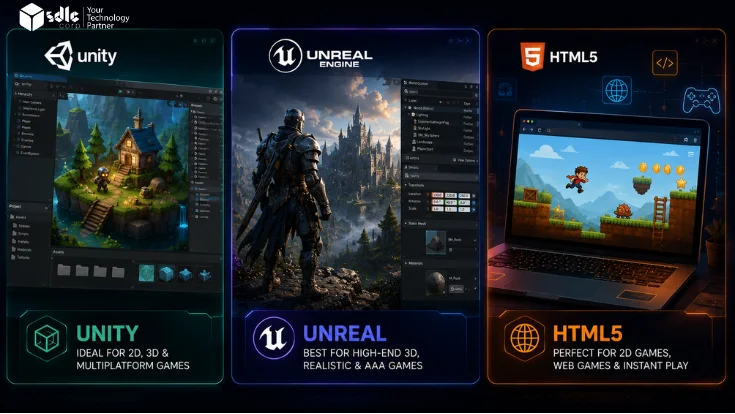
Unity (C#) is the right choice for a mobile battle royale in this style. The engine runs on Unity. It has the best mobile optimisation tooling, the largest pool of Unity developers in India and Southeast Asia, and the broadest asset ecosystem. Unreal Engine 5 is more powerful but requires higher-end devices and has a smaller mobile developer talent pool in emerging markets.
Can I legally build a game inspired by Free Fire?
Yes — game mechanics (battle royale, shrinking zone, last player standing) are not copyrightable. You can implement any mechanic freely. What you cannot use is Garena's specific assets: character designs, weapon models, map layouts, music, or sound effects. All art assets must be original commissions. Garena has actively pursued legal action against studios using directly copied assets — do not use their work even as placeholder art.
How long does it take to develop a battle royale game?
Prototype: 12–16 weeks. Soft-launch MVP: 24–36 weeks. Full commercial launch with ranked mode, guilds, and live ops infrastructure: 36–60 weeks. The original game took 18 months with 40+ people. Plan for a closed beta phase of 4–6 weeks before public launch — it is not optional for a multiplayer game.
How do you monetise a battle royale game?
Cosmetics-only in-app purchases (skins, emotes, parachute trails) combined with a seasonal battle pass is the most successful model for this genre. The platform generates over $1 billion annually from cosmetics with zero pay-to-win mechanics. Gacha systems add revenue but require loot box probability disclosure in most markets from 2024 and are banned in Belgium and the Netherlands. Rewarded video ads work as a supplementary revenue stream for players who do not spend on IAP.