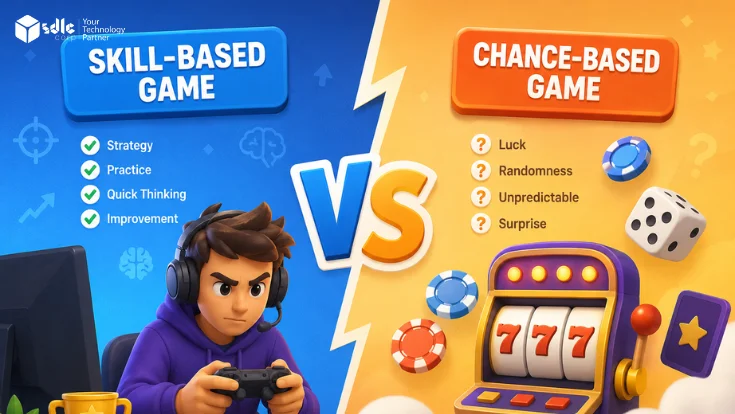
Whether a game is classified as skill-based or chance-based determines everything from its legal status and licensing requirements to its app store eligibility and monetization options. The distinction is not always obvious - many games combine both elements - and the classification that applies depends on the jurisdiction, the specific mechanic, and often a regulator's or court's assessment of which factor predominates.
Skill-based games without real-money stakes generally face fewer regulatory barriers. Skill-based games with entry fees, prize pools, or cash rewards may still trigger gaming, gambling, prize competition, or consumer-protection rules. Chance-based game with real-money prizes are treated as gambling in most regulated markets and require a licence. Neither classification is automatically low-risk - safety depends on the specific game mechanic, monetization design, target jurisdiction, and how regulators interpret the predominance of skill vs chance in your specific product.
Legal notice: This article is an informational planning guide, not legal advice. Classification of games as skill-based or chance-based varies by jurisdiction and is often decided by regulators or courts. Consult qualified legal counsel before launching any real-money game in any market.
How Skill and Chance Are Defined in Law
Most jurisdictions draw the line using a predominance test - whether skill or chance is the predominant factor in determining the game outcome. Courts and regulators apply this test differently, which is why the same game can be legal in one market and restricted in another.
| Characteristic | Skill-based | Chance-based |
|---|---|---|
| Outcome driver | Player decisions, strategy, knowledge, or physical ability | Random number generator, shuffle, dice, or lottery draw |
| Player influence | A more skilled player consistently outperforms a less skilled one | All players have equal probability regardless of ability |
| Repeatability | Performance improves with practice and experience | Outcomes are statistically independent of past results |
| Legal treatment | Often exempt from gambling laws in many jurisdictions | Usually treated as gambling when real money is involved |
| Licence requirement | Often none (social/free-to-play) or lighter (e-sports) | Gambling or gaming licence typically required for real-money play |
| Examples | Chess, fantasy sports, rummy, e-sports; poker - mixed, treatment varies by jurisdiction | Slots, roulette, casino game development services, lottery, keno |
The skill–chance spectrum
The classification of poker illustrates how differently jurisdictions apply the predominance test. In the United States, UIGEA contains a narrow carve-out for qualifying fantasy or simulation sports contests where prizes are fixed in advance and outcomes reflect participant knowledge and skill. Poker is regulated separately - legal for real-money online play only in selected states under state licensing frameworks. The same mechanic can receive different legal treatment.
Regulatory Treatment by Key Market
Jurisdiction is the single biggest variable in the skill-vs-chance safety calculation. The same game can be legally operated without a licence in one country, require a gambling licence in another, and be entirely prohibited in a third.
India now treats online money games with deposits, stakes, entry fees, or cash rewards as high-risk, even when skill is involved. Free-to-play, e-sports, educational, and social games may follow a different path, but any India-facing real-money model should be reviewed under central rules, state laws, advertising limits, and payment restrictions before launch.
The United States requires state-by-state review because UIGEA does not create a blanket exemption for all skill games. Fantasy sports, poker, sweepstakes, paid tournaments, and casino-style games may each face different rules. Operators should confirm licensing, geofencing, age checks, prize terms, and payment processor approval before accepting real-money users.
The UK reviews games based on payment, prize, and chance elements. Prize competitions and free draws may avoid gambling licensing when structured correctly, but real-money products with chance-based outcomes can require Gambling Commission review. Operators should check age-gating, responsible gambling controls, advertising rules, and remote gambling licence needs before launch.
The EU has no single online gambling licence for all member states. Each country applies its own rules for skill games, chance games, payments, player verification, taxation, and advertising. A multi-market EU launch should not rely on one approval; it needs country-specific legal review, compliance checks, and local operating controls.
Regulatory classification of games is not static. Courts, regulators, and legislatures revise their positions. A game that was legal under the previous framework may require a licence under a new one. Ongoing legal monitoring is part of the operational requirement for any real-money game product.
App Store Treatment of Skill and Chance Games
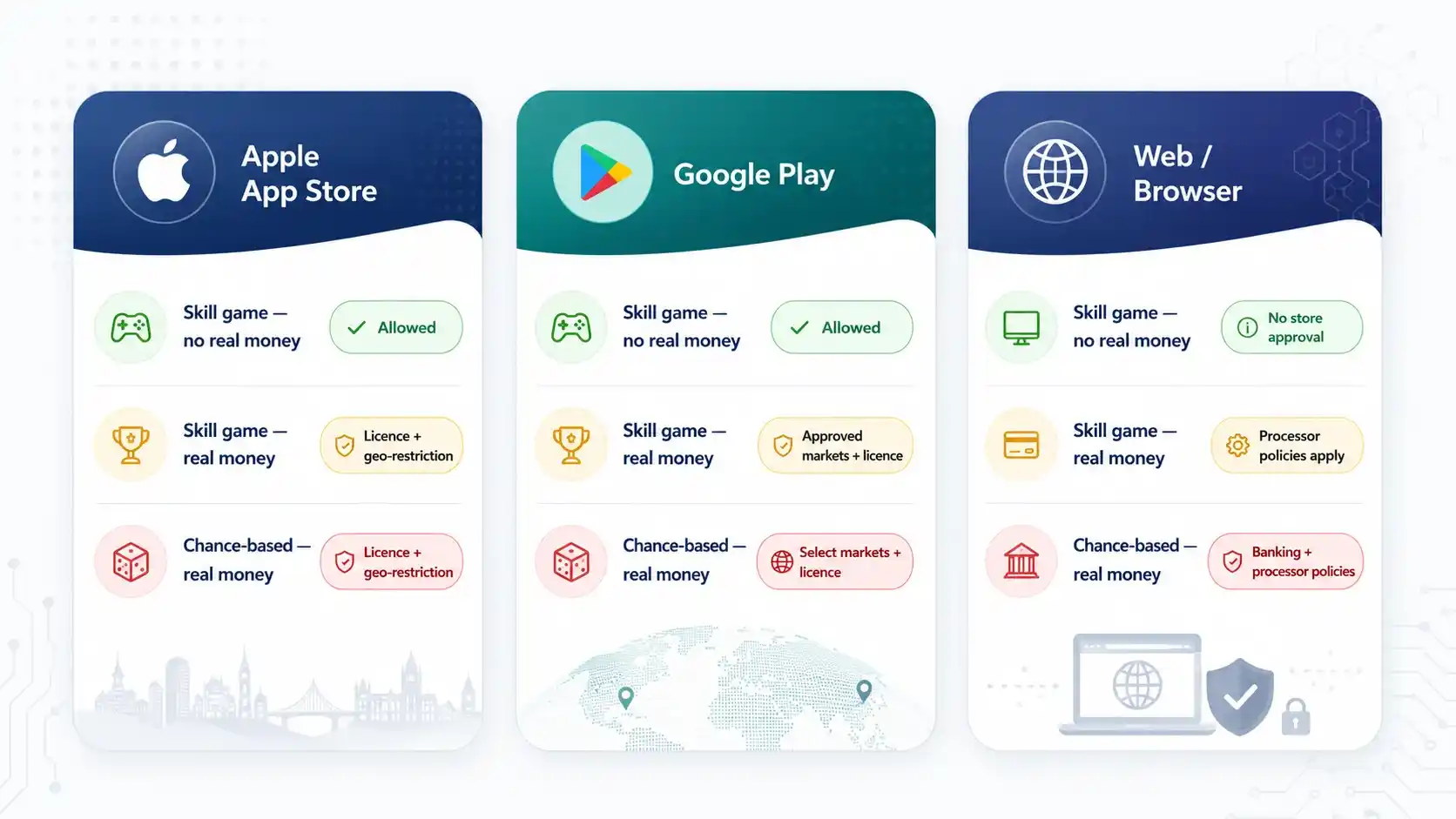
Apple requires real-money gaming apps to hold necessary licences and permissions, be geo-restricted to permitted locations, and be free on the App Store. Google's India DFS/Rummy pilot grace period ended on 22 January 2026 - apps that had real-money features must remove them or comply with updated policy. Confirm current store policy before submitting.
Launch Risk Estimator
Answer eight questions to get a launch risk assessment and the key factors that determine your regulatory exposure.
Skill vs Chance Launch Risk Estimator
Eight questions - about 2 minutes
How would you classify your game mechanic?
What is the monetization model?
Which markets are you targeting?
Does the game include RNG, shuffle, draw, loot box, or randomised reward mechanics?
Can users withdraw, sell, trade, or convert in-game rewards into real-world value?
Which platforms will the game launch on?
Will the product target minors, mixed-age audiences, or adults only?
Do you have legal counsel with gaming regulation experience in the target market?
Skill-Based vs Chance-Based: Launch Safety Factors
Skill-Based Games
Lower regulatory baseline when no real-money value is involved- Usually easier to launch when outcomes depend mainly on player decisions
- Free-to-play models often face fewer gambling compliance requirements
- App store and payment approval may be simpler without cash prizes
- Works well for e-sports, fantasy contests, tournaments, and social games
- Entry fees, cash prizes, or withdrawals can increase legal risk quickly
- Classification may still require market-specific legal review before launch
Chance-Based Games
Higher compliance baseline when real-money rewards are involved- Usually requires a gambling or gaming licence for real-money operation
- RNG, payout logic, game fairness, and audit logs may need certification
- App store access depends on licence status and geo-restriction controls
- Payments, advertising, KYC, AML, and responsible gaming rules are stricter
- Social casino models reduce risk only when rewards cannot be cashed out
- Clearer regulated path exists in licensed markets with mature frameworks
Monetization Models and Regulatory Risk
| Monetization model | Typical regulatory status | Risk level |
|---|---|---|
| Cosmetics, skins, and season passes | Generally unregulated regardless of game type | Low |
| Subscription for access or features | Generally unregulated | Low |
| Advertising (rewarded ads, interstitials) | Subject to standard advertising regulation - lighter than gambling rules | Low |
| Virtual chips / social casino | Lower risk in many markets where there is no cash-out, no monetary prize, and no conversion to real-world value | Low |
| Skill tournament entry fees (cash prizes) | Legal in some jurisdictions for skill games; regulated or prohibited in others | Medium |
| Sweepstakes / promotional prizes | Separate regulatory framework in most markets - requires careful legal structuring | Medium |
| Real-money wagering (skill games) | Regulated as gambling in many jurisdictions even for skill games | Medium–High |
| Real-money wagering (chance games) | Gambling in all regulated markets - licence required | High |
| Loot boxes with randomised real-value items | High regulatory scrutiny globally - Belgium has treated certain paid loot boxes as gambling; Netherlands and others take varying positions. Highest risk where items can be sold or converted to real-world value | High |
Common Launch Mistakes in Skill vs Chance Games
Assuming "skill game" is a universal legal exemption. The skill-game exemption exists in many jurisdictions but is not universal. Its application depends on how the predominance test is applied in each specific market. A legal opinion covering your primary market does not automatically extend to secondary markets.
Launching real-money prize competitions without jurisdiction-specific legal review. Tournament entry fees with cash prizes sit in a grey area in many markets. Some regulators treat them as gambling; others as skill competitions. Launching without jurisdiction-specific legal clearance is one of the most common risk triggers for enforcement action against skill-game operators.
Adding a chance element to an existing skill game without reassessing the classification. Adding a spin wheel, loot box, or randomised bonus to a skill game can shift the predominance assessment. A game that was classified as skill-based may no longer qualify once chance elements are introduced, even as secondary features.
Not distinguishing between social casino and real-money casino from day one. A social casino app (virtual chips, no cash-out) and a real-money casino app are fundamentally different products from a legal and technical standpoint. Teams that build both on the same codebase often find that the real-money product requires architectural changes to wallet, session, audit logging, and compliance systems that were not designed for it.
Treating loot boxes as low-risk cosmetics. Loot boxes with randomised rewards and real-world value face high regulatory scrutiny. Belgium has treated certain paid loot boxes as gambling, while the Netherlands and other jurisdictions have taken more nuanced or changing positions. The highest-risk designs are those where users pay for randomised items that can be sold, exchanged, withdrawn, or converted into real-world value.
Relying on payment processors to gate access instead of technical geo-restriction. Blocking payments from restricted jurisdictions is not a substitute for proper geo-restriction. Regulators expect technical measures - IP blocking, verification checks - not just payment-layer controls.
Questions to Answer Before Launch
- Has the game been assessed under the predominance test in each target jurisdiction?
- Is a gambling or gaming licence required in any target market?
- Have all real-money prize mechanics been reviewed by gaming law counsel?
- Are there any chance elements (loot boxes, randomised bonuses) that could affect classification?
- Has the app store eligibility been confirmed per platform and market?
- Are payment processors willing to process the intended monetization model?
- Is technical geo-restriction implemented - not just payment blocking?
- Is RNG certification required for any game mechanics in target markets?
- Are responsible gaming features (limits, self-exclusion) required?
- Is there a legal monitoring plan for regulatory changes post-launch?
- Has the advertising plan been reviewed for gambling marketing restrictions?
- Is KYC/AML required in any target market for the intended monetization?
- Can any reward, token, item, or credit be sold, transferred, withdrawn, or converted into money?
- Has the product been reviewed for age-gating, responsible gaming, and addiction-risk controls?
Choose Your Launch Path
Skill-first
- Outcome mainly driven by player decisions
- Monetization: ads, subscriptions, cosmetics, or non-cash rewards
- Lower app store and payment friction
- Still requires legal review if real-money prizes are involved
Chance-based (regulated)
- Requires gambling or gaming licence in target markets
- RNG certification, KYC, AML, geo-blocking, and responsible gaming required
- Large addressable market once fully licensed
- Compliance budget and legal counsel are prerequisites
- Casino-style gameplay without real-money stakes
- Faster app store approval path
- No cash-out, trading, or real-world value conversion
- Monetizes through chips, cosmetics, ads, and subscriptions
Building a skill-based or chance-based game?
SDLC Corp develops RNG-certified casino games, skill-game platforms, social casino products, and tournament engines across mobile, web, and operator platforms - with jurisdiction-specific legal and compliance requirements considered during the planning process.
Final Takeaway for Skill-Based and Chance-Based Game Launches
Skill-based and chance-based games follow different legal and compliance paths. Skill games may face fewer restrictions when there are no real-money rewards, while chance-based games usually require licensing, RNG certification, KYC, AML, geo-restriction, and responsible gaming controls.
The final risk depends on the game mechanic, target market, platform rules, and monetization model. Therefore, teams should confirm legal requirements, app store policies, payment support, and compliance needs before launching any real-money game.