Roulette game development typically costs $8K–$25K for a single-player MVP,$25K–$60K for real-money RNG, $40K–$85K for multiplayer, $60K–$130K+ for live dealer, and $80K–$180K+ for a regulated custom product.
However, the final budget depends on wheel variant, betting scope, wallet integration, multiplayer infrastructure, and certification requirements. For comparison, review the blackjack game development cost guide to see how roulette pricing differs from blackjack development.
How Much Does Roulette Game Development Cost?
| Roulette game type | Estimated range | Typical use |
|---|---|---|
| Basic single-player roulette | $8K – $25K | MVP, demo, casual game |
| Real-money RNG roulette | $25K – $60K | Online casino integration |
| Multiplayer roulette | $40K – $85K | Shared table, concurrent bettors |
| Live dealer roulette front-end | $60K – $130K+ | Live casino operators |
| Regulated custom roulette product | $80K – $180K+ | Licensed operators, full certification |
Final cost depends on wheel variants, bet types, platform count, wallet integration, multiplayer scope, and certification requirements. For full online casino platform budgets beyond a single roulette title, see the online casino software development cost guide.
What Drives Roulette Game Development Scope?
Five decisions define the build size: wheel variant, money model, betting scope, platform targets, and certification requirements. As a result, every roulette estimate should start with these choices before features are added.
Roulette Game Types and Cost Impact
| Type | What it adds to scope | Cost tier |
|---|---|---|
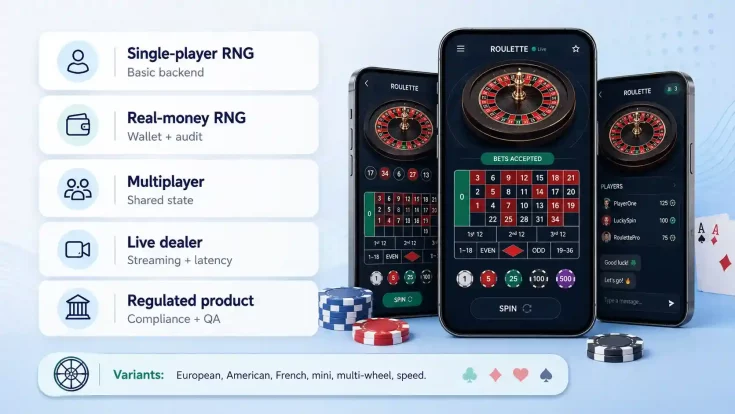
| Single-player RNG | Minimal backend, no wallet, standard QA coverage | $8K – $25K |
| Real-money RNG | Secure spin log, wallet integration, audit records, RNG docs | $25K – $60K |
| Multiplayer | Shared wheel state, concurrent bet handling, late-bet lockout, round sync | $40K – $85K |
| Live dealer | Streaming layer, bet timer, OCR/sensor integration, latency handling | $60K – $130K+ |
| Regulated product | Full certification, jurisdiction-specific compliance, multi-round audit QA | $80K – $180K+ |
Before choosing a roulette build model, compare custom vs white-label vs turnkey casino software. This helps decide whether a fully custom roulette product, white-label module, or turnkey casino solution is the better commercial fit.
Wheel variants in common scope include European, American, French, mini-roulette, multi-wheel, and speed roulette. Each variant with different rules requires its own payout model and math validation.
Roulette Scope Estimator: What Will Affect Your Cost?
Answer four questions to get a directional planning range and identify which decisions carry the most budget weight for your specific build.
Roulette Scope Estimator
Four questions — about 60 seconds
What format of roulette game are you planning?
Will real-money betting be required?
Which platforms need to be supported?
How many wheel variants and bet types are in scope?
Features That Change Roulette Development Cost
Not all features carry equal budget weight. These are the ones that meaningfully shift the number.
| Feature | Why it increases cost |
|---|---|
| Announced / call bets | Add racetrack UI, neighbour bets, sector mapping, and payout validation. |
| Multi-wheel roulette | Requires parallel wheel states, separate RNG streams, and result tracking. |
| Late bet lockout | Controls when bets close during multiplayer or live dealer rounds. |
| Hot/cold number statistics | Needs round history, session data, and simple UI reporting. |
| Autoplay | Adds repeat betting, stop limits, and responsible gaming checks. |
| Multiplayer shared table | Concurrent betting, round sync, and reconnection logic need a scalable casino game architecture. |
| Live dealer integration | Adds streaming, result detection, dealer workflow, and timer sync. |
| Wallet integration | Handles bet debit, win credit, voids, rollbacks, and transaction logs. |
| Configurable payout tables | Requires admin settings and separate math validation per rule set. |
| Dispute replay | Stores spin events so each round can be reconstructed later. |
Roulette Betting Logic, Payout Rules, and Development Cost
Betting logic is complex because each bet type needs its own placement, outcome, and payout rules. In addition, every new bet category expands QA and increases settlement risk before launch.
Inside bets
Straight up, split, street, corner, six-line, and trio bets. Each requires precise chip placement detection on the grid, correct coverage mapping to wheel numbers, and accurate payout ratios (35:1 down to 5:1).
Outside bets
Red/black, odd/even, low/high, columns, and dozens. Simpler outcome logic but must correctly handle zero and double-zero rules — especially French rules where La Partage returns half the stake on even-money bets when zero lands.
Announced and call bets
Voisins du Zéro, Tiers du Cylindre, Orphelins, and neighbour bets require a racetrack UI overlay, sector-to-number mapping, and multi-chip placement logic. These are significantly more complex than standard inside/outside bets and add dedicated development and QA effort.
| Bet category | Development complexity | Payout range |
|---|---|---|
| Outside bets | Low — binary outcome logic | 1:1 to 2:1 |
| Inside bets | Medium — grid mapping, multi-number coverage | 5:1 to 35:1 |
| Announced / call bets | High — racetrack UI, sector mapping, multi-chip | Varies by coverage |
| Neighbour bets | High — dynamic number adjacency, configurable range | Varies by coverage |
| Special bets (Finals, Full Completes) | High — custom multi-chip logic per number group | Varies by bet |
Payout calculation must be mathematically exact. A rounding error in multi-bet settlement accumulates over millions of spins and produces certification failures and player disputes. Validate against a full simulation run before any real-money deployment.
RNG Requirements for Digital Roulette
In RNG roulette, software determines the wheel outcome instead of a physical wheel. For real-money games, the result should be committed server-side so it is easier to audit, recover, and certify.
A real-money RNG roulette product requires:
- Unpredictable number-to-pocket mapping with secure seed handling
- Server-side spin resolution before result is sent to client
- Tamper-resistant spin logs with round ID, timestamp, and result
- Deterministic QA mode for simulation testing and audit replay
- Bet lockout enforcement server-side — not client-controlled
- Round recovery on session interruption
- RNG specification documentation for lab review and certification
Certification note: For real-money roulette, RNG design, fairness checks, audit logs, and compliance documentation should be reviewed against independent testing and certification requirements from authorities such as GLI iGaming testing and eCOGRA certification.
| Factor | RNG roulette | Live dealer roulette |
|---|---|---|
| Spin outcome | Software-generated via RNG | Physical wheel, sensor or OCR result detection |
| Round speed | Configurable — faster | Physical wheel pace, slower |
| Build cost | Lower | Higher — streaming and detection layer |
| QA focus | RNG audit, payout logic, bet lockout | Stream latency, result detection accuracy, timer sync |
| Best for | Scalable digital casino tables | Premium live casino experiences |
Roulette Math Model, RTP, and House Edge
The math model defines the theoretical return to player and house advantage for a specific wheel and rule configuration. It must be validated before any real-money deployment. For a detailed explanation of how RTP is set across casino games, see RTP in casino games.
How wheel variant affects house edge
| Wheel type | Zero pockets | House edge | Development note |
|---|---|---|---|
| European | 1 (single zero) | ~2.70% | Baseline — most common online variant |
| French (La Partage) | 1 (single zero) | ~1.35% on even bets | La Partage rule adds conditional payout logic for even-money bets |
| American | 2 (zero + double zero) | ~5.26% | Adds 00 pocket — changes number mapping, layout, and house edge model |
| Mini roulette | 1 (single zero) | ~7.69% | 13-number wheel — different payout table and bet grid |
What the math model must define
- Wheel pocket count and zero rule
- Payout ratios for every bet type
- La Partage / En Prison rule handling
- Expected house edge per bet category
- Neighbour and sector bet payout schedules
- Multi-bet simultaneous settlement order
Each wheel variant deployed requires its own math validation pass. An operator offering European and American roulette on the same platform needs two independent math sign-offs, not one.
Roulette Development Cost by Component
A basic single-player build stays lean because it avoids wallet logic, live streaming, multiplayer infrastructure, and certification documentation. However, real-money roulette needs these systems plus simulation testing across every bet type.
| Component | Cost range |
|---|---|
| Game design and UX | $4K – $14K |
| Wheel and spin engine | $6K – $20K |
| Betting logic and payout engine | $8K – $28K |
| RNG and result validation | $6K – $18K |
| Frontend development | $8K – $32K |
| Backend and session logic | $10K – $45K |
| Wallet integration | $8K – $35K |
| Multiplayer infrastructure | $15K – $50K |
| Admin panel | $6K – $22K |
| QA and simulation testing | $6K – $22K |
| Certification documentation | $8K – $40K+ |
What Increases the Budget?
- Real-money betting and wallet security
- Live dealer streaming and result detection
- Multiple wheel variants with separate math models
- Announced and call bets with racetrack UI
- Multiplayer shared table and round lifecycle
- Native iOS and/or Android builds
- KYC/AML integration
- Certification and lab-review documentation
- Custom 3D wheel animation pipeline
- Configurable payout tables per operator
- Platform API integration (existing casino)
- Multi-currency wallet support
Timeline by Roulette Game Type
| Project type | Timeline |
|---|---|
| Basic single-player MVP | 3 – 7 weeks |
| Single-variant real-money RNG roulette | 8 – 14 weeks |
| Multiplayer roulette | 12 – 22 weeks |
| Live dealer roulette front-end | 16 – 28+ weeks |
| Regulated custom roulette product | 20 – 36+ weeks |
Certification, integration approvals, payment onboarding, and licensing can extend the launch timeline. Therefore, plan these tasks alongside development, not after completion.
Common Roulette Development Mistakes
Treating the bet grid as a UI problem, not a logic problem. Chip placement, multi-number coverage, and simultaneous bet settlement are engineering decisions. Getting these wrong produces incorrect payouts.
Adding announced bets after the base game is built. Racetrack bets require a dedicated UI layer and number-mapping table. Retrofitting this after the main table is complete adds disproportionate rework.
Implementing bet lockout client-side. If the client controls when bets stop being accepted, players can exploit network latency to place bets after the outcome is determined. Lockout must be enforced server-side.
Not validating payout math per variant. European, French (La Partage), and American roulette each have different house edges. Deploying a variant without its own math validation creates unverified RTP that fails certification.
Ignoring round recovery for interrupted sessions. If a player disconnects during a spin, the round must complete server-side and the result must be retrievable. This needs to be designed in, not patched later.
Underestimating live dealer integration scope. Integrating with a live dealer system requires result detection accuracy (OCR or sensor), stream synchronisation, and dealer workflow tooling. This is not a UI skin on top of an RNG game.
Not planning RNG documentation early. Certification labs require RNG specification documents, test logs, and reproducible QA builds. Starting this documentation late delays launch by weeks.
Finalizing UI before confirming wheel variant scope. Adding a second wheel variant after UI sign-off requires layout changes, number grid updates, and new payout table integration. Lock variant scope before design begins.
Questions to Finalize Before Requesting a Quote
Have clear answers to these before briefing a team. They directly determine scope, architecture, timeline, and cost.
- Which wheel variant or variants are in scope?
- RNG, live dealer, or hybrid?
- Real-money, sweepstakes, or social casino?
- Which jurisdictions are targeted?
- Are announced and call bets required?
- What RTP and house edge are expected per variant?
- Is multiplayer shared table required at launch?
- Will it integrate with an existing casino platform?
- Who owns source code and game IP?
- Is RNG lab documentation required for certification?
- Are configurable payout tables needed by operator?
- How are spin results, bets, and payouts logged for audit?
When to Speak With a Roulette Development Team
Once you have confirmed wheel variant, bet scope, game format, money model, and platform targets, you have enough to brief a team and receive a meaningful estimate. Engaging before these are defined produces an estimate too broad to be useful for budgeting.
A specialist casino game development company can help validate roulette rules, RNG requirements, wallet integration, multiplayer infrastructure, compliance documentation, and launch planning before development starts.
Frequently Asked Questions About Roulette Game Development Cost
These answers cover the most common questions about roulette game development cost, timeline, RNG, live dealer integration, multiplayer scope, and real-money casino platform requirements.
Roulette game development cost usually ranges from $8,000 to $25,000 for a basic single-player game. A real-money RNG roulette game can cost $25,000 to $60,000, while multiplayer roulette may range from $40,000 to $85,000. Live dealer roulette or a regulated custom roulette product can cost $60,000 to $180,000+, depending on wallet integration, compliance, platform support, certification, and game complexity.
The biggest cost drivers are real-money betting, wallet integration, multiplayer infrastructure, live dealer streaming, RNG validation, announced bets, wheel variants, audit logs, KYC/AML integration, admin tools, and certification documentation. Each feature increases backend logic, QA effort, compliance work, and launch preparation.
Yes. RNG roulette is usually cheaper because the spin result is generated by software. Live dealer roulette costs more because it needs video streaming, dealer workflow tools, bet timers, result detection, latency handling, and real-time synchronization between the player interface and physical wheel outcome.
A basic single-player roulette game usually costs $8K–$25K. For real-money RNG roulette, the budget typically increases to $25K–$60K because wallet integration, RNG validation, and audit logs are required.
Multiplayer roulette usually ranges from $40K–$85K. Meanwhile, live dealer roulette can cost $60K–$130K+ because it needs streaming, dealer workflow, result detection, and latency handling.
European roulette uses a single-zero wheel and is usually the baseline version. French roulette adds rules such as La Partage or En Prison, which require extra payout handling for even-money bets. American roulette includes both zero and double-zero pockets, which changes the wheel mapping, betting table layout, payout validation, and house edge model.
A digital roulette game needs RNG when it does not use a physical live dealer wheel. For real-money roulette, the RNG should be server-side, secure, tamper-resistant, tested, and documented for certification review. This helps protect fairness and prevents players from manipulating results through the client side.
Yes. A roulette game can integrate with an existing casino platform through wallet APIs, payment gateways, KYC/AML providers, bonus engines, game aggregators, reporting systems, and admin dashboards. The API structure should be confirmed before backend development starts to avoid expensive rework.
A single-player RNG roulette game is usually the best MVP option because it has a lower cost, shorter timeline, and fewer compliance requirements. After validating the market, the product can be expanded with real-money wallets, multiplayer tables, native mobile apps, advanced bet types, or live dealer features.