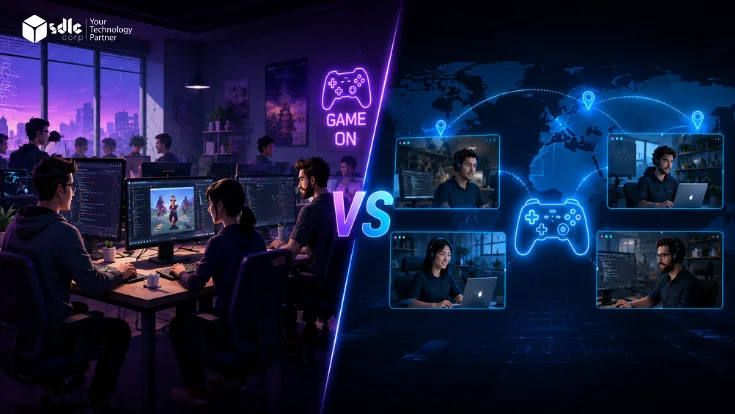
The choice between an in-house game team and an outsourced studio is not primarily about cost it is about control, capability, timeline, and what kind of game company you are building. Both models produce successful games. The question is which model fits your current project, your team's strengths, and your long-term direction.
In-house gives you control, institutional knowledge, and a team that deepens over time at a higher fixed cost. Outsourced studios give you speed, specialist skills, and variable cost at the price of coordination overhead and less direct control. Many commercial game projects work best with a hybrid model: a small internal team for direction and core systems, supported by outsourced specialists for art, QA, audio, localization, or porting.
Which Model Fits Your Project?
Answer seven questions to get a tailored model recommendation and the key factors driving it.
In-House vs Outsourced Recommender
Seven questions about 90 seconds
How many games are you planning to build?
What is your current team situation?
How important is IP ownership and codebase control?
What is your launch timeline?
What is your budget model?
How clearly defined is the project scope?
Will the game need live operations after launch?
In-House vs Outsourced Game: What Does Each Model Actually Cost?
Cost comparisons between in-house and outsourced models are rarely straightforward. In-house cost is ongoing and predictable; outsourced cost is project-variable. The break-even point depends on team size, location, and whether you are building one game or running a studio. For a detailed budget breakdown by game type, platform, and complexity, see the game development cost guide.
In-House Team
Annual cost per person (US market)Outsourced Studio
Typical studio / specialist hourly rangesHybrid Model
Core in-house + outsourced disciplinesThese are planning ranges for blended game development, specialist engineering, production, and studio engagements. Asset-only art, QA, or audio work may price differently. In-house costs are ongoing regardless of project status; outsourced costs stop when the project ends.
What Actually Drives the Decision?
| Decision factor | Favours in-house | Favours outsourcing |
|---|---|---|
| Budget model | Predictable ongoing cost justified by multi-game pipeline | Variable cost better for a single game or uncertain scope |
| Timeline pressure | Team already assembled and aligned | Studios can start faster no hiring cycle |
| IP and trade secrets | Full control no external access to core systems | Requires strong contracts and NDA discipline |
| Specialist skills | Hard to justify a full-time hire for a niche discipline | Natural for VFX, audio, QA, porting, and localization |
| Long-term knowledge | Team builds deep product and codebase knowledge over time | Knowledge transfer risk when contract ends |
| Quality control | Daily visibility into work and decisions | Depends on studio fit, brief quality, and review discipline |
| Scaling | Slow hiring takes weeks to months | Fast most studios can scale by discipline |
| Post-launch operations | Permanent team is more reactive for live-service updates | Harder to manage ongoing work through external engagement |
Platform choice also affects team planning. For example, Unity platform support covers mobile, desktop, console, XR, and web game development, which can change the skills needed in-house or through outsourcing.
In-House and Outsourced: Detailed Comparison
In-House Team
- Full ownership of IP, code, and creative direction
- Institutional knowledge compounds over multiple projects
- Daily collaboration faster iteration and decision-making
- Team alignment around a single game vision
- Better for live-service games requiring ongoing updates
- Easier to protect trade secrets and proprietary systems
- High fixed cost regardless of project workload
- Hiring takes weeks to months no fast scaling
- Gaps in specialist skills require additional hires
- Retention risk losing a senior developer mid-project is disruptive
- Expensive to maintain during gaps between projects
Outsourced Studio
- Variable cost pay for work, not headcount
- Access to specialist skills without permanent hire
- Faster to start no hiring cycle required
- Lower-cost regional talent access
- Easier to scale up or down by discipline
- Good for defined-scope deliverables with clear specs
- Coordination overhead briefs, reviews, revisions
- Output quality depends on studio fit, brief quality, and review discipline
- Less control over daily decisions and priorities
- Knowledge leaves when the contract ends
- Time-zone differences can slow communication loops
- IP protection requires strong contracts confirm with legal counsel
IP and work-for-hire rules vary by jurisdiction. Treat this comparison as a planning guide, not legal advice. Confirm IP assignment, source-code ownership, and reuse rights with legal counsel before signing any outsourcing agreement.
Many studios use external game development to meet production demand, scale skills, and support tight deadlines without adding permanent headcount.
The Hybrid Model: What Most Studios Actually Do
The choice is rarely binary. Most commercially successful studios use a hybrid: a small permanent in-house team owns product direction, engine decisions, and player-facing systems, while specific disciplines are outsourced based on project need. This approach is common across indie studios, mid-tier developers, and larger publishers alike. For art-specific outsourcing considerations, For art-specific outsourcing support, explore SDLC Corp’s 2D game development services and 3D game development services . guide.
Keep in-house
- Game design and core loop development
- Engine and backend architecture
- Live-service and post-launch operations
- Game director and producer roles
- Player-data, analytics, and monetization systems
- Security-sensitive and wallet-critical code
Good to outsource
- Environment and character art
- 3D modeling, texturing, and animation
- QA and device-compatibility testing
- Audio production and sound design
- Localization and translation
- Console porting and platform certification
- UI/UX design and icon production
- Marketing creative and trailer production
Disciplines best suited to outsourcing share a common property: they can be specified with a clear brief and reviewed against objective quality criteria without deep knowledge of the game's codebase. Art, QA, audio, and localization all meet this test. Core gameplay, engine, and monetization systems do not.
Which Model Works Best by Scenario
Building a single mobile game MVP with limited budget. Outsourcing defines scope, controls cost, and avoids the overhead of hiring a full-time team for a project that may not warrant it.
Running a live-service game with ongoing feature updates. Constant new features, patches, balance updates, and seasonal content make a permanent in-house team more cost-effective and far more reactive.
Needing specialist 3D art your team cannot produce. Outsourcing art to a specialist studio is standard practice across the industry, including at major studios. Define style guide, poly count targets, and revision rounds in the brief.
Building your first commercial game with a small founding team. Keep core mechanics and backend in-house. Outsource 3D art, QA, audio, and disciplines your founding team does not cover.
Developing proprietary engine features or security-critical systems. Wallet logic, anti-cheat, authentication, and core game state should stay in-house. The lower cost of outsourcing may not justify the IP, security, or continuity risk.
Porting an existing game to a new platform. Console certification and platform-specific optimization are well-defined, deliverable-based tasks that specialist porting studios handle efficiently.
Scaling production beyond your current team's capacity. Use outsourced studios for production tasks art, QA regression, localization while your in-house team focuses on design, direction, and integration.
Common Mistakes When Choosing Between Models
Treating outsourcing as a cost-cutting shortcut rather than a strategic partnership. Studios that treat outsourcing as a way to pay less for the same output end up with misaligned expectations, poor quality, and expensive rework. Outsourcing works when the brief is specific, the relationship is collaborative, and the review process is structured.
Outsourcing core IP or security-sensitive code. Wallet logic, anti-cheat systems, and proprietary game engine code should not be outsourced without strong legal frameworks and deep trust. The lower cost may not justify the IP, security, or continuity risk.
Building a full in-house team for a single game. A team of eight hired for one mobile game will be overstaffed between milestones and expensive to dissolve. In-house teams are most justified when there is a sustained pipeline of work.
Selecting an outsourced studio based on rate rather than portfolio match. The cheapest hourly rate is meaningless if the studio has no experience with your game type, engine, or platform. Review portfolio depth in your specific genre before hourly rates.
Not planning for knowledge transfer when a contract ends. When a studio finishes, the developers who know the codebase and undocumented edge cases leave with them. Require structured documentation and handover sprints as contract deliverables.
Underestimating the management cost of outsourcing. Outsourcing shifts management overhead, not eliminates it. Writing clear briefs, reviewing deliverables, and maintaining quality across an external team is a real job. Without a dedicated internal owner, outsourced quality slips.
Choose In-House, Outsource, or Hybrid
- You are building multiple games or a live-service product
- Core gameplay, backend, or monetization logic is proprietary IP
- You can sustain long-term payroll and manage retention
- You need daily creative and technical control
- Post-launch operations require a permanent, reactive team
- You are building one defined-scope game or MVP
- You need specialist art, QA, audio, porting, or localization
- You need to start quickly without a hiring cycle
- You have a clear brief and an internal project owner
- Budget certainty is more important than team permanence
- You have a small internal team but missing key disciplines
- You want to protect core IP while controlling cost
- You need to scale production without permanent hiring
- You are validating a game before building a full studio
- Some work is easily specified; other work requires deep context
If your game will launch on app stores, review platform rules early. The Google Play Developer Policy Center explains policy requirements for publishing apps and games safely.
Questions to Answer Before Choosing a Model
- Is this a single game or the start of a multi-game studio?
- How much of the codebase and design is proprietary IP?
- Does the team have all required disciplines, or are there gaps?
- What is the launch timeline, and can hiring fit inside it?
- Is the project scope defined clearly enough to brief an external studio?
- What happens to the team between projects?
- Who internally will own the outsourcing relationship?
- Are there disciplines art, QA, audio that can be cleanly separated?
- What legal frameworks cover IP, NDAs, and work-for-hire?
- Is live operations and ongoing player support in the plan?
- How risk-tolerant is the organization to coordination overhead delays?
- Has the model worked for similar studios making similar games at a similar scale?
Still unsure which model fits your game?
SDLC Corp can help compare in-house, outsourced, and hybrid options based on your scope, budget, platform, and timeline.
Last reviewed and references
Last reviewed: May 2026
Salary ranges: US developer salary ranges reflect BLS Occupational Outlook Handbook data for software developers (May 2024 median: $133,080). Benefits overhead of 20–35% reflects BLS Employer Costs for Employee Compensation data (December 2025).
Hourly ranges: Planning ranges for blended studio / specialist engineering engagements. Asset-only art, QA, or audio outsourcing may price lower.
IP note: IP and work-for-hire rules vary by jurisdiction. Confirm IP assignment, source-code ownership, and reuse rights with legal counsel. This article is a planning guide, not legal advice.
Frequently Asked Questions
For a single project, outsourcing is usually cheaper because you pay for work rather than ongoing headcount. For a studio building multiple games, an in-house team typically reaches cost parity at 18–36 months depending on team size and location, after which it is often more cost-effective than repeated outsourcing for the same disciplines.
IP ownership is determined by the contract, not by default law. Without a work-for-hire agreement or IP assignment clause, the creating studio may retain rights to code or art they produce. Always confirm IP assignment, source code delivery, and usage rights before work begins not at the end of the project.
Disciplines that can be specified with a clear brief and reviewed against objective criteria outsource well: environment and character art, 3D modeling, QA and device testing, audio production, localization, UI/UX design, console porting, and marketing creative. Core gameplay code, backend systems, anti-cheat, and monetization logic are harder to outsource safely.
Quality in an outsourced engagement is directly proportional to brief quality. Define deliverables clearly: style guide, technical specs, revision rounds, file format requirements, and acceptance criteria. Assign an internal owner who reviews output and manages feedback. Build milestone reviews into the contract.
The biggest risk is committing to a year of payroll before the game concept is validated at scale. A common mitigation is to validate the core loop with a small prototyping team or outsourced engagement before scaling to a full in-house studio. The second major risk is retention: losing a senior developer or technical lead mid-project can disrupt timelines and knowledge continuity significantly.