Open-World Crime · Narrative · Online Economy · UE5
Grand Theft Auto V has generated over $8 billion in revenue — more than any entertainment product in history. But This genre is not battle royale, not a mobile game, and not a simple shooter. It is an open-world city simulation with a living population of NPCs, a full vehicle physics system covering cars, boats, and aircraft, a narrative campaign with AAA cinematics, and a persistent online world with its own economy, properties, and businesses.
If you want to develop a game like GTA, you are building one of the most technically complex products in the games industry. This guide covers the architecture, systems, team, and realistic costs — with the precision a serious studio needs before committing budget.
How this differs from our battle royale guides: Our Free Fire guide covers 50-player mobile battle royale in Unity. Our PUBG guide covers 100-player PC battle royale in Unreal Engine. A an open-world crime sandbox is architecturally different from both — it is a persistent open-world simulation, not a match-based competition. Different engine priorities, different NPC systems, different server architecture, different monetisation model.
On cost: Figures of "$20,000–$100,000" for this type of game are for a simple open-world prototype — not a production game. GTA V cost Rockstar Games approximately $265 million to develop. A serious indie open-world action game starts at $300,000–$800,000. We cover the real breakdown in Step 8.
1. What Makes an Open-World Crime Game Distinct
 Step 1 — Product Definition
The core product is not the shooting mechanics or the missions — it is the city as a living world. NPCs follow daily routines, react to crime, call police, flee explosions. Traffic obeys signals. Radio stations play licensed music. Shops open and close. This ambient simulation is what separates this genre from games that superficially resemble it.
Building this requires systems that battle royale games simply do not need:
- World simulation engine: Hundreds of NPCs with independent AI routines running simultaneously. Pedestrians walking to work, drivers following routes, shopkeepers running businesses. Not scripted — simulated.
- Wanted level / crime system: The city reacts to player crime. Witnesses call police. Police escalate response based on severity (1–5 stars). Military responds at extreme levels. This is a reactive reputation system, not a simple trigger.
- Vehicle physics engine: Cars, motorcycles, boats, helicopters, planes — each with distinct handling physics. Damage modelling (windows break, panels deform, tyres blow). The vehicle physics system is a dedicated system, not a generic physics engine.
- Mission scripting system: GTA's 69 story missions are each scripted in a proprietary event system. Building an equivalent requires a flexible mission framework that can trigger cutscenes, spawn vehicles, modify world state, and track player progress independently per mission.
- An online persistent world equivalent: A persistent online world where up to 30 players share one server instance, own properties, run businesses, and interact with the persistent economy. This is a separate product from the single-player game in terms of backend architecture.
2. Core Systems You Must Build You Must Build
Step 2 — Feature SetEach feature below is a distinct engineering system — not a checkbox. Building all seven simultaneously is the primary reason open-world games take 3–5 years and large teams.

Player Features
- Character customisation: Appearance, clothing, tattoos, hairstyle. Persistent across sessions in the online mode.
- Skill system: The game uses passive skill progression — drive enough and your driving skill improves. Organic progression without explicit XP bars.
- Inventory management: Weapons, consumables, phone, map, money. Context-sensitive weapon wheel (radial selector) is The primary inventory UI pattern.
- Health and armour: Regenerating health to a floor (not full regen), armour as ablative protection. Medical system for critical injuries.

Gameplay Mechanics
- Cover-based shooting: Snap-to-cover with blind fire and aiming over/around cover. Third-person and optional first-person.
- Driving physics: Each vehicle class (sports, muscle, SUV, motorcycle) has distinct handling. Tyre grip simulation, weight transfer, crash physics.
- Wanted system: 1–5 star escalation. Line-of-sight detection (can break pursuit by hiding). Police AI pursues, blocks routes, calls helicopter at 3+ stars.
- Free-roam activities: Side missions, random events, collectibles, property purchases. The open world must justify exploration beyond the main story.
Multiplayer / Online World
- Persistent session: Up to 30 players share one city instance. Players can cooperate on missions or interact freely.
- Property ownership: Apartments, garages, businesses. Each property stores vehicles, serves as a spawn point, and may generate income.
- Session continuity: Player progress persists between sessions — money, properties, vehicles, character appearance all saved server-side.
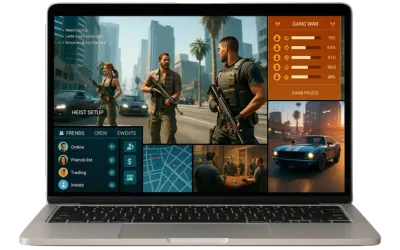
- Cooperative heists: Multi-player structured missions with distinct roles (driver, hacker, gunman). Require matchmaking, session lobby, and coordinated server-side scripting.

AI and NPC Behaviour
- Behaviour trees: NPCs follow daily routines — commuting, shopping, socialising. Each routine is a behaviour tree with condition triggers.
- Police AI: Response escalation logic, pursuit behaviour, roadblock placement, helicopter coordination. The police system is a self-contained AI subsystem with multiple agent types.
- Crowd simulation: Hundreds of pedestrians visible simultaneously, each with reactive animation. Flee from gunfire, scatter from explosions, react to player's wanted level.
- Traffic AI: Vehicles follow road rules, pull over for police, react to crashes. Traffic density scales with area (downtown vs rural).

Economy and Commerce
- In-world economy: Shops, restaurants, car dealerships, strip clubs — all purchasable or interactable. Some generate income for player-owned businesses.
- Stock market (single-player): The stock market system reacts to mission outcomes and player actions. A dedicated economy simulation system.
- Online currency: GTA Online uses Shark Cards (real-money currency) and in-game cash. Two-currency model (earned cash + premium currency) is the monetisation foundation.
- Vehicle market: 600+ purchasable vehicles with tiered pricing. Vehicle modifications (performance, cosmetic) at in-world shops.

Immersion and Realism
- Dynamic weather: Rain, fog, thunderstorms, heat haze. Weather affects driving physics (wet road = reduced traction), NPC behaviour, and visibility.
- Day/night cycle: Time progression affects which NPCs are active, which businesses are open, and ambient lighting. Can be fast-forwarded by sleeping.
- Radio stations: 17 in GTA V. Licensed music with DJ commentary. Radio continues when entering/exiting vehicles. One of the most culturally distinctiveive features.
- Phone system: In-game smartphone for accessing missions, contacts, apps, and the internet. An in-game browser with fake websites is a substantial content development effort.

Modularity and Live Service
- DLC architecture: The game has received free DLC updates for 11+ years. The content system must support adding new vehicles, weapons, missions, and properties without engine rebuilds.
- Seasonal events: Halloween, Christmas, and seasonal updates change world appearance and add temporary content. Requires a content flag system in the live ops backend.
- Modding support (PC): The modding community extends the game's life significantly. On PC, a published modding API increases community engagement and press coverage.
3. Architecture for an Open-World City
Step 3 — ArchitectureThe central architectcentral challenge of an open-world game is the city as a streaming environment. Los Santos (The game city) covers approximately 49km² of playable area. No hardware can load this entirely into memory — the engine must stream terrain, buildings, and NPC data as the player moves through the world.
- World streaming: Divide the city into cells (UE5 World Partition does this automatically). Load adjacent cells as the player moves, unload distant cells. Streaming must be seamless — no loading screens mid-world.
- Physics server: Vehicle physics, ragdoll physics, destructible objects — all require a dedicated physics thread. NVIDIA PhysX or Chaos Physics (UE5) handles this. Separating physics from rendering prevents frame rate hitches when complex collisions occur.
- NPC simulation layer: A separate simulation thread manages NPC schedules and routines for the entire city, including NPCs not currently visible. When an NPC enters the player's visible range, they are "instantiated" — given a physical representation consistent with their simulated state.
- Online session server: For multiplayer, a dedicated server manages the shared world state — player positions, vehicle ownership, property states, mission progress. Unlike battle royale, this server must run continuously (the world persists when players are offline).
- Narrative event system: Missions trigger world events: traffic blocked, police spawned, cutscene loaded, NPC spawned at location. A scriptable event system (separate from gameplay code) allows mission designers to author content without engineering involvement.
4. Technology Stack
Step 4 — Tech Stack5. Team Structure
Step 5 — TeamRockstar Games employed over 1,000 people on GTA V. A serious indie open-world project needs a minimum of 15–25 specialists — more than a battle royale because the content surface area is vastly larger.




6. Development Process
Step 6 — Process7. Monetisation — How the Online Mode Makes Money
Step 7 — RevenueThe online mode generates approximately $500M–$800M per year for Take-Two Interactive — 11 years after launch. The monetisation model is the two-currency system: earned in-game cash (grinded through missions) and Shark Cards (purchased with real money). No pay-to-win — everything purchasable with real money is also earnable through play, just faster.


8. Real Cost to Develop a Game Like GTA
Step 8 — InvestmentThese figures are for production-quality games. Open-world games are the most expensive game category to develop because every system (AI, physics, vehicles, streaming, narrative) must work simultaneously and consistently across an enormous explorable space.
| Scope | What's Included | Investment | Timeline |
|---|---|---|---|
| Vertical Slice / Proof of Concept | Single district (not full city), driving + combat, basic NPC reactions, no online mode, no economy | $80,000 – $150,000 | 16–24 weeks |
| Indie Open-World MVP | Full small city, story missions (10–15), vehicle roster (20–30), wanted system, basic online (10 players), cosmetic shop | $300,000 – $600,000 | 36–60 weeks |
| Mid-Scale Commercial Launch | Large city, 30+ story missions, 60+ vehicles, full NPC simulation, online with property system, DLC architecture, PC + console | $600,000 – $1,500,000 | 60–90 weeks |
| Full AAA Production Scale | Original cost $265M over 5 years with 1,000+ staff. GTA VI is estimated at $1B+. These figures are industry context — not targets for a new studio. | $10,000,000+ | 3–5 years |
Ongoing live ops: The update cadence has run for 11 years. A live open-world game requires a permanent team of 8–15 people for content updates, balance patches, anti-cheat, and server maintenance. Budget live ops at 30–40% of initial development cost per year.
Pre-Development Checklist
- Define city size and mission count in your GDD before starting — these determine server infrastructure, streaming architecture, and team size simultaneously
- Build core systems (vehicle physics, NPC AI, world streaming) before authoring any story missions — missions authored before core systems are stable will need to be rebuilt
- Design the online economy from day one — retrofitting an online mode into a single-player open-world is a near-total backend rewrite
- Use UE5 World Partition for open-world streaming — manually managing level streaming at city scale is a solved problem; don't reinvent it
- Hire a dedicated AI engineer, not a programmer who "can do AI" — NPC simulation quality is the primary difference between an immersive open world and one that feels hollow
- Plan anti-cheat for the economy specifically — The online economy's most persistent problem is duplication exploits and chargebacks, not combat cheating
- If you want a mobile battle royale instead, see our Free Fire guide — the architecture, cost, and team are completely different
Frequently Asked Questions
How do I develop an open-world game like GTA?
Use Unreal Engine 5 with World Partition for open-world streaming. Build core systems first: vehicle physics, NPC AI with behaviour trees, wanted level logic, and the mission scripting framework. Only after these systems are stable should you author story content. For an online mode, design a persistent session server architecture before starting multiplayer development. See our Unreal Engine development services — SDLC Corp has shipped open-world multiplayer titles in UE5.
How much does it cost to develop a game like GTA?
A vertical slice prototype costs $80,000–$150,000. An indie open-world MVP with a full small city, story missions, and basic online mode runs $300,000–$600,000 over 36–60 weeks. A mid-scale commercial launch is $600,000–$1,500,000. Rockstar spent $265 million on development. Figures of "$20,000–$100,000" describe a simple open-world demo — not a production game with NPC simulation, vehicle physics, and an online economy.
Which engine is best for a open-world crime game?
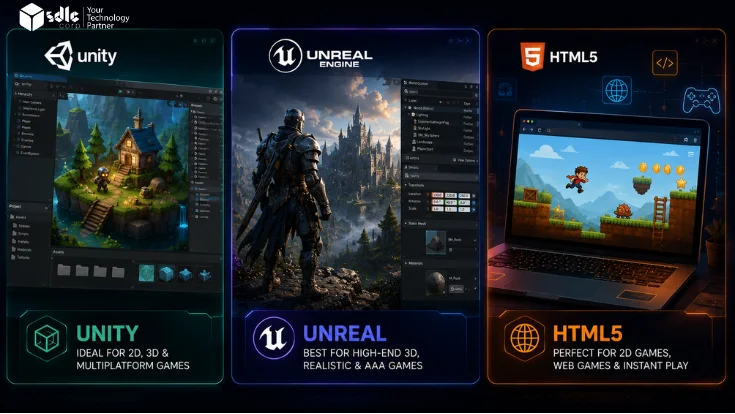
Unreal Engine 5 is the strongest choice. World Partition handles open-world level streaming automatically, Nanite provides high-detail city environments without manual LOD management, Lumen delivers dynamic lighting across large distances, and Chaos Physics handles vehicle simulation. GTA V uses Rockstar's proprietary RAGE engine — UE5 is the best publicly available alternative for this type of game.
How is a open-world game different from a battle royale?
Fundamentally different products requiring different teams and budgets. This genre is a persistent open-world simulation with NPC AI, vehicle physics, narrative missions, and an online economy — the world always exists, whether players are in it or not. A battle royale is a match-based competition where the world is loaded for each session and cleared after. It requires city streaming architecture, NPC simulation engines, and economy servers that battle royale games simply do not need. See our Free Fire guide and PUBG guide for battle royale development specifically.
How long does it take to develop a GTA-style game?
A vertical slice: 16–24 weeks. An indie open-world MVP: 36–60 weeks. A mid-scale commercial launch: 60–90 weeks (over a year). The game took 5 years with 1,000+ people. Even a modest indie open-world game requires 18–24 months minimum for a team of 15–20 — open-world content creation takes significantly longer than equivalent battle royale content because every area of the city must be populated, lit, and tested.