

Introduction
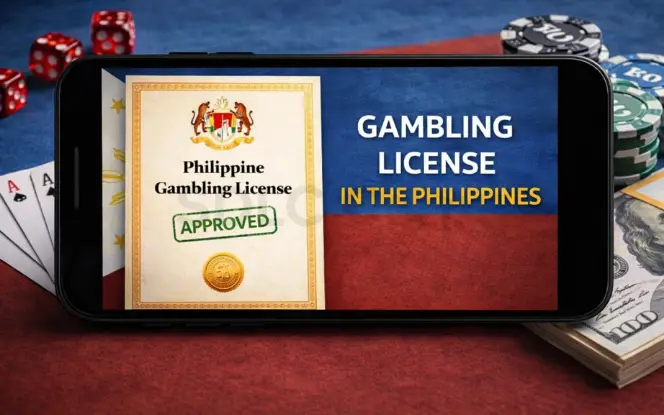
If you want to run a legal gambling business in the Philippines, start with one question: what exactly are you planning to offer? The right path is different for a land-based casino, an eCasino, a sports betting product, a remote play setup, or a B2B service.
That is why many older guides miss the mark. They treat the market like one simple offshore license. It is not that simple now. The safer approach is to work from current PAGCOR categories, current fees, and current compliance rules.
The three things that shape the application
A strong application usually has three parts in place early. Regulators do not only review paperwork. They also look at your controls, your reporting setup, your player checks, and whether the product fits the category you want.
- a business model that fits a current PAGCOR pathway
- clear ownership and funding records
- a platform setup that can pass technical and compliance review
Why many older guides are now outdated
A lot of pages still use old assumptions. That creates bad expectations before the filing even starts. A better page should help you choose the right category, budget for the real cost, and avoid building the plan around legacy offshore playbooks.
What changed in the market
| Outdated idea | Better way to look at it |
|---|---|
| One Philippines gambling license fits every business | The right approval depends on the exact product, the operating model, and the role you play. |
| Old offshore playbooks are enough | Current PAGCOR frameworks matter more than older POGO-era advice. |
| Fees are simple | Fees, renewals, and cash deposits vary a lot by category. |
| Approval ends the job | Compliance work continues after approval. |
The practical takeaway is simple: do not build your plan around old POGO assumptions. Start with the current PAGCOR path that matches your model.
Who regulates gambling in the Philippines
For most operators, PAGCOR is the main regulator to understand. It publishes the key frameworks, fee schedules, application materials, and lists of regulated entities. Local permits may still matter for the company, the office, or the venue, but they do not replace gaming approval.
| Authority | What it means in practice |
|---|---|
| PAGCOR | Main regulator for licensed casino activity, electronic gaming categories, remote-play rules, accreditations, and related fee schedules. |
| Local government and company registries | Still relevant for incorporation, tax registration, office or venue setup, and local business permissions. |
| Legacy offshore references | Useful only as historical context. They should not be treated as the default route for a new application today. |
Which license path fits your model
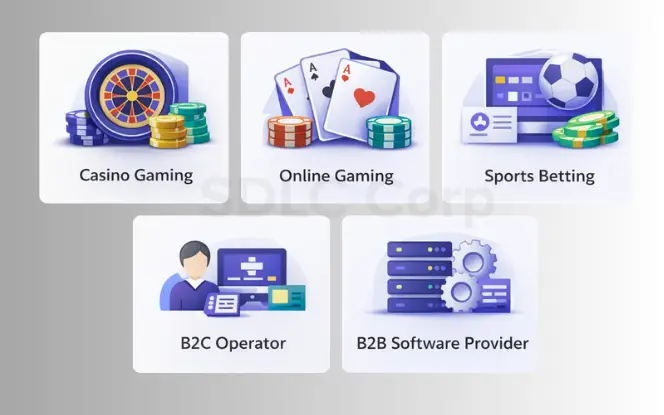
The Philippines does not offer one generic approval for every gambling business. Your path depends on what you offer and what role you play.
- Land-based casino operations: for a physical casino in an approved location.
- Electronic gaming and venue-linked online play: covers categories such as eBingo, eCasino, sports betting, specialty games, online poker, and numeric games.
- System-level or technical operating roles: for businesses running the system, platform, or core gaming operations.
- B2B and support services: for game content providers, aggregators, payment support, customer support, KYC systems, and testing labs.
- Equipment or studio permissions: where gaming equipment, paraphernalia, or a live gaming studio setup needs separate approval.
If sports wagering is part of your plan, review our guide to sports betting laws in the Philippines.
What regulators usually want to see
The details change by category, but the core checks stay similar.
- Corporate setup: a proper legal entity, a clear ownership structure, and clean records for directors, shareholders, and key officers.
- Financial proof: enough capital, banking readiness, and a funding story that makes sense.
- Technical readiness: player registration, KYC, audit logs, reporting, security, and access controls.
- Compliance controls: working policies for AML, KYC, responsible gaming, incident handling, and data security.
If you are still scoping the build side, your iGaming platform setup should be planned around compliance from the start.
Documents you will usually need
Most applications need a mix of legal, financial, technical, and compliance records.
- company registration papers
- articles and by-laws
- tax and local business registrations
- director and shareholder details
- proof of funds or audited financials
- business plan and operating model
- AML, KYC, and responsible gaming policies
- platform and security documents
- hosting and disaster recovery details
- supplier or testing certifications where needed
Step-by-step licensing process
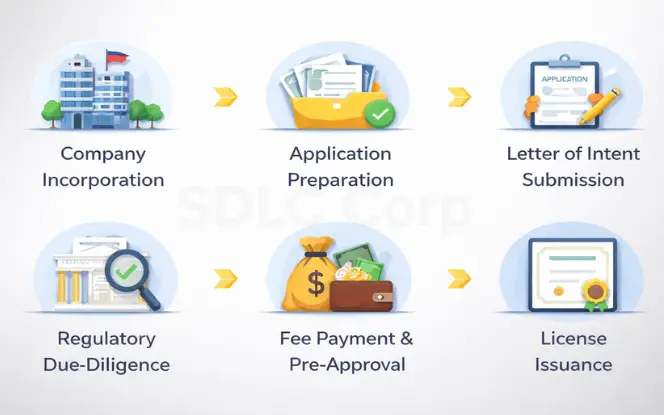
A clean application usually moves through the same broad stages: define the model, set up the entity, match the business to the right PAGCOR path, submit a complete package, and prepare for due diligence and technical review.
Step 1: Define the model before you file
Be specific. Are you launching an eCasino, a sports betting product, a venue-linked online service, a content business, or a support service? This choice shapes the rest of the application.
Step 2: Set up the legal structure
Once the model is clear, form the company, complete the tax setup, arrange the office or operating base that fits the category, and prepare the basic governance structure.
Step 3: Match the model to the right PAGCOR pathway
This step matters a lot. A good filing shows exactly how the product fits the current category, how players will be served, and how the operation will be monitored. It should not rely on vague claims or old offshore templates.
Step 4: Build the application pack
Your legal, financial, technical, and compliance documents should tell one clear story. Gaps between those documents usually lead to follow-up questions.
Step 5: Submit the application and pay the fees
The fee level depends on the category. Some filings are modest. Others involve large accreditation fees and large cash deposits. Always check the official schedule before you file.
Step 6: Prepare for due diligence and technical review
Regulators may review:
- ownership and key officers
- source of funds
- system security
- RNG or fairness controls where needed
- payments and reporting
- player-protection tools
A clean document pack helps, but the platform review still needs to stand on its own.
PAGCOR fees and cash deposits (official snapshot – Oct 2025)
Fees are one of the most misunderstood parts of this topic. The gap between a lighter B2B approval and a system-level role can be very wide, so there is no single “Philippines gambling license cost” that fits every case.
Examples below are based on the PAGCOR schedule dated 02 October 2025. Confirm the current amount for your exact category before filing.
Gaming venue operator
| Category | Application fee | Renewal fee | Cash deposit |
|---|---|---|---|
| Traditional Bingo / Electronic Bingo / Electronic Casino | PHP 300,000 per offering | PHP 200,000 per offering | PHP 500,000 to PHP 1,000,000 depending on the game |
| Sports Betting / Specialty Games / Numeric Games / Online Poker | PHP 200,000 per offering | PHP 200,000 per offering | PHP 100,000 to PHP 200,000 depending on the game |
Gaming system administrator and B2B
| Category | Application or accreditation fee | Renewal fee | Cash deposit |
|---|---|---|---|
| Gaming System Administrator | PHP 5,000,000 per game offering | See current PAGCOR schedule | PHP 25,000,000 for one offering / PHP 50,000,000 for two or more |
| B2B Game Content Provider | PHP 250,000 per offering | PHP 250,000 per offering | PHP 1,000,000 |
| B2B Support Service Provider types | PHP 250,000 per service type | PHP 250,000 per service type | PHP 1,000,000 per type |
| Independent Game Testing Laboratory SSP | PHP 500,000 | PHP 500,000 | Check the applicable classification |
Permit to hold
| Category | Application fee | Renewal fee | Other published fees |
|---|---|---|---|
| Gaming equipment and gaming paraphernalia | PHP 1,000,000 | PHP 1,000,000 | Additional live studio set-up: PHP 1,000,000 / Transfer of existing set-up: PHP 250,000 / Reprinting or reissuance: PHP 20,000 |
Compliance after approval
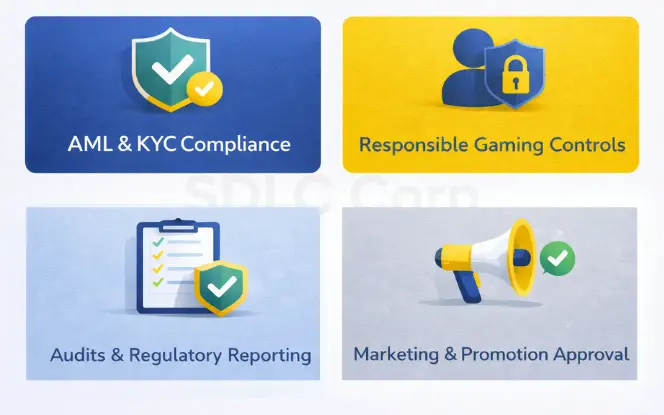
Approval is the start of the ongoing work, not the end.
- KYC and transaction monitoring
- player-protection tools
- regular reporting
- audit readiness
- security controls
- approval of certain changes to products, content, or operations
Tax, fees, and recurring costs
Tax treatment depends on the category and on how revenue is classified. It is also a mistake to focus only on the first application fee. The real budget often includes renewals, cash deposits, testing, legal work, office setup, compliance staff, payment controls, and ongoing monitoring.
Common reasons applications get delayed
- the product does not fit the category being requested
- ownership or source-of-funds records are incomplete
- the platform description is vague
- AML, KYC, or responsible gaming policies look generic
- supplier or certification details are missing
- the legal file is prepared, but the platform side is underdeveloped
Conclusion
A strong Philippines gambling license application is built on fit. Pick the right PAGCOR path, prepare the technical and compliance setup early, and budget for the real cost of the category you want.
If your next step is the launch plan after licensing, read our guide on how to start an online casino in the Philippines.
FAQs
Is gambling legal in the Philippines?
Yes, but only when the activity fits a permitted framework and has the right approval.
Who regulates gambling licenses in the Philippines?
PAGCOR is the main regulator most operators need to understand.
Are old POGO playbooks still useful?
No. Current PAGCOR categories and current public rules are a safer base than older offshore-era assumptions.
What license types are available?
Common paths include land-based casino approval, electronic gaming categories, system-level technical roles, B2B accreditations, and permit-to-hold approvals.
What usually delays an application?
Delays often come from poor category fit, weak source-of-funds records, vague technical documents, and generic compliance policies.
How much does a gambling license cost?
There is no single number. Fees vary a lot by category, and cash deposits can materially change the budget.
How long does the process take?
Timing depends on the category, the quality of the filing, and the amount of technical review needed.
Can foreigners apply?
Foreign participation may be possible in some structures, but the answer depends on the exact category and setup.
What happens after approval?
Operators still need to meet reporting, compliance, audit, and player-protection duties after approval.
Can I operate online gambling without a license?
No. The operation must sit inside a permitted framework and hold the right approval before launch.
What documents are usually required?
Most filings need company records, ownership details, proof of funds, platform documents, and AML, KYC, and responsible gaming policies.