
Getting a gambling licence in the Philippines means working through PAGCOR — the Philippine Amusement and Gaming Corporation — the primary regulator for most online and land-based gambling in the country. The Philippines is one of Asia's major iGaming hubs, home to hundreds of licensed online casino operators, a large B2B gaming service industry, and a rapidly evolving regulatory framework. The right licence path depends entirely on what you offer — eCasino, sports betting, remote gaming, B2B technology, or a combination — because PAGCOR operates distinct licence categories with very different fee structures, ranging from under ₱200,000 for B2B accreditations to multi-million peso cash deposits for system-level operators.
Part of our gambling licence cluster: This is the Philippines-specific guide. For the full global jurisdiction comparison, see our gambling licence overview guide. For launching a casino in the Philippines, see our Philippines casino startup guide. For sports betting law context, see our Philippines sports betting law guide.
Who regulates gambling in the Philippines — PAGCOR and CEZA
The Philippines gambling regulatory landscape is primarily PAGCOR-governed, with a secondary jurisdiction operated by CEZA (Cagayan Economic Zone Authority) for operators in the Cagayan Special Economic Zone.
- PAGCOR (Philippine Amusement and Gaming Corporation): A government-owned corporation established under Presidential Decree 1869, PAGCOR both regulates gambling and operates casinos directly. It issues licences for land-based casinos, eCasinos, online sports betting, gaming machine operations, and B2B technology accreditations across the Philippines. PAGCOR publishes official fee schedules and lists of licensed operators on its website.
- CEZA (Cagayan Economic Zone Authority): Issues licences specifically for operators physically located in the Cagayan Special Economic Zone and Freeport in northern Luzon. CEZA-licensed operators can offer online gambling services internationally. CEZA was historically associated with the offshore POGO framework but continues to operate as a separate licensing authority for zone-based operators.
- POGO framework: The Philippine Offshore Gaming Operators (POGO) framework, which allowed foreign-facing online gambling operators to obtain Philippine licences, was effectively terminated by President Marcos in mid-2024 following significant controversy over criminal activity, labour violations, and national security concerns. Operators who held POGO licences can no longer renew them. Any content referencing POGO as an active licensing route is outdated.
POGO is terminated: The Philippine Offshore Gaming Operator framework was banned by executive order in mid-2024. All POGO licences expired or were non-renewable from that point. Any guide recommending POGO as a current licensing route is publishing outdated information. Current operators must use PAGCOR's active licence categories — primarily eCasino, OGSL, PIGO, or RGA pathways depending on the business model.
PAGCOR licence types — choosing the right path
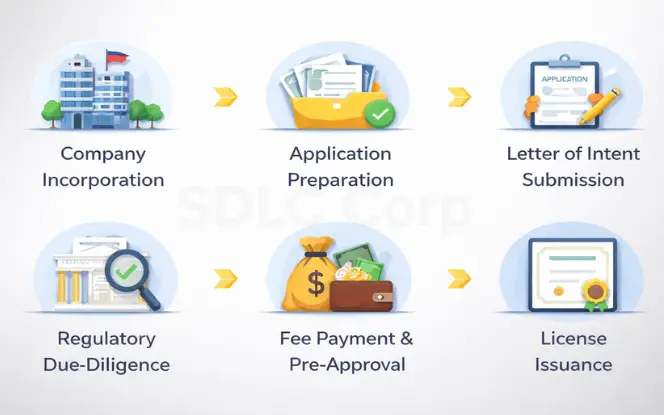
Philippines gambling licence application process — step by step
PAGCOR fees and cash deposits — what to budget
PAGCOR fee schedules vary by category and are updated periodically. The figures below are based on PAGCOR's published schedules — always confirm current fees directly with PAGCOR before applying, as schedules are revised.
| Category | Application / licence fee | Cash deposit / bond | PAGCOR franchise fee |
|---|---|---|---|
| eCasino | ₱1M–₱5M+ (licence fee) | ₱5M–₱50M+ depending on scale | 25% of GGR |
| OGSL (Sports Betting) | ₱2M–₱10M | ₱5M–₱20M | 25% of GGR |
| PIGO | ₱1M–₱5M | ₱5M–₱25M | 25% of GGR |
| RGA (land-based linked) | Variable by venue size | Variable | 25% of GGR |
| B2B / Gaming Support Services | ₱100,000–₱500,000 | Typically none or minimal | N/A (revenue share with operator) |
| Additional brands per licence | Additional fee per brand | Additional deposit per brand | 25% of GGR per brand |
The 25% PAGCOR franchise fee is the largest ongoing cost. PAGCOR charges 25% of gross gaming revenue as a franchise fee for most B2C categories — this is in addition to corporate income tax and other Philippine taxes. At any meaningful revenue scale, the PAGCOR franchise fee is the dominant operating cost. Model your unit economics carefully before committing to the Philippine market — the 25% GGR fee is significantly higher than most comparable Asian jurisdictions.
Cash deposits tie up working capital. The cash deposits/performance bonds required by PAGCOR (₱5M–₱50M+ depending on category) are held by PAGCOR throughout the licence term. They are returned at expiry if the operator is in good standing — but they are not available as operating capital during the licence period. Factor this into your financing plan.
Documents required for a PAGCOR gambling licence
- SEC certificate of registration and articles of incorporation (Philippine entity)
- Mayor's permit and BIR (Bureau of Internal Revenue) tax registration
- List of directors and shareholders with certified passports, NBI clearance (Philippines) or equivalent background certificates
- Audited financial statements (at least 2 years) and source of funds documentation
- Business plan covering product scope, Philippine market strategy, projected revenue, and operating model
- AML and KYC programme meeting AMLC (Anti-Money Laundering Council) standards
- Responsible gaming policy and player protection procedures
- Technical platform documentation — system architecture, security controls, data protection (Philippine Data Privacy Act compliance)
- RNG certificate from an approved test laboratory (for casino game categories)
- Third-party supplier and technology provider agreements
Ongoing compliance for Philippines-licensed gambling operators
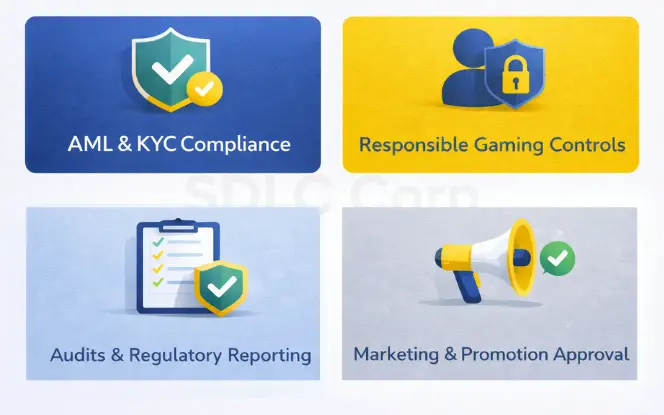
- Monthly franchise fee remittance: The 25% GGR franchise fee is remitted to PAGCOR monthly based on audited gross gaming revenue reports. Late remittance generates penalties. PAGCOR conducts regular audits to verify GGR calculations.
- AMLC reporting obligations: Philippine gambling operators are covered entities under the Anti-Money Laundering Act (AMLA). Suspicious transaction reports must be filed with the AMLC. Cash threshold reports apply for transactions above ₱500,000 (approximately $9,000 USD). The AMLC conducts examinations of covered entities' AML programmes.
- Real-time monitoring connectivity: PAGCOR requires eCasino and applicable online operators to maintain real-time system connectivity to PAGCOR's monitoring infrastructure. System downtime or monitoring connectivity failures must be reported to PAGCOR promptly.
- Responsible gaming programme: Self-exclusion integration with PAGCOR's national self-exclusion system, player session limits, deposit limits, loss limit tools, and problem gambling support resources. PAGCOR's responsible gaming standards apply to all licensed operators.
- Annual licence renewal: PAGCOR licences are typically issued for 5-year terms with annual compliance assessments and fee payments. Renewal requires clean compliance history and updated financial statements.
- Player data protection: The Philippine Data Privacy Act (Republic Act 10173) applies to all operators handling Philippine player data. Data Privacy Officer appointment, privacy impact assessments, and NPC (National Privacy Commission) registration are required.
Tax and recurring costs for Philippines gambling operators
- PAGCOR franchise fee (25% GGR): The dominant recurring cost — 25% of all gross gaming revenue remitted monthly. This is above the rate in most comparable jurisdictions (Brazil 12%, Malta 5%, UK 21%).
- Corporate income tax: Philippine corporate income tax at 25% on net income. PAGCOR-licensed operators are subject to regular BIR corporate tax filing obligations.
- Value Added Tax (VAT): Gaming revenue is generally exempt from VAT, but related services and costs may be subject to VAT at 12%.
- Withholding taxes: Player winnings are subject to Philippine final withholding tax (20% on gambling winnings above threshold amounts for Philippine residents).
- Annual licence renewal and compliance fees: Annual regulatory fees to PAGCOR, plus audit costs, legal advisory retainers, compliance programme maintenance, and technology platform ongoing costs.
FAQ — Philippines gambling licence (PAGCOR)
How do I get a gambling licence in the Philippines?
Apply to PAGCOR (Philippine Amusement and Gaming Corporation) for the appropriate licence category — eCasino, OGSL (sports betting), PIGO (internet gaming), or B2B accreditation depending on your business model. The process requires a Philippine-incorporated company (SEC-registered), complete documentation in English, payment of application and licence fees, passing PAGCOR due diligence and technical review, and paying the cash deposit/performance bond upon approval. Licence terms are typically 5 years. For launching an online casino after licensing, see our Philippines casino startup guide.
How much does a PAGCOR gambling licence cost?
Costs vary significantly by category. eCasino and OGSL licence fees typically range from ₱1M–₱10M (approximately $17,000–$175,000 USD). Cash deposits/performance bonds add ₱5M–₱50M+ depending on category and scale. The most significant ongoing cost is PAGCOR's 25% GGR franchise fee — remitted monthly on all gross gaming revenue. B2B Gaming Support Services accreditations are cheaper (₱100,000–₱500,000) with no major cash deposit requirement. Always confirm current fees with PAGCOR directly before budgeting.
Is POGO still available as a Philippines gambling licence?
No. The Philippine Offshore Gaming Operator (POGO) framework was effectively terminated by executive order in mid-2024 following significant controversy. No new POGO licences are being issued and existing licences cannot be renewed. Operators who served foreign-facing online gambling under POGO licences must transition to alternative arrangements. Current PAGCOR frameworks (eCasino, OGSL, PIGO) serve Philippine-based players. Any guide recommending POGO as a current option is publishing outdated information.
What is PAGCOR's franchise fee and how does it work?
PAGCOR charges a 25% franchise fee on gross gaming revenue (GGR) for most B2C gambling categories. This fee is remitted monthly based on audited GGR reports. At 25% of GGR, PAGCOR's franchise fee is one of the highest effective gambling tax rates in Asia — significantly above Brazil (12%), Malta (5%), or most offshore jurisdictions. This fee is in addition to Philippine corporate income tax and must be factored into unit economics modelling before committing to the Philippine market.
Can foreign companies hold a Philippine gambling licence?
Foreign companies cannot hold PAGCOR licences directly — a Philippine-incorporated company is required. Foreign equity in Philippine gambling entities is generally limited to 40% under the Foreign Investment Act, though PAGCOR's framework has specific provisions for some categories. Foreign nationals can serve as directors and officers subject to PAGCOR's fit and proper persons review. Engage a Philippine gaming attorney to structure the corporate arrangement correctly before SEC registration. For sports betting law context, see our Philippines sports betting law guide.