
Top Poker Software Provider in USA in 2026

SDLC CORP
- $25 - $50/hr
- 10,000+
- 2015
- USA
- 4.7/5

GammaStack
GammaStack leans more toward launch speed and front-end feature coverage than deep enterprise structure. Its offer is likely to appeal to operators that want tournaments, multiple game modes, and flexible packaging, but U.S. buyers should still check whether the reporting and compliance layer is strong enough for the intended operating model.
- $25 - $50/hr
- 10,000+
- 2012
- Italy
- 4.5/5

Playtech
For operators that care about liquidity, network effects, and enterprise-scale operating history, Playtech is easier to justify than many niche poker vendors. Its value comes less from poker-only positioning and more from established infrastructure, commercial scale, and market credibility. The main shortlist question is whether that model aligns with a U.S.-focused rollout.
- $100 - $300/hr
- 50+
- 1999
- Global
- 4.6/5

EvenBet Gaming
- $50 - $150/hr
- 100+
- 2004
- Global
- 4.5/5

BetConstruct
BetConstruct is typically stronger when poker sits inside a broader multi-vertical strategy. Its positioning highlights customization, branding flexibility, and wider ecosystem integration. For U.S. buyers, the main question is whether the poker layer itself is strong enough on reporting, cashier controls, and day-to-day operator workflow.
- $40 - $120/hr
- 800+
- 2004
- Global
- 4.4/5

Connective Games
Connective Games feels more product-deep than many broader gaming vendors. Its poker specialization and support for multiple gameplay formats make it easier to consider for operators that care about product flexibility. The key check is whether that flexibility is backed by the reporting, authentication, responsible-gaming, and control standards needed for a U.S.-facing setup.
- $80 - $250/hr
- 150+
- 2005
- Global
- 4.8/5

SoftSwiss (now BGaming)
Unlike poker-first vendors, SOFTSWISS is easier to understand as a broader iGaming ecosystem play. That can work well for operators that value payments, back-office control, and multi-product scale more than pure poker specialization. The shortlist question is how poker-specific the product really is and whether the commercial structure fits U.S. requirements.
- $40 - $100/hr
- 1,000+
- 2012
- Global
- 4.6/5

Creationsoft
Creatiosoft comes across as a more commercially accessible option for buyers considering white-label poker and faster-launch software models. Its positioning leans toward blockchain-oriented setups, customization flexibility, and practical product packaging. What needs closer review is whether the reporting quality, ledger controls, admin visibility, and post-launch support are strong enough operationally.
- $100 - $250/hr
- 700+
- 2012
- Global
- 4.4/5

EveryMatrix
EveryMatrix should be viewed less as a pure poker specialist and more as a regulated platform supplier with modular infrastructure and broader scale. That positioning makes it easier to shortlist for operators prioritizing regulatory posture, platform breadth, and integration flexibility. The real decision is whether its poker capabilities and deployment model match the operator’s product strategy closely enough.
- $100 - $250/hr
- 700+
- 2012
- Global
- 4.4/5

Capermint Technologies
Capermint sits closer to a service-led gaming model than to a mature poker-platform specialist. That does not automatically remove it from consideration, but it changes the diligence focus. Buyers should spend more time validating product maturity, operator controls, and whether the offer behaves like a platform product or a delivery-led engagement in practice.
- $100 - $250/hr
- 700+
- 2012
- Global
- 4.4/5

U.S. Poker Market Outlook 2026
The U.S. market is making platform governance, reporting transparency, and payment readiness harder to treat as optional extras. As scrutiny rises, vendor selection depends more on operational stability and compliance readiness than on front-end features alone.
How Regulation and Technology Drive Growth
The U.S. market is making platform governance, reporting transparency, and payment readiness harder to treat as optional extras. As scrutiny rises, vendor selection depends more on operational stability and compliance readiness than on front-end features alone.
| Year | Estimated Market Size (USD Billion) | Annual Growth Rate (%) | Key Growth Drivers |
|---|---|---|---|
| 2024 | 5.12 | — | Legal expansion across major U.S. states |
| 2025 | 6.01 | 17.4 | Increased adoption of real-money poker platforms |
| 2026 | 7.12 | 18.4 | AI-driven fraud prevention and personalized gameplay |
| 2027 | 8.36 | 17.3 | Wider multi-state licensing and cross-platform support |
| 2028 | 9.74 | 16.5 | Blockchain-backed transactions and transparency systems |
| 2029 | 10.98 | 16.5 | Nationwide market maturity and regulatory clarity |
How to Choose the Right U.S. Poker Software Provider
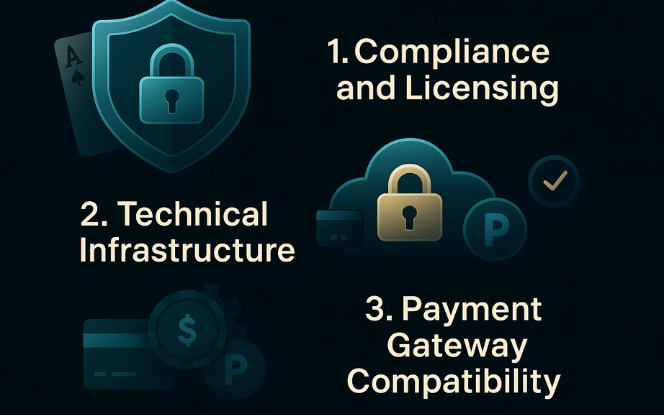
A strong provider needs to hold up in six areas: platform stability, wallet integrity, fraud controls, reporting depth, admin access controls, and integration flexibility. In the U.S. market, operators should also test transaction visibility, audit readiness, and the reliability of day-to-day payment and gameplay workflows.
What Separates Stronger Poker Software Providers from Weaker Ones
The difference between stronger and weaker providers usually shows up in control quality, not in headline messaging. Mature vendors demonstrate discipline across reporting, permissions, audit visibility, transaction workflows, fraud response, and operational continuity. In U.S. evaluations, those standards carry more weight than sales language.
New Technology Trends Shaping the Industry
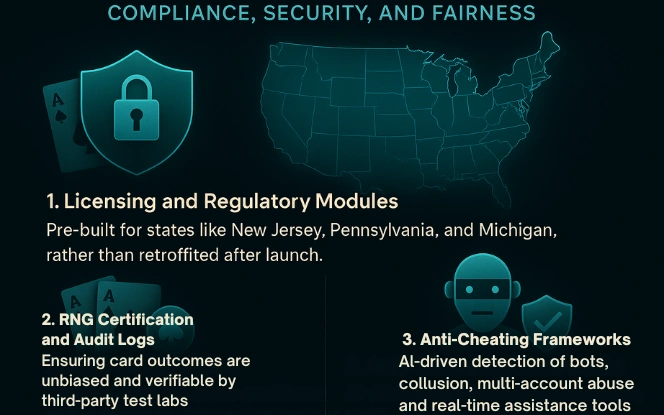
Technical Capabilities Buyers Should Evaluate in 2026
Technical capability matters only when it improves control, visibility, and platform reliability. In poker software evaluations, buyers should pay closest attention to fraud monitoring, transparent reporting, audit-ready controls, and stable real-time performance.
Transparency, Auditability, and Control Systems
Stronger platforms support audit visibility, admin traceability, and reporting structures that allow operators to review gameplay, transactions, and control decisions with confidence.
Real-Time Multiplayer Performance and Stability
Platform quality should also be measured through responsiveness, gameplay consistency, and reliability during peak usage.
Conclusion
The strongest poker software provider is not the one with the broadest marketing language, but the one that demonstrates operational consistency, reporting depth, platform visibility, and commercial readiness. For U.S. operators, the most effective approach is to compare shortlisted vendors against the same technical, operational, and governance criteria before making a final selection.
Explore more of our services:
FAQs
What defines a top poker software provider in the U.S.?
A leading U.S.-focused provider combines deep technical expertise, compliance readiness for state regulation, and a strong track record of scalable real-money platforms. Key differentiators include certification of RNGs, anti-fraud systems, modular licensing support, and proven multi-state launches.
How much does U.S. poker software development cost in 2026?
Costs vary widely depending on features, platform, and whether it supports real-money play. Basic real-money poker systems start around $50,000 and can exceed $500,000 for full-scale platforms with advanced features and multi-state compliance. Additionally, even simpler white-label or social-play versions may begin in the $10,000 to $30,000 range.
Which technologies are essential for compliance and performance?
Can poker software be integrated with payment gateways like PayPal?
Yes — leading poker software providers support major U.S. payment solutions (e.g., PayPal, ACH, debit/credit cards) in a way that meets regulatory standards. They typically handle PCI-DSS compliance, integrate fraud-prevention modules, and allow withdrawals and deposits in line with state regulations.