It is also one of the fastest-growing categories in digital commerce. Estimates vary by source. The U.S. International Trade Administration projects the global B2B ecommerce market will reach roughly $36 trillion in 2026, while Research and Markets values it at $19.34 trillion in 2024, rising to $47.54 trillion by 2030 at about a 16% compound annual growth rate. The direction is consistent: more B2B spend moves online every year, and the companies that build well are the ones capturing it.
This guide covers what B2B ecommerce development actually involves, how it differs from B2C, the features your platform needs, the leading platforms to build on, the development process step by step, realistic costs and timelines, the SEO work that decides whether buyers find you, and how to choose a partner you can trust.
What Is B2B Ecommerce Development?
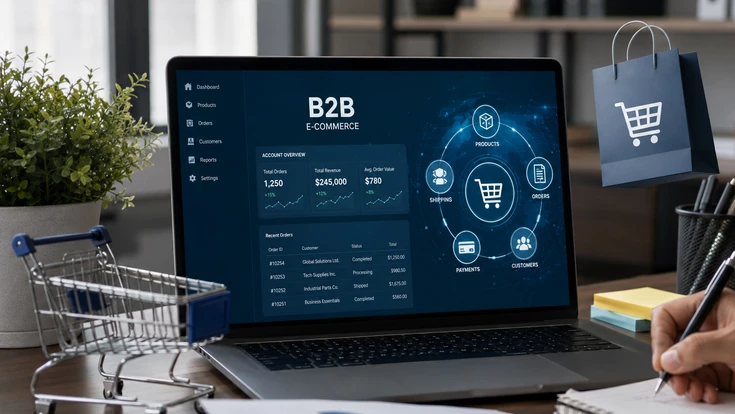
B2B ecommerce development is the end-to-end work of building a digital platform that lets one business sell products or services to other businesses online. A specialist B2B ecommerce development company can help plan the portal, buyer workflows, integrations, and launch roadmap together.
That includes the storefront and catalog, but the real engineering sits underneath: customer-specific pricing logic, account and role management, order-approval routing, request-for-quote (RFQ) handling, and live data exchange with enterprise systems such as ERP, CRM, and inventory management.
The model already powers some of the largest names in commerce, from Amazon Business and Grainger to Alibaba, where the storefront sits on top of heavy pricing, account, and procurement logic. It matters because a B2B purchase is rarely one person clicking “buy now.” It usually runs through a buying committee, a procurement policy, a contract price negotiated months earlier, and an internal approval step before an order is placed. Software that ignores those realities creates friction exactly where it costs you revenue. Done well, B2B ecommerce development removes that friction for the buyer while automating order capture for you.

In practice, the work spans several project types:
Custom B2B storefronts
A branded ordering portal for manufacturers, wholesalers, or distributors that need direct selling, account pricing, and faster repeat purchasing.
B2B marketplaces
A multi-vendor commerce system connecting buyers and sellers with onboarding, commissions, product control, settlement rules, and scalable admin workflows.
Hybrid B2B/B2C stores
A shared commerce backend for business and consumer buyers, supporting separate catalogs, pricing rules, checkout flows, and customer experiences.
Replatforming & integration
A structured migration to a stronger commerce platform, connected with ERP, CRM, inventory, payments, tax, and fulfillment systems.
B2B vs B2C Ecommerce: What’s Different
B2B and B2C both sell online, but the technical and UX priorities diverge. B2C optimizes for fast, emotional, single-buyer transactions. B2B optimizes for accuracy, repeat ordering, and relationship-driven buying cycles. Here is how they compare across the decisions that shape your build:
| Dimension | B2C Ecommerce | B2B Ecommerce |
|---|---|---|
| Buyer | Individual consumer | Company / buying committee |
| Pricing | One public price for all | Account-specific, contract, and tiered volume pricing |
| Order size & frequency | Small, often one-off | Large, recurring, predictable reorders |
| Checkout | Card payment, instant | Purchase orders, net terms, credit limits, approvals |
| Accounts | Single user | Multi-user company accounts with roles and permissions |
| Catalog | Curated, lifestyle-led | Large, SKU-heavy, technical, account-restricted |
| Sales motion | Marketing-driven | Sales- and procurement-driven, RFQ-based |
| Integrations | Light | Deep ERP, CRM, PIM, WMS, tax, and payment integrations |
| UX goal | Delight and inspire | Make ordering fast, accurate, and frictionless |
In short, a B2B build is more complex than a standard shop. It needs a different architecture, a different UX mindset, and deeper customization, which is why a generic ecommerce template rarely survives contact with real B2B requirements.
Why Build a B2B Ecommerce Platform in 2026?
Four forces make this the right moment to build.
Your buyers are already digital
Modern B2B buyers expect self-service, comparison tools, online reordering, and supplier portals that make routine purchasing faster and easier.
Operational savings are real
Self-service portals reduce order entry, invoice requests, shipment questions, quote follow-ups, manual rekeying, and avoidable support workload.
The market is expanding fast
More business purchasing is moving online, and suppliers with stronger digital ordering experiences capture demand before slower competitors adapt.
Your sales team scales faster
Sales teams get cleaner account data, faster reorder visibility, fewer routine tasks, and more time for renewals and larger deals.
The clearest business case is not only revenue, it is efficiency: fewer manual orders, less routine support, sharper data on how buyers actually behave, and a sales team pointed at strategy.
Must-Have Features for a B2B Platform
These are the capabilities that separate a real B2B platform from a consumer store with a wholesale discount bolted on. Use this as your requirements checklist.
Customer-specific & contract pricing
Show logged-in buyers negotiated pricing, volume tiers, and contract rates instantly, without duplicating products or creating messy catalog workarounds.
Self-service buyer portals
Give buyers one secure portal to manage profiles, orders, invoices, shipments, reorders, account documents, and support information.
Bulk ordering & quick-order tools
Support SKU search, saved lists, CSV upload, quick-order forms, and reorder history so bulk purchasing stays fast.
RFQ & quote management
Let buyers request quotes, let sales teams respond quickly, and convert approved quotes into tracked orders without manual follow-ups.
Multi-user accounts & role-based access
Support company accounts, user roles, approval thresholds, procurement permissions, budget controls, and secure access for different buyer teams.
ERP, CRM & PIM integration
Connect ERP, CRM, PIM, WMS, payments, inventory, and order status flows. Our ecommerce integration services support this.
Flexible B2B payment terms
Offer purchase orders, net terms, credit limits, approval gates, and card payments so procurement teams can buy correctly.
Multi-store, currency & language
Run multiple storefronts from one backend with localized language, currency, tax, catalogs, and buyer rules across regions.
Advanced search & filtering
Help buyers find exact SKUs, parts, specifications, and substitutes quickly with precise search, filters, and product attributes.
Mobile and PWA experience
Provide responsive mobile ordering or a PWA so buyers can reorder, approve, and track purchases from any device.
Best B2B Ecommerce Platforms in 2026
Your platform choice shapes cost, timeline, and how much B2B functionality you get natively versus by custom development. There is no universally best platform, only the best fit for your catalog size, integration needs, customization appetite, and budget.
| Platform | Best for | B2B depth | Typical build cost* |
|---|---|---|---|
| Shopify Plus | Fast launches, mid-market, hybrid B2B/B2C | Good (price lists, company accounts, PO terms) | ~$25K–$150K |
| BigCommerce (B2B Edition) | Open SaaS, no extra transaction fees | Strong native B2B feature set | ~$50K–$200K |
| Adobe Commerce (Magento) | Large catalogs, deep customization | Very deep B2B suite | ~$50K–$500K+ |
| OroCommerce | B2B-first / complex enterprise | B2B-native by design | ~$100K–$500K+ |
| Salesforce B2B Commerce | Salesforce-centric enterprises | Deep, CRM-integrated | Enterprise |
| WooCommerce | WordPress sites, full control, lower entry | Via extensions / custom dev | ~$15K–$80K |
| Headless / composable | Unique workflows, multi-channel | Unlimited (you build it) | $100K+ |
*Indicative full-build ranges including customization, data migration, and integration, not license fees alone.
A practical way to decide: list the B2B features you need (account pricing, RFQ, role-based access, ERP integration) and check whether each is native or custom on a given platform. Every “custom” item adds to your timeline and your total cost of ownership. SDLC Corp builds and customizes across the major stacks, from Shopify Plus and BigCommerce to Adobe Commerce and fully custom, composable (MACH) architectures.
How to Build a B2B Ecommerce Platform, Step by Step
Production-grade B2B ecommerce development follows a disciplined sequence. The teams that stay on budget are the ones that treat the early phases as seriously as the build itself.
Discovery & requirements
Get clarity on who your buyers are, their purchase journey, and which integrations are non-negotiable (ERP, CRM, PIM, 3PL). Document pricing rules, account structures, and approval workflows. This de-risks everything that follows.
Platform selection
Based on requirements, scale, customization needs, and budget, choose the platform or decide on a headless build. Map each required feature to native versus custom.
UX & design
B2B UX rewards speed and accuracy over visual flair. Produce a sitemap, customer-portal wireframes, checkout and approval flows, mobile-responsive layouts, and WCAG 2.1 accessibility.
Development
Build the storefront and catalog, custom pricing and account-management logic, RFQ and approval systems, and the buyer portal. For advanced workflows, custom ecommerce development helps shape the platform around real buyer and operations needs. This core phase typically runs 8 to 24 weeks.
Integration
Wire the platform into ERP, CRM, PIM, payment gateways, and tax and shipping systems. Legacy systems use unfamiliar data formats and limited APIs, so plan more time here than feels necessary.
Data migration
Move customer accounts, catalog and pricing data, historical orders, and inventory records. Teams routinely underestimate this step, so build in buffer and validate the data after it lands.
QA & testing
Run functional, integration, performance, and security testing, plus user-acceptance testing with real buyers placing real orders.
Launch
Use a phased rollout to a subset of customers, train internal teams and key accounts, and stand up monitoring dashboards to catch issues early.
Post-launch optimization
Go-live is a milestone, not the finish line. Track buyer behavior, remove friction, and keep shipping improvements. This is where long-term ROI comes from.
B2B Ecommerce Development Cost in 2026
B2B ecommerce development typically costs between $25,000 for a focused build and $500,000+ for an enterprise-grade platform with advanced features, deep integrations, and global reach. Costs vary widely because requirements vary widely — the same “store” label covers a templated WooCommerce build and a fully integrated Adobe Commerce platform.
Costs break down roughly by project tier:
| Project tier | What it includes | Indicative cost |
|---|---|---|
| Entry / MVP | Single storefront, core B2B pricing, light integration | $25,000 – $50,000 |
| Mid-market | Custom portal, RFQ, ERP/CRM integration, migration | $50,000 – $150,000 |
| Enterprise | Multi-store, complex pricing, multiple integrations, headless | $150,000 – $500,000+ |
Across the 2026 pricing analyses, the biggest line item is rarely the software license. It is the system integrations (ERP, CRM, inventory, accounting) that keep operational data in sync. The five cost layers to model are: (1) licensing or subscription, (2) implementation and data migration, (3) integration development and ongoing maintenance, (4) custom development for B2B features the platform does not handle natively, and (5) hosting, security, and support.
Think in total cost of ownership, not sticker price. A platform that is cheap to launch but costly to scale and maintain can cost more over three years than one with a higher upfront price and lower ongoing overhead. For a mid-market business, budget roughly $100K–$300K over three years on Shopify Plus, and more on enterprise platforms once licensing, integration, custom features, hosting, and maintenance are included. An MVP-first build that starts earning quickly, then expands, is usually the soundest financial path.
How Long Does B2B Ecommerce Development Take?
Timelines depend on scope and how cleanly your requirements and integrations are defined. As a planning baseline:
| Build type | Typical timeline |
|---|---|
| Template / configured store | 2 – 4 weeks |
| Semi-custom B2B store | 1 – 2 months |
| Full custom B2B platform | 3 – 6 months |
| Enterprise / marketplace / headless | 6 – 12 months |
These assume clear requirements and timely stakeholder feedback. Projects slip mainly when scope keeps shifting or decisions stall, not because development is slow. The fix is disciplined discovery up front and one empowered decision-maker on the client side.
SEO & GEO for B2B Ecommerce
A well-built B2B platform that no one can find is a sunk cost. SEO belongs in the build, not after it, and in 2026 that increasingly means optimizing for AI answer engines too.
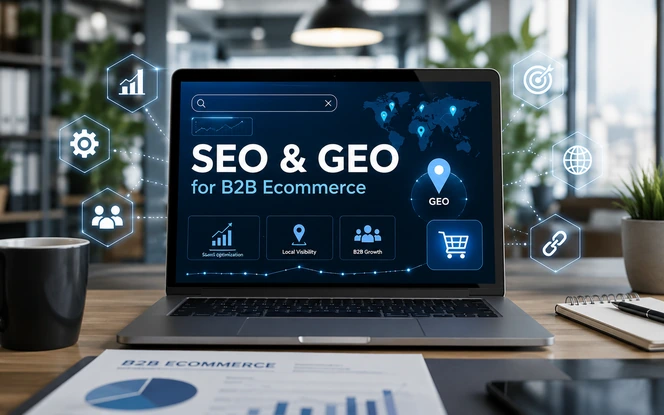
Keyword & intent strategy
Target precise buyer searches with product pages, application guides, comparison content, and FAQ pages built around real purchasing questions.
Structured data schema
Add Product, Organization, FAQPage, BreadcrumbList, and HowTo schema so search engines understand pages, entities, and answers.
Technical SEO
Improve Core Web Vitals, clean URLs, mobile rendering, canonicals, crawlability, and wider website development services support.
Generative engine optimization
Write answer-first content, use strong headings, publish original data, build topic clusters, and make AI citation a visibility KPI.
Helpful blogs, product guides, and how-to articles establish your expertise and trustworthiness as a vendor. The same signals that earn organic traffic also build buyer confidence.
Common B2B Development Challenges (and How to Avoid Them)
Knowing what goes wrong helps you plan around it.
Integration complexity
Connecting to legacy ERP and CRM systems is consistently the hardest part. Fix: run an integration discovery early, confirm API availability, and budget extra time and money here.
Customer adoption
Existing buyers have habits: a phone number and a rep they trust. Fix: make the new channel genuinely easier, then drive adoption with training and incentives.
Underestimated data migration
Pricing, catalog, and order history are messier than they look. Fix: treat migration as its own workstream with validation and rollback plans.
Security and compliance
Protecting buyer data, payment information, and account access is critical. Fix: build in secure architecture, HTTPS, access controls, and testing from day one.
Scalability
A platform that works at launch can buckle as catalog and order volume grow. Fix: design the architecture for the volume you expect in three years, not just today.
How to Choose a B2B Ecommerce Development Company
Your platform choice matters, but your development partner matters just as much. Use this checklist when evaluating vendors:
- Demonstrable B2B portfolio. Ask to see projects with custom pricing, ERP integrations, multi-account management, and RFQ or approval workflows — not just consumer stores.
- Integration experience with your stack. Hands-on experience with your specific ERP (SAP, Oracle, NetSuite, Dynamics), CRM, and payment systems.
- A real discovery process. The partner that asks the most questions about your goals usually understands B2B best. Be wary of anyone who quotes before understanding your workflows.
- Transparent pricing and timeline. Clear scope, milestones, and total project cost, not just an hourly rate. The cheapest quote rarely offers the best value.
- Post-launch support. B2B platforms keep evolving after launch. Confirm warranty, maintenance, and optimization terms before you sign.
- Security and process maturity. NDAs, code warranties, certified developers, and documented QA signal a partner that protects your project.
Why teams choose SDLC Corp
SDLC Corp is a B2B ecommerce development company that has delivered 50+ scalable B2B platforms, built for complex pricing and workflow requirements and held to ISO-certified development standards. We have supported digital commerce for brands including Fujitsu, Haier, Orange, and Rubix, and we build across Shopify Plus, BigCommerce, Adobe Commerce, WooCommerce, and fully custom architectures.
We handle the full lifecycle, from discovery and platform selection through custom ecommerce development, ERP and CRM integration, and post-launch growth. If you need a broader digital foundation, our website development services cover the rest of your stack.
Build a B2B Ecommerce Platform That Compounds
B2B ecommerce development is no longer optional. It is the digital backbone of how modern wholesalers, manufacturers, and distributors operate and grow. The companies that win online start with disciplined discovery, pick a platform that fits their real workflows, get integration right early, design for the buyer, and keep improving after launch.
Get those fundamentals right and the gains compound: fewer manual orders, lower operating cost, larger accounts, and a sales team free to focus on growth.
Ready to Build Your B2B Ecommerce Platform?
Get a tailored cost estimate, timeline, and technical recommendations for your B2B project from the specialists at SDLC Corp.
Start My B2B Ecommerce BuildB2B Ecommerce Development FAQs
B2B ecommerce development is the process of designing, building, and launching an online store or self-service ordering platform for business-to-business transactions, where the buyer is a company rather than a consumer. It includes account-specific pricing, bulk ordering, multi-user accounts, RFQ and approval workflows, and integration with ERP and CRM systems.
Most B2B ecommerce projects cost between $25,000 and $500,000+. An entry or MVP build typically runs $25,000–$50,000, a mid-market platform $50,000–$150,000, and an enterprise system $150,000–$500,000+. The biggest cost driver is usually system integration, including ERP, CRM, and inventory systems, rather than the software licence.
A configured store can launch in 2–4 weeks, a semi-custom B2B store in 1–2 months, a full custom platform in 3–6 months, and an enterprise or marketplace build in 6–12 months. The core development phase of a custom B2B platform usually takes 8–24 weeks.
B2C sells to individual consumers with one public price and instant card checkout. B2B sells to companies with account-specific and contract pricing, bulk and repeat orders, multi-user accounts with approval workflows, purchase orders and net terms, and deep ERP and CRM integration. B2B builds are usually more complex and customised.
It depends on your needs. Shopify Plus suits fast mid-market and hybrid builds; BigCommerce B2B Edition offers strong native B2B features; Adobe Commerce and OroCommerce suit large, complex enterprises; WooCommerce fits WordPress-based, lower-entry builds; and headless or composable architecture suits unique workflows. Match every required feature to native or custom support before deciding.
At minimum, a B2B ecommerce platform needs customer-specific and contract pricing, self-service buyer portals, bulk and quick-order tools, RFQ and quote management, multi-user accounts with role-based access, ERP, CRM and PIM integration, flexible payment terms, multi-store and multilingual support, advanced search, and a mobile-friendly experience.
For most mid-sized wholesalers, manufacturers, and distributors, yes. It can reduce manual order errors and overhead, increase repeat orders, support larger buyer accounts, and scale with the business. The key is to plan for total cost of ownership and start with an MVP that generates value before expanding.
Target specific long-tail buyer keywords, publish answer-first content with clear definitions and useful statistics, add Product, Organization, FAQPage, BreadcrumbList, and HowTo schema where relevant, and improve technical foundations such as Core Web Vitals, mobile usability, clean URLs, and crawlability. Build topical authority with connected content clusters.