The custom software development process turns a business requirement into a production system through a sequence of discovery, requirements, architecture, design, engineering, testing, release, and ongoing improvement. The strongest projects do not treat these as isolated phases. Decisions made during discovery affect architecture, architecture affects testing, and release planning affects how safely the product can evolve after launch.
This guide explains the full process from requirements to release, including what each stage should produce, which risks to resolve early, and how to keep scope, quality, and delivery ownership visible throughout the project. If you are planning an implementation, our custom software development services page covers the commercial delivery scope behind this process.
Process guide
Custom software development: the process in one view
A reliable custom software process moves from business problem → testable scope → architecture → design → incremental engineering → multi-level testing → controlled release → support and improvement. The most important control is continuity between stages: every decision should create evidence the next stage can use.
In this guide 19 sections
- Custom software development process at a glance
- Stage 1: Discovery — define the problem before the solution
- Stage 2: Turn requirements into testable scope
- Stage 3: Define the software architecture
- Stage 4: Plan integrations and data ownership
- Stage 5: Design user journeys and interfaces
- Stage 6: Break the roadmap into delivery increments
- Stage 7: Choose the team and delivery model
- Stage 8: Engineering with quality built into delivery
- Stage 9: Testing across multiple levels
- Stage 10: Prepare data migration and cutover
- Stage 11: Production deployment and observability
- Stage 12: Hypercare, support and continuous improvement
- How change requests should be handled
- How custom software development cost changes across the lifecycle
- Common process mistakes that create delivery risk
- Custom software development process checklist
- Frequently asked questions
- Final takeaway
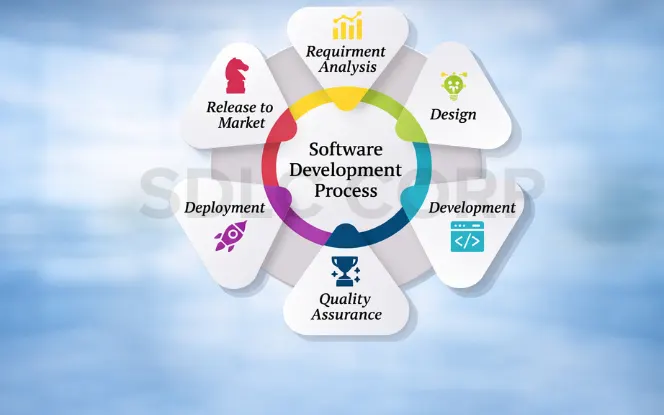
Custom software development process at a glance
| Stage | Main objective | Typical outputs |
|---|---|---|
| 1. Discovery | Define the business problem and constraints | Goals, users, workflows, assumptions, risks |
| 2. Requirements | Translate needs into testable scope | Functional requirements, non-functional requirements, acceptance criteria |
| 3. Architecture | Design the technical foundation | System boundaries, integrations, data model, security and deployment approach |
| 4. UX and solution design | Define how users and systems interact | Flows, wireframes, prototypes, interface contracts |
| 5. Planning | Sequence delivery into manageable increments | Backlog, milestones, dependencies, team plan |
| 6. Engineering | Build and integrate the product | Working software, code, automated checks, environments |
| 7. Testing | Verify quality and business acceptance | Test results, defects, UAT evidence, release readiness |
| 8. Deployment | Release safely into production | Cutover plan, monitoring, rollback, runbooks |
| 9. Support and evolution | Operate and improve the software | Monitoring, maintenance, roadmap feedback, improvements |
Stage 1: Discovery — define the problem before the solution
Discovery should establish why the software is being built, who will use it, which workflows are affected, what systems already exist, and which constraints could change the solution. Starting development before these questions are clear often creates expensive rework later.
Useful discovery outputs include business goals, stakeholder map, current workflows, target outcomes, major assumptions, existing-system inventory, data sources, integration dependencies, compliance requirements, and known risks.
If the problem, architecture direction, or delivery model is still uncertain, our software consulting guide explains how to structure the decision before development begins.
Stage 2: Turn requirements into testable scope
Requirements should describe what users and systems need to achieve, not only a list of requested features. Strong requirements combine functional behavior with non-functional expectations such as performance, availability, security, auditability, accessibility, scalability, and supportability.
Each important requirement should be testable. Acceptance criteria help prevent different teams from interpreting “done” differently.
Functional requirements
Functional requirements describe workflows, roles, actions, rules, calculations, integrations, notifications, reporting, and exceptions.
Non-functional requirements
Non-functional requirements describe quality attributes such as response time, throughput, resilience, security, privacy, data retention, recoverability, and operational support.
Stage 3: Define the software architecture
Architecture establishes how the system will be structured and how major components interact. It should identify application boundaries, data stores, interfaces, integrations, identity, trust boundaries, deployment environments, external dependencies, and operational responsibilities.
The goal is not to over-design every future possibility. The goal is to make the current system understandable, testable, secure, and able to evolve without unnecessary coupling.
Stage 4: Plan integrations and data ownership
Modern custom software rarely operates alone. It may need to connect with CRM, ERP, payment, identity, ecommerce, analytics, SaaS, or legacy platforms.
Before integration development begins, define which system owns each important business object, how identifiers are mapped, how failures are retried or reconciled, and how API or event changes will be managed.
Our software integration strategy guide covers APIs, middleware, data ownership, security, failure handling, observability, and testing in more detail.
Stage 5: Design user journeys and interfaces
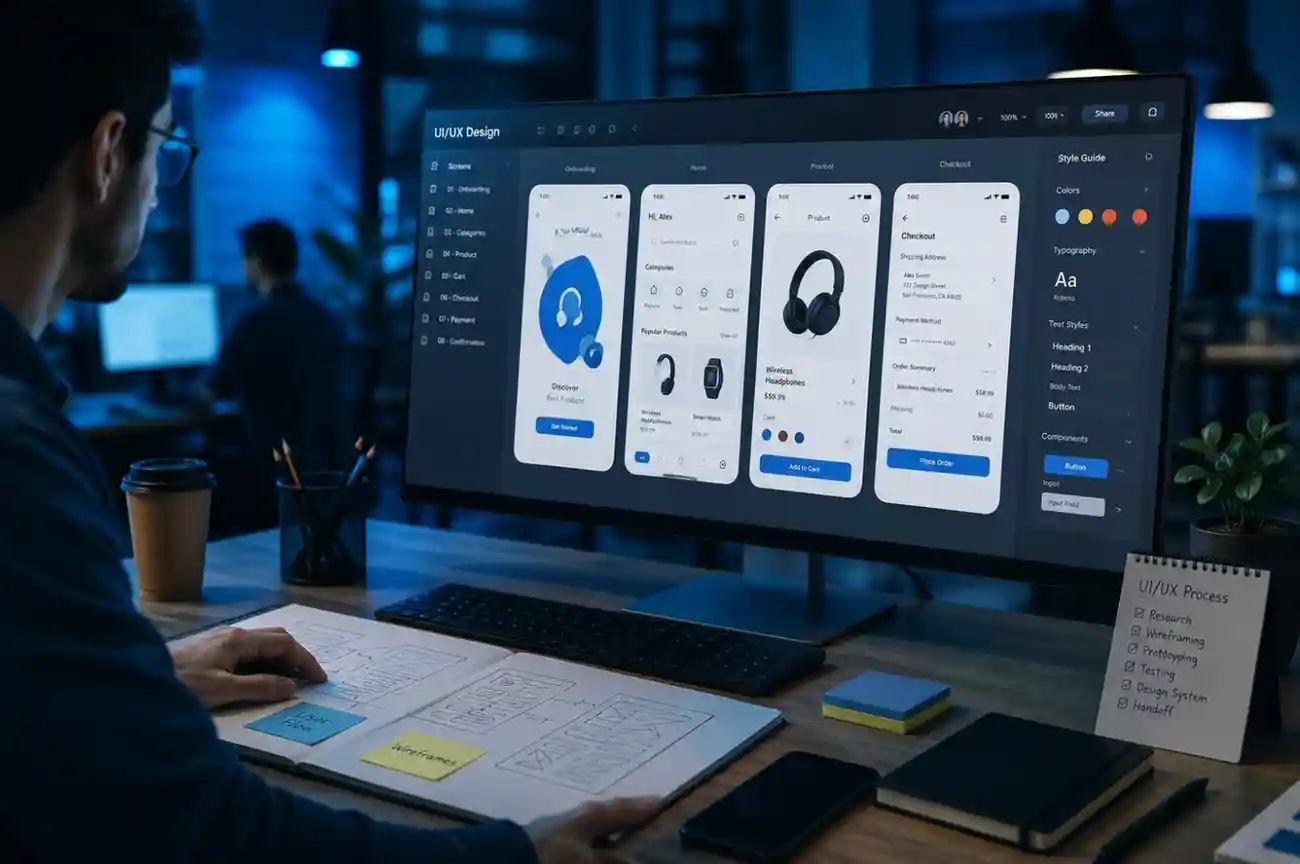
UX design should turn requirements into clear user flows before engineering effort is committed. Wireframes and prototypes help validate navigation, roles, workflow sequencing, edge cases, and information hierarchy with stakeholders.
For system-to-system interactions, interface design should also define request and response contracts, validation behavior, error states, and operational expectations.
Stage 6: Break the roadmap into delivery increments
Large projects are easier to control when they are delivered in meaningful increments rather than one final release. Each increment should have a clear outcome, dependencies, acceptance criteria, and evidence that it is ready to move forward.
Prioritize by business value, technical dependency, and risk. High-risk assumptions—such as a difficult integration, migration, performance requirement, or security constraint—often deserve early validation.
If the product can benefit from a narrower first release, see our MVP vs full product development guide.
Stage 7: Choose the team and delivery model
The delivery model should match the scope and the client’s internal management capacity. A few well-defined roles may be enough for one initiative, while another project may need a coordinated cross-functional team or a stable dedicated team.
Use our developers vs development team comparison and dedicated team vs staff augmentation guide when deciding how engineering capacity should be structured.
Stage 8: Engineering with quality built into delivery
Engineering should include code review, source control, branching strategy, automated builds, environment management, secure configuration, and repeatable deployment practices. Quality is cheaper when it is part of daily development rather than a separate activity at the end.
Teams should also maintain enough documentation that important architecture, integration, deployment, and operational knowledge does not exist only in individual memory.
Stage 9: Testing across multiple levels
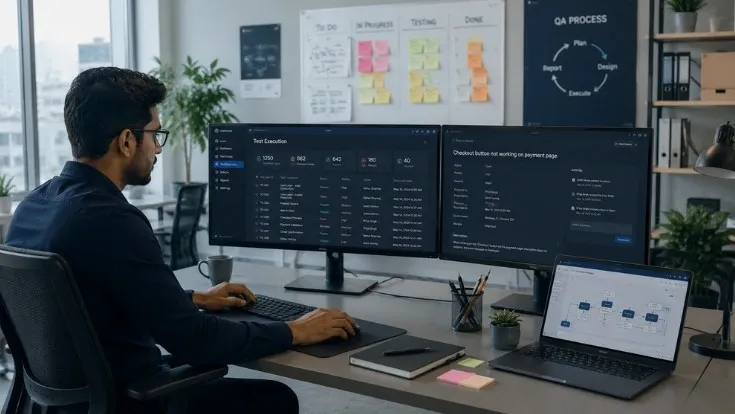
Testing should verify both technical behavior and business acceptance. A typical strategy may include unit, component, integration, contract, end-to-end, security, performance, regression, accessibility, and user acceptance testing depending on the product.
Testing should include failure paths, not only successful workflows. Timeouts, duplicate events, invalid data, permission failures, dependency outages, and recovery behavior often reveal the most important production risks.
Stage 10: Prepare data migration and cutover
If the project replaces or extends an existing system, data migration and cutover should be managed as their own workstreams. Migration may require data profiling, mapping, cleanup, transformation, validation, rehearsal, and reconciliation.
The cutover plan should define go-live steps, owners, freeze periods, validation checks, rollback criteria, communication, and support coverage.
Stage 11: Production deployment and observability
Deployment is not complete when code reaches production. The team also needs to know whether the product is healthy after release.
Production readiness should include logs, metrics, alerts, dashboards, dependency monitoring, error tracking, backup and recovery procedures, and escalation ownership. Important user and business workflows should be observable enough to diagnose failures quickly.
Stage 12: Hypercare, support and continuous improvement
The first period after launch often reveals real-world behavior that testing could not fully reproduce. Hypercare gives the team a structured period to monitor adoption, resolve defects, tune performance, and verify integrations and operational processes.
After stabilization, the software moves into an ongoing lifecycle of maintenance, security updates, platform changes, feature improvements, technical debt management, and roadmap evolution.
How change requests should be handled
Change is normal in custom software. The important question is how change is evaluated. Every meaningful request should be assessed for user value, scope impact, architecture impact, dependencies, testing effort, timeline, and cost.
Not every requested feature belongs in the current release. A visible decision process protects both product quality and delivery predictability.
How custom software development cost changes across the lifecycle
Project cost depends on more than engineering hours. Discovery, UX, architecture, integrations, migration, security, environments, testing, deployment, support, and operational readiness all contribute to the total effort.
Our software development cost and timeline guide explains the main variables that affect estimates and delivery ranges.
Common process mistakes that create delivery risk
- Starting development before business goals and workflows are clear.
- Treating non-functional requirements as an afterthought.
- Allowing multiple systems to own the same data without governance.
- Postponing integration testing until the end.
- Using one large final release instead of incremental validation.
- Estimating before critical assumptions are resolved.
- Leaving migration and cutover planning too late.
- Testing only the happy path.
- Launching without monitoring and operational ownership.
- Depending on undocumented knowledge held by a few people.
Custom software development process checklist
- Define business goals and success measures.
- Map users, workflows, systems, and constraints.
- Write testable functional and non-functional requirements.
- Design target architecture and system boundaries.
- Define integrations and data ownership.
- Validate UX flows and interface contracts.
- Sequence work into manageable delivery increments.
- Choose the right team and ownership model.
- Build quality and security into daily engineering.
- Test functional, integration, security, performance, and recovery paths.
- Plan migration, cutover, rollback, and hypercare.
- Instrument production monitoring and support.
Frequently asked questions
What are the main stages of custom software development?
The main stages are discovery, requirements, architecture, UX and solution design, planning, engineering, testing, deployment, and ongoing support and improvement.
How long does custom software development take?
Timeline depends on scope, team size, integrations, migration, security requirements, testing depth, and how much uncertainty must be resolved. Smaller focused releases may take months, while complex enterprise platforms can require phased delivery over a longer period.
Should discovery happen before development?
Yes when requirements, workflows, architecture, integrations, or risks are not already well understood. Discovery reduces uncertainty before engineering estimates and commitments are treated as reliable.
What is the difference between discovery and requirements?
Discovery investigates the business problem, users, systems, constraints, and options. Requirements convert the chosen direction into testable behavior, quality expectations, and acceptance criteria.
When should testing start?
Testing should begin during planning and engineering, not only before launch. Automated checks, contract tests, integration testing, security validation, and acceptance criteria should be built into delivery as early as practical.
Final takeaway
A reliable custom software development process connects business intent to production operations. Discovery clarifies the problem, requirements make scope testable, architecture creates a maintainable foundation, engineering turns plans into working software, and testing and operational readiness make release safer. The goal is not to follow phases mechanically; it is to resolve the right risks before they become expensive production problems.