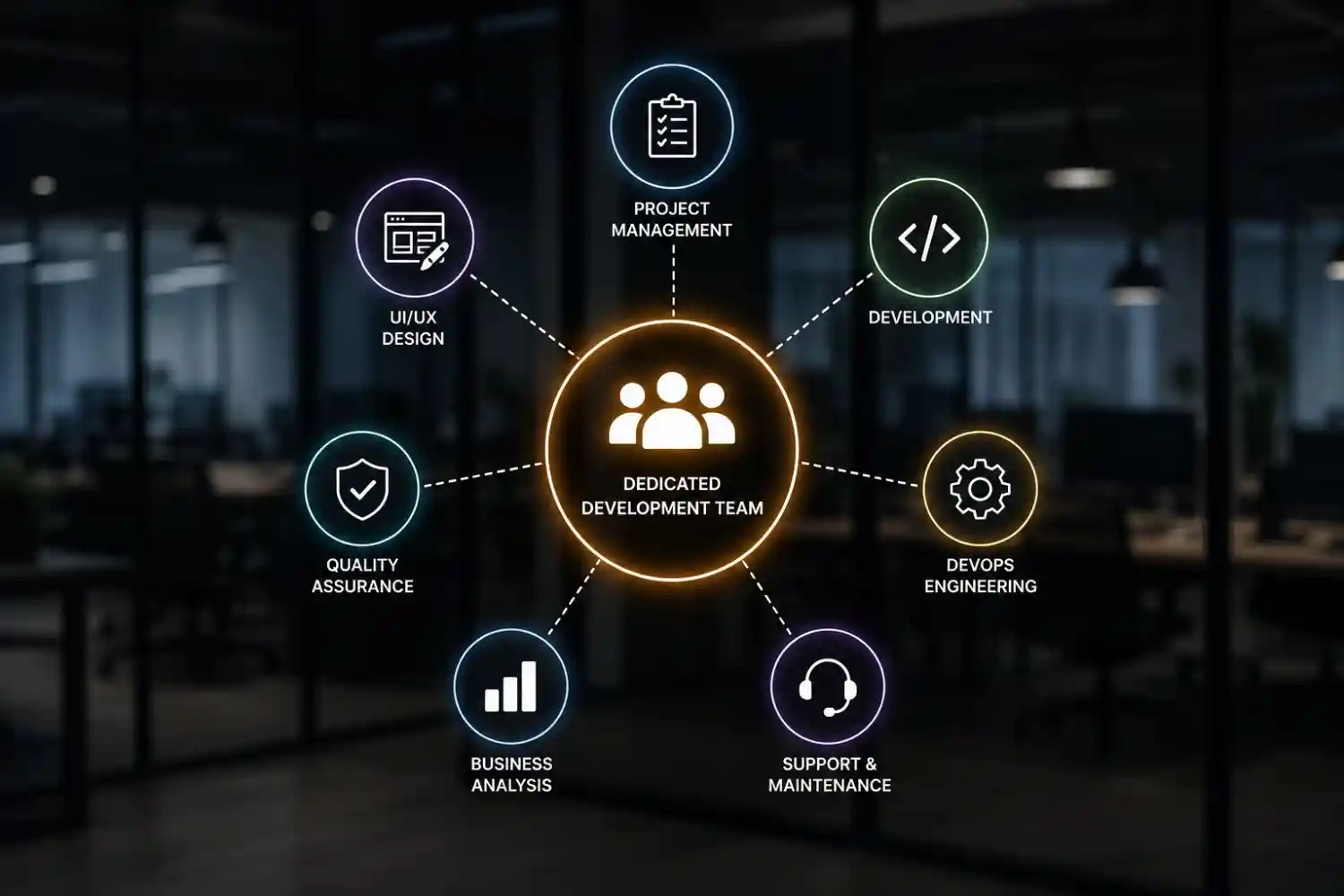
Dedicated development teams and staff augmentation both add external engineering capacity, but they solve different operating problems. Staff augmentation is designed for teams that already have strong internal delivery leadership and need specific skills or extra capacity. A dedicated development team is better suited to an ongoing product or platform roadmap that needs a stable, multi-role unit and continuity across releases.
The practical decision is not “Which model is cheaper?” It is “Who should own delivery, how long will the work continue, and how much internal management capacity do you already have?”
In this guide 14 sections
- Quick comparison: dedicated team vs staff augmentation
- What is staff augmentation?
- What is a dedicated development team?
- The biggest difference is delivery ownership
- Management effort: which model requires more from your internal team?
- How roadmap duration changes the decision
- Dedicated team vs staff augmentation for changing requirements
- Cost model: compare responsibility, not only rates
- When should you use a software project team instead?
- When should you hire individual developers instead?
- Decision checklist
- How does this compare with hiring developers or a project team?
- Frequently asked questions
- Final takeaway
Quick comparison: dedicated team vs staff augmentation
| Factor | Dedicated development team | Staff augmentation |
|---|---|---|
| Best fit | Ongoing product or platform roadmap | Specific skill gaps or temporary capacity |
| Team structure | Stable multi-role product team | Individual specialists added to your team |
| Daily management | Shared delivery structure and agreed governance | Mainly managed by your internal leads |
| Continuity | High across releases and roadmap changes | Depends on assignment duration and retention |
| Knowledge ownership | Designed to accumulate product context over time | Knowledge remains more distributed across your internal team |
| Commercial model | Recurring team-based engagement | Resource-based engagement |
| Change tolerance | Good for evolving product priorities | Good when the work is directed internally |
What is staff augmentation?
Staff augmentation adds external specialists to an existing engineering organization. The client normally retains responsibility for priorities, architecture, task assignment, code review, delivery cadence, and day-to-day coordination.
This model works well when the internal team is already functioning effectively but needs more capacity or a skill that is difficult to hire quickly. Typical examples include adding a backend engineer to relieve a bottleneck, bringing in DevOps expertise for a migration, or adding QA automation capacity during a release cycle.
See our IT staff augmentation services if this is the delivery model you need.
Staff augmentation is usually a good fit when:
- You already have product and engineering leadership.
- Your delivery process, tooling, and architecture decisions are controlled internally.
- You need one or several specialists rather than a complete product team.
- The skills gap is temporary or tied to a defined phase.
- You want direct control over daily work and technical decisions.
What is a dedicated development team?
A dedicated development team is a stable engineering unit aligned to one product, platform, or long-running roadmap. Instead of adding isolated specialists, the engagement is structured around a coordinated team that can include software engineers, QA, DevOps, design, technical leadership, and delivery roles.
The value is continuity. The team learns the codebase, business workflows, release process, integrations, operational dependencies, and architectural history over time. That accumulated context becomes important when the product changes across multiple releases.
Explore our dedicated development team services for ongoing product and platform delivery.
A dedicated team is usually a better fit when:
- Your roadmap extends across multiple releases or quarters.
- The work needs several roles operating as one delivery unit.
- Requirements will evolve as the product grows.
- Architecture, integrations, QA, DevOps, and product knowledge need continuity.
- You want sustained capacity without building the entire team internally.
The biggest difference is delivery ownership
Both models can provide skilled engineers. The more important distinction is who owns the delivery system around those engineers.
With staff augmentation, your internal organization usually remains the operating system for delivery. External specialists join your ceremonies, backlog, code-review process, architecture standards, and management structure.
With a dedicated team, the external partner contributes a more complete delivery unit. Governance is still agreed with the client, but the team is organized around sustained outcomes rather than filling isolated seats.
Management effort: which model requires more from your internal team?
Staff augmentation generally requires stronger internal management capacity. Adding talented engineers does not remove the need to define work, make architecture decisions, review output, coordinate dependencies, and maintain engineering standards.
If your internal engineering leadership already performs those functions well, augmentation can be efficient. If the organization is trying to add a large number of people because the existing team lacks delivery capacity or cross-functional coverage, a dedicated team may be easier to govern.
How roadmap duration changes the decision
Short-term needs often favor augmentation. Long-term product work often favors a stable team.
A three-month need for a Kubernetes specialist is different from a two-year SaaS roadmap involving backend services, frontend applications, APIs, automated testing, cloud environments, analytics, and continuous releases.
The longer the roadmap and the more interconnected the work becomes, the more valuable continuity becomes.
Dedicated team vs staff augmentation for changing requirements
Evolving requirements do not automatically mean one model is superior. The deciding factor is where product and technical decisions will be made.
If your internal product and engineering leads are driving those decisions, augmented specialists can adapt within that structure. If the work requires a coordinated team to own a large portion of the delivery process, a dedicated team is usually the stronger model.
Cost model: compare responsibility, not only rates
Comparing hourly rates alone can be misleading because the two models allocate responsibility differently. Staff augmentation can appear simpler because you pay for named specialists, but your internal organization absorbs more coordination and management effort.
A dedicated team typically carries a team-based recurring cost, but that model can include broader delivery roles and continuity across releases. The right comparison should include internal management effort, onboarding, handoffs, rework, knowledge retention, and the cost of delivery gaps.
When should you use a software project team instead?
There is a third model between individual augmentation and an ongoing dedicated team: a cross-functional team assembled around a defined software initiative.
If the requirement has a clear project or delivery scope but you need developers, QA, design, and technical leadership working together, compare our software development team model.
When should you hire individual developers instead?
If you know the exact role or technology you need and your internal team will manage the work directly, individual hiring may be simpler than either a dedicated team or a complete project team.
See hire software developers for role-based software engineering capacity.
Decision checklist
- Choose staff augmentation when you have strong internal engineering leadership and need targeted skills or temporary capacity.
- Choose a dedicated development team when the roadmap is ongoing, multi-role, and benefits from continuity across releases.
- Choose a project team when the initiative has a defined delivery scope but needs coordinated cross-functional execution.
- Hire individual developers when you already know the role, stack, and management structure required.
How does this compare with hiring developers or a project team?
These two models sit inside a wider set of software delivery choices. If you need specific people by role, compare hiring individual developers vs a software development team. If you need a defined cross-functional project rather than an ongoing roadmap, the project-team model may be more appropriate than a dedicated team.
Frequently asked questions
Is a dedicated development team the same as staff augmentation?
No. Staff augmentation normally adds individual specialists into a delivery structure you already manage. A dedicated team is a stable multi-role unit aligned to an ongoing product or platform roadmap.
Which model gives the client more day-to-day control?
Staff augmentation usually gives the client more direct control because augmented specialists work inside the client’s existing management, backlog, architecture, and delivery process.
Can staff augmentation become a dedicated team later?
Yes. If several augmented roles become long-running, tightly coordinated, and dependent on shared product knowledge, moving to a dedicated-team model can make governance and continuity clearer.
Which model is better for a short-term skills gap?
Staff augmentation is generally the better fit when the need is temporary and the internal team already knows how the specialist will be managed.
Which model is better for a long-running SaaS roadmap?
A dedicated development team is usually the stronger fit when multiple roles need to work together across recurring releases, integrations, operational changes, and product evolution.
Final takeaway
Dedicated development teams and staff augmentation are not competing versions of the same service. They place responsibility in different places. The right model depends on the maturity of your internal engineering organization, the duration and complexity of the roadmap, and whether you need individual capacity or a stable team that can carry product knowledge forward.