To develop a game like Fortnite you need more than a battle royale template. Fortnite's defining mechanics — a real-time building system layered on top of a 100-player shrinking-zone battle, a cross-platform player pool spanning PC, console and mobile, and a seasonal Battle Pass that has generated billions in cosmetics revenue — each require distinct engineering decisions that set this game apart from other battle royale titles.
This guide covers everything you need to build a Fortnite-inspired game: the core mechanics, the Unreal Engine 5 stack it runs on, the development process, the real cost breakdown, and the challenges that make this genre technically demanding.
How this differs from our other battle royale guides: Our PUBG guide covers realistic military simulation with ballistics physics and no building system. Our Free Fire guide covers a mobile-first BR for low-end Android with 50-player lobbies. Fortnite's building mechanic, cross-platform architecture, and Battle Pass model are architecturally different from both — this guide focuses on what makes Fortnite specifically challenging to replicate.
What makes Fortnite different from other battle royale games
Fortnite achieved what no other battle royale has managed: it runs on every major platform simultaneously, operates a free-to-play model that generates billions purely from cosmetics, and built a distinct mechanical identity through the building system. Understanding why it succeeded is the prerequisite for building a game in the same space.
- Building mechanic — the core differentiator: No other battle royale title gives players the ability to build structures during combat. This creates a second skill layer entirely separate from aim — players who master building can outplay superior gunfighters. Your version of this game needs to decide how deeply to implement building. A full build system is architecturally complex; a simplified one risks feeling like a downgrade.
- Free-to-play with cosmetics only: Fortnite generates all its revenue from skins, emotes, and Battle Pass purchases — none of which affect gameplay. This was a deliberate decision that built trust with a broad player base including younger audiences. Any pay-to-win element would have fundamentally changed its trajectory.
- Battle Pass seasonal model: Fortnite popularised the seasonal content model that most live-service games now use. Each season introduces a new Battle Pass with 100 tiers of cosmetic rewards earned through gameplay. This creates predictable revenue, drives daily active user engagement, and gives the game a cultural event cadence (new season = news cycle).
- Cross-platform play: PC, PlayStation, Xbox, Nintendo Switch, and mobile players all share the same lobbies. This required deep investment in cross-platform account systems, input-based matchmaking (controller vs keyboard/mouse), and platform-level certification compliance. It significantly expanded the addressable player pool.
- Creative mode: Fortnite's Creative mode lets players build and share their own maps and mini-games within the Fortnite ecosystem. This transformed a single game into a platform — and spawned a creator economy that keeps content fresh without developer overhead.
Key features to develop in a game like Fortnite
Technology stack for developing a Fortnite-like game
Step-by-step development process for a Fortnite-like game
Key challenges in developing a Fortnite-like battle royale game
Cost breakdown for developing a Fortnite-like game
| Component | Cost range | Notes |
|---|---|---|
| Development team | $50,000 – $200,000 | Lead developer, gameplay engineers, network engineer, UI developer, QA. Team size is the largest cost driver. 6–12 months minimum for an MVP. |
| Game art and design | $30,000 – $150,000 | Character models, weapon assets, environment art, UI design, VFX. Fortnite-style cartoon shading requires fewer poly counts than photorealism but still demands high-quality concept art and rigging. |
| Unreal Engine 5 | Free → 5% royalty | UE5 is free to use. Epic charges 5% royalty on gross revenue above $1M lifetime. For most indie launches this cost is near-zero initially. |
| Dedicated servers | $5,000 – $20,000/month | AWS GameLift or Azure PlayFab per-match server costs at scale. In beta with <1,000 concurrent players the cost is manageable. Scales significantly with player numbers. |
| Audio production | $5,000 – $25,000 | Weapon SFX, ambient sounds, music, UI audio. Fortnite's audio design (weapon feedback, building sounds) is a significant part of the game feel. |
| Anti-cheat integration | $0 (EAC free) | Easy Anti-Cheat is free for UE5 games. Integration engineering time is the main cost. Ongoing cheat monitoring requires a trust and safety team post-launch. |
| Battle Pass backend | $10,000 – $40,000 | Season management, XP tracking, inventory database, currency transactions, item shop rotation. Requires a dedicated backend service separate from game servers. |
| QA and testing | $10,000 – $50,000 | Structured QA including 100-player stress tests, platform certification testing (PlayStation, Xbox each require separate certification), and balance playtesting. |
| Total estimate — MVP BR | $100,000 – $300,000 | PC-only, single region, simplified building system, basic cosmetics. No mobile port, no Creative mode, no console certification. |
| Total estimate — full launch | $300,000 – $1M+ | Cross-platform, multi-region, full building system, live ops team, console certification, Battle Pass system, marketing budget. |
Cost context: Fortnite was built by a team of hundreds over several years with Epic Games' resources. A realistic indie or studio goal is an MVP battle royale with a simplified building system, PC-first, single region — not a feature-for-feature Fortnite clone. Define your scope clearly before budgeting. Our game development team can help scope a realistic MVP based on your budget.
How to make your Fortnite-inspired game stand out
- Rethink the building mechanic: The most obvious path — replicate Fortnite's wood/brick/metal build system — is also the most direct comparison. Consider a different expression: terrain modification instead of placed structures, temporary constructions that decay, or a simplified "one-structure" system that's easier to control on mobile.
- Distinct art style: Fortnite's cartoonish aesthetic is intentional — it allows characters to wear wildly different skins without visual inconsistency. Your game can go darker, more realistic, sci-fi, or heavily stylised. A strong art direction makes screenshots recognisable at a glance. Generic military aesthetics compete directly with PUBG and Warzone, where you will lose on budget.
- Niche theme or setting: A Fortnite-like game set in a specific cultural context (anime, mythology, specific geographic region) can build a dedicated community that a generic game cannot. Several successful Fortnite competitors are themed regionally and outperform Fortnite in those specific markets.
- New game modes: Zero Build mode (Fortnite removed building as an option) was added because players asked for it. A Fortnite-inspired game could ship Zero Build only (simpler to build, broader audience) and add building as a mode post-launch rather than leading with it.
Why choose SDLC Corp to develop your Fortnite-like game
What our clients say about SDLC Corp



FAQ — Developing a game like Fortnite
How much does it cost to develop a game like Fortnite?
A PC-only MVP battle royale with a simplified building system costs approximately $100,000–$300,000 and takes 12–18 months with an experienced team. A full cross-platform launch with console certification, multi-region servers, a Battle Pass system, and live ops pipeline runs $300,000–$1M+. The largest cost drivers are the development team, art production, and ongoing server infrastructure. Fortnite itself was built by a team of hundreds with Epic Games' resources — a realistic indie launch targets a scoped MVP first.
How long does it take to develop a Fortnite-like game?
A simplified PC battle royale with basic building mechanics and 100-player lobbies takes 12–18 months with a team of 8–15 people. A full-featured cross-platform launch matching Fortnite's feature set takes 2–4+ years. Development time is primarily driven by the building system complexity, art volume, and the number of target platforms. Mobile adds 3–6 months of optimisation and control adaptation on top of a PC build.
What game engine is best for developing a Fortnite-like game?
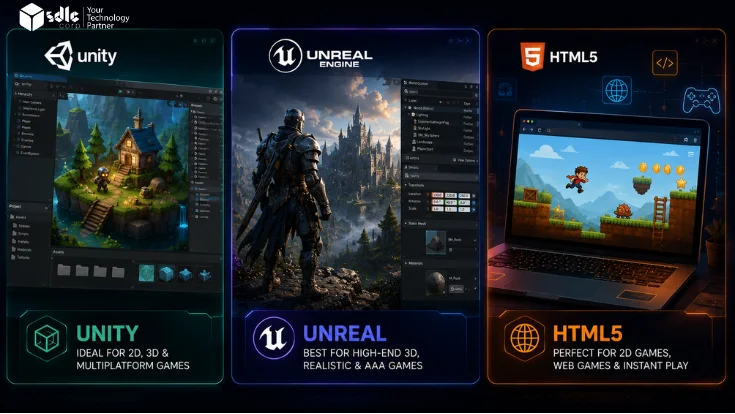
Unreal Engine 5 is the clear choice. Fortnite runs on UE5, Epic's dedicated server tooling is built around UE, Easy Anti-Cheat integrates natively, and Epic Online Services provides cross-platform account management. The UE5 Battle Royale template gives a starting point for core mechanics. Unity is an option for a mobile-first or stylised title where UE5's visual capabilities are not needed and the team has stronger Unity experience.
What is the hardest part of building a Fortnite-like game?
The building system synchronisation. Getting wall placement to feel instantaneous on the local client while staying synchronised across 100 connected players and the authoritative server — without visual desync or exploit opportunities — is the most technically challenging aspect of Fortnite's design. It requires client-side prediction, server reconciliation, and careful network bandwidth management that most game development teams will not have tackled before.
Can I use a Fortnite clone script to build my game?
Clone scripts provide basic gameplay mechanics but require extensive customisation to ship a commercial product. The base mechanics are the smallest part of the development work — the art, balance, live ops pipeline, anti-cheat, Battle Pass backend, and cross-platform account systems all need to be built regardless of the starting script. A clone script is a prototype starting point, not a shortcut to launch.
How do I monetise a Fortnite-inspired game?
Fortnite's model — free to play, cosmetics only, seasonal Battle Pass — is the most proven monetisation approach for this genre. It maximises the player base (no paywall to play), protects competitive integrity (no pay-to-win), and generates predictable recurring revenue through the Battle Pass. In-game currency bundles for cosmetics add a second revenue layer. Avoid loot boxes with gameplay-affecting items — regulatory risk in EU markets and player trust damage are both significant.