
Core Technical Components of a Live Casino API
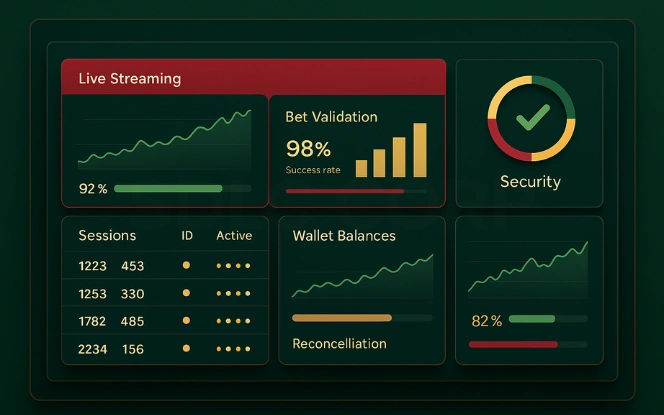
A live casino API integration is more complex than an RNG game integration because it adds real-time video streaming to the game state and wallet requirements. The components that must work together correctly on every session:
| Component | Function | Critical requirement |
|---|---|---|
| Session management | Creates a player session tied to table, currency, and jurisdiction rules | Must include signed token with player ID, table ID, and betting limits — prevents session manipulation |
| Game state synchronisation | Delivers round events (card dealt, wheel spin result) to all connected players simultaneously | All players at the table must see the same game state within 100ms of each other — inconsistency is a fairness issue |
| Video streaming | Delivers encoded video of dealer and game from studio to player device | Adaptive bitrate for varying connection quality; fallback to lower resolution before dropping connection |
| Wallet callbacks | Processes bet debit, win credit, and rollback via callbacks to operator wallet | Idempotency keys and retry-safe callbacks — provider will retry failed callbacks; duplicates cannot create double credits |
| Side bets and features | Additional betting options (Perfect Pairs, Dragon Bonus, etc.) and game features (Squeeze, Speed mode) | Each side bet must be handled as a separate wallet transaction with its own round ID |
| Multi-language and localisation | Dealer language, interface language, currency display | Localisation must be configured at session creation — not patchable mid-session |
Live Games Available Through Casino APIs
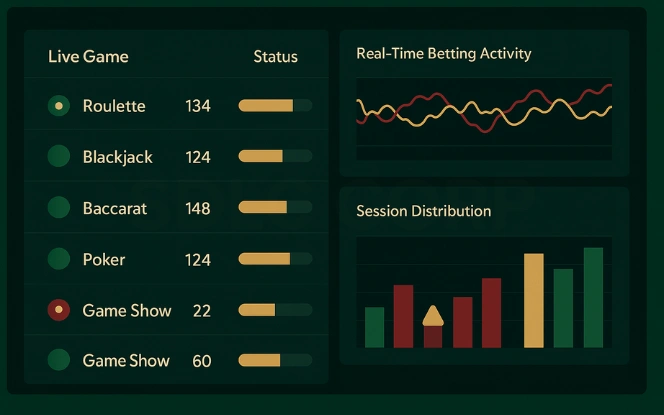
The major live casino API providers cover all standard dealer-led game categories and have expanded significantly into game show formats driven by player demand. When evaluating a provider, confirm certification for each game type in your target jurisdictions — not all games are certified in all markets.
Standard table games
- Blackjack: Classic, Infinite Blackjack (unlimited seats), Speed Blackjack, Free Bet Blackjack. Most common operator request for live casino launch.
- Roulette: European, American, French, Auto Roulette, Lightning Roulette (Evolution). High player demand; multiple table variants required to satisfy different market preferences.
- Baccarat: Standard, Speed Baccarat, No Commission Baccarat, Squeeze. Dominant in Asian markets; standard offering in European markets.
- Poker: Casino Hold'em, Three Card Poker, Ultimate Texas Hold'em. Skill-game element drives higher session lengths.
Game show and multiplier formats
Game show formats have become the fastest-growing live casino category, driving new player acquisition beyond traditional casino audiences. Evolution's Crazy Time, Dream Catcher, Monopoly Live, and Pragmatic Play's Big Bass Bonanza Live are the leading titles. These formats require a separate API module in most providers — confirm availability and certification status before including them in launch plans.
Asian and regional game variants
- Dragon Tiger: Standard in Southeast Asian markets; simple card comparison game with fast round pace
- Sic Bo: Dice-based game popular across Asian markets; high house edge, fast play
- Fan Tan: Traditional bead-counting game; niche but in-demand in Chinese-speaking markets
Business Benefits of Live Casino API Integration
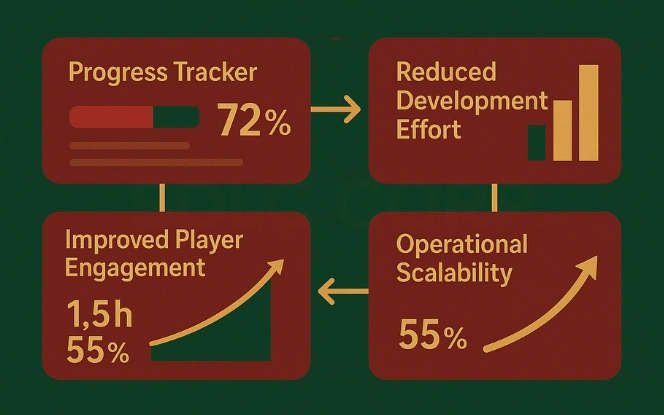
Live casino content has moved from a premium differentiator to an operator baseline expectation. Players who deposit on a casino platform and find no live dealer content have significantly higher churn rates than those who find a well-stocked live lobby. The ROI case for live casino API integration is straightforward:
| Benefit | Impact |
|---|---|
| Player retention | Live dealer sessions are 3–5x longer than RNG game sessions on average. Session length is the primary driver of GGR per player. |
| New player acquisition | Live casino is the primary content category for players converting from land-based casinos. It is the most effective acquisition tool for the highest-LTV player segment. |
| Cross-sell from sportsbook | Sports bettors convert to live casino at significantly higher rates than to RNG casino. Live dealer content is the natural bridge for operators with a sportsbook. |
| Speed to market | API integration provides instant access to hundreds of live tables without building studio infrastructure. A studio from scratch costs $2M+ and takes 18+ months. |
| Regulatory compliance | Tier-1 providers hold certifications across 50+ jurisdictions. Operators inherit this compliance footprint rather than certifying their own studio per market. |
SDLC Corp delivers live casino integrations with wallet-first architecture, correct session handling, and multi-provider support for white-label and custom casino platforms.
How Live Casino API Integration Works — Technical Rollout
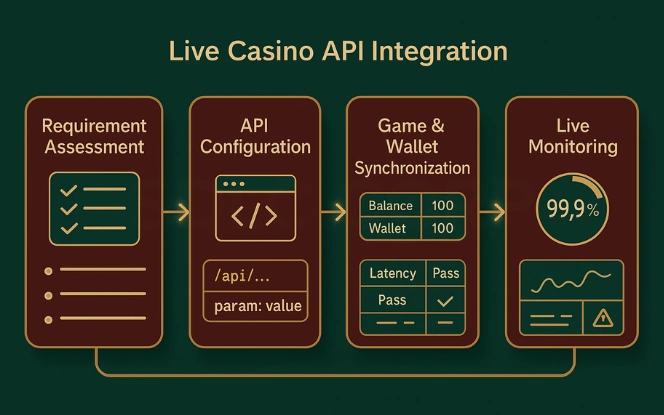
Live casino API integration follows the same phased approach as RNG game integration, with additional complexity for video streaming infrastructure and multi-table session management. A typical integration from contract to go-live takes 6–12 weeks for a single provider.
Phase 1: Commercial and technical scoping
- Confirm game types required, target jurisdictions, and certification requirements per market
- Agree commercial model — revenue share, flat fee, or hybrid. Revenue share is standard for tier-1 providers.
- Review API documentation completeness before signing. A provider who cannot supply a full API reference and sandbox access before contract is a risk.
- Agree wallet callback behaviour, idempotency requirements, and reconciliation report format
Phase 2: Sandbox integration
- Configure sandbox credentials, IP allowlists, and test player accounts
- Implement session token generation — the most common integration error is incorrect signing of session tokens, causing all game launches to fail
- Implement and test wallet callbacks: bet, win, rollback. Test all edge cases in sandbox before touching wallet logic in production
- Validate video streaming embed — confirm adaptive bitrate works correctly on mobile network conditions
Phase 3: Lobby integration
- Ingest live lobby feed — table availability, occupancy, betting limits — updated in near-real-time
- Implement table thumbnail display including live video thumbnail where provider supports it
- Handle table states: open, full, closed for maintenance, opening soon
Phase 4: QA and load testing
- Test concurrent session handling — a live blackjack table with 7 seats has 7 simultaneous wallet callback streams
- Test session expiry and reconnection — player closing browser mid-round must not leave an orphaned bet
- Verify reconciliation: run 24 hours of test transactions and confirm round-level match between platform ledger and provider report
Security and Compliance in Live Casino APIs
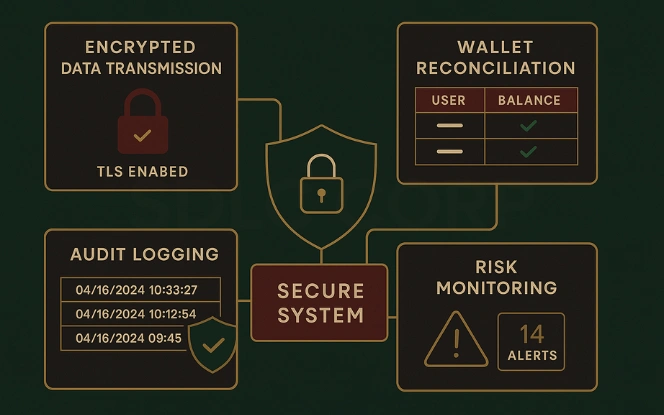
Live casino APIs operate in regulated real-money environments. Security and compliance requirements apply both to the provider (whose studio and API must hold relevant certifications) and to the operator (whose wallet integration and session management must meet platform-level requirements).
Provider-side requirements to verify
- Jurisdiction certifications: Confirm the provider holds active certification for every market where you plan to offer their content. MGA, UKGC, and German GGL certifications each require separate audits — a provider certified for MGA is not automatically certified for UKGC.
- RNG and game fairness certification: Live dealer outcomes are determined by physical processes (cards, roulette wheel) verified by studio cameras. The provider must document their shuffle procedures, dealer training standards, and camera coverage requirements per jurisdiction.
- Data processing agreements: Live casino providers receive player session data. GDPR requires a signed DPA before any personal data flows to a third-party processor.
- SOC 2 / ISO 27001: Request certifications covering the provider's streaming infrastructure and API platform.
Operator-side integration security requirements
- Session token signing — use HMAC-SHA256 or provider-specified algorithm; never transmit unsigned session parameters
- IP allowlisting — only accept wallet callbacks from provider IP ranges; validate on every callback
- Responsible gambling hooks — deposit limits and self-exclusion must be checked before creating a live session, not just at login
- Bet limit enforcement at session layer — the live casino session token must encode the player's current permitted betting limits; do not rely on the provider to enforce operator-specific limits
Performance and Scalability Requirements

Live casino API performance requirements are more demanding than RNG game APIs because video streaming adds a latency-sensitive layer that directly affects player experience. A blackjack player who sees a 3-second delay between the dealer dealing a card and their interface updating is getting a materially worse experience than the dealer's in-person table.
Video streaming performance targets
- Stream latency: WebRTC target under 500ms; HLS with low-latency mode under 3 seconds; standard HLS 3–8 seconds acceptable for RNG-backed live games
- Adaptive bitrate: Provider must support minimum 3 quality levels — mobile (500kbps), standard (1.5Mbps), HD (4Mbps) — with automatic quality switching based on client bandwidth detection
- CDN coverage: Tier-1 providers use global CDN infrastructure for stream delivery. Confirm PoP coverage for your primary player markets before contract — a provider with poor Asian CDN coverage will underperform for Asian player bases regardless of European specifications.
API scalability requirements
- Session creation endpoint must support burst capacity — tournament events can spike session creation 10x normal rate within minutes
- Wallet callback throughput — a popular live roulette table with 200 concurrent players generates 200 simultaneous bet callbacks per round (every 30–60 seconds)
- Lobby feed update frequency — live lobby occupancy and table status must update at least every 30 seconds; stale lobby data drives player frustration
Common Integration Challenges
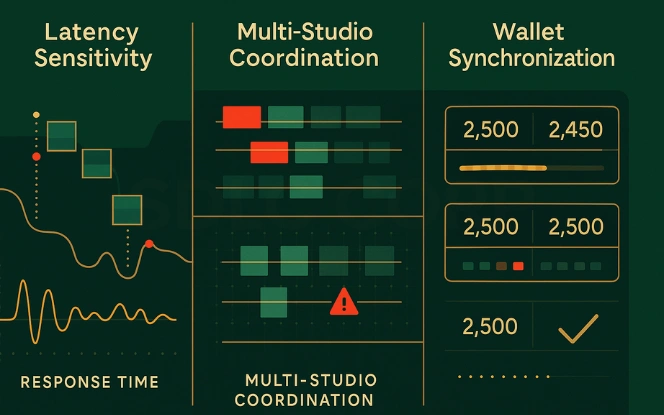
Even with a well-documented provider API, live casino integrations surface specific challenges that purely technical documentation does not capture. Teams that have done multiple live casino integrations recognise these patterns before they become production incidents:
Session token expiry during long sessions
Live casino sessions can last 2–4 hours for engaged players. If the session token expires mid-session, the player loses their game state and any active bets are left in an unresolved state. Implement automatic token refresh at 80% of the token TTL — do not wait for the player to trigger a refresh by interacting with the game.
Concurrent bet callbacks from multi-seat blackjack
Infinite Blackjack and multi-seat table games can generate 3–7 simultaneous bet callbacks for a single player (one per seat). Your wallet service must handle these as separate idempotent transactions, not as a single combined bet. Idempotency keys must be unique per seat per round — not per player per round.
Network disconnection mid-round
When a player's connection drops mid-round, the bet has already been debited. The provider will settle the round regardless. The operator's reconnection flow must query the active round state on reconnect and reconcile the wallet if the settlement callback was missed. Build an explicit "check active bets on reconnect" flow — do not rely on the player refreshing and the provider resending callbacks.
Lobby cache staleness
A cached lobby showing a table as "open" when it is actually at capacity causes player frustration. Set lobby cache TTL at 30 seconds maximum and implement server-push updates where the provider supports webhooks for table state changes.
SDLC Corp has integrated live casino APIs for operators across MGA, UKGC, and Asian markets. We handle session management, wallet architecture, lobby integration, and full go-live testing.