
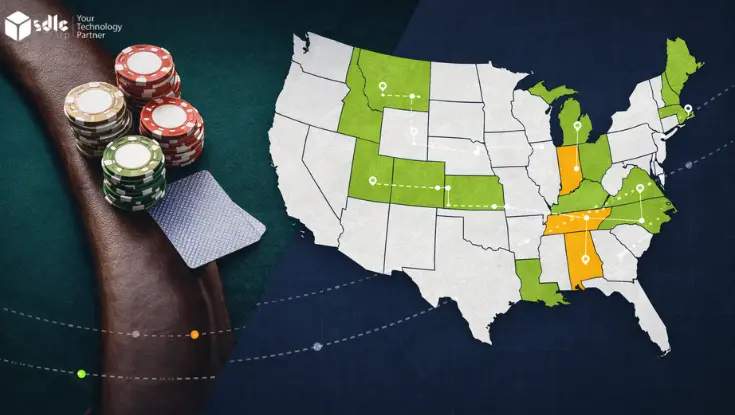
US iGaming compliance is easier to manage when you treat it as a product problem, not a legal task left for the end. A launch is only ready when identity checks, location controls, wallet flows, responsible gambling tools, and reporting rules work the way your approved state scope says they should.
This guide is for operator teams, product owners, engineering leads, payments teams, and compliance managers preparing for launch. It focuses on what you need to map, build, test, document, and prove before real-money traffic goes live.
Quick answer: a US iGaming launch is ready when state scope is locked, KYC and geolocation are enforced before money or play, AML monitoring links identity to wallet and gameplay, responsible gambling controls work at platform level, and your logs can reconstruct any player session on demand.
What launch-ready looks like
You are launch-ready when you can:
- Explain exactly which states, products, partners, and channels are in scope.
- Show that KYC, age checks, geolocation, AML, and responsible gambling work end to end.
- Export clear audit trails with stable IDs, timestamps, and change history.
- Show who owns each control, who approves changes, and how failures are escalated.
Build your jurisdiction matrix first
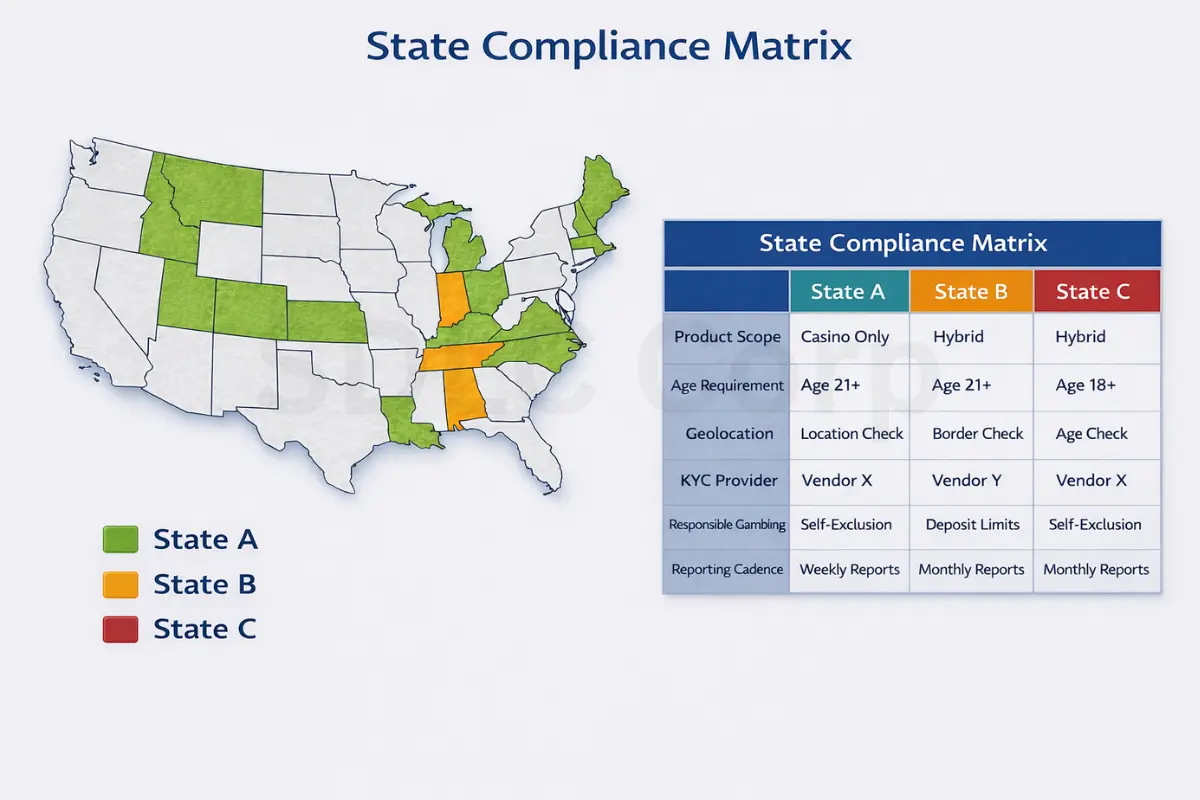
Do not start with a “default” national flow. Start with a jurisdiction matrix. In the US, the rule set is different enough by state that late patching creates avoidable risk in onboarding, payments, marketing, and reporting.
As of March 2026, legal online casino play is live in New Jersey, Pennsylvania, Michigan, Connecticut, West Virginia, Delaware, and Rhode Island. Maine has authorized internet gaming, but rollout still depends on rulemaking and licensing. That means your market map should cover both live states and near-term expansion states from day one.
If you are still comparing launch order and approval workload, our guide to securing a gambling license for online casino apps is the best follow-on read.
Each state line in the matrix should include:
- Product scope: casino, poker, sportsbook, or a limited mix.
- Operating model: commercial, tribal, lottery-led, or partner-based.
- Age and identity rules: onboarding depth, hard blocks, manual review, and re-verification triggers.
- Geolocation rules: when checks run, when they repeat, and how border cases are handled.
- Wallet and payment limits: deposits, withdrawals, payment methods, and exception handling.
- Responsible gambling rules: limits, cooling-off, self-exclusion, reality checks, and enforcement scope.
- Reporting and incident duties: who gets notified, when, and with what evidence.
- Vendor constraints: approved labs, KYC tools, geo vendors, PSPs, and hosting limits.
US iGaming state overview
New Jersey ›
Pennsylvania ›
Michigan ›
Connecticut ›
West Virginia ›
Delaware ›
Rhode Island ›
Maine ›
Assign control ownership early
Strong control design starts with ownership. A checklist is not enough if nobody owns the live workflow behind it.
Compliance should own rule interpretation and regulator response. Engineering should own control logic, event logging, and evidence exports. Payments teams should own cashier risk, settlement, chargebacks, and exception review. Support should own self-exclusion handling, player messaging, and escalation paths.
Keep approvals simple but strict: define who can change limits, risk rules, payout settings, and vendor configurations, then make those changes visible in audit history.
Go-live controls that must work end to end
Licensing and scope ›
Identity and age checks ›
Geolocation ›
Wallet and payments ›
AML and fraud monitoring ›
Responsible gambling ›
Audit trail and change control ›
Use GLI-19 as a proof framework
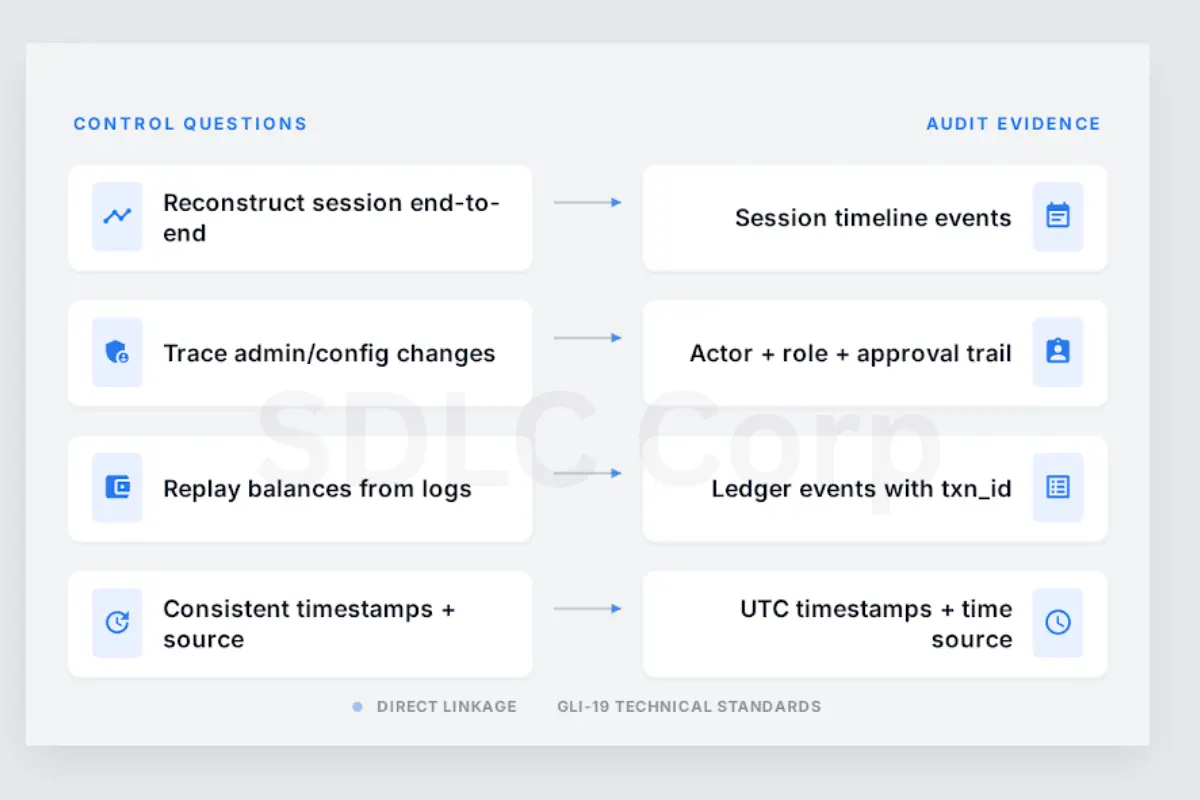
Many jurisdictions and labs use GLI standards as a starting point for interactive gaming controls. Use GLI-19 the same way your internal reviewers will use it: as a proof framework that asks whether you can explain, trace, and reconstruct what happened.
The fastest way to fail a review is to have a control that exists in a policy file but does not leave usable evidence in the product.
Use these questions before certification and before go-live:
- Can you reconstruct a player session from login to wager to payout?.
- Can you tie an admin or configuration change to a person, approval, and timestamp?.
- Can you replay wallet balances and transaction history without gaps?.
- Can you show which rule version or configuration was active at the moment a decision was made?.
Logging coverage to support
Good logs answer reviewer questions quickly. They are structured, consistent, and easy to export. They do not rely on screenshots, free-text notes, or one team remembering what another team changed.
- Player lifecycle events: registration, verification changes, lockouts, and account status.
- Session events: login, logout, timeout, device change, and error state.
- Wallet events: deposits, withdrawals, reversals, balance changes, bonuses, and adjustments.
- Gameplay events: game launch, wager request, wager result, interruption, and resettlement.
- Risk and control events: AML alerts, geolocation outcomes, responsible gambling actions, and payment exceptions.
- Admin and release events: configuration edits, approvals, build versions, and release timestamps.
Geolocation evidence
Geolocation is not just a pass-or-fail gate. It is proof that you enforced state boundaries at the right moments and handled uncertainty the right way.
When to check location
Run geolocation checks when access, money movement, or wagering risk changes:
- At login or session start.
- Before deposits and withdrawals.
- Before the first wager or gameplay session.
- During play at sensible intervals, especially near borders or after network changes.
- Whenever device, browser, network, or GPS signals change in a way that affects confidence.
What to keep for review
Store the decision result, method used, confidence or quality signal, state outcome, reason for denial, re-check trigger, and the exact message shown to the player. If location cannot be confirmed, block the regulated action and show a next step that helps the player fix the issue instead of guessing.
For a broader view of recurring launch issues, see our article on regulatory compliance challenges in the iGaming industry.
AML signals
AML monitoring works best when identity, wallet, and gameplay signals meet in one pipeline. Looking at deposits alone leaves too much context behind.
Build one event stream that normalizes signals from KYC, cashier, gameplay, device, and account behavior. Score activity with rules or models, create a clear case workflow, and preserve the reason codes and reviewer actions that explain each outcome.
- Identity events: registration, login changes, document reviews, manual review outcomes, and device changes.
- Wallet events: deposit attempts, failures, successes, withdrawals, reversals, chargebacks, and unusual funding patterns.
- Gameplay events: wager spikes, unusually short sessions, rapid balance swings, and bonus-related patterns.
- Case events: alert creation, reviewer assignment, escalation, disposition, and report export.
Responsible gambling at the platform layer
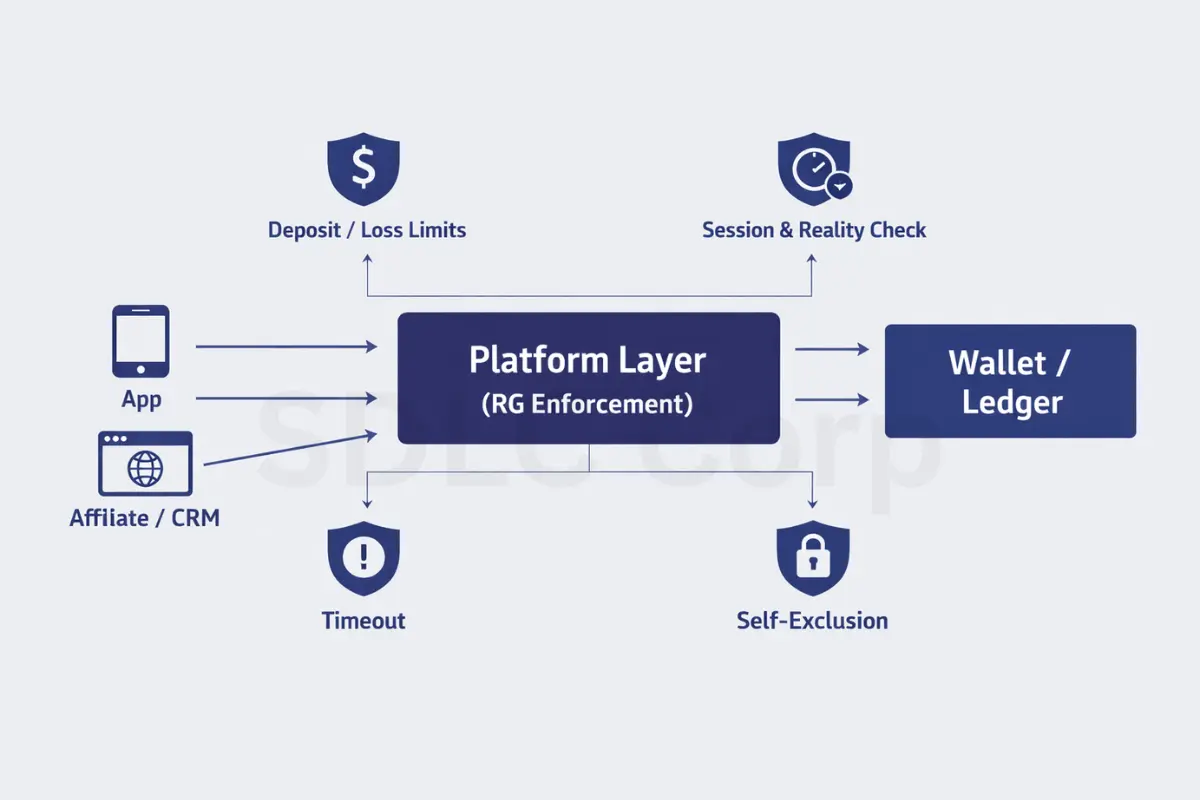
Responsible gambling controls should live in the platform and wallet layer, not only in the interface. If a user can bypass a limit by switching surface, skin, or device, the control is not finished.
- Deposit, loss, and session limits with clear timing logic.
- Cooling-off tools and full self-exclusion workflows.
- Reality checks and clear status messages at the right moments.
- Suppression rules for bonuses, marketing, and reactivation attempts when a player is restricted.
Keep the full history: requests, approvals, effective dates, enforcement logs, and every blocked action tied to the rule that triggered it.
Audit trails that stand up to review

Auditors usually ask one simple question: can you reconstruct what happened? Build your audit model to answer that fast.
Use stable player, session, transaction, and correlation IDs across services. Keep timestamps consistent, keep core events append-only, and store rule versions and build versions with the decisions they shaped.
Teams building a new stack from scratch can also review our iGaming software development overview to map account, wallet, and game services cleanly before launch.
Final pre-launch drill
The final two weeks before launch should feel like a controlled pressure test, not a content review. Test real failure paths, not only happy paths.
- Confirm state scope and partner configuration in the live release candidate.
- Test KYC pass, fail, retry, manual review, and timeout paths.
- Test geolocation near borders, on weak signals, and after device or network changes.
- Test deposit, withdrawal, reversal, and exception flows in the cashier.
- Test responsible gambling limits, cooling-off, self-exclusion, and blocked-action messaging.
- Run an audit export drill: one player, one session, one payment trail, one admin change, one risk case.
- Verify who gets alerted when a control fails and how quickly the issue is contained.
After launch, review thresholds, admin access, payment exceptions, vendor health, and blocked-user events every week. Most compliance drift starts after launch, not before it.
Conclusion
US iGaming launches go well when the control design is clear before traffic starts. Lock the state matrix first, connect KYC to geolocation and wallet flows, enforce responsible gambling at platform level, and make sure your logs can explain every decision without guesswork.
FAQs
How many US states have legal online casino play right now?
As of March 2026, legal online casino play is live in New Jersey, Pennsylvania, Michigan, Connecticut, West Virginia, Delaware, and Rhode Island. Maine has authorized internet gaming, but it is not live yet because rulemaking and licensing still need to be completed.
What does state-by-state compliance mean in practice?
It means one national rule set is not enough. You need a versioned matrix that maps product scope, onboarding rules, geolocation logic, responsible gambling controls, reporting duties, and approved vendors for each state you serve.
What logs matter most before go-live?
Keep logs that let you reconstruct player identity decisions, session flow, geolocation outcomes, wallet movement, gameplay events, admin actions, rule versions, and release history. If a reviewer cannot follow the sequence quickly, the log is not good enough yet.
What geolocation evidence should operators store for audits?
Store the result, method, confidence signal, denial reason, re-check trigger, state outcome, and the exact player-facing message. The goal is to show not just that a control fired, but why it fired and what happened next.
How do KYC and AML work together in iGaming?
KYC defines what you know about the player and what activity you allow. AML monitors how that account behaves over time. The two work best when identity, payments, device data, and gameplay signals feed one case workflow.
Which responsible gambling controls must work at platform level?
Deposit limits, loss limits, cooling-off, self-exclusion, and blocked-user suppression should all be enforced in shared platform and wallet services. That prevents players from bypassing controls by switching app, channel, or skin.