
AI in NGO ERP connects operational records to practical decisions: which grants need attention, which costs are unusual, which donors need follow-up and which reports are at risk. It should operate within the same permissions and decision boundaries as the underlying system. A suggested action is different from an authorised payment, grant amendment or approved report.
Start with the task and its failure consequences. A useful assistant saves review effort while leaving the evidence and accountable decision visible. A fluent answer without traceable inputs can increase work for finance and programme teams.
Each AI task has a reviewable decision
For broader context, see AI in ERP. Inside NGO workflows, the useful distinction is whether an answer joins authorised grant, finance and programme records and gives the owner evidence for a decision.
| Task | Input And AI Output | Human Decision | Evidence To Retain |
|---|---|---|---|
| Finance coding and matching | Structured transaction plus ERP context becomes proposed coding and exceptions | Approve the account, grant allocation and resolution | Supplier, order, receipt, budget and reviewed entry |
| Record search | Permitted question returns relevant records | Assess whether records answer the question | Record references and query scope |
| Exception detection | Transactions become a prioritised review list | Investigate before alleging error or misconduct | Trigger, investigation and disposition |
| Donor prioritisation | Permitted giving history informs suggestions | Review suitability and communication preferences | Reasons, overrides and campaign outcome |
| Reporting assistance | Approved figures inform draft narrative | Verify claims and authorise release | Source versions, edits and approval |
The workflow determines the controls. AI finance coding, matching and approvals needs accounting, procurement and funding context, while donor intelligence needs appropriate use of relationship data. Neither is established by a generic claim that a platform “has AI.”
An unspent budget needs evidence before explanation
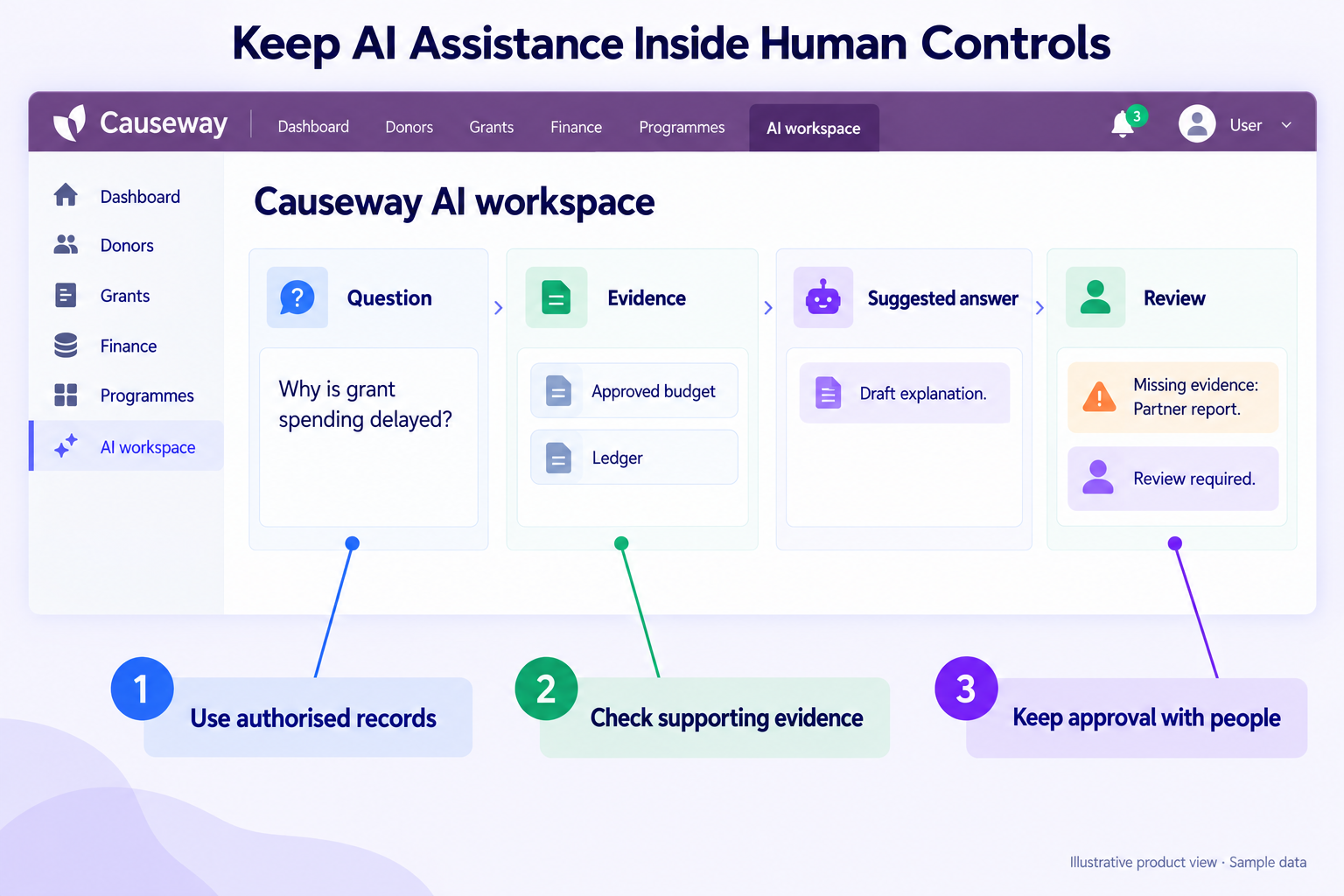
Consider a programme manager asking why a grant has unspent budget. The assistant retrieves permitted budget and expenditure records for the selected period. It proposes a variance explanation with references to those records. The manager checks whether late partner submissions or a changed delivery schedule explain the position.
If the evidence only shows underspending, the answer must not invent a cause. The reviewer can mark the explanation incomplete and request the missing partner report. Approval of a narrative does not change the award budget or authorise reallocation.
The same distinction matters in AI-assisted grant reporting: retrieving an amount, explaining an amount and proving a programme outcome require different evidence.
Causeway AI across the NGO operating model
Causeway AI spans finance, grants, donors, programmes, procurement, beneficiary and case work, compliance, executive analytics and workflow agents. AI capabilities are included in the platform, with usage and infrastructure boundaries defined for the chosen arrangement. Evaluate each area against the operational decision it needs to support.
| Causeway AI Area | Question For A Workflow Demonstration |
|---|---|
| Finance Intelligence | Can the reviewer trace a financial answer to its transactions? |
| Grant Intelligence | Are award terms and amendments preserved in recommendations? |
| Donor Intelligence | Are giving context and contact preferences respected? |
| Programme Intelligence | Can programme findings be traced to defined indicators? |
| Procurement Intelligence | Do recommendations preserve procurement and payment approval boundaries? |
| Beneficiary / Case Assistance | Can case staff review suggestions without exposing restricted personal records? |
| Compliance Intelligence | Is every suggestion tied to an applicable rule and responsible reviewer? |
| Executive Analytics | Do summaries preserve the reporting period, definitions and underlying evidence? |
| Workflow Agents | Which actions are permitted, which require approval, and how are failures recovered? |
For Workflow Agents, distinguish a suggested next step from an executed action. Establish permitted tools, approval points, activity records and recovery behaviour for the particular workflow. A category name alone does not define transaction authority.
Which grants need attention in the next 30 days?
A grant owner asks: “Which grants have reports due within 30 days and unresolved financial exceptions?” The useful workflow combines award records, reporting deadlines, current budgets, expenditure, open commitments and exception status within that user's access.
| Grant In The Worked Dataset | Deadline | Financial Exception | Expected Treatment |
|---|---|---|---|
| EDU-01 | In 12 days | Unmatched invoice INV-01 | Include with owner and source link |
| HLT-02 | In 24 days | Partner advance awaiting acceptance | Include with missing evidence identified |
| WAT-03 | In 45 days | Budget variance under review | Exclude from the 30-day result |
| EDU-04 | In 18 days | No unresolved financial exception | Exclude from this combined query |
The result is a focused queue, not every open grant. EDU-01 links to its reporting calendar, invoice and order; HLT-02 links to the advance and partner submission. The grant owner assigns the next action, and finance resolves the accounting exception. The AI does not approve expenditure or alter a deadline.
Use a fixed as-of date and a defined timezone for the test. A deadline that changes during the review should be shown with its current version. A restricted grant must not appear merely because an administrator indexed it earlier. These details determine whether the answer can be used in a real weekly grant meeting.
Programme and procurement intelligence in one decision
Another question asks which procurement commitments will exceed a programme's grant budget. In a worked record, budget is $50,000, posted expenditure $32,000 and open commitments $14,000. The remaining capacity is $4,000. A proposed $6,000 order would exceed it by $2,000 before any authorised amendment.
The useful output names the grant line, current budget version, existing commitments and proposed order. The programme manager can change the delivery plan; the grant owner can seek a valid amendment; procurement can hold the order. A forecast supports that decision but does not create funding authority.
Executive Analytics can then present the same position at programme or entity level, preserving currencies and periods. This is the value of connected NGO ERP intelligence: the explanation and the operational record share the same context.
AI answers must respect the user's access
Test the assistant with restricted records, former staff accounts and prompts requesting cross-country detail. The response and its source links should respect the user's effective permission. Include cached results, exports and service logs in the test; access can leak through more than the answer text.
Treat instructions found inside uploaded documents as document content, not authority to change permissions or execute transactions. Keep transaction approvals outside the model's text output unless a separately designed, authorised workflow controls the action. Specify these boundaries in the ERP security requirements.
Accepted results are the useful quality measure
Build a representative test set with an independently reviewed expected result. Include missing evidence, ambiguous questions and records the user must not access. Separate retrieval failures from reasoning errors and permission failures so the corrective action is clear.
Track supported-answer rate, reviewer correction rate and time to an accepted result. Define the denominator, task mix and review method. An answer that requires lengthy correction should not count as a successful time saving merely because it appeared quickly.
NIST's voluntary AI Risk Management Framework offers a structure for governing, mapping, measuring and managing AI risks. Use it to organise responsibility and monitoring rather than treating a framework reference as a product certification.
Keep deployment changes reviewable
Record which model, retrieval configuration and data sources produced the answer. Repeat important tests after changes and retain a way to disable the affected workflow. Assign a person to investigate complaints and withdraw a misleading output before it becomes operational evidence.
Record which model or service version, permitted sources and access rules produced the accepted result. For a proposed change, rerun the same grant-deadline question with an ordinary user, a restricted user and a record with missing evidence. Compare the returned grants, cited sources and unresolved exceptions with the expected results. If the new version exposes a restricted award or hides an exception, stop the release and retain the previous working route. The release owner records the decision and the evidence; a more fluent answer is not sufficient acceptance.
Conclusion
Good ERP assistance connects a specific task to authorised data, a reviewable output and an accountable human action. Choose workflows that can be tested, preserve their evidence and measure the effort required to obtain an accepted result.
Explore governed AI with Causeway
Explore Causeway AI using a grant-deadline question, a budget exception and the source records behind each answer. AI capabilities are included within the global NGO operating platform. Bring the reporting period, user roles and expected actions so the demonstration can show how finance, grants and programme context support a decision, with the responsible person retaining approval authority.




