AI is transforming ERP systems into intelligent platforms that can forecast outcomes, detect exceptions, generate recommendations, and automate controlled workflows. In addition, predictive analytics, embedded copilots, and AI agents are improving operations across finance, procurement, manufacturing, supply chain, and HR.
Successful adoption also depends on data quality, integrations, governance, security, and human oversight. Accordingly, this guide explores the leading AI in ERP trends for 2026, their practical applications, business value, readiness requirements, and implementation considerations.
Quick answer: The leading AI in ERP trends for 2026 include embedded AI copilots, agentic workflows, AI-powered decision intelligence, predictive and prescriptive analytics, intelligent process automation, industry-specific AI models, AI-enabled IoT operations, and stronger AI governance across core ERP modules . In addition, cloud ERP, trusted enterprise data, composable integrations, and cybersecurity serve as foundational enablers that support enterprise AI adoption. Therefore, organizations should prioritize AI initiatives according to business value, process maturity, data readiness, autonomy level, and governance requirements.
Key Takeaways
- Prioritize AI in ERP initiatives based on measurable business value, process maturity, and data readiness.
- Treat AI copilots and AI agents differently because greater autonomy requires stronger governance and accountability.
- Strengthen ERP data, workflows, integrations, identity controls, and security before deploying predictive AI or autonomous operations.
- Start with bounded AI use cases that can be validated before scaling across the enterprise.
How These AI in ERP Trends Were Evaluated
Click to read the full methodology
How These AI in ERP Trends Were Evaluated
Each AI in ERP trend was evaluated according to product availability, ERP workflow integration, enterprise adoption maturity, supported business use cases, autonomy level, data dependency, implementation complexity, validation requirements, and governance risk. Specifically, the trends are classified as Established, Scaling, or Emerging:
- Established: Available for broad enterprise deployment with documented use cases and implementation patterns.
- Scaling: Increasingly available across ERP platforms but still dependent on platform maturity, data readiness, or process standardization.
- Emerging: Best suited for controlled pilots because functionality, governance models, or enterprise adoption remain limited.
Each trend also has a strategic role:
- AI Foundation: Capabilities required to support trusted and secure AI.
- Assistive Capability: AI that helps users retrieve information, analyze data, or prepare actions.
- Decision-Support Capability: AI that forecasts outcomes and recommends business responses.
- Controlled Autonomous Capability: AI that performs bounded actions under defined policies and oversight.
Because enterprise AI capabilities evolve rapidly, this guide should be interpreted alongside the latest official ERP vendor release notes and product documentation. In addition, organizations evaluating AI capabilities should verify feature availability through official vendor documentation such as Microsoft Dynamics 365 ERP solutions , SAP Joule, Oracle Fusion Applications AI, and Oracle NetSuite AI, since functionality, licensing, deployment models, and regional availability may differ across ERP platforms and release cycles.
Why These AI in ERP Trends Matter in 2026
These trends were selected based on four evaluation factors: publicly documented ERP platform roadmaps, enterprise adoption maturity, AI capability readiness, and recurring investment priorities across finance, supply chain, ERP for manufacturing, and operations. Instead of ranking technologies by popularity, this guide focuses on AI capabilities that enterprises can realistically evaluate, pilot, or scale during ERP modernization initiatives.
Moreover, each trend is assessed based on its business value, implementation complexity, governance requirements, and operational readiness, so decision-makers can prioritize investments based on practical adoption rather than market hype. They should also compare ERP system types and deployment models because AI availability, integration options, and operating responsibilities differ across cloud, on-premise, and hybrid environments.
AI in ERP Trends at a Glance
Specifically, this matrix helps enterprise leaders compare AI in ERP trends according to adoption maturity, strategic role, business application, and implementation complexity. The classifications should not be interpreted as universal ratings because maturity may vary by ERP platform, industry, geography, deployment model, and the quality of an organization's data and process foundations.
| AI in ERP trend | Adoption maturity | Strategic role | Best suited for | Complexity |
|---|---|---|---|---|
| AI Copilots | Scaling | Assistive Capability | Knowledge workers and business users | Medium |
| Agentic AI in ERP | Emerging | Controlled Autonomous Capability | Bounded cross-functional workflow execution | High |
| AI-Powered Decision Intelligence | Scaling | Decision-Support Capability | Inventory, pricing, procurement, production, and finance decisions | High |
| Cloud ERP for AI Deployment | Established | AI Foundation | Organizations modernizing legacy ERP environments | Medium |
| AI-Driven Process Automation | Established | Assistive Capability | High-volume, rules-based business processes | Medium |
| Trusted ERP Data for AI | Established | AI Foundation | Cross-functional analytics, forecasting, and AI initiatives | High |
| AI, IoT, and ERP Integration | Scaling | Decision-Support Capability | Manufacturing, logistics, and asset-intensive operations | High |
| Predictive and Prescriptive AI | Scaling | Decision-Support Capability | Forecasting, planning, risk detection, and operational optimization | Medium |
| Industry-Specific AI in ERP | Scaling | Assistive Capability | Businesses with specialized processes and regulatory requirements | Medium |
| AI Security in ERP | Established | AI Foundation | Security, compliance, identity, and operational risk management | High |
| AI Governance and Oversight | Scaling | AI Foundation | Organizations deploying AI across material business processes | High |
| AI-Enabled Sustainability Analytics | Emerging | Decision-Support Capability | Emissions analysis, supplier assessment, and ESG reporting | Medium |
Established broad deployment Scaling platform-dependent Emerging pilot-stage
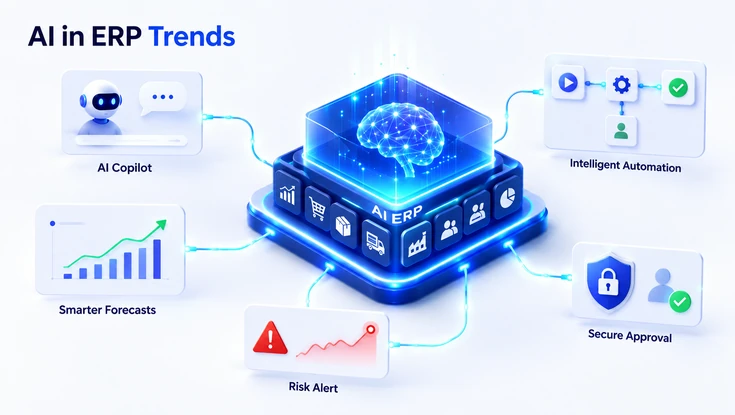
Visual Overview of AI in ERP Trends
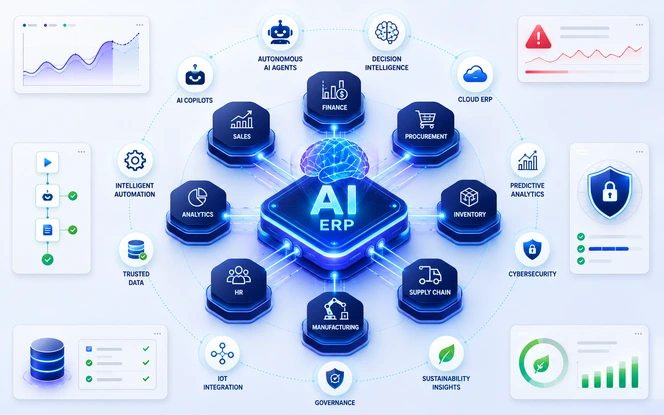
Visual overview of the leading AI capabilities transforming ERP platforms and enterprise operations in 2026.
12 AI in ERP Trends Shaping Enterprise Operations in 2026
AI assistance, autonomy, and cloud intelligence
AI Copilots Transform Everyday ERP Work
For example, AI copilots simplify ERP work with natural-language queries, summaries, variance analysis, and guided actions. See the SAP Joule AI assistant.
For instance, a finance leader asks why operating margins declined and receives an explanation supported by approved ERP data.
Governed enterprise data, shared business definitions, role-based permissions, and response validation.
However, AI responses are only as reliable as the quality, security, and governance of the underlying ERP data.
Agentic AI Expands Autonomous ERP Operations
Meanwhile, agentic AI monitors business events, triggers workflows, and completes approved ERP tasks within defined policies and controls.
For example, an AI agent identifies delayed purchase orders, recommends alternate suppliers, and escalates exceptions for approval.
Decision boundaries, approval thresholds, audit logging, escalation paths, and human oversight.
However, poor governance can weaken segregation of duties and increase operational or compliance risks.
AI-Powered Decision Intelligence Becomes Embedded in ERP
In addition, decision intelligence combines ERP data, predictive analytics, and rules to recommend actions. See Oracle Fusion Applications AI.
For example, an operations manager receives AI recommendations to rebalance inventory before stock shortages occur.
High-quality data, measurable business KPIs, trusted AI models, and defined decision ownership.
However, recommendations should support, not replace, business judgment for high-impact decisions.
Cloud ERP Accelerates Enterprise AI Adoption
Similarly, cloud ERP speeds AI adoption with embedded services and continuous updates. Start by choosing the right ERP system for long-term fit.
Finance adopts cloud ERP to enable AI-powered forecasting while manufacturing continues operating on a specialized production platform.
Cloud migration planning, integration architecture, release governance, and customization assessment.
However, moving to the cloud without simplifying legacy processes limits AI's long-term value.
Automation, trusted data, and connected operations
AI-Driven Automation Expands Across Business Processes
In addition, AI automates exceptions across finance, orders, procurement, and inventory. ERP and CRM integration workflows connect operational data.
For example, AI processes invoices, validates exceptions, routes approvals, and prepares payments with minimal manual intervention.
Standardized workflows, exception management, measurable process baselines, and governance.
However, automating inefficient processes can increase operational inefficiencies at scale.
Trusted Enterprise Data Powers AI in ERP
Therefore, trusted AI depends on standardized master data, governed metadata, and consistent business definitions across ERP processes.
For example, finance and operations generate identical profitability reports using centralized master data.
Data ownership, master-data governance, quality controls, integration standards, and continuous monitoring.
However, AI may generate confident but inaccurate recommendations when enterprise data is inconsistent.
AI Combines IoT and ERP for Real-Time Operations
Meanwhile, AI connects IoT telemetry with ERP transactions to detect anomalies, predict failures, and support real-time operational decisions.
AI detects abnormal equipment behavior and automatically schedules preventive maintenance before production is interrupted.
Secure device connectivity, event filtering, integration architecture, and operational governance.
However, excessive sensor data without filtering can reduce AI accuracy and increase integration complexity.
Predictive and Prescriptive AI Improve Business Decisions
Predictive AI forecasts likely outcomes, while prescriptive AI recommends the best response using optimization and scenario analysis.
AI predicts supplier delays and recommends inventory adjustments before customer orders are affected.
Reliable historical data, continuous model monitoring, and accountable business ownership.
Therefore, AI models require ongoing validation as business conditions evolve.
Industry AI, security, governance, and sustainability
Industry-Specific AI Delivers More Relevant ERP Insights
In addition, industry-specific AI improves sector workflows and compliance. Compare ERP platforms for small and mid-size businesses by fit and readiness.
For example, a pharmaceutical manufacturer uses AI to monitor batch traceability, compliance documentation, and quality deviations.
Validate whether AI capabilities are native, configurable, partner-developed, or dependent on third-party services.
However, industry-specific AI should be evaluated alongside integration, localization, and governance requirements.
AI Security and Cybersecurity Become Enterprise Priorities
Moreover, ERP security must cover AI models, prompts, APIs, agents, integrations, identities, and traditional access controls.
For example, an AI procurement agent reviews contracts and detects pricing anomalies but cannot approve high-value contracts. Human approval remains mandatory.
Least-privilege access, identity governance, continuous monitoring, audit logging, and periodic permission reviews.
Consequently, expanding AI capabilities increases the potential impact of excessive permissions and insecure integrations.
AI Governance Becomes Essential for Enterprise ERP
Therefore, AI governance defines accountability, validation, monitoring, and human oversight. Use the NIST AI Risk Management Framework as guidance.
For example, an enterprise defines which procurement decisions AI may recommend, automate, or escalate to management.
Governance policies, documented autonomy levels, audit trails, continuous monitoring, and executive ownership.
However, unclear governance can reduce transparency and accountability for AI-driven decisions.
AI Improves Sustainability and ESG Reporting
Finally, AI combines ERP, supplier, logistics, and environmental data to identify emission patterns and recommend operational improvements.
AI combines procurement, transportation, and supplier data to identify opportunities for reducing carbon emissions.
Traceable data sources, standardized calculation methods, supplier collaboration, and governance.
AI can only produce reliable ESG insights when sustainability data is complete, accurate, and consistently governed.
AI-Enabled ERP Adoption Roadmap
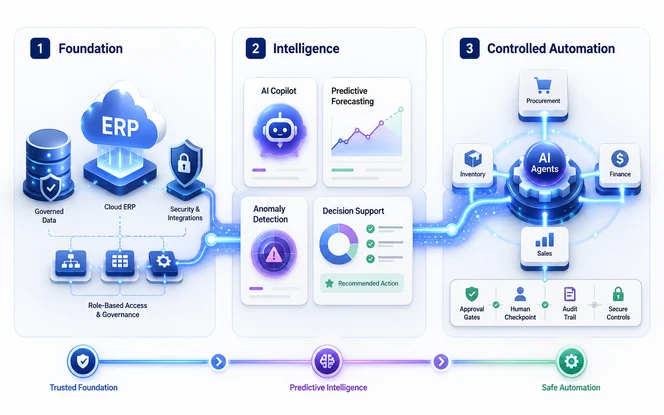
AI-enabled ERP adoption roadmap progressing from trusted data and governance to predictive intelligence and controlled automation.
Not sure which AI in ERP capability to pilot first?
SDLC Corp helps you match AI opportunities to your ERP's actual data and process readiness.
AI in ERP Value and Readiness Model
Before investing in an AI-enabled ERP capability, enterprise leaders should determine whether it can deliver measurable business value without creating unacceptable operational, security, or governance risk. Financial assumptions should also account for licensing, implementation, integration, data preparation, training, support, and optimization using a practical ERP cost planning guide . This framework evaluates each initiative across five areas:
| Evaluation layer | Leadership question | Evidence required |
|---|---|---|
| Business Value | Which measurable operational outcome justifies the investment? | Baseline KPI, target outcome, financial or operational impact |
| Process Readiness | Is the workflow standardized, documented, and owned? | Process maps, decision rules, exception handling, process owner |
| Data & Integration Readiness | Is the required ERP data accurate, governed, accessible, and integrated? | Data-quality assessment, master-data validation, integration architecture |
| AI Autonomy & Risk | What may the AI recommend, initiate, approve, execute, or escalate? | Autonomy boundaries, approval thresholds, risk classification, rollback plan |
| Governance & Adoption | Can the capability be monitored, controlled, explained, and adopted at scale? | Decision ownership, audit logs, governance policies, user training, support model |
Example: Readiness Check for an AI-Powered Accounts Payable Agent
Before deploying an AI-powered accounts payable agent, an organization should confirm:
- A measurable objective such as reducing manual invoice review or exception-resolution time.
- Standardized invoice-matching and approval workflows.
- Reliable supplier, purchase-order, invoice, and payment data.
- Clear limits on what the agent may recommend or execute.
- Human approval for high-value or unusual transactions.
- Audit logging, monitoring, escalation, and rollback procedures.
As a result, this evaluation prevents organizations from treating AI availability as proof of business readiness.
How Enterprises Should Prioritize AI in ERP Initiatives
Successful AI in ERP adoption depends on sequencing capabilities according to business priorities, operational maturity, data readiness, and decision risk. Organizations should not begin with the most autonomous capability simply because it appears more advanced. Instead, align AI adoption with a controlled ERP implementation process that covers discovery, design, data migration, integration, testing, training, go-live, and continuous optimization.
Establish AI-ready ERP foundations
- Process ownership
- ERP master-data quality
- Integration reliability
- Identity and access controls
- Cybersecurity
- Cloud and platform readiness
- Governance and decision accountability
Deploy assistive and predictive AI
- AI copilots
- Natural-language ERP search
- Document extraction and classification
- Predictive analytics and forecasting support
- Anomaly detection
- Decision recommendations
- Bounded workflow automation
Scale controlled agentic operations
- Workflows are standardized
- Autonomy levels are documented
- Approvals and escalation paths are defined
- Auditability is available
- Human oversight is retained
- Rollback procedures are tested
- Business KPIs can be monitored
Implementation sequence
Organizations should measure operational outcomes before enterprise-wide expansion. For example, useful measures may include cycle time, exception volume, forecast accuracy, manual effort, decision latency, error rates, user adoption, and control violations.
However, many organizations understand the potential of AI in ERP software but struggle to determine which capabilities are realistic for their existing ERP environment. A structured AI readiness assessment helps prioritize high-value opportunities while reducing implementation risk.
How SDLC Corp Supports AI-Enabled ERP Modernization
SDLC Corp helps organizations identify where AI can deliver measurable value within existing ERP processes and whether the required data, integrations, workflows, and governance controls are ready for implementation.
First, the engagement begins with AI-enabled ERP consulting services that evaluate business objectives, operational pain points, ERP architecture, process maturity, data quality, integration dependencies, and decision risk before recommending the most appropriate AI adoption strategy.
Support may include
- AI use-case discovery
- Process assessment
- ERP data-readiness analysis
- AI integration architecture
- Predictive analytics planning
- Copilot and agent integration
- Security and access design
- AI governance policies
- Pilot development and testing
- Workflow monitoring
Assessment deliverables
- AI and ERP maturity summary
- Prioritized opportunity map
- Use-case and KPI definition
- Data-readiness assessment
- Process gap analysis
- Integration gap analysis
- Security requirements
- Governance requirements
- Autonomy level recommendations
- Pilot implementation roadmap
The outcome is a structured roadmap that connects AI investment to specific ERP processes, measurable business outcomes, and appropriate operational controls.
Ready to build your AI-in-ERP roadmap?
Get a prioritized opportunity map based on your data, processes, and governance readiness.
For nonprofit operations, connect AI answers to authorised grant, finance and programme evidence. See AI in NGO ERP.
Conclusion: Building a Governed AI-Enabled ERP Strategy
AI is becoming an embedded operating layer within ERP, influencing how enterprises retrieve information, forecast outcomes, identify exceptions, automate workflows, and coordinate controlled decisions.
However, successful adoption should not begin with the most advanced technology. Organizations should first strengthen ERP data, processes, integrations, identity controls, and decision ownership. They can then progress from copilots and predictive insights to intelligent automation and governed agentic workflows.
As a result, enterprises that connect AI initiatives to measurable operational outcomes, validated data, clear autonomy limits, and accountable governance will be better positioned to modernize ERP without sacrificing control, security, or decision quality.
Frequently Asked Questions About AI in ERP Trends
What are the most important AI in ERP trends enterprises should
adopt in 2026?
Organizations should prioritize AI copilots, predictive analytics, intelligent automation, AI governance, and cloud ERP capabilities based on business objectives, data readiness, and process maturity.
How does AI improve ERP systems for enterprise business
operations?
AI enhances ERP by automating routine tasks, improving forecasting, supporting decision-making, detecting anomalies, and helping employees work more efficiently with trusted business data.
How do enterprises choose the right AI in ERP implementation
strategy?
Start by assessing business goals, process maturity, data quality, integration readiness, governance requirements, and expected ROI before deploying AI capabilities.
What are the biggest challenges of implementing AI in ERP
systems?
Common challenges include poor data quality, legacy ERP systems, integration complexity, weak governance, security risks, and limited user adoption.
Why is AI governance important for enterprise ERP modernization?
AI governance helps organizations define accountability, monitor AI decisions, maintain compliance, protect sensitive data, and ensure human oversight for critical business processes.