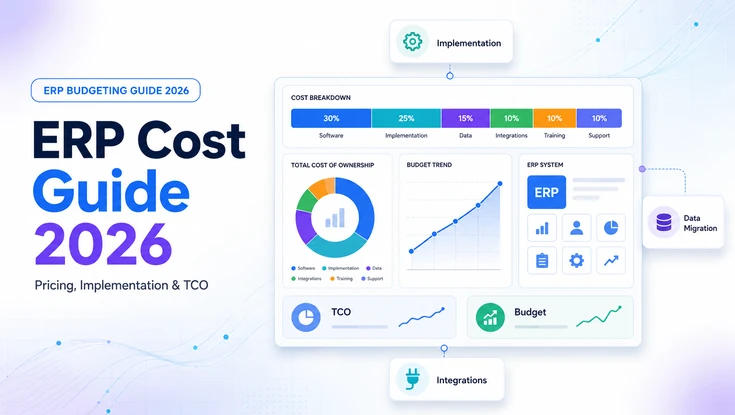
ERP cost goes beyond software licensing. In addition, implementation, integrations, data migration, customization, training, and ongoing support influence the final investment. This guide explains ERP pricing, budgeting, and Total Cost of Ownership (TCO) so organizations can plan more accurately.
Quick ERP Cost Answer
An ERP cost guide should include software, implementation services, data migration, integrations, configuration, testing, training, internal resources, contingency, and ongoing support. However, the final investment depends on project scope, business processes, data quality, deployment, customization, and organizational readiness.
For a stronger foundation, organizations can first review what ERP is. Then, they should evaluate Total Cost of Ownership instead of relying on license pricing alone.
Key Takeaways
Plan beyond software licensing: ERP cost is shaped more by implementation scope, operational complexity, and organizational readiness than by software licensing alone.
Use Total Cost of Ownership: TCO provides a more reliable budgeting model because it considers implementation, operations, support, and long-term value realization, not just acquisition costs.
Prepare processes, data, and integrations: Process standardization, data readiness, and integration planning often influence ERP outcomes as much as platform selection.
Control scope through governance: Effective governance helps manage delivery risk and improve user adoption throughout the implementation lifecycle.
Optimize after go-live: Long-term ERP value is strengthened through continuous optimization, measurable business outcomes, and ongoing process improvement.
What Does ERP Cost Include?
ERP cost is the combined investment required to purchase, implement, operate, support, and continuously improve an ERP system throughout its lifecycle.
While software licensing establishes the initial technology cost, ERP implementation cost factors usually represent the largest share of the budget. However, These factors include process analysis, solution configuration, ERP migration, data validation, integrations, testing, training, governance, and post-go-live support.
In addition, customization, infrastructure, compliance, and ongoing optimization may increase the investment. Therefore, evaluating all components through Total Cost of Ownership (TCO) provides a more realistic estimate than comparing software prices alone.
| ERP Cost Component | Typical Purpose |
|---|---|
| Software licensing | Access to ERP platform |
| Implementation services | Deployment, configuration, testing |
| Data migration | Transfer and validation of business data |
| Integrations | Connects ERP with other systems |
| User training | Improve adoption and productivity |
| Support & optimization | Maintain and continuously improve ERP |
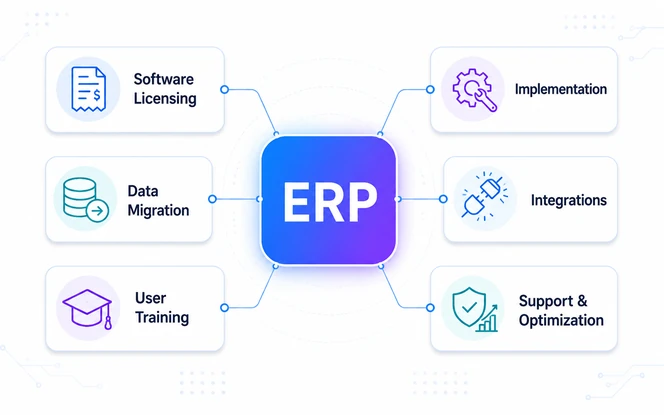
ERP Cost Components at a Glance
A supporting visual here helps readers understand that the complete ERP investment includes implementation and lifecycle costs, not only software licensing.
Enterprise ERP Cost Planning Framework™
The majority of ERP cost guides start with pricing of the software. Therefore, Unlike pricing-led comparisons, the Enterprise ERP Cost Planning Framework™ begins with the decisions that determine project scope, implementation effort, delivery risk, and long-term value.
Its five connected stages help organizations move from business-case definition to complexity assessment, readiness, governance, and continuous value realization.
The Five Decision Stages
Strategic Business Outcomes
What measurable business objectives should the ERP cost achieve?
Defines success metrics, implementation priorities, and project scope.
Implementation Complexity Assessment
What operational and technical factors will drive implementation effort and delivery risk?
Establishes a realistic implementation approach, budget expectations, and partner requirements.
Enterprise Readiness Validation
Is the organization prepared to adopt new processes, governance, and ways of working?
Identifies organizational gaps, change management priorities, and go-live readiness.
ERP Cost Governance
How will scope, budget, risks, and delivery decisions be controlled throughout the project?
Creates governance, decision rights, budget oversight, and risk management processes.
Continuous Value Realization
How will business value be measured and improved after go-live?
Defines KPI reviews, optimization priorities, upgrade planning, and continuous improvement.
Each stage builds on the previous one, moving from business objectives and complexity assessment to organizational readiness, cost governance, and continuous value realization. In addition, Together, these stages help organizations create a more realistic ERP budget and control investment throughout the ERP lifecycle.
Methodology Note: The Enterprise ERP Cost Planning Framework™ is an independent editorial decision-support model developed for this guide. As a result, It combines implementation planning concepts reflected in ERP implementation project planning with governance, readiness, and lifecycle budgeting principles.
However, the framework is intended only to support ERP budgeting and evaluation. For example, It should not be interpreted as an industry standard, certification, or universal cost-prediction methodology.
What Actually Determines ERP Cost?
Organizations often underestimate ERP cost because they compare software prices before evaluating implementation complexity.
In practice, process standardization, system integrations, reliable data, and governance requirements influence project cost more than software licensing alone. Therefore, these factors should be assessed before the budget is finalized.
Effective ERP integration planning is especially important when several enterprise applications and data sources must work together. As a result, organizations can create more realistic budgets and evaluate ERP cost through Total Cost of Ownership (TCO).
Key ERP Cost Drivers
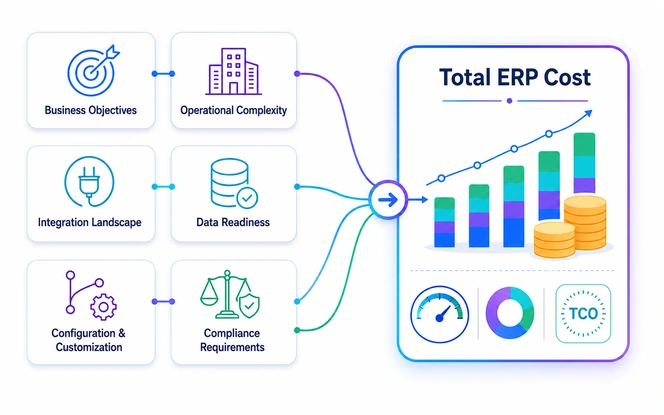
How ERP Cost Drivers Connect
This image can show how technical and operational complexity combine to increase implementation effort, delivery risk, and total cost.
With the overall ERP budgeting approach established, the next step is understanding which technical and operational factors have the greatest influence on ERP cost.
ERP Implementation Complexity Assessment Matrix
Use this matrix to assess how operational, technical, data, customization, and compliance factors can affect implementation effort.
| Assessment Area | Low | Medium | High |
|---|---|---|---|
| Operational complexity | Single entity, standardized operations | Multi-entity, moderate process variation | Global operations with complex business processes |
| Integration landscape | 0–1 systems | 2–4 systems | 5+ enterprise systems |
| Data readiness | Clean, centralized data | Moderate cleansing required | Fragmented, multi-source data |
| Configuration & customization | Mostly standard configuration | Moderate customization | Extensive custom development |
| Compliance requirements | Minimal obligations | Industry-specific controls | Multi-jurisdictional regulatory requirements |
Implementation Insight
Implementation complexity is cumulative rather than isolated. For example, a project with a simple organizational structure may still become high risk when poor data quality, extensive integrations, and regulatory requirements occur together. Therefore, organizations should assess every dimension before estimating budgets, timelines, or delivery risk.
ERP Cost by Business Size
ERP pricing varies according to business size, project scope, integrations, data migration, customization, training, and implementation complexity.
Small businesses generally require a more focused implementation, while mid-size and large organizations often need broader process coverage, more integrations, and stronger governance. Therefore, the following ranges provide a practical starting point for ERP budget planning.
Estimated ERP Implementation Cost
| Business Size | Estimated ERP Cost | Typical Project Scope |
|---|---|---|
| Small Business | US$15,000–US$30,000 | Focused modules, limited integrations, standard configuration, and essential training |
| Mid-Size Business | US$35,000–US$45,000 | Multiple modules, moderate integrations, data migration, workflow configuration, and user enablement |
| Large Enterprise | US$50,000+ | Enterprise-wide implementation, complex integrations, advanced data migration, governance, and customization |
Pricing note: These are estimated ERP implementation ranges. Final costs may vary according to project scope, platform, modules, users, integrations, data condition, customization, deployment model, and post-go-live support.
Managing ERP Costs Across the Full Implementation Lifecycle
Investment extends well beyond implementation. Consequently, ERP costs accumulate across the entire project lifecycle from early planning and solution design to post-go-live optimization.
Although each ERP implementation process differs across platforms and organizations, most enterprise projects follow a similar sequence of activities. However, Understanding where investment occurs, where risks emerge, and how governance controls those risks helps organizations build more realistic budgets and improve long-term ERP outcomes.
ERP Implementation Lifecycle
| Phase | Primary Investment | Key Risk | Budget Control |
|---|---|---|---|
| Strategy | Business case, scope, executive alignment | Poor project direction | Define measurable objectives and realistic scope before implementation begins. |
| Discovery | Process analysis, requirements, readiness | Missing business requirements | Validate integrations, data quality, and stakeholder expectations early. |
| Solution Design | Process redesign, solution architecture | Over-customization | Prioritize standard processes and approve design before configuration. |
| Configuration & Integration | System setup, integrations, data migration | Scope expansion and technical complexity | Prefer configuration over customization and implement integrations based on business value. |
| Testing & Deployment | User acceptance testing, data validation, go-live | Business disruption and deployment defects | Resolve issues before go-live and select a rollout strategy aligned with business risk. |
| Hypercare & Optimization | User support, performance improvements, continuous enhancement | Low adoption and unrealized business value | Measure adoption, review KPIs, and continuously optimize business processes. |
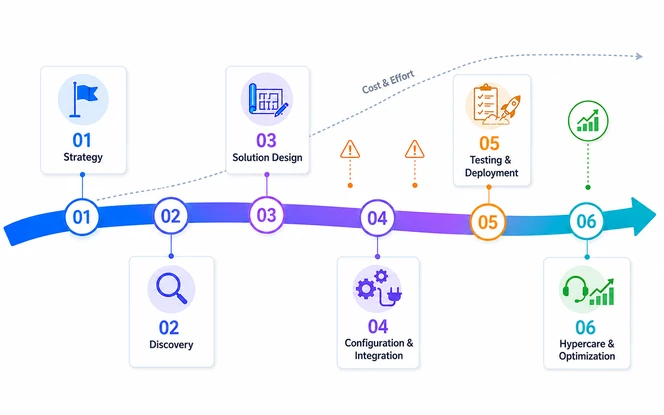
ERP Implementation Lifecycle and Cost Flow
A lifecycle roadmap helps readers see where budget, delivery risk, and governance requirements change from planning through post-go-live optimization.
ERP Total Cost of Ownership (TCO)
For a complete estimate, ERP implementation cost should be evaluated across three categories rather than software licensing alone.
Initial Investment
Software, implementation, integrations, ERP migration.
Operational Costs
Support, maintenance, training, upgrades.
Opportunity Costs
Delayed adoption, productivity loss, unrealized business value.
Evaluating ERP through Total Cost of Ownership (TCO) provides a more accurate view of long-term investment than comparing software prices in isolation. Therefore, When reviewing enterprise options such as SAP Cloud ERP pricing and packages, organizations should include implementation, integration, operating, support, and optimization costs in the comparison.
Why ERP Budgets Exceed Expectations
Budget overruns often result from scope, data, integration, and readiness issues that were not addressed early enough.
| Common Cause | Business Impact | Recommended Action |
|---|---|---|
| Scope expansion | Budget overruns and project delays | Establish formal change approval and prioritize business requirements. |
| Poor data quality | Longer migration and testing cycles | Clean and govern data before implementation begins. |
| Underestimated integrations | Increased technical effort and implementation risk | Assess integration requirements during discovery rather than after configuration. |
| Limited organizational readiness | Slow adoption and reduced business value | Invest in executive sponsorship, user enablement, and change management throughout the project. |
ERP Budget Readiness Checklist
Before selecting an ERP platform or implementation partner, confirm that your organization has:
- Executive sponsorship and business ownership
- Defined implementation scope and success metrics
- Data quality and ERP migration readiness assessment
- ERP integration inventory and architecture review
- Governance and change approval process
- Change management and user enablement plan
Organizations that complete these readiness activities before vendor selection are generally better positioned to estimate realistic budgets, evaluate implementation partners, and reduce delivery risk throughout the ERP lifecycle.
How Business Complexity and Platform Choice Influence ERP Cost
In many cases, operational maturity shapes ERP implementation cost more than company size alone.
Organizations with similar headcounts can require very different ERP budgets. For example, business entities, process variation, regulatory obligations, integrations, and deployment strategy can significantly change the required investment.
Meanwhile, understanding the main types of ERP systems helps decision-makers compare cloud, on-premises, hybrid, and other approaches. Although platform architecture matters, organizational complexity has a greater effect on implementation effort, Total Cost of Ownership (TCO), and business value.
ERP Cost Decision Factors
| Decision Factor | Lower Operational Burden | Higher Operational Burden |
|---|---|---|
| Operational maturity | Standardized processes, single entity | Multi-entity, multi-country operations |
| Deployment strategy | Cloud deployment | Hybrid or on-premise environments |
| Platform architecture | Standardized implementation | Extensive customization and enterprise-wide integration |
| Integration landscape | Limited business systems | Multiple enterprise applications and complex APIs |
| Regulatory requirements | Minimal compliance obligations | Industry-specific or multi-jurisdictional compliance |
Executive Insight
Rather than asking “Which ERP platform is the least expensive?”, organizations should ask “Which platform best aligns with our operational complexity, implementation requirements, and long-term business objectives?” Selecting a platform that matches business complexity often results in a lower Total Cost of Ownership than choosing software based solely on its initial purchase price.
Organizations that understand these implementation complexity factors are better positioned to estimate realistic ERP budgets, evaluate implementation partners, and reduce delivery risk before vendor selection.
Executive ERP Implementation Partner Evaluation Matrix
Selecting the right implementation partner is one of the most important decisions affecting ERP cost, implementation quality, and long-term business outcomes.
Choosing a partner based only on implementation price can increase total ERP cost through project delays, scope expansion, rework, and additional customization. In addition, Organizations should evaluate partners based on delivery capability, governance maturity, industry expertise, and proven implementation experience rather than cost alone.
| Evaluation Criteria | Suggested Weight |
|---|---|
| Industry & ERP expertise | 40% |
| Delivery methodology & integrations | 30% |
| Governance & change management | 20% |
| Post-go-live support | 10% |
Executive Insight
The strongest ERP partners combine technical expertise with industry knowledge, governance discipline, and change management capabilities to deliver measurable business outcomes, not just a successful system deployment.
How SDLC Corp Helps Organizations Plan and Control ERP Cost
Successfully managing ERP cost requires more than selecting the right software platform. As a result, It also depends on working with an implementation partner capable of aligning business objectives, ERP implementation processes, governance, and post-go-live optimization throughout the ERP lifecycle.
ERP Consulting and Discovery
ERP consulting services and discovery workshops that align ERP cost decisions with business objectives, implementation priorities, and long-term transformation goals.
Proven ERP Delivery Experience
Official ERP Ready Partner with 150+ ERP implementations delivered across diverse business environments.
Enterprise Application Expertise
22 enterprise business applications published on a leading ERP application marketplace, demonstrating practical expertise in extending, customizing, and optimizing ERP platforms.
Connected Enterprise Integrations
200+ enterprise integrations across platforms, including SAP, Oracle ERP, Microsoft Dynamics, CRM, eCommerce, and third-party business systems to support connected enterprise operations.
Industry-Focused Implementation
Proven delivery experience across manufacturing, retail, healthcare, logistics, finance, hospitality, and construction with publicly available implementation case studies.
Modernization and Continuous Improvement
ERP modernization, migration, AI-enabled ERP solutions, and post-go-live optimization designed to improve operational efficiency and maximize long-term business value.
Structured Governance and Support
Structured delivery governance, certified consultants, and SLA-driven project execution that support predictable implementation, lower delivery risk, and stronger user adoption.
By combining implementation expertise, governance, integration capability, and continuous optimization, SDLC Corp helps organizations reduce ERP implementation risk, accelerate value realization, and maximize long-term return on investment.
For nonprofit budgets, include fund configuration, donor reporting and country rollout in NGO ERP cost.
Conclusion
Successful ERP programs are built through disciplined planning rather than software selection alone. Therefore, organizations should understand the factors that influence ERP cost, including implementation complexity, data readiness, governance, and continuous optimization.
With this knowledge, businesses can develop realistic budgets, reduce delivery risk, and maximize long-term value. In addition, structured planning and informed partner selection can turn ERP cost into a strategic investment that supports sustainable growth.
FAQ
Answers to common ERP cost, implementation, budgeting, and platform-selection questions.
What does ERP cost include?
ERP cost can include software licensing, implementation services, configuration, data migration, integrations, testing, training, internal resources, support, upgrades, and post-go-live optimization. For example, Total Cost of Ownership provides a more complete view than software pricing alone.
Why is ERP implementation often more expensive than licensing?
Implementation involves process design, data preparation, system integrations, testing, change management, and user enablement. Meanwhile, These activities vary by business complexity and can require significantly more effort than purchasing the software itself.
Is cloud ERP always cheaper than on-premises ERP?
Not necessarily. Moreover, Cloud ERP can reduce infrastructure ownership and maintenance responsibilities, but total cost still depends on subscriptions, integrations, customization, security, data migration, and support. The right comparison is lifecycle TCO, not upfront cost alone.
How can an organization estimate its ERP budget?
Start with an estimated range of US$15,000–US$30,000 for a small business, US$35,000–US$45,000 for a mid-size business, and US$50,000+ for a large enterprise. Then refine the budget according to scope, integrations, data condition, customization, compliance, internal resources, and post-go-live support.
What ERP costs are most commonly overlooked?
Commonly overlooked costs include data cleansing, integration development, internal employee time, reporting redesign, testing, user training, temporary productivity loss, hypercare, upgrades, and ongoing optimization after go-live.