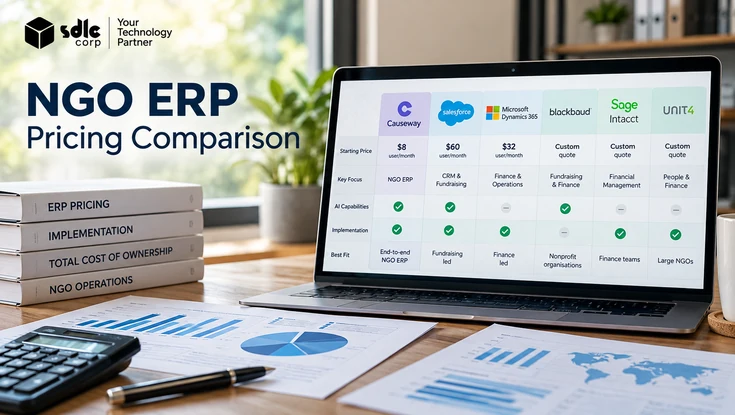
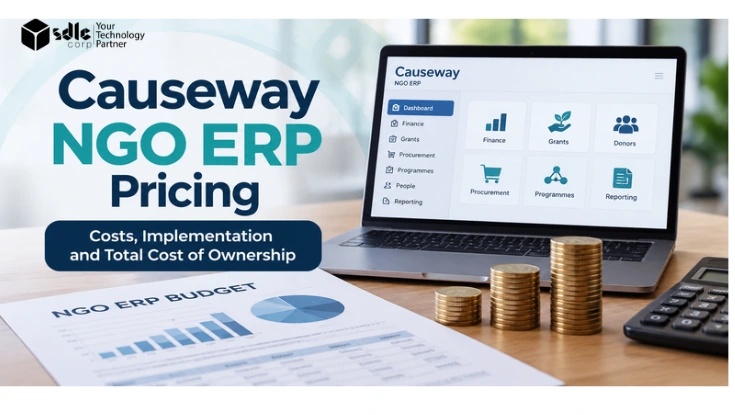
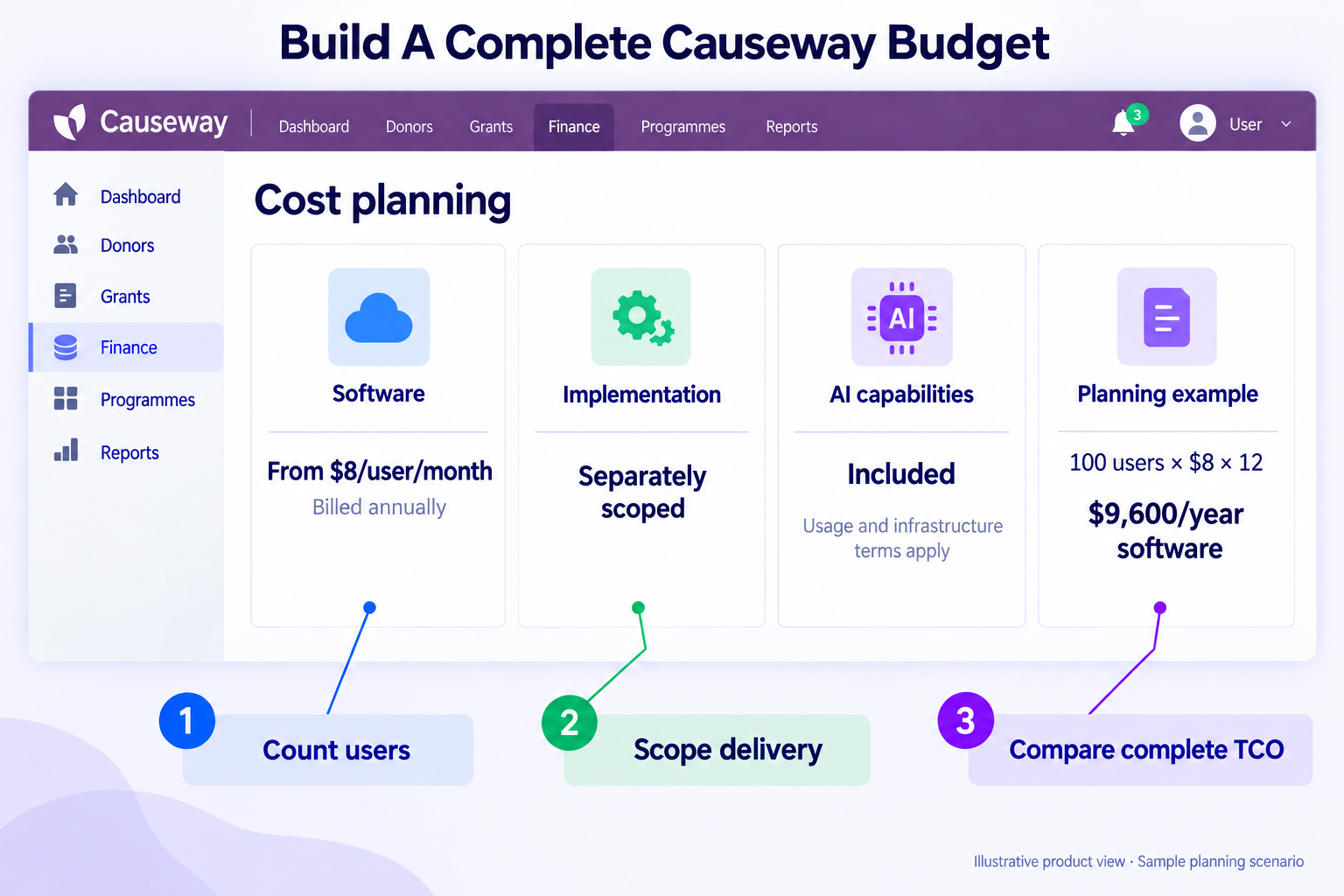
Causeway starts at $8/user/month, billed annually. At that starting rate, 100 users cost $9,600 per year in software. Implementation is separately scoped. A complete NGO ERP budget also includes applicable integration, migration, localisation, infrastructure, third-party service and internal delivery costs.
Total cost of ownership (TCO) compares those costs over a defined period and operating scope. Keep the starting software calculation distinct from the final proposal: the user definition, required configuration, deployment responsibilities, taxes and renewal terms belong in the commercial schedule.
What the starting software price covers
For broader context, see ERP cost and TCO fundamentals. For NGOs, the scope must also price grant dimensions, restricted-fund controls, country rollout and donor reporting.
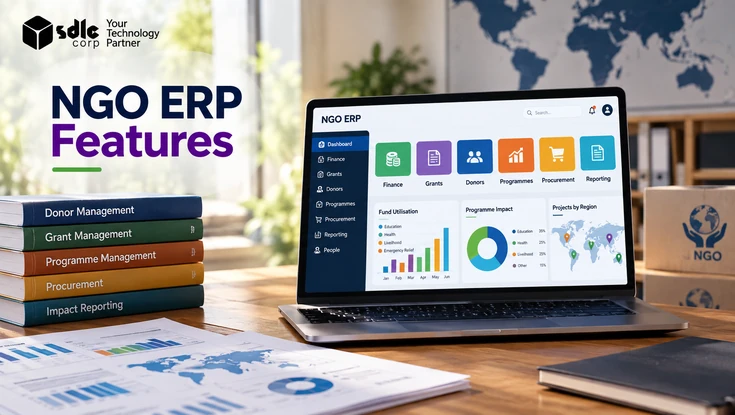
Causeway is a global NGO operating platform connecting finance, funds, grants, donors, procurement, programmes, people, beneficiaries and reporting. AI capabilities are included. Causeway Cloud, Private Cloud and Self-Hosted / Customer-Managed Deployment are supported.
Causeway starts at $8/user/month, billed annually. Implementation and other separately scoped costs are shown below.
| Users At The Starting Rate | Monthly Software Equivalent | Annual Software |
|---|---|---|
| 20 | $160 | $1,920 |
| 50 | $400 | $4,800 |
| 100 | $800 | $9,600 |
Each row uses users × $8 × 12 for the annual amount. It does not assume a package of included seats or a separate AI edition. Record which staff, volunteers, external users and occasional users are chargeable in the proposal. A planning calculation cannot settle those contract definitions.
AI inclusion should appear beside the applicable usage and infrastructure boundaries. If an organisation chooses a particular external service or customer-managed AI infrastructure, identify those costs explicitly. Included capability does not mean every third-party service is free or that every workload is unlimited.
Implementation is a defined delivery scope
Implementation is separately scoped around the organisation's operating model. Use testable NGO ERP requirements to identify the countries, entities, workflows and acceptance results that the delivery team must support.
| Workstream | Scope To Price | Evidence Of Completion |
|---|---|---|
| Configuration | Modules, roles, dimensions and approval rules | Agreed scenarios pass with named owners |
| Migration | Masters, opening balances, history and attachments | Counts, relationships and balances reconcile |
| Integration | Banks, payments, payroll, identity and retained tools | Normal processing and recovery tests pass |
| Localisation | Country records, donor conditions and reporting | Applicable mappings approved and tested |
| Deployment | Environments, network, monitoring and recovery | Responsibilities assigned and restoration demonstrated |
| Training | Roles, locations, languages and exception handling | Users complete the relevant workflow |
| Cutover | Final load, reconciliation and stabilisation | Go/no-go criteria and handover evidence accepted |
A bank interface can mean statement import, payment initiation, status callbacks or several of these. Price the agreed boundary. The same applies to payroll: importing an approved journal is different from implementing a local payroll calculation service.
An additional country can introduce reporting, migration, language and training work without changing the global data model. Keep those items visible as a country work package rather than hiding them in a general contingency.
Hosting location and operating responsibility affect cost
Causeway Cloud, Private Cloud and Self-Hosted offer different operating arrangements. The deployment decision should identify the party responsible for infrastructure, database operations, backups, disaster recovery, application upgrades and security monitoring.
Private cloud may be supplier-managed or customer-managed. Self-hosting may use rented infrastructure. Neither label establishes who is on call, who tests recovery or who maintains connected services.
For each option, assign a cost line to the responsible party. Include production and test environments, storage growth, monitoring, backup retention and recovery exercises where separately chargeable. Do not add an infrastructure item twice if it is already included in the contracted service.
Support and provider charges need their own terms
Record the actual support scope, service hours, escalation route and response commitments in the agreement. Separate an included service from an optional service only when the proposal establishes that distinction. The starting software price alone does not define a service-level agreement.
Payment gateway fees, SMS, external APIs and customer-selected hosting can remain separate. A payment provider may charge against transactions rather than users. Model that driver using expected volume and the relevant provider terms.
Later enhancements, custom integrations and additional localisation should have their own approved scope where required. Tie a change quote to the requirement it delivers, the environments it affects and the tests needed after release.
A three-year and five-year planning model
At a constant 100 users and unchanged starting software rate, three years of software equal $28,800 and five years equal $48,000. These are planning calculations, not renewal guarantees or complete TCO.
| Cost Line | Three-Year Treatment | Five-Year Treatment |
|---|---|---|
| Software | $28,800 under the stated assumptions | $48,000 under the same assumptions |
| Initial implementation | Add the scoped delivery proposal once | Add the same initial proposal once |
| Integration and migration | Add only costs not already in implementation | Include separately planned later changes |
| Hosting and operations | Add separately chargeable annual costs | Apply documented growth and renewal assumptions |
| Support and provider services | Use actual service terms and expected usage | Extend the same defined basis |
| Internal work | Include approved staff time and backfill | Include continuing administration and later rollouts |
| Complete TCO | Unresolved while a material input is missing | Unresolved while a material input is missing |
A blank amount means unknown. Enter zero only when there is evidence of no charge or no required work. Keep the original quote, currency, tax basis, date and source beside every input.
For an example decision, an NGO could approve the software arithmetic while leaving implementation and hosting unresolved. That decision supports a budget discussion; it does not authorise procurement against a falsely complete total.
Growth and delay change different parts of the model
If users increase from 100 to 125 in year two and remain there in year three, starting-rate software becomes $9,600 + $12,000 + $12,000 = $33,600 across three years. Record the timing and licence terms rather than assuming every user is added at the start.
A delayed cutover can extend retained-system subscriptions and require a second migration rehearsal. It does not necessarily increase the long-term user count. Model delay as named parallel-operation and delivery lines.
A new-country scenario may add localisation and support coverage. A higher transaction-volume scenario may affect gateways or external APIs. Each scenario should change the relevant driver, with an explanation that the finance reviewer can reproduce.
Compare equivalent operating scope
A vendor's published licence price is a useful input, but a fundraising seat and a complete ERP operating scope are different purchase boundaries. The vendor pricing comparison separates public rates from quote-based offers and identifies the product combination behind each.
For a fair evaluation, run the same grant-funded purchase through each proposed architecture: budget check, approval, receipt, invoice, payment, reconciliation and donor report. Record which steps need another module, interface or supplier.
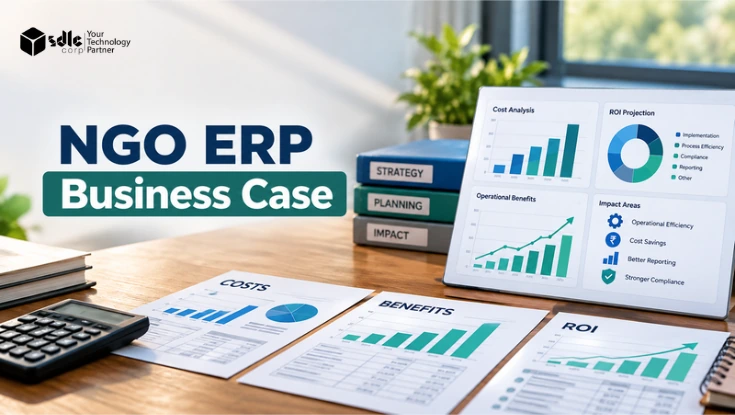
Causeway's accessible starting rate creates room for a cost-efficient enterprise NGO architecture. A final lower-TCO conclusion still depends on the comparable proposals and the NGO's operating costs. Keep measured benefits in the business case separate from supplier charges; released staff capacity does not reduce an invoice.
Model the three- or five-year ownership cost with the NGO ERP TCO Calculator. Missing costs remain unresolved rather than becoming zero.
Among its reported customer outcomes, Causeway cites month-end close moving from 12 days to 4 days. That operational result can inform which benefits to measure, but it is separate from the software price and TCO calculation. A shorter close does not establish a monetary return without the NGO’s own workload and cost basis.
Conclusion
Calculate the cost of the operating model you will actually use. Begin with annual software, then add delivery, migration, interfaces, hosting operations, support and internal effort over the chosen period. Causeway starts at $8/user/month, billed annually; implementation remains separately scoped. Compare alternatives only after assigning the same responsibilities and volumes to each. The useful decision is whether the full cost buys the mandatory workflows and a supportable service, including the cost of growth and change.
Discuss your Causeway implementation budget
Evaluate Causeway against your users, entities, countries and delivery requirements. Bring the same scope to each supplier so the proposals can be compared. SDLC Corp's ERP consulting team can help turn the requirements into implementation work packages, acceptance criteria and a cost schedule that distinguishes software, delivery and ongoing operation.
Frequently asked questions
Is implementation included in the starting software price?
Implementation is separately scoped. Identify configuration, migration, integrations, localisation, training and cutover in the proposal so the project budget includes the work needed to operate the system.
Does AI inclusion remove every infrastructure cost?
AI capabilities are included in Causeway. The applicable usage terms and infrastructure arrangement still matter, particularly when the customer selects external services or operates its own infrastructure.