
An NGO ERP business case should explain which operating problems justify investment, what will change and how the organisation will verify the result. A claim that staff will “save time” is not enough to establish financial return. Released capacity, avoided expenditure and improved control are different benefits and should remain distinguishable.
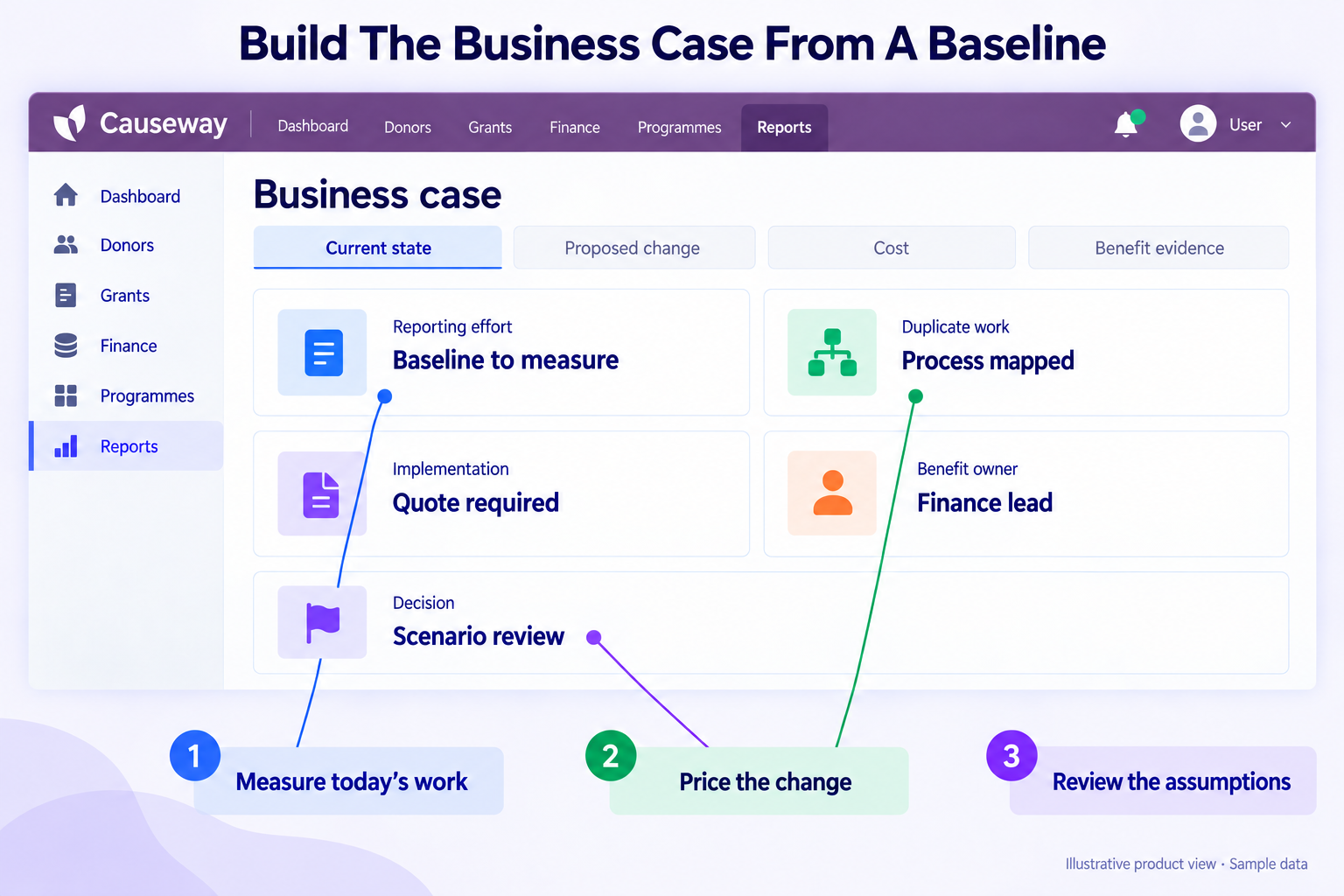
Build the case from measurable baselines, scope-based costs and explicit assumptions. Include a realistic downside scenario and the work needed to achieve adoption. This gives decision-makers a basis for judging the investment without turning optimistic estimates into guaranteed savings.
A baseline makes the benefit testable
Choose a few problems with observable consequences. Examples include the effort required to prepare a reconciled donor report, the number of unresolved transaction exceptions or the time between an approved request and a complete purchase record.
For donor reporting, define the start and end of the measurement. Ten hours of preparation is not comparable with ten elapsed days that include waiting for partner information. Separate active effort, waiting time and rework where the distinction matters.
Collect representative observations and record their limitations. A single unusually difficult month should not automatically become the annual baseline. Assign an owner who can repeat the measurement after implementation using the same definition.
Connect problems to proposed changes
For each problem, explain the mechanism by which the proposed system or process could improve it. Reducing manual recoding may depend on agreed mappings and better transaction entry, not merely on purchasing a reporting module.
| Baseline Problem | Proposed Change | Condition For Benefit |
|---|---|---|
| Repeated report recoding | Governed budget mappings | Users code transactions correctly |
| Missing approval evidence | Controlled workflow | Relevant purchases use the workflow |
| Duplicate reconciliation work | Shared identifiers and exceptions | Interfaces and ownership are maintained |
| Slow access removal | Defined role-change process | Responsible teams act promptly |
Keep the benefit separate from the deliverable. A report can be delivered without reducing preparation effort if its source data remains inconsistent. Acceptance should test the system; benefit review should test whether operating performance actually changes.
Released capacity is not automatically cash savings
Value released time on a stated basis and identify the work it will support. Count it as cash savings only where a corresponding expense is actually avoided or reduced. Keep that decision visible in the benefits register.
Valuing those hours at an internal rate can help compare resource use, but label the result as a capacity valuation. Do not add it again as a payroll saving unless the cost reduction is separately justified. The same improvement should not appear in several benefit categories under different names.
Control improvements may be valuable without a credible monetary estimate. Describe the exposure reduced, evidence expected and responsible owner. Avoid inventing a financial value for every risk simply to produce an attractive return figure.
Delivery assumptions affect cost and benefit timing
Use the total-cost model to include supplier charges, internal effort, integrations, retained systems and ongoing support. Keep timing visible because costs and benefits may start in different periods.
Identify delivery assumptions that could delay benefits: unavailable local staff, unresolved policy decisions, poor data quality or external-system dependencies. Assign mitigation owners and include the cost of necessary preparation rather than assuming it happens without resources.
Separate known costs from contingency and uncertain options. If a major dependency is unpriced, show the gap. A business case with an explicit unresolved input is more useful than one with a precise total built on an unstated zero.
Test scenarios and sensitivity
Create a base case, a slower-adoption case and a case with material scope or cost changes. Vary assumptions that could realistically change the decision, such as rollout timing, recurring cost and the proportion of the workload affected.
The selection process should use these scenarios to compare options under the same assumptions. Do not give one supplier immediate full benefits while assigning another a cautious adoption curve without evidence.
Where financial metrics are used, state their basis and limitations. Keep nominal cash flows separate from discounted analysis, and make the discount assumption explicit if used. A result sensitive to one uncertain input should be presented as conditional rather than certain.
Each benefit needs an owner and review date
The implementation plan should connect adoption work to the expected benefits. Assign an operational owner, measurement method and review date to each material benefit. The implementation supplier may support delivery, but internal teams often control the process changes needed to realise value.
Review both successful and unsuccessful outcomes. If reporting effort has not improved, examine data quality, mappings and workflow adoption before concluding that the original estimate merely needs more time. Record corrective actions and revise forecasts transparently.
Keep the original approved case so later reviews can compare expectations with outcomes. Changing the baseline after launch to match the result makes the business case less useful as a learning and accountability tool.
Build a baseline you can recheck
Measure at least one representative reporting cycle before estimating benefits. Record the number of reports, people involved, hours spent collecting evidence, time spent correcting errors and the elapsed approval delay. Keep ordinary processing separate from unusual cleanup so one bad month does not inflate the expected benefit.
Suppose a team prepares 12 monthly packs, each requiring five staff hours. Reducing that work to three hours releases 24 hours per month. At an assumed loaded rate of USD 30 per hour, that is USD 720 of monthly capacity value. It becomes a cash saving only if paid expenditure actually falls; otherwise the business case should state which work will use the released capacity.
Include implementation invoices, internal backfill, data cleanup, retained applications, payment-provider costs, support and future integration maintenance in the cost baseline. Reuse the three-year cost model without subtracting the same benefit twice. Assign an owner to confirm the post-launch measurement and explain changes in volume or scope before attributing every improvement to software.
A reference such as the Causeway digital transformation case study can help frame questions about implementation scope. Any numerical benefit included in your business case still needs a comparable baseline, measurement method and supporting evidence.
Sensitivity without a fabricated ROI
Using the worked 12-pack monthly workload and $30 hourly capacity rate, test adoption rather than assigning an unsupported financial return.
| Planning Case | Hours Saved Per Pack | Packs Per Month | Monthly Capacity Value |
|---|---|---|---|
| Slower adoption | 1 | 12 | $360 |
| Base assumption | 2 | 12 | $720 |
| Stronger adoption | 3 | 12 | $1,080 |
The calculation is hours saved × packs × hourly rate. These are planning assumptions, not measured Causeway results. The cost side starts with Causeway software from $8/user/month, billed annually, plus separately scoped delivery and operating costs. Do not calculate a complete return while a material cost or benefit input remains unresolved.
The baseline sheet should retain pack ID, period, report type, active preparation time, waiting time, rework time, volume, owner and measurement method. Reuse that definition after deployment. This makes a later measured outcome distinguishable from the scenario originally used for approval.
Model the three- or five-year ownership cost with the NGO ERP TCO Calculator. Missing costs remain unresolved rather than becoming zero.
Track reconciliation, exception resolution and sign-off with the Month-End Close Checklist.
Causeway’s reported customer outcomes include month-end close moving from 12 days to 4 days and 67% fewer payroll-related queries. These first-party results identify two benefit measures for a business case. They are not a cash-savings calculation: the NGO still needs its own workload, staff-cost and deployment assumptions to value a comparable change.
Conclusion
Approve the business case on changes the organisation can measure and own. Keep released staff time separate from cash savings, and show when each benefit can begin after rollout. A credible case includes the cost of data work, participation and ongoing operation, plus a lower-benefit scenario. If the decision depends on one optimistic assumption, resolve it through a pilot or reference check before treating the projected return as dependable.
Build your Causeway investment case
Assess how Causeway might address the workflows behind your business case. Bring the baseline measures, proposed scope and assumptions requiring validation.
Ask for evidence of the relevant capabilities and a clear estimate of implementation responsibilities. The proposed delivery approach can inform further questions, but your own baseline and adoption conditions should determine the benefits included in the investment decision.
Frequently asked questions
Can time saved be counted as cash savings?
Only when it leads to a justified reduction or avoidance of expenditure. Otherwise it is released capacity, which may still be valuable. Label its valuation clearly and avoid counting the same improvement again as a separate payroll saving.
How should uncertain benefits be presented?
State the assumption, owner and conditions needed to realise the benefit. Show plausible alternative outcomes and identify inputs that materially change the decision. Do not present an example estimate or supplier claim as a guaranteed result.
What baseline data should we collect first?
Measure the workflows driving the investment, such as reporting effort, rework, unresolved exceptions or approval delays. Define each measure precisely and collect representative observations. Choose data that can be measured again after implementation using the same method.